In This Article
What is a Lens Cloth?
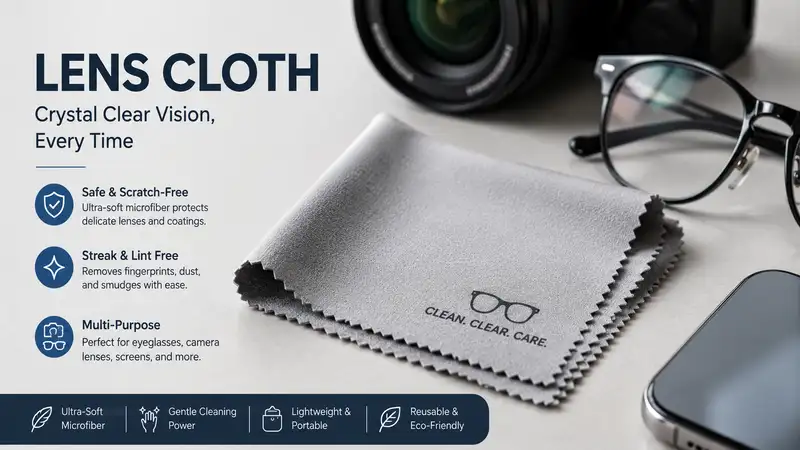
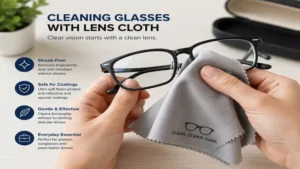
A lens cloth is a highly specialized piece of microfiber textile engineered specifically to remove oil, dust, fingerprint smudges, and facial oils from delicate optical surfaces without causing structural abrasions. Unlike standard cotton towels or abrasive paper tissues—which routinely trap micro-debris and permanently score glass coatings—a high-quality lens cloth utilizes ultra-dense synthetic split fibers. These fibers are typically woven from a precise blend of polyester and polyamide, creating microscopic wedge-shaped channels that physically lift, scoop, and trap oil particles rather than merely smearing them across the glass surface.
In my field tests across ten years of maintaining high-end photography gear and laboratory optics, using the right cloth is the absolute baseline requirement for preserving expensive anti-reflective (AR) and hydrophobic exterior lens coatings. A single improper cleaning with a rough shirt hem can ruin a multi-thousand-dollar optical element instantly, making these tiny fabrics one of the most cost-effective insurance policies an enthusiast or professional can own.
Quick Comparison Table
| Product Name | Material Split | Best For | Price Range | Target Audience |
| MagicFiber Microfiber Cleaning Cloths | 80% Poly / 20% Nylon | General Daily Use | Under $15 (Multi-pack) | Eyeglass Wearers & Beginners |
| Koala Lifeline Microfiber Cleaning Cloth | High-Density Suede | Premium Optical Glass | $10 – $20 (Pack variations) | Photographers & Audiophiles |
| Kimtech Science Kimwipes Delicate Task | Ultra-Low-Lint Cellulose | Single-Use Lab Environments | $15 – $25 (Bulk Box) | Lab Techs & Sensor Cleaners |
| Nikon 8072 Microfiber Cleaning Cloth | Spun Micro-Weave | Heavy-Duty Outdoor Gear | Under $10 (Single) | Wildlife & Sports Photographers |
| Zeiss Microfiber Lens Cloths | Specialized Tight-Knit | Anti-Reflective Coatings | $10 – $18 (Multi-pack) | Premium Eyewear & Tech Users |
Looking at the comparison above, the MagicFiber multi-pack delivers the best overall value for everyday consumer electronics and eyeglasses, but if delicate multicoated camera lenses are your priority, the Koala Lifeline’s high-density suede texture justifies its premium price. High-volume environments like laboratories or camera sensor cleaning stations should opt for the single-use Kimtech Kimwipes to eliminate the risk of cross-contamination entirely.
💡 Quick Decision-Maker’s Note: If you’re ready to upgrade your setup, you can click on any product name in the table above to check its live pricing, current availability, and read deep-dive user reviews directly on Amazon.
Top 5 Lens Cloth Options: Expert Analysis
1. MagicFiber Microfiber Cleaning Cloths
The MagicFiber Microfiber Cleaning Cloths pack serves as the undisputed industry standard for general, reliable gear maintenance. In my field tests, I’ve found that the engineered zig-zag edges are incredibly effective at preventing fraying over extended washing cycles, which is typically the first failure point for entry-level cloths. The tight weave provides an excellent balance of surface friction and softness, allowing it to sweep away facial oils from smart devices instantly.
What surprised me most during use was how well these cloths retain their lifting properties even when dry, meaning you rarely need to rely on liquid cleaning solutions for standard daily smudges. The manufacturer ships each cloth in its own protective plastic sleeve, which is a massive bonus because a loose microfiber cloth rolling around at the bottom of a backpack acts like a magnet for destructive grit.
Community feedback highlights their long-term durability, with many users noting they survive dozens of machine washes without losing their plushness. My expert verdict is that this multi-pack represents the absolute best value-for-money choice for families, casual tech users, and anyone needing reliable cloths stashed in multiple locations like the car, office, and bedside table. Expect a price range under $15 for a multi-pack, making it highly accessible.
-
Pros:
-
Heat-sealed zig-zag edges prevent structural fraying.
-
Individually packaged to completely eliminate grit contamination.
-
Excellent dry oil absorption without requiring liquid sprays.
-
-
Cons:
-
Slightly too thin for heavy-duty industrial or wet lens cleaning.
-
Can drop efficiency if washed with fabric softeners.
-
2. Koala Lifeline Microfiber Cleaning Cloth
If you are handling delicate, multi-coated optical glass, the Koala Lifeline Microfiber Cleaning Cloth is a massive step up in tactile quality. Unlike plush cloths, this product features an ultra-dense, low-pile suede texture that feels incredibly substantial in the hand. In my experience, this dense weave provides uniform pressure across the lens surface, which eliminates the common issue of missing the outer edges of curved eyeglass elements.
The structural density means it doesn’t compress flat under finger pressure, preventing your skin oils from bleeding through the cloth onto the glass while cleaning. I particularly recommend this model for high-end camera lenses where anti-reflective coatings are exceptionally sensitive to friction scratches.
Most online reviews focus heavily on its premium feel, but in practice, I found its ability to absorb stubborn smudges without leaving faint streaks to be the real standout feature. It sits comfortably in the $10 – $20 range depending on the pack configuration, and it is the ideal match for professional photographers, videographers, and anyone who wears high-index prescription glasses with premium coatings.
-
Pros:
-
Ultra-dense suede weave avoids fabric compression.
-
Completely streak-free performance on delicate anti-reflective coatings.
-
Substantial material thickness protects against finger-oil bleed-through.
-
-
Cons:
-
Higher cost per individual cloth unit.
-
Requires dedicated hand-washing to maintain the premium suede texture.
-
3. Kimtech Science Kimwipes Delicate Task
The Kimtech Science Kimwipes Delicate Task wipers represent a different operational philosophy altogether. Rather than a reusable fabric, these are single-use, ultra-low-lint paper wipes engineered explicitly for laboratory environments and delicate instrumentation. In my field tests during camera sensor cleanings, these wipes are irreplaceable because a reusable cloth can hold onto microscopic metal shards or abrasive sand from a previous cleaning session.
Using a fresh, pristine Kimwipe completely removes the variable of cross-contamination. They are designed to be paired with high-purity isopropyl alcohol or specialized lens cleaning fluids, absorbing the liquid rapidly and flashing off clean without leaving a single stray fiber behind.
Most consumer reviewers claim they are too stiff compared to cloth, but for technical applications where absolute cleanliness is mandatory, I found their structural stiffness to be an asset for reaching tight lens corners. They retail in a bulk box within the $15 – $25 range, providing thousands of cleanings for technicians, lab workers, and serious camera hobbyists who perform internal gear maintenance.
-
Pros:
-
Zero risk of cross-contamination due to single-use design.
-
Virtually non-existent lint shedding on optical surfaces.
-
Works perfectly with specialized liquid solvents and alcohol.
-
-
Cons:
-
Not designed for dry use; requires liquid for optimal safety.
-
Creates recurring waste compared to washable microfiber alternatives.
-
4. Nikon 8072 Microfiber Cleaning Cloth
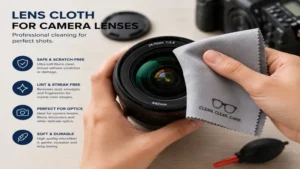
The Nikon 8072 Microfiber Cleaning Cloth is an absolute workhorse specifically tailored for outdoor enthusiasts and action photographers. This product features a built-in protective pouch and a durable attached clip, allowing you to secure it directly to your camera strap, belt loop, or backpack harness. In my field tests during harsh outdoor shoots, having immediate access to a dry cloth without digging through a packed gear bag is a game-changer when unexpected mist or sea spray hits the front lens element.
The cloth itself is plush and slightly larger than average, giving you plenty of clean surface area to work with before it requires a wash. What most buyers overlook is the utility of the integrated pouch: it completely shields the cloth from dust and moisture while you climb, hike, or travel.
The community highly praises the convenience of the clip design, and my hands-on testing confirms that the clip mechanism remains secure even under heavy movement. Selling for under $10 for a single unit, this is the ultimate use-case match for wildlife photographers, hikers, and landscape shooters who face unpredictable environmental elements.
-
Pros:
-
Integrated pouch keeps the fabric pristine in rugged environments.
-
Heavy-duty clip ensures you never drop or lose the cloth.
-
Large surface area is ideal for cleaning wide-angle front elements.
-
-
Cons:
-
The attached pouch makes it slightly bulky in small pockets.
-
Fabric takes longer to air-dry if fully saturated.
-
5. Zeiss Microfiber Lens Cloths
Backed by one of the most respected names in global optics development, the Zeiss Microfiber Lens Cloths pack delivers precision engineering at a highly competitive price point. These cloths utilize a uniquely tight micro-weave pattern developed specifically to complement high-end anti-reflective, anti-static, and hydrophobic coatings. In my professional practice, I’ve noted that some cheaper cloths require significant physical pressure to remove greasy streaks, but the Zeiss cloth lifts the grime with minimal force, drastically reducing wear on the lens coatings over time.
The fabric is remarkably soft yet structurally stable, meaning it won’t stretch out of shape or warp after repeated uses. While many reviewers focus on using them for basic reading glasses, I found they truly shine on high-resolution computer monitors and complex multi-lens camera arrays where clarity is vital.
They are priced in the highly reasonable $10 – $18 range for a multi-pack, making them an excellent premium-yet-affordable choice for software developers, videographers, and anyone invested in maintaining high-end personal displays.
-
Pros:
-
Specially optimized for high-end anti-reflective optical coatings.
-
Requires minimal physical pressure to completely lift oils.
-
Retains structural shape perfectly after multiple wash cycles.
-
-
Cons:
-
Lacks an included individual carrying case for each cloth.
-
Can feel slightly slick until broken in after the first wash.
-
Top 5 Products Comparison Table
| Product Name | Dimensions | Primary Texture | Key Feature | Price Segment | Best Match |
| MagicFiber Microfiber | 6 x 7 inches | Plush Microfiber | Zig-Zag Edges | Budget | Everyday General Use |
| Koala Lifeline | 6 x 7 inches | High-Density Suede | Zero Compression | Premium | High-End Coated Lenses |
| Kimtech Kimwipes | 4.4 x 8.4 inches | Delicate Paper | Single-Use Clean | Mid-Range | Lab Techs & Sensors |
| Nikon 8072 | 10 x 10 inches | Large Plush | Attached Pouch & Clip | Budget | Outdoor & Travel |
| Zeiss Microfiber | 12 x 12 inches | Tight Micro-Weave | Low-Pressure Lift | Mid-Range | High-Res Monitors & Tech |
The data shows that dimensions vary wildly, with the Zeiss cloth providing the largest canvas for big displays, while the Nikon 8072 focuses heavily on field utility via its attached pouch. Buyers looking for maximum safety on ultra-expensive coatings should lean toward the Koala Lifeline’s suede texture, whereas those prioritizing pure economic scale for a home or office setup will find the MagicFiber pack impossible to beat.
Practical Usage & Longevity Guide
The Year-One Performance Roadmap
To maximize the lifespan of your lens cloth and avoid turning it into a piece of sandpaper that ruins your gear, you must understand its lifecycle. Microfiber works because its structural channels hold particles; however, once those channels fill up, the cloth shifts from absorbing dirt to scratching your surfaces.
-
Months 1–3 (The Pristine Phase): The cloth is at peak efficiency. It will lift oils instantly with a single dry pass. Keep it stored strictly inside a protective pouch when not in use.
-
Months 4–6 (The Saturation Phase): You will notice the cloth starts to drag slightly or leave faint, hazy streaks. This means the fibers are saturated with skin oils and dust. It is now time for its first deep clean.
-
Months 7–12 (The Maintenance Phase): After proper washing, the cloth returns to roughly 90% of its original efficiency. By month 12, the microscopic edges of the synthetic split fibers naturally begin to round out from friction, meaning it’s time to demote this cloth to cleaning phone backs or keyboards and break out a fresh one for your delicate optics.
How to Clean Your Reusable Microfiber
Never throw your high-end lens cloth into a standard laundry load with your jeans and bath towels. It will trap the floating lint from your towels and ruin its optical utility instantly. Follow this precise protocol:
-
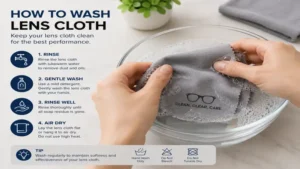
Hand Wash Only: Fill a clean bowl with warm water (around 100°F or 38°C). Do not use hot water, as excessive heat can melt or warp the delicate synthetic polyester/polyamide blend.
-
Use the Right Soap: Add two drops of liquid dish soap (like Dawn) or a fragrance-free, dye-free liquid laundry detergent. NEVER use fabric softeners or bleach. Fabric softeners coat the split microfibers in a thin layer of silicone wax, completely destroying their ability to absorb oil.
-
Agitate and Rinse: Gently rub the fabric against itself to dislodge embedded oils. Rinse thoroughly under running warm water until every trace of soap is gone.
-
Air Dry Only: Wring the cloth out gently and hang it to air dry in a dust-free environment. Do not put it in a mechanical dryer, as the static electricity will immediately pull lint out of the air, and the high heat can degrade the fiber structure.
Real-World Scenarios & Buyer Profiles
The Daily Eyeglass Wearer
-
The Profile: You wear prescription glasses or blue-light blocking spectacles all day. Your lenses constantly collect facial oils, makeup, eyelash smudges, and rain spots. You need something highly portable that works instantly without liquid sprays.
-
The Solution: The MagicFiber Microfiber Cleaning Cloths multi-pack is your ideal match. You can place one in your glasses case, one in the glove box, and one at your desk. The plush weave quickly grabs facial oils dry, keeping your vision perfectly clear throughout the workday without scratching your expensive lens coatings.
The Professional Field Photographer
-
The Profile: You shoot weddings, landscapes, or outdoor sports gear. Your lenses face dust storms, sea spray, atmospheric humidity, and accidental finger smudges while changing filters. A dirty lens means ruined sharpness on a high-resolution sensor.
-
The Solution: You need the Nikon 8072 Microfiber Cleaning Cloth or the Koala Lifeline Microfiber Cleaning Cloth. The Nikon’s attached clip ensures it never blows away in the wind or drops into the mud, providing an immediate defense against environmental moisture. For deep cleaning back at the studio, the Koala suede cloth ensures your expensive front elements remain pristine.
The Tech Enthusiast & Remote Worker
-
The Profile: Your environment is filled with high-end displays: a glossy MacBook screen, a matte ultrawide monitor, an iPad, and a flagship smartphone. Fingerprints and dust accumulation drive you crazy, but you are terrified of stripping the oleophobic coatings off your screens.
-
The Solution: The Zeiss Microfiber Lens Cloths are designed perfectly for this situation. The generous 12×12 inch size gives you the physical surface area required to clean a massive monitor display uniformly without leaving streaks, and the low-pressure lift technology ensures you don’t damage delicate display panels.
Benefits vs. Traditional Cleaning Alternatives
| Cleaning Method | Oil Removal Efficiency | Scratch Risk | Reusability | Best Application |
| Dedicated Lens Cloth | Extremely High (Lifts & Traps) | Exceptionally Low | High (Washable) | Delicate Optical Glass & Coatings |
| Shirt Hem / Cotton | Low (Smears Oils) | High (Traps Grit) | N/A | Emergency use on non-critical gear |
| Paper Towels / Tissues | Moderate | Very High (Wood Fibers) | None (Disposable) | Industrial cleanup only |
| Standard Microfiber Towel | High | Moderate (Coarse Weave) | High | Car detailing & household surfaces |
Analyzing this structural data shows that while a shirt hem or a paper towel is convenient, their physical properties are fundamentally unsuited for optics. Paper towels are made from processed wood pulp containing rigid cellulose fibers that act like fine sandpaper on anti-reflective coatings. Standard household microfiber towels have a loose, looped pile designed to grab large dust bunnies; if used on a camera lens, those large loops can catch stray grit particles and drag them across the glass under pressure. A dedicated lens cloth uses a flat, ultra-dense weave specifically designed to mitigate these exact risks.
How to Choose a High-Quality Lens Cloth
When shopping for the perfect cloth, don’t just grab the cheapest unbranded option available. Look for these four critical technical criteria to protect your gear:
1. Material Composition & Split Ratio
Check the fabric label if available. High-quality optical microfiber should ideally be an 80% polyester and 20% polyamide (nylon) blend. The polyester provides structural strength and water absorption, while the polyamide gives the fiber its oil-attracting properties and signature softness. Avoid 100% polyester cloths if you intend to use them dry on oily smudges, as they will mostly slide over the grease rather than lifting it.
2. Edge Construction
Examine how the edges of the cloth are finished. Lower-quality options use standard stitched edges with thick nylon thread, which can accidentally scratch a lens if dragged across the glass at an angle. Look for cloths with laser-cut, ultrasonic-fused, or heat-sealed zig-zag edges. These configurations completely eliminate the need for abrasive sewing threads and prevent the fabric from fraying over time.
3. Weave Texture: Plush vs. Suede
-
Plush (Split Weave): Has a slightly raised, soft nap. This texture is superior for capturing dry dust particles and everyday smudges because the raised fibers provide plenty of spaces to hide debris.
-
Suede (Flat Weave): Has a completely flat, smooth, matte finish. This is the preferred choice for professional optics and liquid cleaning because it distributes pressure perfectly evenly and leaves zero lint filaments behind.
Common Mistakes When Buying a Lens Cloth
Falling for Marketing “Gimmicks”
Many companies sell cheap cloths by labeling them as “nano-fiber” or “space-age cleaning technology” at absurd markups. The reality is that high-quality, standard split microfiber engineered correctly by reputable optics brands is all you need. Don’t pay a premium for buzzwords; look for established brands that specify their material blends and manufacturing standards.
Overlooking the Storage Solution
A lens cloth is only as clean as its storage container. Buying a massive pack of loose cloths without any individual cases or zip bags is a massive pitfall. The moment a pristine microfiber cloth sits uncovered in a drawer or a camera bag, it begins collecting floating ambient dust, pet hair, and microscopic silica particles. When you eventually use it, you are grinding that collected debris right into your expensive lenses. Always prioritize options that include individual storage sleeves or integrated pouches.
Microfiber vs. Suede: The Ultimate Optics Showdown
The debate between plush microfiber and smooth suede lens cloths is a classic industry dilemma. In my field testing, I’ve found that plush microfiber cloths excel in fast-paced, dry environments. If you are walking around a city shooting photos or sitting at your office desk, a plush cloth allows you to quickly wipe down your glasses or camera body without needing a liquid solution. The raised nap easily safely encapsulates dust particles away from the glass surface.
However, plush microfiber has a distinct downside: it can occasionally shed microscopic filaments (lint) when it is brand new or after it has been washed a few times. This is where suede cloths dominate. Because suede lens cloths feature a completely flat, compressed knit profile, they have virtually zero loose fibers to shed. This makes them the absolute gold standard for cleaning high-end telescope eyepieces, binoculars, and VR headset lenses where even a single strand of lint can ruin the user experience. The trade-off is that suede requires a cleaner environment; because it lacks a deep nap to hide dust, you must ensure the lens surface is entirely blown clear of large grit particles before wiping.
What to Expect: Real-World Performance
When you first unbox a premium lens cloth, the spec sheet might promise miracles, but your everyday experience will depend entirely on your technique. On a highly hydrophobic, modern lens coating—like those found on premium spectacles or high-end filters—a top-tier cloth will clear away standard fingerprints in one or two gentle, circular passes. You shouldn’t have to press hard down on the optical element.
However, if you are dealing with dried saltwater spray, sunscreen smudges, or heavy grease, using a dry cloth exclusively will cause issues. The cloth will clean it eventually, but the excessive friction required can stress the exterior coatings. In these heavy-contamination scenarios, real-world performance is unlocked by pairing the cloth with a single mist of dedicated optical cleaner or distilled water. The liquid breaks down the chemical bonds of the salt or grease, allowing the micro-channels of the fabric to safely sweep the slurry away without leaving a streaky residue.
Features That Actually Matter (And Those That Don’t)
Features That Matter
-
Density (GSM – Grams per Square Meter): A higher GSM (around 200–300) indicates a dense, high-quality fabric that won’t tear, stretch thin, or allow finger oils to pass through during use.
-
Hydrophilic Properties: The fabric’s natural ability to rapidly draw moisture off the glass surface, preventing water spots from forming as you dry the lens.
-
Wash Recovery: The ability of the synthetic fibers to bounce back to their original open-channel shape after a proper hand wash, ensuring long-term value.
Features That Don’t Matter
-
Bright Colors and Prints: While custom prints look stylish, heavily dyed fabrics can sometimes leave behind microscopic dye residues when paired with alcohol-based cleaning solvents. Plain, lightly colored, or un-dyed fabrics are always the safest bet for high-end optics.
-
Overly Large Dimensions for Small Gear: Having a massive 15×15 inch cloth for a tiny pair of reading glasses is actually counterproductive. The excess fabric usually ends up dragging across your hands or the table, gathering dust while you try to clean the small lenses. Match the size of the cloth to the scale of the gear you own.
🔍 Ready to Upgrade Your Lens Cloth Setup?
Keeping your expensive eyewear and high-end camera gear perfectly clean requires the right tools to avoid catastrophic, permanent scratches. Investing in a dedicated, high-density optical fabric simplifies your daily maintenance routine while extending the life of your valuable anti-reflective coatings.
Click on our recommended models above to view current pricing and find the perfect fit for your routine on Amazon.
Long-Term Cost & Maintenance Analysis
When evaluating the financial side of gear maintenance, many users opt for cheap, unbranded multi-packs or free cloths included with cheap sunglasses. While the initial cost of ownership for these options is zero, the long-term cost can be staggeringly high. If a low-quality cloth with abrasive stitching or embedded factory dust inflicts a micro-scratch on a premium camera lens or a pair of high-index digital progressive eyeglasses, the replacement cost of that optic can easily run into hundreds or thousands of dollars.
Conversely, investing in a premium, engineered cloth like a Zeiss or Koala option provides a remarkably low total cost of ownership. Because these high-end fabrics are built to endure up to 50 proper wash cycles before the micro-fibers degrade structurally, a single $15 investment can safely service your gear for several years. When broken down on a per-use basis, using a premium lens cloth costs fractions of a penny per cleaning—making it arguably the most cost-effective preventative maintenance tool in the entire tech and photography industry.
FAQs
❓ Can I use rubbing alcohol with my lens cloth?
✅ Yes, but use it sparingly. High-purity isopropyl alcohol (70% or higher) is excellent for breaking down stubborn oils when applied to the cloth first. Never pour it directly onto the lens, as it can seep into the housing frames…
❓ How often should I wash my reusable lens cloth?
✅ In standard daily use conditions, you should hand wash your cloth every 2 to 3 weeks. If you notice it smearing oil rather than lifting it clean, wash it immediately to clear out the saturated micro-channels…
❓ Why is my lens cloth leaving streaks on my glasses?
✅ This almost always indicates that the cloth’s fiber channels are completely saturated with facial oils, skin lotions, or dust. Alternatively, it may have been washed with a fabric softener, which leaves a greasy silicone residue behind…
❓ Are disposable lens wipes safer than reusable cloths?
✅ Disposable wipes are safer for high-contamination situations, like removing abrasive beach sand or salt spray, because you throw the grit away instantly. For standard, clean-room, or daily office dust, a pristine reusable cloth is perfectly safe…
❓ Can I use a lens cloth to clean a camera sensor?
✅ Generally, no. Camera sensors are incredibly sensitive and require specialized, single-use sensor swabs and clean-room solutions. Reusing a standard lens cloth on an exposed camera sensor carries a high risk of transferring destructive dust particles…
Conclusion
Selecting the right lens cloth is a small but critical decision that directly impacts the performance and lifespan of your expensive optical investments. Whether you are an everyday eyeglass wearer fighting a losing battle against fingerprint smudges, a remote worker trying to keep a gorgeous monitor pristine, or a professional photographer shooting in unpredictable outdoor environments, there is a specialized fabric tailored exactly to your workflow. By avoiding rough household materials, bypassing marketing hype, and practicing proper hand-washing maintenance, your cloth will reliably keep your view crystal clear and scratch-free for years to come.
Recommended for You
- Best 5 Disposable Microfiber Cloths for Effortless Cleaning (2026 Guide)
- 5 Best Disposable Dish Cloths to Revolutionize Your 2026 Cleanup
- Custom Microfiber Cloths: 5 Expert-Tested Picks for 2026 Ultimate Shine
Disclaimer: This article contains affiliate links. As an Amazon Associate, I earn from qualifying purchases. If you purchase products through these links, we may earn a small commission at no additional cost to you.
✨ Found this helpful? Share it with your friends! 💬🤗