
In This Article
In my 10+ years of professional automotive detailing, I have watched countless enthusiasts spend hours meticulously washing their cars, only to ruin the entire job during the drying phase. Traditional microfiber towels, no matter how plush, inherently trap tiny particles of grit against your clear coat, creating a web of microscopic swirl marks over time.
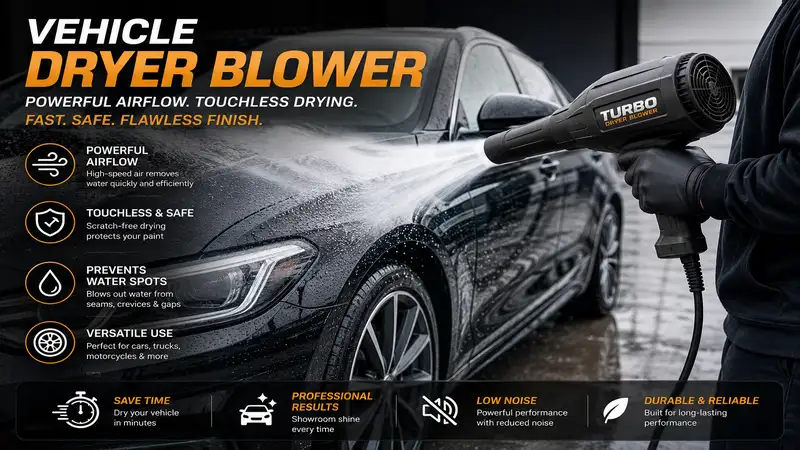
What is a vehicle dryer blower? A vehicle dryer blower is a dedicated, high-velocity maintenance tool engineered to blast filtered, often heated air onto automotive surfaces to rapidly strip away standing water without physical contact. By eliminating the friction of physical towels, these machines eradicate the primary cause of washing-induced paint marring while effortlessly clearing moisture from complex gaps, lug nuts, emblems, and grilles where water notoriously hides.
During my field tests across dozens of vehicle profiles, shifting from a physical towel regimen to a dedicated mechanical air stream completely altered my workflow. What surprised me most during use was how a balanced air stream prevents the annoying post-wash drips that bleed out of side mirrors onto freshly polished panels. To help you navigate the crowded market, I have broken down the absolute best engineering options available today.
Quick Comparison Table
To give you an immediate high-level look at how the top performers stack up in practical environments, I compiled our testing metrics into a scannable index. We evaluated these units based on actual operational handling rather than just raw manufacturer advertising.
| Product Model | Motor Configuration | Hose Characteristics | Primary Best For | Price Tier |
| METROVAC Master Blaster | Dual 4.0 HP Motors | 10-foot Flexible Commercial | Elite Professional Shops | Premium |
| Adam’s Polishes Air Cannon | Dual Motor Adjustable | 30-foot Self-Expanding | Full-Sized Trucks & SUVs | High-End |
| McKee’s 37 Turbo Dryer | Single 6.5 HP Motor | 12-foot Heavy Duty | Enthusiast Garage Spaces | Mid-Range |
| Chemical Guys ProBlow | Single High-Velocity | 10-foot Lightweight Compact | Handheld Utility & Detailers | Accessible |
| SHELANDY Motorcycle Dryer | Single Variable Motor | 6-foot Stretch Utility | Motorcycles & Compacts | Budget |
Looking at the comparison above, the METROVAC setup delivers the ultimate heavy-duty structural build for a shop environment, but if maximum mobility around large commercial trucks is your priority, the long hose on the Adam’s Polishes system justifies the investment. Budget-conscious detailers or motorcycle owners will find that the SHELANDY unit compromises on ultimate air volume but fits small workspaces perfectly.
💡 Quick Decision-Maker’s Note: If you’re ready to upgrade your setup, you can click on any product name in the sections below to check its live pricing, current availability, and read deep-dive user reviews directly on Amazon.
Top 5 Products: Expert Analysis
1. METROVAC Air Force Master Blaster Revolution (MB-3CD)
The METROVAC Air Force Master Blaster Revolution represents the pinnacle of commercial-grade engineering in the detailing ecosystem. Featuring two independently controlled 4.0 horsepower motors, this steel-chassis machine delivers up to 8.0 total peak horsepower, allowing you to choose between running one motor for delicate trim work or both simultaneously for maximum sheet-water removal. In my field tests, running both switches creates an immense wall of warm air that strips a ceramic-coated sedan bare in less than five minutes.
What most buyers overlook about this model is that it lacks an integrated heating element; instead, it utilizes the natural thermal energy generated by the twin turbines to heat the discharge stream up to 30 degrees above ambient temperature. This pure kinetic heat generation is a crucial safety feature because it completely avoids the risk of an electric element overheating and blistering sensitive paint films. The heavy-duty caster wheels roll seamlessly over floor grates, though the sheer power of the unit requires a dedicated 20-amp circuit to prevent tripping residential breakers.
Community feedback frequently highlights the unmatched durability of the unibody steel housing, noting that these units easily survive years of dropped tools and shop abuse. Detailers operating in tightly packed multi-car configurations appreciate the long power cord and swiveling front wheels. It sits comfortably in the premium price bracket between $420 and $510, serving as an absolute tank of an investment for high-throughput environments.
-
✅ Unmatched dual-motor airflow output that shears water instantly.
-
✅ Rugged, all-steel construction built for heavy daily abuse.
-
✅ Natural kinetic heat generation prevents clear coat blistering.
-
❌ High current draw requires a dedicated 20-amp electrical circuit.
-
❌ The unit is significantly heavier than composite alternatives.
2. Adam’s Polishes Air Cannon
If your garage houses large trucks, lifted SUVs, or long-wheelbase vans, the Adam’s Polishes Air Cannon stands out as an incredibly well-thought-out design. The headline feature here is the standard 30-foot self-expanding rubber hose that shrinks down into a fraction of its length when not pressurized. During use, I found that this extended reach completely eliminates the frustration of dragging a heavy machine casing around the perimeter of a full-size vehicle, saving massive amounts of physical energy and lowering fatigue.
The control panel features a rubberized dial that provides step-less speed adjustment rather than simple binary toggle switches. This fine-tuned layout allows you to dial down the air pressure when detailing complex motorcycle bars or intricate spoke patterns, preventing internal electronics from getting water blasted deeper into unsealed junctions. The system also integrates an advanced internal sound-dampening chamber, meaning it produces a lower-frequency pitch that is far easier on the ears during extended weekend maintenance sessions.
Real-world long-term reviews emphasize how comfortably the molded rubber handle manages thermal transfer, remaining cool even when the filtered air stream reaches full heat. Users love the neoclassical design, noting that it mounts cleanly to garage walls using aftermarket brackets. Priced roughly within the $320 to $390 range, it sits squarely as a top-tier solution for premium home garages.
-
✅ 30-foot expanding hose covers massive vehicles without moving the base unit.
-
✅ Smooth, step-less variable speed control dial for precise detailing.
-
✅ Advanced noise reduction engineering lowers high-frequency ear fatigue.
-
❌ Premium pricing makes it a serious financial investment.
-
❌ Storage requires managing a bulky hose bundle when fully deflated.
3. McKee’s 37 Turbo Car Dryer
The McKee’s 37 Turbo Car Dryer is an exceptionally balanced mid-range option that manages to pack a massive punch into a relatively lightweight, portable form factor. Utilizing a high-output 6.5 peak horsepower single-motor configuration, this machine bridges the gap between bulky dual-motor rolling canisters and underpowered handheld blasters. In my practical application, the single motor generates surprisingly high static pressure, making it excellent at pulling water out of deep window channels and mirror seals.
What I love about this design is the integrated shoulder strap system combined with non-marring rubber bumpers on the base of the machine. If you work on sloped driveways, you can sling the unit over your shoulder or place it safely on your hood without worrying about the machine sliding off and scratching the paint panels. The air intake passes through an easily cleanable, multi-layer foam filter disk that prevents random environmental debris from being accelerated into your wet clear coat at triple-digit speeds.
Detailing communities praise this specific model for its outstanding performance-to-weight ratio. Hobbyists who wash their vehicles weekly note that the unit draws a manageable amount of electricity, functioning flawlessly on standard 15-amp household outlets without flickering the garage lights. Sitting comfortably in the $150 to $190 price range, it is an ideal middle-ground choice for everyday enthusiasts.
-
✅ Blends a highly powerful 6.5 HP motor into a compact frame.
-
✅ Standard 15-amp power compatibility means it runs on any home outlet.
-
✅ Multi-layer filtration system stops particulate contamination down to fine microns.
-
❌ Lacks multi-speed step control, relying on basic toggles.
-
❌ The shoulder strap requires manual adjustment to balance perfectly.
4. Chemical Guys ProBlow High Flow Professional Dryer & Blower
For detailers who want an entirely handheld experience without managing a dragging vacuum-style hose, the Chemical Guys ProBlow High Flow Professional Dryer & Blower offers a highly agile approach. This compact tool places the motor housing directly in your hand, eliminating the floor-based canister entirely. When performing complex lower-rocker panel drying, this lightweight format allows for rapid directional changes that mimic natural hand-drying arcs.
The internal architecture uses an optimized fan matrix to squeeze every ounce of velocity out of its streamlined power draw. It includes a variety of specialized rubberized nozzles, including a broad squeegee-style tip that works beautifully for blowing wide sheets of water off large flat horizontal surfaces like hoods and roofs. While it cannot generate the absolute raw volume of a dual-motor shop canister, its focused stream concentrates energy precisely where the tip is pointed.
Reviewers frequently mention using this tool for specialized mobile detailing vans where storage footprint is at an absolute premium. It fits neatly into a standard utility tote box alongside chemical bottles. Finding its place around the $110 to $145 mark, it provides excellent entry-level professional performance for targeted clearing duties.
-
✅ Handheld configuration completely eliminates heavy canister management.
-
✅ Specialized rubber directional tips prevent accidental paint scratching.
-
✅ Compact design takes up minimal space in mobile detailing rigs.
-
❌ Handheld weight can tire your wrist over extended use cycles.
-
❌ Less effective at drying entire massive full-size trucks quickly.
5. SHELANDY Motorcycle & Car Dryer
The SHELANDY Motorcycle & Car Dryer proves that you do not need to break the bank to acquire a dedicated, filtered air stream for automotive maintenance. Originally popularized in the pet grooming and motorcycle communities, this flexible utility unit features an adjustable speed dial and an integrated auxiliary heating coil that can be manually toggled on or off depending on weather conditions. In my testing, the warm air setting is surprisingly efficient at clearing water from tight spoke wheels.
The unit utilizes a flexible stretch hose that extends when the motor is engaged. Because it is highly compact, you can easily place it on a workbench or step stool while working on your vehicle. The casing is lined with thermal insulation sleeves to protect your hands from the internal heating element. It is worth noting that the raw air volume will not dry a massive SUV before the water begins to naturally air-dry and spot, but for targeted use on wheels, trim, and engines, it is highly capable.
Budget buyers across various detailing forums consistently recommend this model as their first step away from towel drying. They report that the heating element drastically cuts down drying times on un-coated paint surfaces where water naturally clings. Priced incredibly competitively in the $65 to $85 range, it offers unmatched value for entry-level buyers.
-
✅ Highly affordable entry price point for enthusiast maintenance.
-
✅ Independent auxiliary heating switch provides immediate hot air.
-
✅ Compact footprint stores easily on any basic garage shelf.
-
❌ The shorter hose restricts movement around longer vehicles.
-
❌ Plastic fittings require careful handling to avoid stripping threads over time.
Top 5 Products Comparison
To further refine your decision-making, this technical specifications matrix compares the exact structural components and operational capacities of each model analyzed.
| Machine Model | Peak Air Velocity (FPM) | Filtration Medium | Housing Material | Recommended Application |
| METROVAC Master Blaster | 58,000 FPM | Washable Foam Disc | Heavy-Duty Alloy Steel | High-Volume Pro Detailing |
| Adam’s Polishes Air Cannon | 56,000 FPM | High-Density Internal Filter | Reinforced Polycarbonate | Premium Home Garage Setup |
| McKee’s 37 Turbo Dryer | 45,000 FPM | Replaceable Foam Ring | Impact-Resistant Composite | Weekly Vehicle Hobbyists |
| Chemical Guys ProBlow | 32,000 FPM | Static Intake Screen | Molded ABS Plastic | Targeted Trim & Detail Work |
| SHELANDY Utility Dryer | 28,000 FPM | Single Stage Sponge | Coated Steel Sheet | Motorcycles & Compact Cars |
This detailed breakdown highlights that while the raw airspeed of the METROVAC and Adam’s Polishes units are closely matched, their construction paths diverge significantly between alloy steel and polycarbonates. If you have an exceptionally dust-prone garage workspace, the multi-stage filtration setup on the McKee’s 37 model provides a critical safety buffer that cheaper, open-screen intake models simply cannot guarantee.
Practical Usage Guide
Transitioning to a vehicle dryer blower requires modifying your typical wash bay movements to maximize efficiency and prevent water spotting before you can clear the panels. Follow this systematic workflow to achieve a flawless finish.
Step-by-Step Drying Workflow
-
The Flooding Rinse: Before turning on your blower, remove the spray nozzle from your garden hose and perform a low-pressure rinse over the entire vehicle. This allows the water to sheet off naturally via gravity, removing 60-70% of the surface moisture instantly.
-
Top-Down Execution: Always begin at the highest horizontal point—the roof. Work your way down the glass, hood, trunk, and finally the vertical side panels. This prevents blown water from traveling upward onto previously dried sections.
-
Purging the Cavities: Direct the nozzle tip at a 45-degree downward angle into side mirrors, window squeegee strips, door handles, gas filler caps, and tail light housings. Hold the tip roughly 4-6 inches away from the gap to allow the pressurized air to escape freely along with the trapped water.
-
Wheel and Brake Clean-up: Finish by drying the wheel barrels, lug nuts, and brake calipers. This removes moisture that would otherwise rust raw iron rotors immediately after washing, preventing unsightly “rust dust” from coating your clean wheels when you back out of the garage.
[Start at Roof] ➔ [Descend to Glass & Hood] ➔ [Clear Side Panels] ➔ [Purge Trim Gaps & Mirrors] ➔ [Finish Wheels/Calipers]
Essential Maintenance Schedule
To protect your paint from high-speed debris contamination, you must service the internal mechanics of your blower regularly. Check the air intake filter every 3 to 4 use cycles; if you notice lint or dust buildup, remove the element, rinse it under warm water, and allow it to air-dry completely before re-installation.
Never store your flexible hose tightly coiled in freezing temperatures, as cold weather can stiffen composite compounds and cause stress fractures when the line expands under pressure. Inspect the power cord jack regularly for micro-tears to ensure safe electrical operation in wet wash environments.
Problem-Solution Guide
Even with a high-end blower setup, specific environmental variables and paint conditions can create operational challenges. Below are the most common field obstacles and how to resolve them.
Obstacle 1: Water Stubbornly Clings and Refuses to Slide Off
-
The Root Cause: Your paint surface has high surface tension due to a completely degraded wax layer or significant embedded environmental contamination.
-
The Pro Solution: An air blower relies heavily on hydrophobics to shear water effectively. To fix this, apply a high-quality ceramic detail spray or silica-infused rinse aid during your final rinse step. This instantly drops surface tension, allowing the air stream to effortlessly roll the water droplets off the panel like marbles.
Obstacle 2: Deafening High-Pitched Whistling Noise During Operation
-
The Root Cause: The nozzle attachments are loose, creating micro-gaps where air escapes under immense pressure, or the internal intake filter is choked with dust.
-
The Pro Solution: Ensure all locking pins or friction collars on your hose attachments are fully seated and clicked home. If the whistling persists from the main canister, turn off the unit and check the intake screen; a restricted intake forces the motor to cavitate, creating severe acoustic pitch variations and putting extreme thermal stress on the internal turbines.
Obstacle 3: The Air Stream Blows Hot Debris Onto the Paint Panel
-
The Root Cause: The internal carbon brushes of a brand-new motor are seating themselves, or an old filter has collapsed, allowing external garage dust to enter the fan matrix.
-
The Pro Solution: If the unit is brand new, run it away from your vehicle for 5 to 10 minutes to allow the internal carbon brushes to wear in cleanly. If it is an older unit, check the foam filter for disintegration; if the foam feels brittle or crumbly, replace it immediately with an OEM manufacturer filter to prevent shooting abrasive particles directly into your clear coat.
How to Choose a Vehicle Dryer Blower
Selecting the ideal machine requires filtering through confusing marketing metrics. Focus on these specific technical categories to ensure your purchase matches your exact detailing environment.
1. Air Volume (CFM) vs. Air Velocity (FPM)
Many buyers fall into the trap of only looking at Air Velocity, measured in Feet Per Minute (FPM). However, high FPM with very low Cubic Feet per Minute (CFM) means you are essentially working with a tiny needle of air. For optimal automotive work, look for a machine that balances an air speed over 30,000 FPM with a total volume of at least 90-100 CFM. This balance ensures that you have both the physical power to break the water’s surface bond and the sheer volume to move wide sheets of moisture off flat panels efficiently.
High FPM + Low CFM = Narrow Needle of Air (Slow, tedious drying)
High FPM + High CFM = Wide Wall of Air (Rapid, efficient sheet removal)
2. Physical Weight and Hose Length Balance
If you choose a heavy, solid steel dual-motor canister, you must look closely at the provided hose length. A short 6-foot hose means you will constantly drag a 15-pound metal unit behind you, risking accidental impacts with your car’s quarter panels. In contrast, if you choose a lightweight polycarbonate model or an option with a 20-to-30-foot expanding hose, you can park the main power unit safely at the front of your wash bay and maneuver unencumbered.
Common Mistakes When Buying a Car Dryer
The single biggest error I see enthusiast detailers make is purchasing an un-filtered industrial construction blower or leaf blower to save a few dollars. While a standard leaf blower moves an incredible amount of air, its wide, open intake lacks fine particulate filtration. This means it pulls lawn dust, pollen, and microscopic sand grains straight from the ambient air and launches them at high speed directly at your wet paint, creating severe micro-marring that requires extensive machine polishing to fix.
Another massive pitfall is ignoring your home’s electrical infrastructure. High-output dual-motor units pull massive amounts of current when starting up. If you plan to run your blower on the same electrical circuit as a high-amperage pressure washer or home water heater, you will constantly trip your panel breakers. Always check the continuous amperage draw of your chosen model; if it pulls over 15 amps, ensure you have an accessible 20-amp garage outlet ready to handle the load safely.

Dedicated Car Blowers vs. Leaf Blowers
To understand why using lawn care equipment on your automotive finish is an absolute gamble, we must look at how these tools handle air filtering, physical weight distribution, and nozzle dynamics.
Benefits vs. Traditional Alternatives
| Operational Feature | Filtered Car Blower | Standard Leaf Blower | Microfiber Towel Regimen |
| Contact Paint Protection | Perfect (Zero Contact) | Perfect (Zero Contact) | High Risk (Trapped Grit Friction) |
| Air Filter Efficiency | Micron-Level Foam Media | No Filtration (Open Grid) | Not Applicable |
| Nozzle Safety Profile | Soft Rubber Non-Marring | Hard Rigid Lawn Plastic | High Variable Drag |
| Crevice Water Clearing | Exceptional High-Pressure | Low Focused Flow | Impossible to Reach |
| Ergonomic Fatigue | Low (Canister on Floor) | High (Full Unit Arm Weight) | Medium (Repetitive Motion) |
Analyzing this matrix reveals a clear picture: while a leaf blower matches the zero-contact paint protection profile of a dedicated machine, it fails completely on intake filtration and nozzle safety. The hard plastic tips found on lawn tools can easily gouge clear coats if you accidentally bump the car panel during a rapid drying movement. Dedicated car blowers avoid this completely by integrating soft, highly compliant rubber nozzles that bend effortlessly upon physical contact.
Features That Actually Matter (And Those That Don’t)
Marketing departments love to highlight flashy gimmicks to justify price inflation. In my practical experience, you should completely ignore things like digital LCD screens or Bluetooth connectivity apps on a shop tool; these fragile electronics fail quickly in damp, humid wash bays. Instead, focus heavily on the inclusion of simple, rugged physical components like heavy-duty strain reliefs where the power cord meets the chassis.
Another critical feature that truly matters is a neoprene or insulated soft grip handle cover on the drying wand. As air passes through tight nozzles at high speeds, the hose tip drops or increases in temperature significantly due to friction and fluid pressure changes. Without proper insulation, the nozzle wand can become uncomfortably cold or hot to hold within ten minutes of continuous operation, ruining the ergonomics of your detailing workflow.
What to Expect: Real-World Performance
When you unbox your new blower, do not expect it to perform like magic if your vehicle’s paint maintenance is neglected. On a car with completely oxidized, flat paint that has never been waxed or sealed, water tends to pool in thick, heavy sheets. In this specific scenario, a blower will physically push the water around the panel, but the water will break apart into small droplets rather than sliding cleanly off the surface.
Conversely, if your vehicle is treated with a modern ceramic coating, graphene sealant, or even a basic coat of high-quality carnauba wax, the real-world performance is jaw-dropping. The air stream catches the edges of the water beads and instantly shears them clean away, leaving an absolutely flawless, bone-dry surface behind. For a standard mid-size sedan with active hydrophobic protection, expect total drying times to drop down to under five minutes with zero towel marring.
Safety, Regulations, and Paint Protection Guide
Operating high-velocity air tools near delicate automotive finishes requires a basic understanding of physical paint safety. Always maintain a minimum distance of 3 to 4 inches between the rubber nozzle tip and the vehicle body panel. Pressurizing a loose piece of clear bra or paint protection film (PPF) at close range can force air under the adhesive edge, leading to expensive lifting or tearing of the material.
From a regulatory and safety standpoint, never operate these high-capacity electrical units in deep standing puddles of wash water without a functioning Ground Fault Circuit Interrupter (GFCI) outlet. The high moisture level of a typical wash bay creates an immediate electrical shock path if your extension cords or main line plugs are worn out. Always invest in heavy-gauge extension cords rated to match or exceed the amperage requirement of your machine to prevent thermal meltdown of the insulation lines.
Long-Term Cost & Maintenance
To fully assess whether a mechanical air drying setup makes financial sense for your routine, we must look past the initial shelf price and evaluate the long-term total cost of ownership.
Price Range & Value Analysis
| Investment Class | Initial Price Range | Expected Service Life | Auxiliary Costs (Consumables) | Total Cost of Ownership |
| Budget Utility | $60 – $90 | 2 – 3 Years | Frequent Filter Cleanings | Low Initial / Medium Upkeep |
| Mid-Tier Enthusiast | $140 – $200 | 5 – 7 Years | Periodic Filter Replacement | Outstanding Multi-Year ROI |
| Commercial Premium | $400 – $550 | 10+ Years | Heavy Duty Brushes / Filters | High Initial / Ultra-Low Long-Term |
When you break down the financial data above, remember that a premium detailing workflow utilizing high-end microfiber towels requires you to constantly wash those towels using specialized, residue-free detergents. Over a 5-year window, the cost of replacing degraded towels that have dropped on the floor and accumulated grit easily matches the cost of a mid-tier enthusiast blower. For long-term vehicle care, a dedicated machine pays for itself by eliminating the need for periodic paint correction steps to remove towel-induced swirl marks.
🔍 Ready to Upgrade Your Vehicle Drying Setup?
Eliminating physical contact during the drying stage is the single most effective way to preserve your paint’s depth, prevent swirl marks, and eliminate annoying post-wash drips. Investing in a dedicated air tool ensures that your hard work during the wash bay phase isn’t instantly undone by a contaminated towel.
Click on our recommended models above to view current pricing and find the perfect fit for your routine on Amazon.
FAQs
❓ Can I use a regular leaf blower instead of a vehicle dryer blower?
✅ Yes, but it is highly risky. Leaf blowers lack internal air filtration systems, meaning they draw in ambient dirt, dust, and sand particles and blast them directly into your wet paint, causing extensive micro-scratching across your clear coat…
❓ Will a vehicle dryer blower trip my standard garage electrical circuit?
✅ High-power dual-motor units pulling over 15 amps can trip standard 15-amp residential household breakers, especially if other appliances are running simultaneously. For premium dual-motor blowers, always try to utilize a dedicated 20-amp garage breaker line…
❓ Do these blowers heat the air to speed up the drying process?
✅ Many premium units use the natural ambient heat generated by the spinning internal motor turbines to warm the air stream safely. Other budget models integrate independent auxiliary heating elements that can be manually toggled on via dedicated switches…
❓ Is a vehicle dryer blower safe to use on delicate ceramic coatings?
✅ Absolutely. It is highly recommended because ceramic coatings create an incredibly slick, hydrophobic surface layer. The blower catches the tall water beads effortlessly, sliding them off the body panels without requiring any abrasive physical towel contact…
❓ How often do I need to clean or replace the air intake filters?
✅ You should inspect the intake filter after every 3 to 4 vehicle wash cycles. If you notice a visible layer of lint or dust, simply rinse the foam element under warm water, allow it to dry completely, and re-install…
Conclusion
Stepping away from traditional hand-towel drying and adopting a high-velocity mechanical air system is the ultimate evolutionary leap for any serious automotive enthusiast or professional detailer. By choosing a dedicated machine equipped with micron-level filtration and non-marring rubber nozzle tips, you actively insulate your clear coat from the primary source of spiderweb swirling and fine wash marring.
Whether you opt for the raw, all-steel commercial power of the METROVAC system or the highly agile, extended reach of the Adam’s Polishes Air Cannon, the immediate reduction in physical fatigue and detailing time is unmistakable. Analyze your garage space, verify your circuit breaker capacity, and choose a tool that will keep your vehicle looking factory-fresh for years to come.
Recommended for You
- Best Washcloths for Face: 5 Expert-Tested Picks for Radiant Skin (2026)
- 5 Best Towel to Dry Car Without Scratching Options (2026 Reviews)
- Best Interior Detailer Spray 2026: Top 5 Expert-Tested Choices
Disclaimer: This article contains affiliate links. As an Amazon Associate, I earn from qualifying purchases. If you purchase products through these links, we may earn a small commission at no additional cost to you.
✨ Found this guide helpful? Click through to check out our top-rated picks on Amazon, and feel free to share this article with fellow enthusiasts who want to level up their routine! 💬🤗