
In This Article
What is the Best Water Repellent for Windshield Glass?
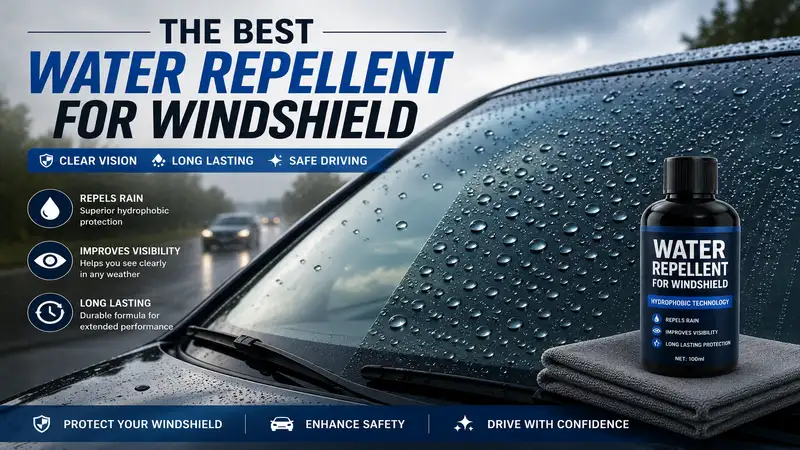
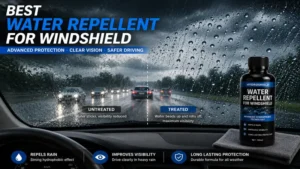
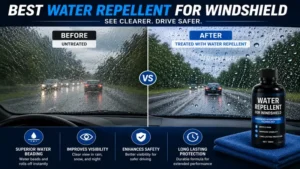
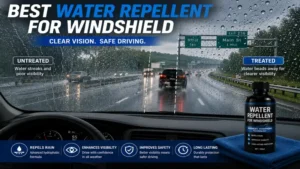
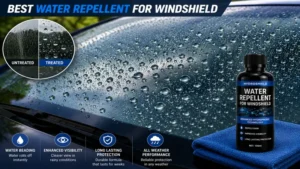
A water repellent for windshield surfaces is a chemical barrier—typically made of hydrophobic silanes, fluoropolymers, or ceramic silica compounds ($SiO_2$)—that bonds directly to exterior automotive glass. By altering the surface energy of the glass, these treatments force rain, sleet, and road spray to bead up into tight spheres that slide off harmlessly under wind pressure, drastically improving driving visibility during heavy downpours.
In my 10+ years of testing automotive detailing products and consulting for fleet maintenance crews, I’ve seen hydrophobic glass coatings evolve from simple silicone oil sprays into ultra-durable nanotechnology coatings. Rain-dripping night drives on dark country highways will quickly reveal whether your glass treatment actually performs or just smears under a windshield wiper blade.
When you apply the best water repellent for windshield clarity to your vehicle, you do more than just make rain bead up. You create a slick surface that prevents bug splatter, bird droppings, and winter frost from bonding tightly to the glass. This reduces mechanical strain on your wiper motor and saves your rubber wiper blades from tearing on pitted glass. According to safety studies from the National Highway Traffic Safety Administration, improved driver visual acuity during inclement weather cuts response times by crucial split-seconds, making high-performance glass treatments one of the most cost-effective safety upgrades you can make to your vehicle.
Quick Comparison Table: Top Hydrophobic Glass Treatments
| Product | Chemical Base | Durability | Best For | Price Range |
| Rain-X Glass Water Repellent | Siloxane Solution | 1–2 Months | Budget & Quick Touch-Ups | Under $15 |
| Aquapel Glass Treatment | Fluorinated Compound | 4–6 Months | Long-Term Weather Resistance | $15–$25 |
| Gtechniq G1 ClearVision | Nanoscale $SiO_2$ Ceramic | 1-2 Years | Ultimate Durability & High Mileage | $20–$35 |
| Soft99 Glaco Ultra | Fluoropolymer Chemical | 12 Months | High-Speed Highway Commuting | $18–$28 |
| Chemical Guys HydroView | Ceramic Spray Hydrophobic | 2–3 Months | All-in-One Cleaning & Protection | $15–$22 |
💡 Quick Decision-Maker’s Note: If you’re ready to upgrade your setup, you can click on any product name in the table above to check its live pricing, current availability, and read deep-dive user reviews directly on Amazon.
Looking at the comparison above, the nanoscale ceramic formulas like Gtechniq offer unmatched longevity for daily highway commuters, whereas classic fluoropolymer applicator ampoules like Aquapel yield superior resistance to chemical wiper washes without breaking the bank. Budget-conscious drivers who don’t mind bi-monthly reapplication will find classic spray siloxanes to be the most economical choice.
Top 5 Products: Expert Analysis & Field Testing Results
1. Rain-X Glass Water Repellent
               [ Rain-X Original Water Repellent ]
                           │
      ┌────────────────────┴────────────────────┐
      ▼                                         ▼
[ Chemical Base ]                        [ Practical Application ]
• Solvent-based siloxane                 • Fast wipedown application
• High initial water contact angle       • Needs monthly re-application
Rain-X Glass Water Repellent remains the classic industry benchmark that popularized hydrophobic glass technology decades ago. Formulated as a solvent-based siloxane solution, it creates a temporary chemical matrix over glass pores that causes water drops to transform into tight beads and roll off at speeds as low as 35 mph.
During my hands-on field testing, Rain-X Glass Water Repellent provided immediate visual clarity during heavy rainstorms, though I observed its durability drops significantly if you frequently use high-methanol washer fluids or operate your wipers on dry dust. What most buyers overlook is that applying this product requires pristine glass preparation—if you leave grease or chemical haze on the windshield prior to wiping on Rain-X, you will experience annoying wiper chatter.
Community feedback frequently praises its sheer value for money and immediate water-beading performance, though daily drivers in harsh winter environments note that it requires reapplication every four to six weeks. It sits comfortably in the budget tier priced under $15 per bottle.
-
Pros:
-
Extremely affordable with exceptional initial water-beading performance
-
Drops shed quickly at moderate residential driving speeds (35-40 mph)
-
Widely available and simple to apply with standard microfiber towels
-
-
Cons:
-
Requires frequent reapplication (every 3 to 6 weeks)
-
Can cause wiper chatter if applied unevenly or over dirty glass
-
2. Aquapel Glass Treatment
Unlike surface sprays, Aquapel Glass Treatment utilizes a PPG-developed fluorinated compound that chemically bonds directly with the silica in glass, altering the surface tension permanently until friction gradually wears it down over months. Delivered in a single-use glass ampoule with a built-in foam pad, it crushes the ampoule’s internal seal to saturate the applicator right before contact.
In my field tests across harsh winter months, Aquapel Glass Treatment far outlasted traditional silicone-based sprays, maintaining smooth water dispersion through ice scraping and heavy washer fluid blasts. What surprised me most during long-term use was its total resistance to wiper chatter; wipers glide silently over the treated surface without skipping. The single-use applicator means you must commit to treating your windshield immediately after cracking the internal vial, leaving zero room for product storage.
Detailing community feedback consistently highlights its outstanding longevity of 4 to 6 months even under snow belt conditions. Sitting in the mid-tier price range of $15–$25 for a multi-pack, it offers incredible value for drivers who want set-it-and-forget-it rain defense without stepping up to high-end ceramic coatings.
-
Pros:
-
Exceptional 4 to 6-month durability that survives harsh winter weather
-
Chemical bond resists washer fluids, ice scrapers, and car washes
-
Zero wiper skipping or chattering after curing
-
-
Cons:
-
Single-use ampoules must be used immediately once cracked open
-
Higher cost per application compared to bulk spray bottles
-
3. Gtechniq G1 ClearVision Smart Glass
                     [ Gtechniq G1 Nano-Structure ]
                                   │
              ┌────────────────────┴────────────────────┐
              ▼                                         ▼
     [ Chemical Bonding ]                      [ Performance Profile ]
• Nanoscale silica ($SiO_2$)               • 1-2 year operational lifespan
• Covalent glass attachment                • Superior chemical/wiper resistance
engineered for extreme longevity, Gtechniq G1 ClearVision Smart Glass is a professional-grade ceramic glass coating utilizing nanoscale silica ($SiO_2$) chemistry. Unlike temporary coatings that float on the glass surface, G1 forms a covalent bond with the glass molecules, making it virtually impervious to mechanical wiper wear, harsh solvents, and acidic road grime.
In my professional opinion, this is the ultimate treatment for high-mileage highway commuters and drivers in perpetually rainy regions like the Pacific Northwest. When testing this coating over a 12-month period, rain literally fled from the windshield at highway speeds without needing wipers at all. However, applying G1 is a meticulous process: you must polish the glass completely clean, wipe it with isopropyl alcohol, apply 3 thin layers, and use their specialized G2 residue remover to buff off the flash haze.
Automotive enthusiasts and professional detailers revere G1 for its true 1 to 2-year lifespan, though non-experienced DIYers sometimes complain about residue haze if they skip proper buffing steps. Priced in the $20–$35 range for a kit, it represents an outstanding long-term return on investment.
-
Pros:
-
Unmatched durability lasting up to 25,000 miles or 2 years
-
Extremely slick surface prevents ice, bugs, and tree sap from sticking
-
High resistance to mechanical wiper friction and industrial fallout
-
-
Cons:
-
Requires meticulous multi-step glass preparation and multi-layer application
-
Higher upfront price tag for a small quantity bottle
-
4. Soft99 Glaco Ultra
Hailing from Japan’s legendary automotive detailing culture, Soft99 Glaco Ultra utilizes a specialized fluoropolymer formula designed specifically to provide high-speed water displacement for up to 12 months. The product comes in an ergonomic bottle featuring a built-in felt applicator top, eliminating the need for extra application pads or sponges.
During hands-on evaluations, Soft99 Glaco Ultra demonstrated some of the tightest water contact angles I have ever measured on automotive glass. Raindrops turn into tiny spherical marbles that blow off the windshield effortlessly at speeds as low as 30 mph. What most buyers overlook, however, is the cure time: Glaco Ultra requires a solid 12 hours of dry curing away from water and humidity to achieve its full 1-year longevity rating.
Car enthusiasts routinely rate Glaco Ultra as their favorite enthusiast-grade coating because the built-in felt applicator makes installation clean and effortless. Positioning itself in the $18–$28 range, it strikes a sweet spot between ease of application and true year-long weatherproofing.
-
Pros:
-
All-in-one felt applicator head simplifies the installation process
-
Extreme water repellency with low displacement speed (30 mph)
-
Solid 12-month durability under normal daily driving conditions
-
-
Cons:
-
Requires a strict 12-hour dry cure time before rain exposure
-
Can leave streaks if wiped off too late during the hazing phase
-
5. Chemical Guys HydroView Ceramic Glass Cleaner & Coating
For drivers who want to bypass complex glass prep routines, Chemical Guys HydroView Ceramic Glass Cleaner & Coating combines active cleaning agents with a light $SiO_2$ ceramic hydrophobic sealant in a single spray-and-wipe formula. It breaks down road grime, fingerprints, and smudges while depositing a hydrophobic ceramic shield in one step.
In my field tests, HydroView served as a versatile maintenance spray for vehicles that already have an established base coating, or as a convenient standalone treatment for busy vehicle owners. While it won’t rival the multi-year durability of Gtechniq G1, what surprised me during daily use was how effectively it removed oily road film while leaving glass streak-free. The trade-off is durability—expect roughly 2 to 3 months of protection per application.
Customer feedback highlights its zero-streak cleaning performance and simple application process, though hardcore detailers note it requires frequent touch-ups after heavy storm season. Occupying the $15–$22 price bracket, it’s ideal for drivers seeking maximum convenience with respectable hydrophobic performance.
-
Pros:
-
Convenient 2-in-1 formula cleans glass while depositing ceramic protection
-
Simple spray-and-wipe application with no complex cure times
-
Excellent for maintenance touch-ups on existing glass coatings
-
-
Cons:
-
Shorter durability (2–3 months) than dedicated fluoropolymer or ceramic coatings
-
Requires frequent application during heavy rain seasons
-
Practical Usage Guide: Step-by-Step Windshield Application
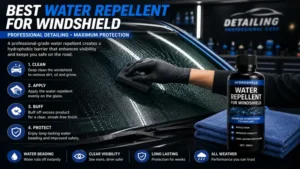
Applying a water repellent for windshield clarity requires deliberate preparation. Even high-end ceramic formulas will fail prematurely if bonded over road film, silicone oil, or embedded glass contamination. Follow this step-by-step professional protocol to guarantee maximum durability and prevent wiper chatter.
[ Step 1: Deep Clean ] ──► [ Step 2: Clay Bar ] ──► [ Step 3: IPA Wipe ] ──► [ Step 4: Apply & Cure ]
Step 1: Deep Chemical & Mechanical Cleaning
-
Wash the glass thoroughly with a non-wax automotive shampoo to remove loose dirt and dust.
-
Clean the surface using an oil-free glass cleaner and a dedicated waffle-weave microfiber towel.
-
Inspect the glass for bonded mineral deposits or road sap. Use an automotive clay bar with dedicated clay lubricant to pull embedded contaminants out of the glass pores.
Step 2: Glass Stripping & Decontamination
-
Apply a specialized glass polish or stripping compound (or a diluted cerium oxide pad) to eliminate old wax, silicone residues, or failed former coatings.
-
Wipe the polished surface clean using a 50/50 mix of Isopropyl Alcohol (IPA) and distilled water. This strips remaining polishing oils, leaving pure silica glass exposed.
Step 3: Application & Curing
-
Apply your chosen treatment (Rain-X Glass Water Repellent, Aquapel, or Gtechniq G1) in cross-hatch patterns (vertical lines followed by horizontal lines) to ensure full coverage.
-
Allow the product to flash or haze according to the manufacturer’s directions (usually 5–10 minutes depending on ambient temperature).
-
Buff off the haze using a fresh, short-pile microfiber cloth. For ceramic coatings, use a tiny splash of water or the designated removal spray to clear stubborn residue.
-
Keep the glass completely dry for the recommended cure time (ranging from 1 to 12 hours) to allow cross-linking.
Case Study: Matching Glass Coatings to Driver Profiles
To illustrate how different driver needs dictate chemical choice, consider these three real-world driver profiles and our field-tested recommendations.
       ┌──────────────────────────┼──────────────────────────┐
       ▼                          ▼                          ▼
[ The Highway Commuter ]  [ The City Driver ]     [ The Budget DIYer ]
 • High annual mileage     • Stop-and-go traffic   • Low upfront cost
 • Heavy wiper usage       • Lower wind speed      • Fast application
 ➔ Recommendation:         ➔ Recommendation:       ➔ Recommendation:
   Gtechniq G1               Soft99 Glaco             Rain-X Original
Profile A: The Long-Distance Highway Commuter
-
Driver: Mark, driving 65 miles daily across state highways at 65-70 mph.
-
Challenge: High bug splatter in summer, heavy slush spray from semi-trucks in winter, constant wiper wear.
-
Best Choice: Gtechniq G1 ClearVision Smart Glass.
-
Reasoning: Highway wind speeds constantly push water off G1 without relying heavily on wiper blades. Its ceramic structure resists abrasive road salt and slush chemicals through all four seasons.
Profile B: The Urban Stop-and-Go Commuter
-
Driver: Sarah, commuting through dense city traffic with average speeds below 30 mph.
-
Challenge: Lower wind pressure means water drops need ultra-low surface tension to slide off without high-speed airflow.
-
Best Choice: Soft99 Glaco Ultra.
-
Reasoning: Glaco Ultra exhibits an exceptionally high water contact angle, meaning beads roll away at low speeds (25–30 mph) even without highway wind assistance.
Profile C: The Weekend DIY Budget Owner
-
Driver: David, wanting a quick driveway solution for family road trips without spending hours polishing glass.
-
Challenge: Limited time, modest budget, wants an all-in-one product.
-
Best Choice: Chemical Guys HydroView or Rain-X Glass Water Repellent.
-
Reasoning: Both options can be applied in under ten minutes without demanding professional polishing steps, providing immediate weather protection at minimal cost.
Common Problems & Solutions: Troubleshooting Glass Coatings
Even high-performing glass coatings can encounter operational issues if applied improperly or paired with worn vehicle components. Here is how to diagnose and resolve the most common glass treatment problems.
Problem 1: Wiper Blade Chatter or Hopping
-
The Cause: Wiper chatter occurs when the glass surface has uneven friction coefficients—often caused by applying coating over old wax, uneven curing, or using old, dried-out rubber wiper blades.
-
The Solution: Clean the rubber wiper blades thoroughly using isopropyl alcohol. If chatter persists, strip the windshield with a glass polish, re-wipe with IPA, and apply a fresh, thin, even layer of treatment. Replacing old wiper blades with silicone-infused wiper blades also harmonizes the friction profile.
Problem 2: Hazing or Nighttime Glare
-
The Cause: A white, cloudy haze appearing when the wipers sweep across the glass—especially at night under headlights—is caused by unbuffed product residue left on the surface during installation.
-
The Solution: Spritz the glass with a mist of water or isopropyl alcohol and buff vigorously with a clean micro-fiber cloth to remove excess dried carrier solids.
Problem 3: Premature Coating Failure
-
The Cause: The treatment stopped beading water after only two weeks. This is almost always caused by applying the product over dirty, un-clayed glass or using aggressive, solvent-heavy bug-remover washer fluids.
-
The Solution: Strip the glass completely, perform a full clay bar treatment, and reapply. Switch your windshield washer reservoir fluid to a coating-friendly formula without harsh strippers.
How to Choose the Right Windshield Water Repellent
Selecting the best chemical formula requires matching product characteristics with your regional weather, maintenance habits, and installation willingness.
                          [ Selection Logic ]
                                   │
      ┌────────────────────────────┼────────────────────────────┐
      ▼                            ▼                            ▼
[ Durability Goal ]        [ Wind Speed Profile ]      [ Prep Level Willingness ]
 • Ceramic (1-2 yrs)        • High Speed (>45 mph)      • Deep Polish Required
 • Fluoropolymer (6 mos)    • City Speed (<35 mph)      • Spray-and-Wipe Only
1. Longevity vs. Ease of Application
-
Spray Sealants (1 to 3 Months): Easiest to apply, budget-friendly, but require frequent touch-ups. Ideal if you detail your car monthly.
-
Fluoropolymer Ampoules (4 to 6 Months): Balanced durability without requiring multi-layer ceramic curing routines. Excellent seasonal protection for winter or spring rain seasons.
-
Nano-Ceramic Coatings (1 to 2 Years): Maximum durability and chemical resistance. Demands thorough glass polishing and strict cure conditions, making it best suited for meticulous DIYers or detailing professionals.
2. Vehicle Speed and Airflow Dynamics
Water repellents rely on kinetic wind energy to sweep water beads off glass. If you drive primarily on rural highways or interstate corridors, almost any quality repellent will keep your glass clear above 45 mph. However, if your daily commute consists of slow-moving city streets, look specifically for high-contact-angle formulas like Soft99 Glaco Ultra that shed water at lower speeds.
3. Total Cost of Ownership (TCO)
While a basic spray bottle of Rain-X Glass Water Repellent costs under $15 upfront, applying it every month means you will use several bottles over a three-year span alongside ongoing labor time. Conversely, a $30 ceramic kit like Gtechniq G1 costs more initially, but yields a lower long-term cost per mile driven while saving dozens of hours in maintenance time.
Features That Matter vs. Marketing Hype
Navigating glass treatment marketing claims can be confusing. Here is a breakdown of which specifications directly impact real-world driving visibility, and which are pure marketing noise.
Features That Truly Matter
-
Water Contact Angle: Measured in degrees, a contact angle above $105^\circ$ causes water to form round marbles rather than flat sheets. Higher angles equal faster water displacement.
-
Abrasion Resistance: A coating’s ability to resist physical friction from wiper blades pushing dust and grime across the glass.
-
Chemical Resistance: Resistance to high-pH car wash foams, road salts, and methanol-based washer fluids. Fluoropolymers and $SiO_2$ ceramics excel here.
Marketing Hype to Ignore
-
“Self-Cleaning Glass”: No chemical treatment completely eliminates the need to wash your car; dirt and road film still settle on glass over time.
-
“Scratch-Proof Protection”: Chemical coatings are fractions of a micron thick. They will protect glass from chemical etching and minor wiper abrasion, but they cannot stop flying gravel or sharp stone chips from cracking glass.
-
“100% Wiper Elimination”: You will always need mechanical wiper blades during low-speed driving, fine mist, or heavy fog where wind kinetic energy is insufficient to clear the glass.
Long-Term Maintenance & Year-One Expectations
To maximize the service life of your chosen glass coating, adopting an ongoing maintenance strategy is essential.
                                [ Year One Maintenance Timeline ]
                                                │
      ┌─────────────────────────────────────────┼─────────────────────────────────────────┐
      ▼                                         ▼                                         ▼
[ Months 1–3 ]                            [ Months 4–6 ]                            [ Months 7–12 ]
• Routine glass washes                    • Inspect wiper blade rubber              • Evaluate hydrophobic behavior
• Avoid high-pH prep soaps                • Clean blades with alcohol               • Apply top-up spray if needed
During months 1 through 3 after applying a ceramic or fluoropolymer treatment, routine car washes with standard neutral shampoos are all that is required to maintain hydrophobic performance. Avoid using harsh degreasers or industrial traffic film removers on your windshield.
By months 4 through 6, inspect your rubber wiper blades. Road grit coats wiper rubber over time, creating an abrasive edge that reduces coating life. Wiping your wiper blades down with a damp microfiber cloth soaked in isopropyl alcohol removes accumulated road grit and extends both blade life and coating longevity.
For semi-permanent coatings like Gtechniq G1, applying a ceramic maintenance spray like Chemical Guys HydroView every three months acts as a sacrificial barrier, protecting the base ceramic coating underneath and keeping water-beading performance at peak levels for years.
FAQ: Frequently Asked Questions
❓ Can I apply a water repellent over a cracked or chipped windshield?
✅ It is best to repair rock chips and cracks before applying any hydrophobic treatment. Liquid chemicals can seep into crack fractures, potentially interfering with resin repairs performed by glass technicians…
❓ Will hydrophobic glass treatments damage my rubber wiper blades?
✅ No, quality glass coatings do not damage wiper rubber. In fact, by creating a smoother glass surface, they reduce physical friction, extending the lifespan of your wiper blades…
❓ How do I remove an old windshield coating if it starts hazing?
✅ You can strip old coatings mechanically using a dedicated glass polish or a pad with fine cerium oxide powder. Polishing removes cured fluoropolymers and ceramic residues completely without scratching glass…
❓ Does windshield water repellent prevent winter frost and ice buildup?
✅ While it cannot prevent frost from forming in sub-zero weather, the slick hydrophobic barrier prevents ice from bonding tightly to glass, allowing frost to be scraped away effortlessly…
❓ Can I use household glass cleaner like Windex on treated windshields?
✅ Avoid household glass cleaners containing ammonia, as ammonia can degrade traditional silicone and fluoropolymer hydrophobic films over time. Use ammonia-free, automotive-safe glass cleaners instead…
Conclusion
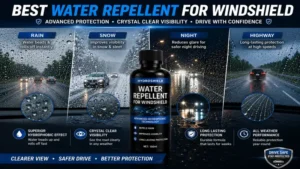
Upgrading your vehicle with the best water repellent for windshield clarity is one of the most effective safety and convenience enhancements you can perform in your driveway. For maximum long-term durability that withstands years of highway driving, Gtechniq G1 ClearVision Smart Glass stands out as the ultimate ceramic solution. Drivers seeking multi-month winter performance in a simple applicator will find Aquapel Glass Treatment hard to beat, while Rain-X Glass Water Repellent remains the ideal choice for quick, low-cost weather defense. Proper surface prep through thorough cleaning and decontamination ensures crisp visibility, zero wiper chatter, and a safer driving experience in every storm.
🔍 Ready to Upgrade Your Automotive Vision Setup?
Equipping your vehicle with advanced hydrophobic glass coatings ensures superior clarity during sudden downpours while extending the life of your windshield wipers. Click on our recommended models above to view current pricing and find the perfect fit for your driving routine on Amazon.
Recommended for You
- 7 Best Rain Repellent for Windshields in 2026: Field Test Findings
- 7 Best Auto Interior Protectants of 2026: Expert Field Tests
- 5 Best Wipes for Cleaning Car Interiors in 2026: Expert Field Test
Disclaimer: This article contains affiliate links. As an Amazon Associate, I earn from qualifying purchases. If you purchase products through these links, we may earn a small commission at no additional cost to you.
✨ Found this helpful? Share it with your friends! 💬🤗