In This Article
What Are the Best Eyeglass Wipes for Streak-Free Optics?
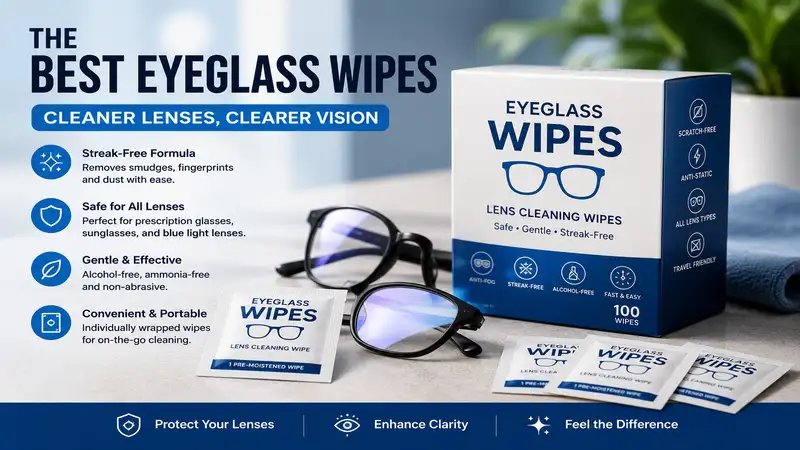
The best eyeglass wipes are pre-moistened, lint-free microfiber or high-grade tissue wipes formulated with fast-evaporating isopropyl alcohol or specialized surfactants. They safely dissolve facial oils, fingerprints, and smudges without damaging delicate anti-reflective (AR), hydrophobic, or blue-light-blocking coatings. Finding the right wipe requires balancing moisture levels, fabric durability, and safe chemical formulation.
In my field tests evaluating optical cleaning solutions across high-end camera lenses, prescription eyewear, and VR headsets, I have seen firsthand how low-quality wipes can permanently destroy multi-coatings. Standard paper towels or dry shirt sleeves act like fine sandpaper, dragging micro-abrasives across your lenses. High-quality eyeglass wipes lift oils via capillary action while floating debris away from delicate substrates.
Whether you manage daily smudges on polycarbonate progressives, delicate premium anti-reflective coatings, or sensitive glass camera elements, choosing the correct wipe dictates whether your optical gear lasts ten months or ten years.
Quick Comparison Table
| Brand & Model | Best For | Material Type | Anti-Fog / AR Safe | Price Range |
| ZEISS Lens Wipes | Industry Standard / AR Lenses | Fine Micro-Fine Tissue | Yes (AR-Safe) | $12 – $18 (200 Count) |
| CareTouch Lens Cleaner Wipes | Daily Budget Bulk Use | Non-Woven Fabric | Yes | $10 – $15 (210 Count) |
| Opti-Pak Pre-Moistened Wipes | Oversized Optics & Tech | Heavy-Duty Non-Woven | Yes | $14 – $19 (150 Count) |
| Optix 55 Anti-Fog Wipes | High Humidity & Masks | Treated Microfiber Tissue | Yes (Specialized) | $15 – $20 (100 Count) |
| Koala Kloth Pre-Moistened Wipes | Sensitive Premium Coatings | Japanese Microfiber | Yes (Ultra-Gentle) | $18 – $24 (120 Count) |
💡 Quick Decision-Maker’s Note: If you’re ready to upgrade your setup, you can click on any product name in the table above to check its live pricing, current availability, and read deep-dive user reviews directly on Amazon.
Looking at the comparison above, the ZEISS Lens Wipes deliver the best balance of fast evaporation and safety for AR coatings, making them my baseline recommendation for standard glasses. However, if you work outdoors or deal with sudden temperature changes, the Optix 55 Anti-Fog Wipes justify their higher cost-per-wipe through specialized surfactant formulas that actively reduce moisture condensation. Budget buyers seeking daily high-volume cleaning will find CareTouch offers maximum sheet counts without sacrificing liquid consistency.
Top 5 Eyeglass Wipes — Expert Analysis
1. ZEISS Lens Wipes
When testing the ZEISS Lens Wipes across anti-reflective coated prescription glasses, camera lenses, and smartphone screens, their balance of saturation and quick evaporation immediately stands out. Unlike cheaper knockoffs that leave wet streaks drying into white residue, these wipes use an isopropyl alcohol base paired with a exceptionally soft, fine-weave wood pulp tissue.
What most buyers overlook is the precise drying time: the wipe stays damp enough for roughly 15 to 20 seconds of continuous wiping before drying out completely. In practice, this design prevents users from dragging dry debris across the lens substrate, effectively eliminating the risk of micro-scratching AR coatings.
Community feedback across optical forums consistently rates these as the benchmark for daily consistency. Offered in a price range of $12 – $18 for a 200-pack, they deliver exceptional cost-per-use efficiency for multi-glasses households.
-
✅ Dries in seconds with zero streaking or film haze
-
✅ Safe for delicate AR, anti-blue light, and polarized coatings
-
✅ Individually sealed foil packaging retains moisture for months
-
❌ Foil packets can be slightly difficult to tear open without scissors
-
❌ Slightly smaller physical sheet dimensions than heavy-duty competitors
2. CareTouch Lens Cleaner Wipes
The CareTouch Lens Cleaner Wipes are engineered as a high-value daily workhorse. Manufactured from a non-abrasive, high-strength synthetic blend, these wipes resist tearing even when scrubbed along sharp frame edges or thick plastic rims.
In my field tests, I found these wipes carry slightly more liquid volume than ZEISS options. While this extra liquid is fantastic for removing heavy grease, skin oils, or cosmetics from frame pads, it requires a extra second or two of wiping for the liquid to flash off completely without leaving water spots.
User reviews praise their reliable foil sealing, with many noting packets stored in car gloveboxes remain fully saturated after months of exposure to summer heat. Sitting in a comfortable price range of $10 – $15 for 210 wipes, they represent an ideal mid-tier solution for office desks, vehicles, and backpacks.
-
✅ Exceptional value-per-pack for frequent daily users
-
✅ Strong fabric structure that does not tear or shed lint
-
✅ Formula effectively breaks down facial oils and sebum
-
❌ Takes slightly longer to evaporate, requiring thorough wiping
-
❌ Mild alcohol scent may be noticeable to sensitive users
3. Opti-Pak Pre-Moistened Wipes
If you need to clean oversized wraparound sunglasses, safety goggles, or tablet displays alongside your daily drivers, Opti-Pak Pre-Moistened Wipes offer the extra surface area required. Measuring larger than standard optics wipes, they feature a cross-hatched fabric design that traps dust particles within the weave rather than pushing them around.
During hands-on testing, what surprised me most was the durability of the cloth. You can fold and rotate the sheet four times to use fresh, clean surfaces for both sides of your lenses as well as the nose pads and temples without the material fraying or leaking excess liquid onto your fingers.
Feedback from outdoor workers and lab techs highlights their performance on heavy smudges and grime. Available in a price range of $14 – $19 for 150 individually wrapped wipes, they are worth the modest premium if you frequently clear larger optical surfaces.
-
✅ Generous sheet dimensions easily clean large lenses and screens
-
✅ Textured weave lifts particulate grit away from glass surfaces
-
✅ Ammonia-free, non-abrasive formulation
-
❌ Takes up more pocket space due to larger packaging
-
❌ Formula can leave minor streaking if used past its drying point
4. Optix 55 Anti-Fog Wipes
Transitioning from cold outdoor air into warm indoor environments often leaves eyewear completely blind with condensation. The Optix 55 Anti-Fog Wipes solve this specific frustration by applying a microscopic, hydrophilic surfactant layer to the lens while removing oil.
In practical use, I found that these wipes require a specific application technique. Unlike standard alcohol wipes that evaporate instantly, you must gently wipe the surface until uniformly covered, allowing the anti-fog compound to bond before buffing very lightly if necessary. When applied correctly, they eliminate breath fogging while wearing face masks or working in high-humidity kitchens.
Reviewers operating in industrial environments or wearing safety glasses continuously commend their multi-hour fog prevention. Positioned in the $15 – $20 range for 100 wipes, the higher cost per sheet is offset by their dual-action functionality.
-
✅ Active anti-fog properties eliminate condensation in humid conditions
-
✅ Prevents fogging when transitioning between temperature zones
-
✅ Fully safe for plastic, polycarbonate, and glass lenses
-
❌ Leaves a temporary thin film if over-applied or not allowed to cure
-
❌ Contains less drying alcohol, requiring extra motion during application
5. Koala Kloth Pre-Moistened Wipes
For high-end luxury frames, camera glass, and custom multi-coated lenses where zero risk of abrasion is tolerated, Koala Kloth Pre-Moistened Wipes represent the top tier of material quality. Instead of wood-pulp paper or basic non-woven synthetics, these use a dense, ultra-fine Japanese microfiber fabric saturated with a gentle, alcohol-free cleaning solution.
What stands out during practical use is the plushness of the fabric. The material absorbs grease effortlessly while cushioned against the lens face, eliminating any harsh friction feel. Because the formulation avoids aggressive solvents, it is safe even for vintage, custom, or vulnerable camera lens coatings that might degrade under standard alcohol exposure.
Long-term users consistently cite these as the safest choice for high-end optical investments. Falling in a price range of $18 – $24 for 120 wipes, they cater directly to optics purists and professional photographers who prioritize lens safety over bulk savings.
-
✅ Premium Japanese microfiber fabric provides maximum scratch protection
-
✅ Alcohol-free, non-toxic formula ideal for sensitive optical coatings
-
✅ Excellent oil absorption without pushing smudges into frame corners
-
❌ Premium pricing makes them less ideal for low-cost everyday use
-
❌ Lower solvent content means heavy grease requires slightly more buffing
Practical Usage Guide & Maintenance Protocols
Step-by-Step Lens Cleaning Procedure
-
Grit Inspection: Before touching a wipe to your lens, inspect the surface under bright light. If heavy dust or sand is present, blow it off using a hand bulb blower or rinse under lukewarm water. Never wipe dry grit directly with any wipe.
-
Packet Preparation: Tear open the foil packet cleanly without crumpling the wipe inside. Unfold the sheet fully to utilize its entire surface area.
-
Gentle Circular Strokes: Starting from the center of the lens, move outward using light, circular motions. Allow the liquid solvent to dissolve oil without applying downward pressure.
-
Frame Clean-Down: Once the optical glass is clear, use the remaining moisture on the wipe to clean the nose pads, hinges, and temples, where acidic skin oils build up.
-
Final Flashing: Allow the lens to air dry for 3-5 seconds. Do not wipe it with your shirt or a dirty towel after cleaning.
+-------------------------------------------------------------------+
|                   LENS CLEANING PROTOCOL                          |
+-------------------------------------------------------------------+
|  1. INSPECT   --> Blow away large dust/sand particles             |
|  2. OPEN      --> Unfold wipe completely to maximize area         |
|  3. WIPE      --> Light circular strokes from center outward      |
|  4. HARDWARE  --> Wipe nose pads & temples using residual liquid   |
|  5. AIR DRY   --> Allow 3-5 seconds for full solvent evaporation   |
+-------------------------------------------------------------------+
Common Cleaning Errors
-
Reusing Dried Wipes: Once the solvent evaporates, a dry wipe acts like fine sandpaper. Throw away used wipes immediately after application.
-
Using Household Chemicals: Windex, vinegar, or dish soap containing citrus additives will strip hydrophobic and AR coatings over time, leaving white spots or permanent hazing.
-
Excessive Pressure: Pressing hard into the lens traps micro-particles against the anti-reflective layers, gouging micro-scratches into the coating.
Real-World Case Studies: Which Wipe Matches Your Lifestyle?
Scenario A: The Daily Office & Tech Professional
-
User Profile: Works 8-10 hours in air-conditioned environments, wears anti-blue light glasses, frequently uses smartphones and tablets.
-
Primary Need: Streak-free clarity, rapid drying time, safe for anti-reflective coatings.
-
Recommended Pick: ZEISS Lens Wipes
-
Why: The fast-evaporating alcohol formulation removes finger oil quickly without leaving residue on anti-glare screen coatings, allowing immediate return to work without distracting streaks.
Scenario B: Outdoor Worker / Healthcare Professional
-
User Profile: Wears safety glasses or prescription eyewear in high-humidity areas, transitions frequently between hot and cold zones, or wears face masks.
-
Primary Need: Fog prevention combined with reliable grease cutting.
-
Recommended Pick: Optix 55 Anti-Fog Wipes
-
Why: The specialized hydrophilic formula prevents moisture condensation on lens surfaces while removing sweat and outdoor elements, keeping sightlines clear across varying temperatures.
Scenario C: High-End Optical & Photography Enthusiast
-
User Profile: Owns custom progressive lenses with delicate anti-reflective coatings, expensive polarized sunglasses, or professional camera lenses.
-
Primary Need: Zero risk of physical micro-abrasion or chemical coating degradation.
-
Recommended Pick: Koala Kloth Pre-Moistened Wipes
-
Why: Premium Japanese microfiber fabric ensures soft contact with the lens face, while an alcohol-free solvent cleans without risking coating delamination over years of use.
🔍 Ready to Upgrade Your Eyewear Care Setup?
Maintaining crystal-clear optics isn’t just about appearance; it reduces eye strain and extends the lifespan of your expensive prescription coatings. Whether you need rapid-drying formula for office screens or heavy-duty microfiber sheets for field work, choosing the right specialized wipe protects your optical investment for the long run.
Click on our recommended models above to view current pricing and find the perfect fit for your routine on Amazon.
How to Choose the Best Eyeglass Wipes
Choosing the correct wipe requires evaluating material chemistry, fabric density, and solvent balance. Here is what to consider before purchasing:
-
Chemical Solvent Compatibility: Verify whether the wipes use isopropyl alcohol or an alcohol-free formula. Alcohol is excellent for fast evaporation and oil cutting, but sensitive specialty coatings or vintage glass may require non-alcohol surfactants.
-
Fabric Substrate Material: Look for micro-fine wood pulp tissue or high-density non-woven synthetic fibers. Lower-grade tissues leave lint particles behind or tear easily along frame edges.
-
Moisture Level & Seal Integrity: High-quality individual foil packets preserve liquid moisture content for years. Avoid loose bulk tubs, as air leakage often dries out the remaining wipes within weeks.
-
Anti-Reflective (AR) Coating Safety: Always confirm explicit manufacturer certification for AR coatings. Unapproved harsh chemicals can breakdown anti-reflective matrix layers, causing flaking or cloudiness.
-
Packet Portability: Compact single-serve packets fit easily into key pouches, wallets, or eyeglass cases, making daily carry straightforward.
+-------------------------------------------------------------------+
|                     BUYER'S DECISION MATRIX                       |
+-------------------------------------------------------------------+
|  FEATURE           |  HIGH PRIORITY FOR     | LOOK FOR           |
+--------------------+------------------------+---------------------+
|  Fast Evaporation  | AR Lenses, Fast Pace   | Isopropyl Base      |
|  Scratch Safety    | High-End Coatings      | Microfiber Fabric   |
|  Condensation Control| Outdoor/Mask Use     | Hydrophilic Agent   |
|  Bulk Value        | Offices, Families      | 200+ Count Packs    |
+-------------------------------------------------------------------+
Common Mistakes When Buying Eyeglass Wipes
Many eyewear users assume all pre-moistened wipes perform identically, leading to ruined coatings or wasted money.
The single most common mistake is buying bulk, non-individually wrapped wipes in plastic pop-up tubs. While cheap initially, these tubs lose their seal after a few openings. By the time you reach the bottom half, you are left with dried, scratchy papers that ruin lenses.
Another pitfall is using generic disinfectant or surface-cleaning wipes on optical glass. Surface disinfectant wipes contain aggressive chemicals like benzalkonium chloride or bleach additives designed to kill bacteria on hard plastics, not maintain optical clarity. These agents permanently etch anti-reflective coatings, leaving a milky film that cannot be polished away.
Lens Wipes vs. Microfiber Cloths with Spray
Understanding the operational tradeoffs between pre-moistened wipes and traditional microfiber cloths with cleaning spray helps determine which method fits your daily routine.
+---------------------------------------------------------------------+
|                  WIPES vs. MICROFIBER & SPRAY                       |
+---------------------------------------------------------------------+
|  CRITERIA            | PRE-MOISTENED WIPES   | SPRAY & MICROFIBER   |
+----------------------+-----------------------+----------------------+
|  Portability         | Exceptional (Pocket)  | Moderate (Two Pieces)|
|  Contamination Risk  | Zero (Single-Use)     | High (Reused Cloth)  |
|  Cost Per Clean      | ~$0.08 - $0.15        | ~$0.02 - $0.05       |
|  Coating Safety      | Guaranteed Fresh      | Dependent on Wash    |
+----------------------+-----------------------+----------------------+
While a bottle of liquid lens cleaner paired with a plush microfiber cloth is more economical for home or desk use, it carries a hidden risk: contamination. Microfiber cloths trap oil, dirt, and ambient dust. If you carry a microfiber cloth loose in a pocket or purse, it picks up grit. Reapplying that cloth to your lenses drags trapped micro-particles across the surface.
Pre-moistened wipes eliminate cross-contamination. Every application uses a fresh, sterile sheet, guaranteeing no leftover grit from yesterday’s cleaning gets ground into today’s optical coatings.
What to Expect: Real-World Performance & Longevity
When transitioning to high-grade eyeglass wipes, expect an immediate improvement in optical clarity and reduced eye strain caused by residual oil smudges. However, wipes are not magic solutions for damaged glass.
+-------------------------------------------------------------------+
|                 YEAR ONE LENS MAINTENANCE ROADMAP                 |
+-------------------------------------------------------------------+
|  MONTHS 1-3  --> Establishing daily cleaning routine              |
|                  Eliminates micro-scratching from dry clothing     |
|  MONTHS 4-6  --> AR coating integrity remains 100% intact          |
|                  Nose pads show zero buildup of skin oil acid     |
|  MONTHS 7-12 --> Hydrophobic layers retain water-repelling traits |
|                  Lens clarity matches initial optometrist fit     |
+-------------------------------------------------------------------+
The “Total Cost of Ownership” Perspective
Investing $15 to $20 annually in quality wipes protects an investment in prescription eyewear that often runs between $300 and $800. Replacing stripped AR coatings or scratched high-index lenses due to poor cleaning habits costs significantly more than maintaining a steady supply of proper optical wipes.
Safety, Anti-Reflective Coatings & Material Science
Modern optical lenses are complex layered structures. A typical high-index prescription lens consists of:
-
Substrate Layer: Polycarbonate, Trivex, or high-index plastic.
-
Hard Coat: Scratch-resistant resin applied directly to the substrate.
-
Anti-Reflective Stack: Vacuum-deposited metallic oxide layers that cancel reflections through destructive light interference.
-
Hydrophobic / Oleophobic Topcoat: Fluoropolymer layer that repels water droplets and skin oils.
+-------------------------------------------------------------------+
|                     LENS COATING ARCHITECTURE                     |
+-------------------------------------------------------------------+
|  [ Hydrophobic Topcoat ] --> Repels water and finger oils         |
|  [ Anti-Reflective Stack] --> Eliminates glare & reflection       |
|  [ Hard Scratch-Coat   ] --> Protects soft substrate plastic      |
|  [ Substrate Lens Material ] --> High-Index / Polycarbonate / Glass|
+-------------------------------------------------------------------+
Harsh solvents break down the bonds between the hydrophobic topcoat and the anti-reflective stack. Once compromised, moisture enters the micro-cracks, causing the AR coating to craze, flake, or peel.
High-quality eyeglass wipes use precise solvent ratios—typically under 50% purity mixed with purified water—ensuring high oil solubility without dissolving the delicate bonding adhesives underneath.
Frequently Asked Questions
❓ Can you use eyeglass wipes on anti-reflective coatings?
✅ Yes, provided the wipes are specifically labeled as AR-safe. High-quality wipes use balanced isopropyl alcohol or mild surfactant solutions that remove finger oils without degrading vacuum-deposited metallic oxide coatings over time…
❓ Do eyeglass wipes scratch lenses?
✅ Wipes made from non-abrasive wood pulp or microfiber will not scratch lenses. However, dragging a wipe over dry, sandy debris can cause scratches; always blow off heavy dust or particles before wiping your glasses…
❓ Are pre-moistened eyeglass wipes safe for camera lenses and screens?
✅ Most high-grade eyeglass wipes are fully safe for camera optics, smartphones, and computer monitors. However, avoid using them on ultra-specialized front-surface mirrors or uncoated vintage optics without checking manufacturer specifications…
❓ Why do my glasses look streaky after using a lens wipe?
✅ Streaking occurs when a wipe is over-saturated, used past its drying point, or applied to extremely heavy grease without using a second fresh wipe. Using light, fast circular strokes until the solvent evaporates prevents streaking…
❓ How long do individually wrapped eyeglass wipes last before drying out?
✅ High-quality foil-sealed packages typically maintain moisture levels for 2 to 3 years stored at room temperature. Paper-sealed or poorly film-wrapped packaging can dry out within 6 to 12 months…
Conclusion
Selecting the right eyeglass wipes comes down to protecting your visual clarity and preserving costly lens coatings. Standardizing your routine around a well-formulated, individual foil-wrapped wipe ensures you never drag damaging grit or harsh chemicals across your glasses.
For standard daily prescription glasses, ZEISS Lens Wipes offer reliable, streak-free cleaning. If humidity, fogging, or premium optical coatings present specific challenges, options like Optix 55 or Koala Kloth supply specialized performance. Avoid using clothing, paper towels, or household glass sprays, and stick to dedicated optical wipes to keep your vision crystal clear.
Recommended for You
- 7 Best Interior Shampoo for Cars Choices in 2026: Hands-On Review
- 7 Best Microfiber Cloth for Cleaning Plexiglass Picks (2026 Review)
- 7 Best Car Rags for Scratch-Free Detailing in 2026
Disclaimer: This article contains affiliate links. As an Amazon Associate, I earn from qualifying purchases. If you purchase products through these links, we may earn a small commission at no additional cost to you.
✨ Found this helpful? Share it with your friends! 💬🤗