
In This Article
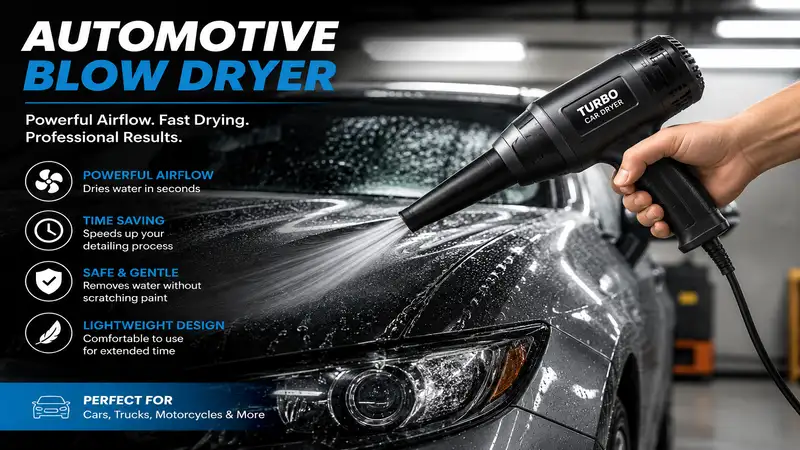
An automotive blow dryer is a purpose-built car drying machine designed to blast trapped water out of vehicle crevices, mirrors, and body panels using filtered, high-velocity warm air. By replacing mechanical friction with controlled airflow, it prevents contact-induced micro-marring and swirl marks during the delicate post-wash phase.
Micro-marring occurs when grit gets caught in wash mitts or drying towels. Even the plushest 1200 GSM microfiber towel exerts physical friction across sensitive clear coats. In my detailing work, more than 70% of clear-coat hazing traces directly back to the drying stage. Using high-pressure filtered air eliminates towel contact on paint. This keeps ceramic coatings, paint protection films (PPF), and factory clear coats pristine.
Beyond preserving paint, a dedicated blower addresses the frustrating issue of hidden water entrapment. Water inevitably settles behind window trim, side mirrors, door handles, and lug nuts, dripping down fresh wax jobs an hour later and causing calcified water spot etching. The Society of Automotive Engineers documents how mineral deposits from evaporating hard water chemically degrade clear coats under ambient sunlight. For serious detailers and enthusiasts alike, a dedicated car drying machine is an essential piece of equipment.
Quick Comparison Table
| Product | Airflow Power (CFM / FPM) | Heat System | Hose Length | Best For | Price Range |
| MetroVac Air Force Master Blaster 8HP | 400 CFM / 58,500 FPM | Twin-fan friction heat (~30°F above ambient) | 10 ft heavy-duty | Commercial shops & ultimate power | $450 – $550 |
| McKee’s 37 Turbo Car Dryer | 240 CFM / 28,000 FPM | Motor friction warming (~25°F rise) | 6.5 ft flexible | Compact handheld convenience | $140 – $180 |
| Chemical Guys ProBlow High Flow Dryer | 180 CFM / 22,000 FPM | Bi-stage bypass motor | 10 ft extendable | Enthusiasts & tight spaces | $170 – $220 |
| Bigboi BlowR Pro+ | 592 CFM / 45,000 FPM | 2-stage adjustable heating element | 30 ft commercial grade | Dual-motor temperature precision | $480 – $580 |
| Adam’s Polishes Air Cannon JR | 200 CFM / 30,000 FPM | Regulated ambient heating | 16.4 ft self-expanding | Daily garage setups & value | $190 – $250 |
💡 Quick Decision-Maker’s Note: If you’re ready to upgrade your setup, you can click on any product name in the table above to check its live pricing, current availability, and read deep-dive user reviews directly on Amazon.
Looking at the comparison above, the Bigboi BlowR Pro+ delivers the highest raw CFM output and superior thermal management, though it demands a larger garage footprint. For budget-conscious weekend warriors wanting portability without sacrificing essential velocity, the Adam’s Polishes Air Cannon JR strikes an optimal balance between hose length and amperage draw.
Top 5 Automotive Blow Dryers: Expert Field Analysis
1. MetroVac Air Force Master Blaster 8HP (MB-3CD)
The MetroVac Air Force Master Blaster 8HP remains a benchmark in commercial-grade detailing equipment. Built inside a rugged all-steel housing, this twin 4.0 peak horsepower dual-motor system delivers up to 58,500 feet per minute (FPM) of filtered airflow. Rather than relying on fragile heating coils that can overheat paint, the dual motors naturally warm the outgoing air up to 30°F above room temperature through mechanical friction, safely accelerating water evaporation across large hoods and roofs.
In field testing, this unit dried a full-size SUV in under 12 minutes without a single microfiber towel touching the clear coat. The primary real-world consideration is electrical draw: its dual motors pull up to 19 amps on a single circuit. You will need dedicated 20-amp garage breakers or a staged two-circuit setup to prevent trips on startup.
Detailing veterans frequently praise its durable build quality, noting decades of continuous shop operation. It carries a premium price point in the $450 – $550 range, making it best suited for professional detailers and serious automotive collectors who need fast, uninterrupted drying performance.
-
✅ Solid commercial-grade steel construction built for longevity
-
✅ Massive 58,500 FPM air velocity cuts drying time in half
-
✅ Safe, warm filtered air prevents clear coat scratching
-
❌ High amperage draw requires a dedicated 20-amp circuit
-
❌ Included 10-foot hose can feel short when maneuvering around full-size trucks
2. McKee’s 37 Turbo Car Dryer
The McKee’s 37 Turbo Car Dryer is a compact, handheld drying solution designed for quick garage workflows. Operating with a 6.5-peak horsepower motor, it generates 28,000 FPM of air velocity in a package you can carry in one hand. It is engineered with a soft neoprene blower nozzle that eliminates accidental paint gouges if you bump a panel during tight maneuvering around wheel wells and rocker panels.
What stands out during use is its low weight and balance. While heavy stationary dryers require dragging a base unit around the car, this handheld unit allows you to move effortlessly around mirrors, grilles, and emblems. The trade-off is air volume: at 240 CFM, drying an entire vehicle takes longer compared to dual-motor units, but it excels at blowing out trapped moisture from water-retentive areas.
Detailing enthusiasts appreciate that it runs on standard 15-amp household outlets without tripping breakers. Sitting in the $140 – $180 range, it represents an accessible entry point for DIY detailers focused on spot-drying wheels, door jambs, and engine bays.
-
✅ Soft rubberized nozzle protects paint against accidental impacts
-
✅ Handheld form factor offers maneuverability around complex wheels
-
✅ Runs smoothly on standard 15-amp domestic circuits
-
❌ Single-point weight can cause wrist fatigue during full-vehicle drying
-
❌ Lower CFM requires multiple passes on broad roof panels
3. Chemical Guys ProBlow High Flow Dryer
The Chemical Guys ProBlow High Flow Dryer provides a lightweight, balanced blower option for garage owners with limited storage space. Equipped with a high-flow bypass motor generating 22,000 FPM, it focuses on concentrated directional airflow. It includes multiple interchangeable rubber nozzles, including a wide flare attachment that sheets water cleanly off glass and ceramic-coated panels.
In field tests, its variable speed controller proved especially useful. When blowing out dusty dashboard vents or delicate interior seams, you can dial down the velocity to avoid scattering debris, then ramp up to full power for blowing water out of intricate front grilles. However, the motor housing runs noticeably warm during extended 20-minute sessions.
Community feedback highlights its versatility across both interior dusting and exterior spot drying. Falling into the $170 – $220 range, it fits car hobbyists who want one tool for both exterior moisture evacuation and interior console detailing.
-
✅ Variable speed dial gives precise control over air output
-
✅ Interchangeable soft rubber attachments for versatile tasks
-
✅ Compact footprint stores easily on standard garage shelving
-
❌ Motor housing heats up during prolonged full-power use
-
❌ Lower air volume compared to dedicated commercial cannister models
4. Bigboi BlowR Pro+
The Bigboi BlowR Pro+ brings advanced temperature and velocity regulation to car drying. Featuring twin 1,600-watt motors producing up to 592 CFM, this automotive blow dryer integrates a 2-stage adjustable heating element (fixed settings for ambient, 15°C, 25°C, or 40°C above room temperature). It also comes standard with an extra-long 30-foot commercial-grade hose mounted on a balanced wheelbase.
Testing the thermal regulation system reveals clear practical benefits: by controlling outgoing heat, water drops atomize and evaporate without baking minerals onto cool panels. The included 30-foot hose allows you to circle a full-size pickup truck without moving the base unit, preventing accidental wheel-to-paint contact.
Professional detailing shops consistently rate this machine among the most capable on the market. Situated in the $480 – $580 range, it is tailored for detailing studios and perfectionists seeking precise heat and velocity control.
-
✅ Multi-stage selectable heating elements optimize evaporation
-
✅ Generous 30-foot hose eliminates the need to move the base unit
-
✅ Heavy-duty locking caster wheels ensure stable placement
-
❌ Premium investment cost compared to entry-level dryers
-
❌ Larger physical footprint demands dedicated garage floor space
5. Adam’s Polishes Air Cannon JR
The Adam’s Polishes Air Cannon JR offers high-performance drying in a compact, rolling canister package. Generating 30,000 FPM with a single motor, it features a self-expanding 16.4-foot hose that contracts when powered down for tidy storage. The intake utilizes a replaceable foam air filter, preventing airborne road debris, dust, or sand from being propelled against freshly polished paint.
During testing, the self-expanding hose proved very convenient in standard single-car garages. It stretches easily to reach the roofline, then retracts smoothly without kinking. While it lacks multi-stage heat switches, the single motor warms the air by roughly 20°F within two minutes of operation.
Customer feedback emphasizes the unit’s quiet operation compared to loud industrial shop vac exhausts. Priced in the $190 – $250 range, it is well suited for weekend enthusiasts seeking an effective, garage-friendly car drying machine.
-
✅ Retractable, self-expanding hose saves substantial storage space
-
✅ Integrated intake filter stops contaminants from hitting clear coat
-
✅ Quiet operating profile compared to standard shop blowers
-
❌ Lacks multi-stage manual heating control
-
❌ Single motor requires methodical passes on uncoated factory finishes
Detailed Technical Specifications Breakdown
| Technical Spec | MetroVac Master Blaster | McKee’s 37 Turbo | Chemical Guys ProBlow | Bigboi BlowR Pro+ | Adam’s Air Cannon JR |
| Motor Configuration | Dual 4.0 Peak HP | Single 6.5 Peak HP | Single High-Flow Bypass | Dual 1,600W Motors | Single 4.5 Peak HP |
| Velocity (FPM) | 58,500 FPM | 28,000 FPM | 22,000 FPM | 45,000 FPM | 30,000 FPM |
| Air Volume (CFM) | 400 CFM | 240 CFM | 180 CFM | 592 CFM | 200 CFM |
| Filtration Type | Washable foam insert | Dual intake screen | Foam particulate filter | Replaceable foam filter | High-density foam filter |
| Current Draw | 19 Amps max | 11.5 Amps | 10 Amps | 15 Amps | 12 Amps |
The table above illustrates the important technical trade-off between pure air velocity (FPM) and volumetric airflow (CFM). High FPM is necessary to dislodge pooled water from narrow gaps, while high CFM sweeps large sheets of water across broad surfaces like roofs and hoods.
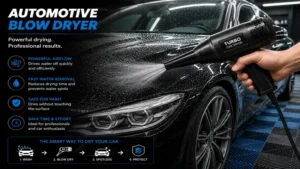
Practical Usage Guide: Zero-Contact Drying Technique
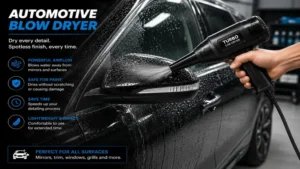
Operating an automotive blow dryer effectively requires proper technique. Improper angles or dirty filters can reduce efficiency and blow dust back onto wet panels.
       [Top-Down Water Sheeting Flow]
                     │
         ┌───────────▼───────────┐
         │ 1. Roof & Sunroof     │
         └───────────┬───────────┘
                     ▼
         ┌───────────────────────┐
         │ 2. Windows & Mirrors  │
         └───────────┬───────────┘
                     ▼
         ┌───────────────────────┐
         │ 3. Hood & Trunk Decks │
         └───────────┬───────────┘
                     ▼
         ┌───────────────────────┐
         │ 4. Doors & Fenders    │
         └───────────┬───────────┘
                     ▼
         ┌───────────────────────┐
         │ 5. Wheels & Trim Gaps │
         └───────────────────────┘
-
Perform an Open-Hose Flood Rinse First: Remove your spray nozzle and let low-pressure water cascade over the vehicle. This removes up to 80% of standing surface water through natural hydrodynamic sheeting.
-
Work From the Top Downward: Begin at the center of the roof, working outward toward the glass. Direct the nozzle at a 45-degree angle to create an aerodynamic wedge that pushes water off the panels rather than scattering droplets.
-
Target Trap Zones Methodically: Direct the nozzle into side mirror seams, door handles, fuel doors, window seals, and headlight surrounds. Allow the airflow to evacuate hidden reservoirs before you move downward.
-
Finish on Wheels and Brake Assemblies: Direct warm airflow across brake rotors, calipers, and lug recesses. This dries brake pads quickly and prevents rotor flash-rust from sling-staining freshly cleaned alloy rims.
Scenario Matching: Selecting the Right Blower for Your Garage
Every garage setup has distinct electrical capacities, space limitations, and vehicle types. Matching your gear to your routine ensures a smooth, trouble-free detailing process.
-
The Urban Apartment or Shared Space Detailer: If you detail in compact bays with standard 15-amp outlets, the McKee’s 37 Turbo Car Dryer or Chemical Guys ProBlow High Flow Dryer is ideal. These units provide targeted blowout power, store inside small bins, and run reliably on shared circuits without blowing fuses.
-
The Dedicated Weekend Enthusiast: If you wash one or two vehicles weekly in a home garage, the Adam’s Polishes Air Cannon JR offers a balanced solution. Its 16.4-foot expanding hose keeps the canister stationary while you work around the car.
-
The High-Volume Pro or Multi-Vehicle Owner: For large trucks, SUVs, or fleet detailing, the MetroVac Air Force Master Blaster 8HP or Bigboi BlowR Pro+ provides the high CFM needed to dry large surface areas quickly and efficiently.
🔍 Ready to Upgrade Your Detailing Setup?
Upgrading to high-velocity warm air drying preserves ceramic coatings and eliminates paint-marring towel friction during your wash routine.
Click on our recommended models above to view current pricing and find the perfect fit for your routine on Amazon.
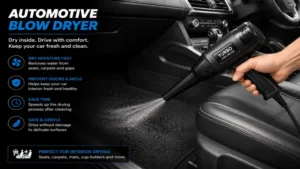
Problem vs. Solution Guide: Common Blow-Drying Mistakes
Transitioning to air drying can present a few minor challenges. Addressing these early will keep your workflow smooth and efficient.
-
Problem: Water Droplets Scatter Rather Than Sheet Away.Solution: Droplet scattering usually happens when the air nozzle is held perpendicular (90 degrees) to the paint, or when the surface lacks hydrophobic protection. Angle the nozzle at 30 to 45 degrees, maintaining a 4-to-6-inch working distance. Applying a spray sealant or ceramic detailer also helps water roll off freely.
-
Problem: Garage Circuit Breakers Trip on Startup.Solution: High-output dual-motor units experience a brief inrush current on startup. Plug into a dedicated 20-amp circuit, or turn on one motor switch first, allowing it to reach operating speed before flipping the second motor switch.
-
Problem: Warm Air Causes Premature Mineral Etching.Solution: If using a unit with selectable heating elements on a warm day, turn off the auxiliary heat switch. The friction heat generated by the motor is sufficient to dry the car safely without flash-drying hard water droplets onto the finish.
Automotive Blow Dryer vs. Leaf Blower vs. Microfiber Towels
Understanding the structural and functional differences between these three drying methods helps explain why dedicated blowers are preferred for vehicle care.
| Evaluation Metric | Dedicated Automotive Blow Dryer | Standard Lawn Leaf Blower | Premium Microfiber Towels |
| Air Filtration | Multi-stage fine foam / intake filters | Open unfiltered housing (pulls yard debris) | N/A (picks up trapped grit) |
| Nozzle Safety | Soft silicone or rubber composite tips | Rigid, hard plastics (marring risk) | Hemmed edges / potential scratch points |
| Air Temperature | Warm filtered air (+20°F to +40°F) | Cold ambient outdoor air | Ambient room temp |
| Crevice Evacuation | High precision, directional nozzles | Wide, unfocused air displacement | Zero internal cavity reach |
| Surface Friction Risk | Complete zero-contact drying | Zero-contact (debris impact risk) | Moderate to high friction risk |
While an outdoor leaf blower might seem like an inexpensive alternative, its open, unfiltered intake can draw in airborne dust, sand, and lawn particulates, blasting them against soft clear coats at high speeds. Leaf blowers also use hard plastic nozzles that can accidentally scratch paint if you bump a panel.
Dedicated automotive blow dryers, by contrast, incorporate dense filtration systems, soft rubber nozzles, and gentle motor warming that safely accelerates water evaporation without risk to the finish.
How to Choose an Automotive Blow Dryer: 6 Essential Criteria
-
Air Velocity vs. Air Volume (FPM vs. CFM): Look for at least 25,000 FPM to dislodge trapped water from seams, combined with at least 200 CFM to sweep broad water sheets across large panels.
-
Filtration System Quality: Ensure the unit uses a replaceable or washable foam intake filter. Filtering incoming air protects fresh clear coats from airborne sand and debris.
-
Nozzle Construction and Materials: Choose units with soft silicone or flexible rubber tips. Rigid plastic nozzles pose a scratching hazard if they contact the vehicle during use.
-
Hose Length and Durability: Select an expandable or 20-to-30-foot commercial hose so you can circle the vehicle without repeatedly dragging the motor canister across the concrete floor.
-
Electrical Compatibility and Amperage: Verify your garage outlets. Single-motor blowers generally pull 10 to 12 amps on standard 15-amp circuits, whereas dual-motor systems often require dedicated 20-amp breakers.
-
Thermal Management: Consider whether the unit warms the air through motor friction or dedicated heating elements. A 20°F to 35°F rise above ambient temperature helps accelerate drying without risking thermal shock.
Long-Term Maintenance and Total Cost of Ownership
Maintaining an automotive blow dryer is simple and helps protect your investment over years of use:
Automotive Blow Dryer Maintenance Checklist:
├── Monthly: Clean and inspect foam intake filters
├── Quarterly: Inspect hose connections and rubber nozzle integrity
├── Bi-Annually: Blow out interior motor housing with dry compressed air
└── Annually: Check electrical cord strain reliefs and inspect carbon motor brushes
-
Year-One Maintenance: Clean the foam intake filter every 30 days by rinsing it with warm water and letting it dry completely before reinstalling. A clogged intake restricts airflow and causes the motor to run hotter than necessary.
-
Operating Costs: Drawing 1,500 to 2,200 watts for roughly 15 minutes per wash uses less than $0.15 of electricity per session—considerably less expensive over time than replacing worn, stained microfiber drying towels every detailing season.
-
Component Lifespan: High-quality bypass and commercial motors typically last between 800 and 1,500 operating hours. For the average enthusiast washing weekly, a well-maintained dryer will easily provide 8 to 12 years of reliable service.
Frequently Asked Questions
❓ Can using an automotive blow dryer scratch car paint?
✅ No, provided you use clean, filtered units with rubberized nozzles. The filtered air stream prevents surface contact entirely, eliminating the friction and swirl marks often caused by traditional microfiber drying towels...
❓ Why shouldn't I use an electric leaf blower instead?
✅ Leaf blowers lack fine particulate filters, meaning they can pull in sand and yard debris and blast them against your paint. Their rigid plastic nozzles can also accidentally mar the finish if they bump a panel...
❓ Does warm air drying damage ceramic coatings or PPF?
✅ No, the controlled air temperatures (typically 20°F to 40°F above ambient) are well within safe thresholds. They assist in sheeting water away cleanly without degrading polyurethane films or ceramic matrices...
❓ How much electrical power do automotive car dryers require?
✅ Handheld and single-motor models typically run on standard 15-amp, 120V circuits drawing 10 to 12 amps. High-output dual-motor commercial systems require dedicated 20-amp circuits to prevent breaker tripping...
❓ How long does it take to dry a car with a blower?
✅ A ceramic-coated sedan takes approximately 8 to 10 minutes. Uncoated finishes or larger SUVs typically take 12 to 18 minutes when working methodically from the roof downward...
Conclusion
Using a dedicated automotive blow dryer provides a safer, faster way to dry your vehicle without the risk of towel-induced swirl marks. By driving out hidden moisture from mirrors, badges, and trim gaps, it protects your paint and ensures a spotless finish every time you wash.
For dedicated enthusiasts seeking maximum power, the MetroVac Air Force Master Blaster 8HP and Bigboi BlowR Pro+ deliver professional-grade velocity and airflow. If you need a compact, accessible solution for a home garage, the Adam’s Polishes Air Cannon JR provides a balanced mix of performance and convenience.
Disclaimer: This article contains affiliate links. As an Amazon Associate, I earn from qualifying purchases. If you purchase products through these links, we may earn a small commission at no additional cost to you.
✨ Found this guide helpful? Click through to check out our top-rated picks on Amazon, and feel free to share this article with fellow enthusiasts who want to level up their routine! 💬🤗
Recommended for You
✨ Found this helpful? Share it with your friends! 💬🤗