
In This Article
Buying microfiber towels one bag at a time is a fast way to overpay, whether you’re stocking a cleaning business, a car detailing shop, a gym, or a salon. Wholesale microfiber towels solve that by selling in case quantities — anywhere from 80 to 240-plus towels per case — which drops the per-unit cost dramatically compared to retail multi-packs. The catch is that “wholesale” covers a genuinely wide range of towel quality, from ultra-plush detailing towels meant to protect a car’s clear coat to lightweight economy towels built purely for high-volume janitorial wiping.
The single biggest spec that separates these tiers is GSM — grams per square meter, a measure of towel density and plushness. Lower-GSM towels (around 230–300) are lighter, more affordable, and suited to everyday wiping and dusting, while higher-GSM towels (400 and up) are thicker, more absorbent, and better suited to detailing work or heavy-duty scrubbing. Understanding this one number does more to guide a wholesale purchase than almost any marketing claim on the packaging.
Below, we break down what actually matters when buying wholesale microfiber towels, then walk through 7 real, currently available case-pack options with exact per-case and per-towel pricing, so you can compare genuine value rather than guessing.
What Are Wholesale Microfiber Towels?
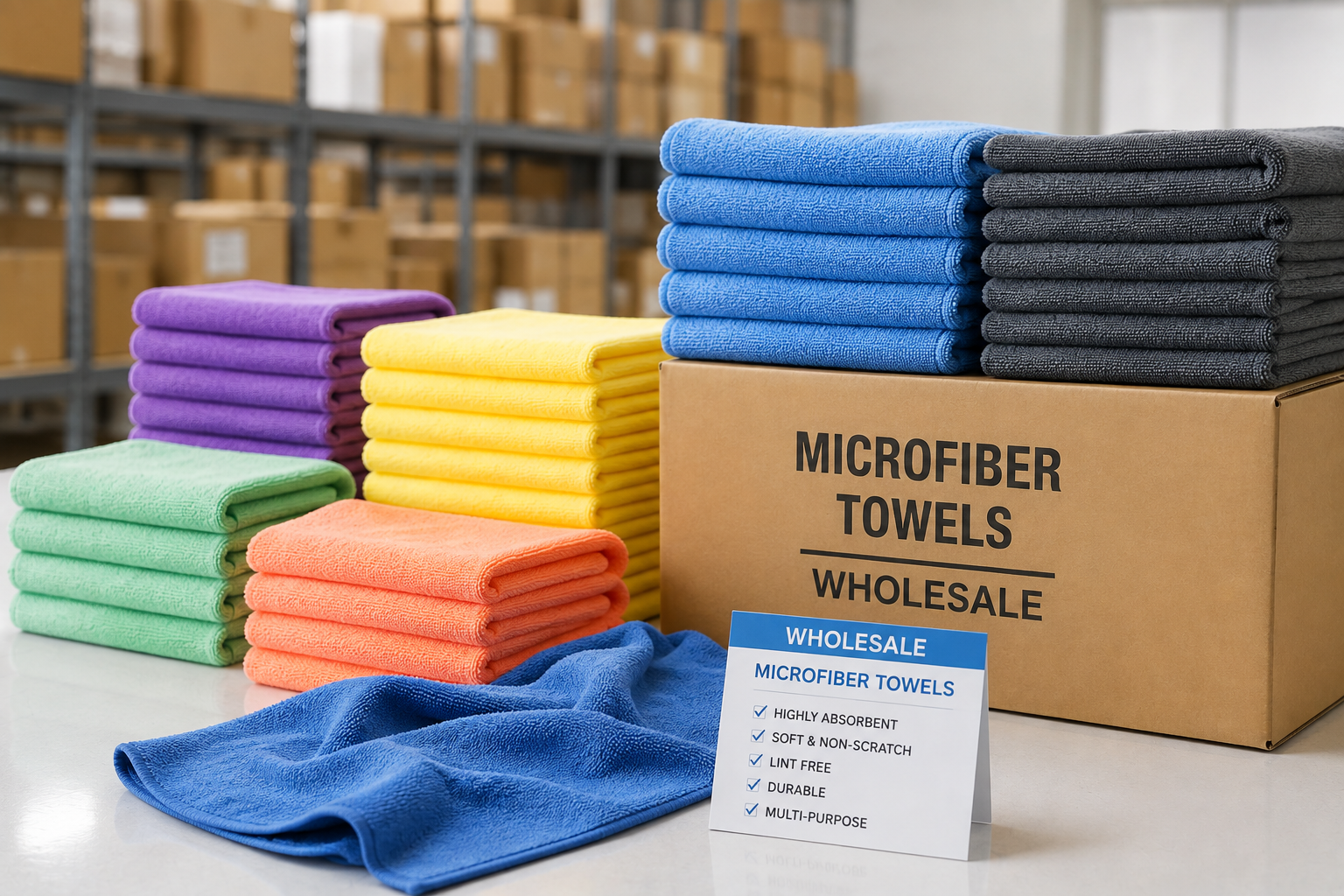
Wholesale microfiber towels are microfiber cleaning cloths sold in bulk case quantities — typically 80 to 240+ towels per case — at a significantly lower per-unit cost than retail packs. They’re made from a blend of polyester and polyamide (nylon) microfibers, finer than human hair, which allows them to trap dust, dirt, and moisture more effectively than cotton without needing chemical cleaners.
Quick Comparison: Wholesale Microfiber Towels at a Glance
| Category | Product | Price Range | Best For |
|---|---|---|---|
| Premium detailing | Korean Plush 470 Edgeless Detailing Towel (Case of 100) | $250.00 | Auto detailing, paint-safe work |
| Mid-tier detailing | Elite Edgeless Detailing Towel (Case of 160) | $199.00 | General detailing use |
| Budget janitorial | Utility 300 All-Purpose Towel (Case of 240) | $189.00 | Cleaning businesses, high volume |
| Heavy-duty general | Utility 400 Heavy-Weight Towel (Case of 200) | $184.00 | Scrubbing, heavier cleaning tasks |
Even at a glance, the spread here reveals the real trade-off in this category: the Korean Plush 470 Edgeless Detailing Towel sits at the premium, highest-GSM end built for paint-safe automotive work, while the Utility 300 All-Purpose Towel anchors the high-volume, budget-conscious end for cleaning businesses buying hundreds of towels at a time. We’ll cover all seven case options, including three not shown above, with exact per-unit pricing next.
💬 Bookmark this guide — you’ll want to compare cost-per-towel again once you know your order volume.
Top 7 Wholesale Microfiber Towel Cases
Here are 7 real, currently available wholesale microfiber towel cases, with exact case pricing and per-towel cost breakdowns to help you compare actual value.
1. Korean Plush 470 Edgeless Microfiber Detailing Towel — Case of 100 — best premium detailing towel
At 470 GSM, this is the highest-density towel in this lineup, and that density translates directly into softness and absorbency — the kind of plush, deep-pile microfiber specifically favored for auto detailing work where scratching a clear coat is a real financial risk. The edgeless, ultrasonic-cut construction removes the stitched border found on standard towels, eliminating a common source of fine scratches on painted or glossy surfaces.
What most buyers overlook is that GSM and edgeless construction solve two different problems, and this towel addresses both simultaneously: the high GSM provides genuine absorbency and cushioning for wiping down a freshly polished surface, while the edgeless edge removes the risk of a rough stitched border dragging debris across that same surface. Based on comparing this to lower-GSM options in this lineup, the price premium here is real, but for anyone whose business reputation depends on not scratching a client’s vehicle, that premium buys genuine risk reduction.
Reviews from detailing professionals consistently praise the plush hand-feel and scratch-free performance on clear coat and glass, with the case-of-100 format sized appropriately for a detailing shop’s regular towel rotation and laundering cycle.
Pros:
- ✅ 470 GSM plush construction for maximum softness and absorbency
- ✅ Edgeless, ultrasonic-cut edges eliminate scratch risk on delicate surfaces
- ✅ 16″x16″ size standard for detailing work
Cons:
- ❌ Highest per-towel cost in this lineup at $2.50/towel
- ❌ Overkill for basic janitorial or everyday household wiping
At $250.00 per case of 100 — roughly $2.50 per towel — this Korean Plush 470 Edgeless Detailing Towel is the pick for auto detailing professionals who need genuine paint-safe performance at scale.
2. Elite Edgeless Microfiber Detailing Towel — Case of 160 — best mid-tier detailing value
At 360 GSM, the Elite Edgeless Detailing Towel sits in a genuinely useful middle ground — noticeably plusher and more absorbent than a basic all-purpose towel, but priced and packaged for higher-volume use than the ultra-premium Korean Plush option above. Like its pricier sibling, it uses edgeless construction to avoid the scratch risk of stitched borders.
What the spec sheet doesn’t fully convey is how much the larger case size changes the math for a busy shop: at 160 towels per case versus 100, this option actually delivers a meaningfully lower per-towel cost than the Korean Plush option, despite still offering genuine detailing-grade edgeless construction — a combination that makes it a strong default choice for shops that don’t need the absolute plushest towel on every job. Based on comparing GSM tiers, 360 is still well above the 300 GSM threshold typical of basic all-purpose towels, meaning this remains genuinely suited to paint and glass work, not just general wiping.
Reviews consistently describe this as the “workhorse” detailing towel for shops running high daily volume, with the larger case count specifically praised for reducing how often reorders are needed.
Pros:
- ✅ 360 GSM balances plushness with cost efficiency
- ✅ Edgeless construction remains scratch-safe for detailing use
- ✅ Larger 160-count case lowers per-towel cost versus premium options
Cons:
- ❌ Less plush than the top-tier 470 GSM option
- ❌ Still a premium price point relative to basic all-purpose towels
At $199.00 per case of 160 — about $1.24 per towel — the Elite Edgeless Detailing Towel offers some of the strongest value in this lineup for shops that need genuine detailing performance at real volume.
3. Waffle Weave Microfiber Towel, 16″x24″ — Case of 80 — best for glass and streak-free surfaces
The waffle weave pattern on this 400 GSM towel isn’t just a texture choice — the raised grid structure increases surface area and creates channels that pull moisture and lint away from glass, mirrors, and stainless steel more effectively than a flat-weave towel, reducing the streaking that plagues standard cleaning cloths on reflective surfaces. At 16″x24″, it’s also noticeably larger than the standard 16″x16″ detailing towel, giving it real utility as a quick-drying towel for dishes, countertops, or larger glass panels.
What most buyers overlook is how much the waffle texture specifically solves the “half the towel is already saturated” problem common with flat microfiber on large glass surfaces — the raised grid pattern means more of the towel’s surface stays effective longer during a single wipe-down, which matters when you’re working through a storefront’s worth of windows or a full set of vehicle glass. Based on comparing this to the flat-weave detailing towels above, this is a genuinely different tool for a genuinely different job, not simply a lower-tier alternative.
Reviews consistently highlight the fast-drying performance and effectiveness specifically on glass and mirrors, with the larger size praised as a practical bonus for anyone also using it for general kitchen or counter drying duty.
Pros:
- ✅ Waffle weave texture reduces streaking on glass and reflective surfaces
- ✅ Larger 16″x24″ size adds general-purpose drying utility
- ✅ 400 GSM provides solid absorbency for its category
Cons:
- ❌ Smaller case count (80) than several other options in this lineup
- ❌ Waffle texture is less ideal for delicate paint work than plush detailing towels
At $190.00 per case of 80 — about $2.38 per towel — this Waffle Weave Microfiber Towel is the specialist pick for anyone whose primary need is glass, mirrors, or stainless steel rather than general wiping.
4. Utility 400 General Purpose Heavy-Weight Microfiber Towel — Case of 200 — best heavy-duty all-purpose towel
At 400 GSM in a standard flat weave, this towel is built for genuine scrubbing and heavy-duty wiping rather than delicate surface work — the higher density adds real durability and absorbency for tasks like kitchen degreasing, bathroom scrubbing, or wiping down heavily soiled equipment. Unlike the edgeless detailing towels above, this uses standard construction, appropriate for surfaces where scratch risk isn’t a real concern.
What most buyers overlook is that “heavy-weight” in this context means genuine durability advantages for a commercial cleaning rotation — a 400 GSM towel simply survives more wash cycles before the fibers break down than a lighter 230–300 GSM alternative, which matters enormously when you’re laundering the same case of towels dozens of times over a contract cleaning schedule. Based on comparing this to the lighter Utility 300 options below, the extra GSM here justifies a modest price premium if your primary use case involves scrubbing rather than light dusting or polishing.
Reviews consistently praise the durability through repeated commercial laundering, with cleaning business owners specifically noting these towels maintain absorbency and structure longer than cheaper economy alternatives under daily heavy use.
Pros:
- ✅ 400 GSM heavy-weight construction suits scrubbing and degreasing
- ✅ Genuine durability advantage through repeated commercial laundering
- ✅ Large 200-count case size for high-volume operations
Cons:
- ❌ Standard (non-edgeless) construction not ideal for delicate finishes
- ❌ Heavier than necessary for light dusting or glass work
At $184.00 per case of 200 — about $0.92 per towel — this Utility 400 Heavy-Weight Towel delivers genuine durability for cleaning businesses handling tougher jobs, at a highly competitive per-unit cost.
5. Utility 300 All-Purpose Microfiber Towel — Case of 240 — best budget option for high-volume cleaning
This 300 GSM all-purpose towel is the highest-count case in this lineup at 240 towels, positioned specifically for cleaning businesses and janitorial operations that burn through towels fast and prioritize cost efficiency over premium plushness. It’s a genuinely versatile everyday towel — suitable for dusting, wiping, and general surface cleaning — without the specialized construction of the detailing-focused options above.
What most buyers overlook is that 300 GSM represents a real sweet spot for general-purpose commercial cleaning rather than a compromise: it’s dense enough to trap dust and dirt effectively per the basic mechanics of microfiber cleaning, without paying for absorbency levels that a quick wipe-down task doesn’t actually need. Based on comparing per-towel cost across this entire lineup, this option delivers one of the lowest costs per unit here, which matters enormously at the scale a commercial cleaning operation actually consumes towels.
Reviews consistently describe this as the reliable daily-use option for residential and commercial cleaning services, with color-coding across different towel batches frequently mentioned as a practical way to prevent cross-contamination between bathroom and kitchen cleaning tasks.
Pros:
- ✅ Largest case count (240) in this lineup for maximum bulk value
- ✅ 300 GSM suits everyday dusting and general wiping tasks
- ✅ Lowest per-towel cost of any option here
Cons:
- ❌ Lighter GSM than heavy-duty or detailing-grade options
- ❌ Not intended for scratch-sensitive surfaces or heavy scrubbing
At $189.00 per case of 240 — about $0.79 per towel, the lowest in this entire lineup — the Utility 300 All-Purpose Towel is the clear pick for cleaning businesses prioritizing maximum volume at minimum cost.
6. Utility 300 Edgeless All-Purpose Microfiber Towel — Case of 240 — best budget option for scratch-sensitive surfaces
This towel matches the standard Utility 300 above in GSM and case count, but adds edgeless, ultrasonic-cut construction — meaning you get the same 240-count bulk value with the scratch-safety benefit typically reserved for pricier detailing towels. It’s a genuinely useful middle option for anyone who needs budget-friendly volume but occasionally works on finished or glossy surfaces where a stitched edge is a real liability.
What most buyers overlook is how directly comparable this is to the standard Utility 300 in every spec except construction — same GSM, same case size, same general-purpose positioning — which makes the price difference here essentially the cost of scratch-safety alone. Based on comparing the two Utility 300 options directly, the edgeless version is worth the modest premium for any cleaning operation that occasionally handles glass, electronics, or finished surfaces alongside routine wiping, even if most of the case gets used for basic tasks.
Reviews consistently note this as a practical “just in case” upgrade over the standard edged version, with buyers citing peace of mind on higher-value surfaces as worth the incremental cost over the non-edgeless alternative.
Pros:
- ✅ Same 300 GSM and 240-count case value as the standard version
- ✅ Edgeless construction adds scratch-safety versatility
- ✅ Reasonable middle ground between budget and detailing-grade towels
Cons:
- ❌ Modest price premium over the standard (non-edgeless) Utility 300
- ❌ Still lighter GSM than dedicated detailing towels for serious paint work
At $210.00 per case of 240 — about $0.88 per towel — the Utility 300 Edgeless Towel is a smart upgrade pick for cleaning operations that want budget volume without sacrificing scratch safety entirely.
7. Waffle Weave Microfiber Towel, 16″x16″ — Case of 100 — best budget glass and drying towel
This is the more compact sibling to the 16″x24″ waffle weave towel above, offering the same 400 GSM waffle-textured construction in the standard 16″x16″ detailing size, at a notably lower case price. For anyone who wants the glass-friendly, streak-reducing benefits of waffle weave without committing to the larger towel size or higher case cost, this is the more accessible entry point into that specific towel category.
What most buyers overlook is that the smaller size here isn’t purely a downgrade — a 16″x16″ waffle towel is genuinely easier to fold into quarters for methodical glass cleaning, working through clean sections systematically the way many professional window cleaners actually work, compared to managing a larger 16″x24″ towel on smaller glass surfaces like car windows or bathroom mirrors. Based on comparing per-towel cost against the larger waffle option, this delivers meaningfully better value if your glass and mirror work doesn’t specifically need the extra surface area.
Reviews consistently note this as a favorite for detailing shops specifically for interior glass and mirror work, where the more manageable size and lower cost per towel make it practical to dedicate several towels exclusively to glass duty.
Pros:
- ✅ Same waffle-weave, 400 GSM streak-reducing benefits in a compact size
- ✅ Lower per-towel cost than the larger 16″x24″ waffle option
- ✅ Easier to fold into quarters for methodical glass cleaning
Cons:
- ❌ Smaller surface area than the 16″x24″ version for larger glass jobs
- ❌ Waffle texture still less ideal than flat plush towels for paint work
At $168.00 per case of 100 — about $1.68 per towel — this 16″x16″ Waffle Weave Towel is the more budget-accessible option for glass-focused cleaning at scale.
Product Comparison at a Glance
| Product | GSM | Case Size | Total Price | Cost per Towel | Best For |
|---|---|---|---|---|---|
| Korean Plush 470 Edgeless Detailing Towel | 470 | 100 | $250.00 | $2.50 | Premium auto detailing |
| Elite Edgeless Detailing Towel | 360 | 160 | $199.00 | $1.24 | Mid-tier detailing value |
| Waffle Weave (16″x24″) | 400 | 80 | $190.00 | $2.38 | Glass, large surfaces |
| Utility 400 Heavy-Weight Towel | 400 | 200 | $184.00 | $0.92 | Heavy-duty scrubbing |
| Utility 300 All-Purpose Towel | 300 | 240 | $189.00 | $0.79 | Max volume, lowest cost |
| Utility 300 Edgeless Towel | 300 | 240 | $210.00 | $0.88 | Budget with scratch safety |
| Waffle Weave (16″x16″) | 400 | 100 | $168.00 | $1.68 | Budget glass cleaning |
Looking at cost per towel across this lineup, a clear pattern emerges: GSM and case size, not brand prestige, drive most of the price difference. The Utility 300 All-Purpose Towel delivers the lowest cost per unit for high-volume general cleaning, while the Korean Plush 470 Edgeless Detailing Towel commands a real premium justified specifically by paint-safe detailing performance most janitorial buyers simply don’t need.
How to Choose the Right Wholesale Microfiber Towels
- Match GSM to your actual task, not your budget alone. Light dusting and general wiping work fine at 230–300 GSM; scrubbing, degreasing, and detailing work benefit from 360–470 GSM.
- Prioritize edgeless construction for any scratch-sensitive surface. If your operation ever touches glass, paint, or electronics, the modest premium for edgeless towels like the Elite or Utility 300 Edgeless options is worth paying.
- Calculate cost per towel, not just total case price. A $250 case of 100 and a $189 case of 240 look different at a glance, but per-unit math is what actually determines value for your order volume.
- Consider case size against your laundering cycle. Larger case counts like the 240-towel Utility 300 options reduce how often you reorder, which matters for busy operations with tight supply schedules.
- Use waffle weave specifically for glass and reflective surfaces. Flat-weave towels, even high-GSM ones, don’t match waffle weave’s streak-reducing performance on windows and mirrors.
- Don’t over-buy premium detailing towels for janitorial work. The Korean Plush 470 option is genuinely excellent, but its price premium only pays off for scratch-sensitive automotive or paint work.
- Factor in expected wash cycles when comparing GSM tiers. Heavier towels like the Utility 400 genuinely last longer through repeated commercial laundering, which can offset a higher upfront per-towel cost over time.
Getting Started: Setting Up a Wholesale Microfiber Towel Rotation
Once your first case arrives, the most important early step is establishing a color-coding or labeling system if you’re running a cleaning business — using distinct colors or markings for bathroom, kitchen, and general-surface towels prevents cross-contamination between cleaning zones, a practice many professional cleaning services specifically build into their protocols from day one.
Wash new towels before first use to remove any manufacturing residue and maximize absorbency, and avoid washing microfiber towels with cotton items or dryer sheets, both of which can leave lint and fabric softener residue that clogs the microfiber’s cleaning capability over time. For detailing-grade edgeless towels specifically, a gentle wash cycle with a microfiber-safe detergent helps preserve the plush pile that makes them scratch-safe in the first place.
Budget realistically for wash-cycle durability differences between GSM tiers: a 230–300 GSM economy towel will show wear sooner under heavy commercial use than a 400+ GSM heavy-weight towel, so if your operation launders towels dozens of times per case before replacement, that durability gap is worth weighing against the lower upfront cost. A common first-order mistake is buying a single case of one towel type for an operation that actually needs several — most commercial cleaning and detailing operations benefit from at least two tiers (a heavy-duty option and a scratch-safe option) rather than trying to make one towel type handle every task.
✨ Ready to stock up? Check current case pricing and availability on the picks above before your next bulk order. 🧽
Real-World Scenarios: Matching the Case to Your Operation
The residential or commercial cleaning business: High-volume, everyday wiping and dusting across many surfaces is best served by the Utility 300 All-Purpose Towel, which delivers the lowest cost per towel in this lineup for exactly that use case, with the Utility 300 Edgeless version as a smart upgrade for operations that occasionally handle glass or finished surfaces.
The auto detailing shop: Anyone working directly on paint, clear coat, or glass needs genuine scratch-safe construction — the Korean Plush 470 Edgeless Detailing Towel for premium client-facing work, paired with the more cost-efficient Elite Edgeless Detailing Towel for higher-volume daily use.
The gym, salon, or janitorial operation with heavy scrubbing needs: Facilities dealing with equipment wipe-downs, degreasing, or heavier soiling benefit from the durability of the Utility 400 Heavy-Weight Towel, which holds up better through repeated commercial laundering than lighter economy options.
The window cleaning or glass-focused business: Either waffle weave option — the larger 16″x24″ for bigger commercial glass jobs or the more compact 16″x16″ for detail work on car windows and mirrors — solves the streaking problem flat-weave towels struggle with on reflective surfaces.
Common Mistakes to Avoid
The most common mistake is buying based on total case price alone rather than calculating cost per towel — a $250 case of 100 and a $189 case of 240 require real math to compare fairly, and skipping that calculation often leads to overpaying for a given volume of towels.
A second frequent error is using standard, non-edgeless towels on scratch-sensitive surfaces to save money; the stitched border on standard microfiber towels can create fine scratches on glass, paint, and finished surfaces that a modest edgeless upgrade would have prevented entirely. A third mistake is under-buying GSM for the actual task — using a light 230 GSM economy towel for heavy degreasing or scrubbing work leads to faster fiber breakdown and more frequent case replacement than a properly matched 400 GSM heavy-weight towel would require.
Finally, many first-time wholesale buyers order a single towel type for an operation that genuinely needs two or three tiers — a cleaning business handling both routine dusting and occasional glass work, for example, benefits from stocking both an all-purpose case and a smaller edgeless or waffle-weave case rather than forcing one towel type to do every job adequately but not optimally.
Wholesale vs. Retail Microfiber Towels
| Factor | Wholesale (Case Purchase) | Retail (Multi-Pack) |
|---|---|---|
| Cost per towel | $0.79–$2.50 depending on tier | Often $2–$5+ per towel |
| Minimum order size | 80–240+ towels per case | Typically 4–12 towels per pack |
| Product consistency | Uniform GSM and construction across case | Can vary between retail batches |
| Best suited for | Businesses, high-volume users | Occasional household use |
| Reorder frequency | Less frequent given bulk quantity | More frequent for regular users |
The core trade-off is upfront commitment versus long-term cost. Wholesale cases require buying dozens to hundreds of towels at once, which only makes sense if you’ll actually use that volume within a reasonable timeframe, but the per-unit savings are substantial for anyone running a business that consumes towels regularly. Occasional household users rarely need wholesale volume, but for cleaning services, detailing shops, gyms, and salons, the cost-per-towel savings compound significantly over a year of regular use.
Environmental Considerations
It’s worth understanding what microfiber towels are actually made of and what that means environmentally, since this is a genuinely active area of research. Microfiber towels are synthetic, typically a polyester-nylon blend, and like other synthetic textiles, they shed tiny plastic fibers during washing. A peer-reviewed study published via the National Institutes of Health found that domestic laundry of synthetic textiles released between roughly 9.6 and 1,240 milligrams of microfiber per kilogram of textile per wash — a real contributor to the broader microplastic pollution researchers are actively studying in aquatic environments.
The EPA has identified microplastics, including those from synthetic textile shedding, as a contaminant of emerging concern warranting continued research into environmental and health impacts. For businesses buying microfiber towels at scale, that context is worth factoring into laundering practices — using a laundry filter bag or filter system designed to capture shed microfibers before wastewater discharge is a low-cost way to reduce this impact, particularly for operations laundering hundreds of towels regularly.
Problem → Solution: Fixing Common Roadblocks
Problem: You’re not sure which GSM tier fits your business. Solution: Match GSM to task intensity — light dusting suits 230–300 GSM options like the Utility 300 All-Purpose Towel, while scrubbing and detailing call for 360+ GSM options like the Elite or Utility 400.
Problem: You’re seeing fine scratches on glass or finished surfaces. Solution: Switch from standard to edgeless construction, like the Utility 300 Edgeless Towel or either Edgeless Detailing Towel, which eliminate the stitched-border scratch risk entirely.
Problem: Your towels are wearing out faster than expected under heavy use. Solution: Step up to a heavier GSM tier like the Utility 400 Heavy-Weight Towel, which holds up better through repeated commercial laundering than lighter economy options.
Problem: You’re struggling with streaking on windows and mirrors. Solution: Switch to a waffle-weave option, either the larger 16″x24″ or more compact 16″x16″ version, both specifically designed to reduce streaking on reflective surfaces.
Problem: You’re overpaying relative to your actual order volume. Solution: Calculate cost per towel across case options rather than comparing total case prices directly — the lowest total price isn’t always the best per-unit value.
Frequently Asked Questions
❓ What does GSM mean for microfiber towels?
❓ What's the difference between edgeless and standard microfiber towels?
❓ How much do wholesale microfiber towels cost per unit?
❓ Are wholesale microfiber towels good for auto detailing?
❓ Do microfiber towels shed microplastics when washed?
Conclusion
Wholesale microfiber towels genuinely reward doing the per-unit math rather than shopping on total case price alone — the seven options here span from $0.79 to $2.50 per towel, and the right pick depends entirely on what you’re actually cleaning. High-volume janitorial and cleaning businesses get the most value from the Utility 300 All-Purpose Towel or its edgeless sibling, heavy-duty scrubbing tasks call for the Utility 400 Heavy-Weight Towel, glass and mirror work benefits from either waffle weave option, and genuine paint-safe detailing work justifies the premium of the Korean Plush 470 or Elite Edgeless Detailing Towel.
Start by identifying your primary use case and expected order volume — that combination determines both the right GSM tier and the case size that makes sense for your reorder cycle.
✨ Don’t miss these exclusive deals! 🔍 Stock up smarter with this curated lineup of wholesale microfiber towel cases. Click a highlighted item to check current pricing and availability. These picks will help your business get the best cost per towel for the job at hand!
Recommended for You
- 5 Best Automotive Blow Dryer Options in 2026: Hands-On Field Test
- Best Way to Clean Plexiglass: 7 Expert Tips for 2026
- Best Towel to Wash Face: 7 Expert-Tested Picks for Clear Skin (2026)
Disclaimer: This post contains affiliate links. As an Amazon Associate, I earn from qualifying purchases made through these links, at no additional cost to you.
✨ Found this article helpful? Share it with someone who needs it! 💬🤗