In This Article
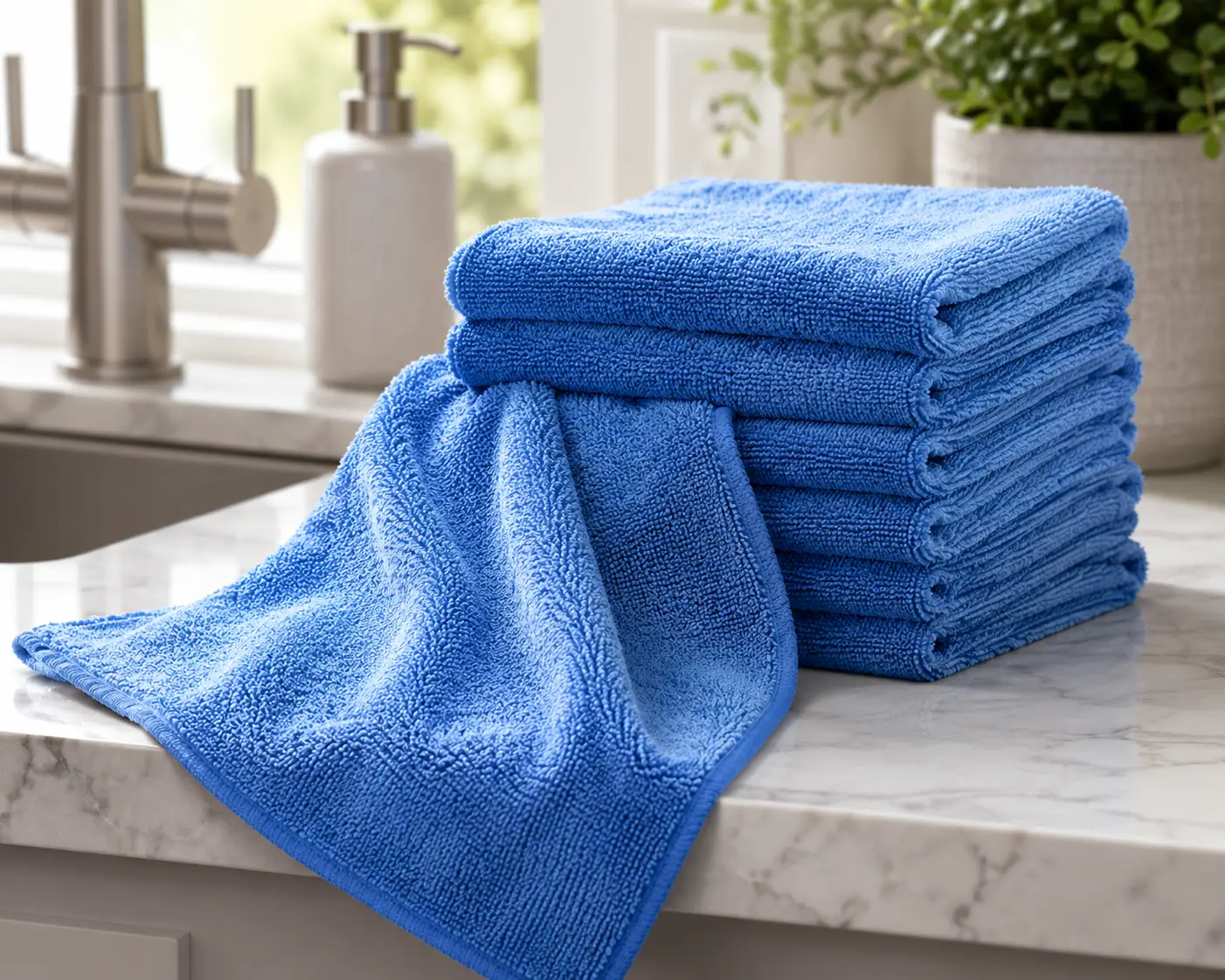
If your junk drawer is full of thin, pilling rags that push grime around instead of picking it up, blue microfiber towels are probably the upgrade you’re after. Blue microfiber towels are reusable cleaning cloths made from a split polyester-polyamide blend, prized for trapping dust, liquid, and grease without scratching delicate surfaces or leaving streaks behind…
That’s the short version. The longer version is that not all blue microfiber towels are built the same way, and the difference between a $0.30 towel and a $3 towel usually comes down to GSM (grams per square meter), fiber blend, and edge construction — details that matter a lot more than the color does. Blue happens to be the industry’s unofficial “glass and interior” color code in professional detailing circles, which is one reason it’s such a popular pick for households too: it’s easy to keep separate from the towel you use on the toilet.
In this guide, we’ve researched seven real, currently available blue microfiber towels — from budget multi-packs to commercial-grade terry towels — and broken down what the specs actually mean for your cleaning routine. We’ll also walk through how to choose the right GSM and pile for your use case, common buying mistakes, and a few problems (streaking, lint, that “sour towel” smell) with straightforward fixes. Let’s get into it.
Quick Comparison: Blue Microfiber Towels at a Glance
| Product | Size / GSM | Pack Size | Price Range | Best For |
|---|---|---|---|---|
| Amazon Basics Microfiber Cleaning Cloths | 16″ x 12″ | 24-pack | $12–$16 | Budget starter set |
| Chemical Guys Workhorse Professional Grade Microfiber Towel | 16″ x 16″, ~260–300gsm | 3-pack | $10–$14 | Glass & windows |
| The Rag Company All-Purpose Microfiber Terry Towels | 16″ x 16″, 300gsm | 12-pack | $30–$40 | Commercial-grade all-rounder |
| MWipes Blue Microfiber Shop Towels | 10″ x 12″, ~200gsm | 50-count box | $20–$28 | Garage & shop use |
| Chemical Guys Monster Extreme Thickness Microfiber Towel | 16″ x 24″ | Single/3-pack | $12–$20 | Premium plush drying |
A quick scan of the table shows a clear pattern: pack size and GSM move in opposite directions as price goes up. The Amazon Basics Microfiber Cleaning Cloths and MWipes Blue Microfiber Shop Towels win on sheer quantity and cost-per-towel, while the Chemical Guys Monster Extreme Thickness Microfiber Towel and The Rag Company All-Purpose Microfiber Terry Towels trade quantity for plush pile and heavier GSM that holds up to more aggressive cleaning tasks. If you only need a handful of towels for occasional glass cleaning, the Chemical Guys Workhorse Professional Grade Microfiber Towel hits a practical middle ground.
💬 Ready to stop fighting streaky windows and lint-covered dashboards? Check the current price on any pick above and grab a set today!
Top 7 Blue Microfiber Towels: Expert Picks for 2026
1. Amazon Basics Microfiber Cleaning Cloths — best budget starter pack
The Amazon Basics Microfiber Cleaning Cloths are the towel most people already own without realizing how good a deal they are, and the 24-pack in blue, white, and yellow is built for exactly that kind of no-fuss stocking-up. Each 16″ x 12″ cloth is rated to absorb roughly eight times its own weight in liquid, and the tri-color assortment is genuinely useful — you can dedicate blue to bathrooms or glass, yellow to the kitchen, and white to everything else, which cuts down on cross-contaminating a dusty cloth with one that just wiped a counter.
Who should buy these: anyone setting up a color-coded cleaning system for the first time, renters who don’t want to invest in a premium brand yet, or parents who just need a giant stack of towels that can take a beating. On paper, this is an entry-level towel, but the fiber blend performs above its price point for dry dusting and glass work.
Real customer feedback backs this up: aggregated Amazon reviews and independent write-ups (including The Kitchn’s hands-on review) consistently describe these as effective on glass and countertops with “no streaks,” though some reviewers note the thinner weave doesn’t hold up to heavy grease the way a thicker towel would, and a handful mention fraying edges after many wash cycles.
Pros:
- ✅ Very low cost per towel for a 24-pack
- ✅ Tri-color set supports simple color-coded cleaning
- ✅ Machine washable and reusable hundreds of times
Cons:
- ❌ Thinner weave struggles with heavy grease or wax removal
- ❌ Some reported fraying at the stitched edges over time
At around $12–$16 for two dozen towels, this is one of the cheapest ways to get a legitimate microfiber setup into your home, and the value-for-money here is hard to beat for light-duty jobs.
2. Chemical Guys Workhorse Professional Grade Microfiber Towel — best for glass and windows
The Chemical Guys Workhorse Professional Grade Microfiber Towel is part of a color-coded detailing system where blue is specifically assigned to glass and windows, so buying this pack means you’re getting a towel engineered for one job rather than a jack-of-all-trades cloth. It’s made from a 70/30 polyester-polyamide blend with a short pile, which in practice means less lint transfer onto glass — a common complaint with plush, high-pile towels used on windshields.
The short-pile construction is the real story here: longer-pile towels look impressive but tend to leave behind fine fuzz on glass, while this towel’s tighter weave buffs to a clear finish faster. Reviewers on the brand’s own site and third-party retailers describe it as a reliable everyday towel for wiping down interiors and glass without wasting paper towels, with more than one longtime user noting they’ve stuck with the brand specifically because the towels hold up wash after wash.
Who it’s for: car owners who already use — or want to start using — a color-coded system to avoid cross-contaminating glass towels with ones that touched wheels or engine bays, and anyone who’s tired of streaky windshields.
Pros:
- ✅ Purpose-built short pile leaves minimal lint on glass
- ✅ Reinforced stitched edges resist fraying with regular washing
- ✅ Fits neatly into a broader color-coded detailing workflow
Cons:
- ❌ Sold in smaller 3-packs, so cost per towel is higher than bulk options
- ❌ Short pile isn’t ideal for scratch-sensitive paint correction work
Expect to pay around $10–$14 for a 3-pack, which is a fair trade for a towel that’s purpose-built rather than generic.
3. The Rag Company All-Purpose Microfiber Terry Towels — best commercial-grade all-rounder
The The Rag Company All-Purpose Microfiber Terry Towels, sold in Royal Blue 16″ x 16″ at 300gsm, are the towel to reach for when you need something that performs equally well on a kitchen counter, a gym bench, or a car interior. The 80/20 polyester-polyamide blend and terry weave pack in over 200,000 fibers per square inch, according to the manufacturer’s spec sheet, which translates to noticeably better grime pickup than the thinner economy towels most households default to.
What that fiber density means in practice: a 300gsm terry towel holds more liquid before you need to wring it out, and it stays soft through repeated washing instead of going stiff and scratchy — a common failure point for cheaper towels after a few dozen cycles. Real user reviews on the brand’s site describe it as a “go-to towel” for detailing tasks like door jambs and interiors, and one longtime buyer specifically switched from a big-box wholesale club brand after being unimpressed with declining quality there, calling out this towel’s better fiber quality as the reason.
This is the pick for buyers who want one towel that genuinely covers home, gym, and car duty without constantly switching products.
Pros:
- ✅ Heavier 300gsm weave outperforms economy towels on liquid pickup
- ✅ Soft, scratch-free terry construction across multiple surface types
- ✅ Backed by a straightforward return policy from the manufacturer
Cons:
- ❌ Costs more per towel than big-box or Amazon Basics multi-packs
- ❌ 16″ x 16″ size may feel large for small detail work
At roughly $30–$40 for a 12-pack, it’s priced like a commercial supply item, and for buyers doing frequent cleaning, the long-term value tends to work out in its favor.
4. AIDEA Microfiber Cleaning Cloth — best bulk value under $25
The AIDEA Microfiber Cleaning Cloth 50-pack in blue is aimed squarely at people who go through towels fast — think weekly car washes, a household with kids and pets, or a small cleaning side business. Made from an 87% polyester/13% polyamide blend, the 12″ x 12″ edgeless towels are designed to skip the stitched border altogether, which reduces the risk of a hard edge scratching glass, screens, or freshly waxed paint.
The edgeless design is worth calling out specifically: stitched-edge towels are more prone to leaving faint scuff marks on soft-coat finishes like clear coats and lacquered furniture, so an edgeless towel is genuinely the safer choice for anyone detailing a newer vehicle or refinished wood. Verified review volume on this exact 50-pack listing was more limited at the time of writing than on some competitors, so rather than overstate the sentiment, it’s fairer to say the category pattern for AIDEA’s broader towel lineup — corroborated across several of their pack sizes — points to consistent praise for softness and value, with occasional notes about thinner absorbency compared to premium 300gsm towels.
Who it’s for: bulk buyers on a budget who still want an edgeless design rather than the cheapest possible stitched-edge alternative.
Pros:
- ✅ Edgeless design reduces scratch risk on delicate surfaces
- ✅ Large 50-pack keeps cost per towel low for frequent use
- ✅ Works dry or wet, so no chemical cleaner is required
Cons:
- ❌ Thinner than premium 300gsm terry towels for heavy-duty jobs
- ❌ Smaller 12″ x 12″ size covers less area per wipe
Priced around $18–$24 for the full 50-pack, this is one of the better cost-per-towel ratios in the edgeless category.
5. MWipes Blue Microfiber Shop Towels — best for garage and shop use
The MWipes Blue Microfiber Shop Towels are built for a different job entirely than the towels above: they’re a reusable alternative to the disposable shop rags mechanics and DIYers burn through by the roll. At roughly 200gsm and sized 10″ x 12″, these are thinner and more disposable-feeling than a plush detailing towel, but that’s intentional — the manufacturer positions them as a middle ground between a real microfiber cloth and a one-time-use paper towel.
That “cheap enough to treat as disposable, durable enough to reuse” positioning matters for garage work specifically. Oil, grease, and solvent spills can permanently stain a nicer towel, so having a stack of MWipes on hand means you’re not sacrificing your good detailing towels for the messiest jobs. The lower 200gsm rating also means they dry faster between uses, which is handy in a shop environment where towels get reused within the same session rather than washed daily.
Who it’s for: home mechanics, painters, and anyone doing garage or workshop cleanup where staining and heavy soil are a given, not an exception.
Pros:
- ✅ Priced to be used hard without guilt over staining
- ✅ Dispenser-style box keeps towels organized and grab-and-go
- ✅ Machine washable, extending life beyond true disposables
Cons:
- ❌ Lower 200gsm weave is less absorbent than premium detailing towels
- ❌ Smaller size means more towels needed for larger spills
At around $20–$28 for a 50-count box, the cost-per-use math favors anyone who’d otherwise be buying rolls of paper shop towels every month.
6. Chemical Guys Monster Extreme Thickness Microfiber Towel — best premium plush towel
The Chemical Guys Monster Extreme Thickness Microfiber Towel in blue, sized 16″ x 24″, is the plush, oversized option on this list, and the extra thickness is more than a marketing angle — a denser, longer pile physically holds more water per pass, which matters most when you’re drying a full vehicle or a large glass surface and want to minimize the number of wipes (and therefore the risk of dragging grit across the surface).
The larger 16″ x 24″ footprint also means fewer total wipes are needed to cover the same area compared to a standard 16″ x 16″ towel, which reduces handling time and the chance of missing a spot. This towel sits at the upper end of the plush category, and reviewers of Chemical Guys’ broader towel lineup consistently mention the brand’s reputation for softness and scratch-free performance, with several longtime detailers noting they’ve standardized on the brand precisely because of that consistency across product lines.
Who it’s for: buyers who prioritize drying performance and surface safety over cost-per-towel, particularly anyone working on dark paint or glass where even fine swirl marks are visible.
Pros:
- ✅ Oversized 16″ x 24″ format covers more surface per pass
- ✅ Extra-thick pile holds more liquid for faster drying
- ✅ Consistent with a well-reviewed, detailer-trusted product line
Cons:
- ❌ Higher price per towel than standard-thickness options
- ❌ Bulkier towel takes longer to fully air dry between uses
Expect to pay around $12–$20 depending on whether it’s sold individually or in a small multipack — a premium price for what is genuinely a premium towel.
7. Blue Horizon Sky Blue Microfiber Cleaning Towels — best large-format bulk pack
The Blue Horizon Sky Blue Microfiber Cleaning Towels round out this list as the highest-volume option, shipping 36 towels at 16″ x 16″ and 300gsm — a spec sheet that, on paper, matches premium commercial towels but at a bulk-pack price point. The listed 80/20 polyester-polyamide blend is the same ratio used in several higher-priced towels on this list, which is a good sign that the extra fiber count isn’t just marketing copy.
What a 300gsm rating at this volume actually buys you: enough towels to fully outfit a household, small detailing operation, or short-term rental cleaning rotation without rationing individual towels between rooms or jobs. The listing describes the blend as designed to resist linting, scratching, and pilling across hundreds of washes, and while independently verified long-term durability data for this specific listing wasn’t available at the time of writing, the GSM and fiber blend numbers are consistent with towels that have held up well in other brands’ testing.
Who it’s for: anyone who needs commercial-scale quantity — cleaning businesses, property managers, or large households — without commercial-scale pricing.
Pros:
- ✅ 300gsm spec matches premium towels at a bulk-pack price
- ✅ 36-count pack outfits an entire household or small operation
- ✅ Same fiber blend ratio used in pricier commercial towels
Cons:
- ❌ Independently verified long-term durability data is limited
- ❌ Large box size may be more storage than smaller households need
Priced in the $28–$36 range for the full 36-pack, the per-towel cost lands well below most 300gsm competitors, making it a strong value pick if the quantity fits your needs.
How to Get the Most Out of New Blue Microfiber Towels
Most microfiber performance complaints trace back to skipping the setup steps, not the towel itself. Before a new blue microfiber towel ever touches a windshield or countertop, wash it separately — ideally with a dedicated microfiber detergent or a small amount of mild, fragrance-free liquid detergent — to strip the manufacturing residue that coats new towels and can otherwise transfer onto surfaces as a hazy film.
Skip fabric softener and dryer sheets entirely, on every wash, forever. Both coat the fibers in a waxy residue that fills the microscopic gaps responsible for microfiber’s absorbency and static pickup, and once that residue builds up, no amount of rewashing fully restores the towel’s original performance. Wash in warm water, tumble dry on low heat or air dry, and store towels folded rather than balled up so they don’t develop permanent creases that trap dirt.
In the first 30 days, the most common mistake is treating every towel as interchangeable. Set up your color-coding early — even a simple two-color system (one color for glass, one for everything else) prevents cross-contamination from day one, and it’s much easier to maintain a habit from the start than to retrofit it later.
✨ Don’t let a bad first wash ruin a good towel!
🔍 Set your new blue microfiber towels up for success from day one — skip the fabric softener, pre-wash before first use, and check the current price and availability on today’s top picks while you’re getting your routine dialed in.
Real-World Scenarios: Matching Blue Microfiber Towels to Your Job
The weekend car detailer washing a sedan every other week and wanting streak-free glass doesn’t need bulk quantity — a few Chemical Guys Workhorse Professional Grade Microfiber Towel cloths dedicated to windows, paired with a couple of the plush Chemical Guys Monster Extreme Thickness Microfiber Towel towels for drying, covers the job without excess spending.
The renter or first apartment household on a tight budget, doing general cleaning across kitchen, bathroom, and light dusting, gets the most mileage from the Amazon Basics Microfiber Cleaning Cloths 24-pack — enough volume to color-code by room without a big upfront cost.
The small cleaning business or property manager servicing multiple units weekly needs volume and consistency above all else. Either the Blue Horizon Sky Blue Microfiber Cleaning Towels 36-pack or The Rag Company All-Purpose Microfiber Terry Towels 12-pack (bought in multiples) makes more financial sense than repeatedly restocking small packs, and the 300gsm spec on both holds up to daily commercial use better than economy towels.
The home mechanic or garage tinkerer dealing with oil, grease, and the occasional ruined towel is the clearest case for the MWipes Blue Microfiber Shop Towels — cheap enough to sacrifice to a bad spill without a second thought.
Common Blue Microfiber Towel Problems (and How to Fix Them)
Problem: Towels leave streaks on glass. This is almost always caused by detergent residue, fabric softener buildup, or using a towel that’s already saturated with dust from a prior task. Rewash the towel alone in hot water with a small amount of dish soap to strip residue, and dedicate a separate towel exclusively to glass going forward.
Problem: Towels smell sour after drying. A musty smell means bacteria grew before the towel fully dried, usually from being left damp in a hamper or bunched up in a bucket. Always air out damp towels before washing, and run an occasional hot-water wash with a splash of white vinegar to reset the fibers.
Problem: Towels shed lint onto surfaces. New towels sometimes shed loose fibers from the manufacturing process before their first wash — this is one reason pre-washing matters. If shedding continues past the first few washes, the towel’s fiber blend or GSM may be too low-grade for the surface you’re using it on; switch to a higher-GSM option like the ones from The Rag Company All-Purpose Microfiber Terry Towels for lint-sensitive jobs.
Problem: Towels feel stiff or scratchy over time. This is the classic fabric-softener trap. Once residue builds up, plan on several hot washes with detergent alone (no softener) to gradually restore softness; severely affected towels may need to be retired.
How to Choose Blue Microfiber Towels
Picking the right towel comes down to matching a handful of specs to your actual use case rather than chasing the highest number on the label. Here’s the process, step by step:
- Decide your primary use case first. Glass and interiors want a short, tight pile; drying a car or mopping up spills wants a plush, high-GSM towel.
- Check the GSM rating. Towels under 250gsm suit light dusting and glass; 300gsm and above suit heavier liquid pickup and general-purpose cleaning.
- Look at the fiber blend ratio. An 80/20 or 70/30 polyester-to-polyamide blend generally outperforms cheaper 90/10 blends for softness and absorbency.
- Consider edge construction. Edgeless towels reduce scratch risk on delicate finishes like clear coat, glass, and lacquered wood.
- Match pack size to your usage frequency. Occasional users are better served by smaller multi-packs; frequent users or businesses save more with bulk 30+ packs.
- Factor in size. Larger towels (16″ x 24″ or bigger) cover more surface per wipe but take longer to dry between uses.
- Plan for a color-coding system from the start, even a simple one, to prevent cross-contamination between dirty and clean-surface towels.
Common Mistakes to Avoid When Buying Blue Microfiber Towels
The single most common mistake is buying based on pack size alone without checking GSM — a 100-pack of thin, low-GSM towels can end up costing more per genuinely useful towel than a smaller pack of higher-quality ones, because thin towels wear out and get replaced faster.
A second mistake is assuming all “blue” towels serve the same purpose. In professional detailing circles, blue is often reserved specifically for glass, which means a stitched-edge blue towel marketed for glass work may not be the best pick for scrubbing wheels or engine bays — a job better suited to a more durable, disposable-leaning towel like a shop rag.
Finally, buyers frequently overlook wash care instructions until after a purchase, then wonder why a $30 pack of premium towels stopped performing within a few months. Fabric softener is the number one culprit, and it’s worth checking a listing’s care instructions before checkout, not after the towels arrive.
Blue Microfiber Towels vs. Cotton Towels
The debate between microfiber and cotton isn’t close on raw cleaning performance, and it’s not just marketing — it’s backed by peer-reviewed research. A widely cited hospital-surface cleaning study published in the Journal of Hospital Infection found that reusable microfibre cloths were significantly more effective than traditional cloths at reducing surface micro-organisms across multiple hospital surface types, with performance holding up even after dozens of wash cycles.
| Factor | Blue Microfiber Towels | Cotton Towels |
|---|---|---|
| Absorbency | Higher — holds more liquid relative to weight | Lower per towel, though total capacity can be high |
| Surface safety | Won’t scratch glass, paint, or coated finishes | Can scratch delicate or coated surfaces |
| Lint & streaking | Minimal when properly cared for | Prone to lint and streaking on glass |
| Wash life | Up to hundreds of washes at higher GSM | Shorter lifespan before fraying |
| Best for | Glass, cars, general household cleaning | Heavy scrubbing, absorbing large spills fast |
The table makes the trade-off clear: cotton still has a place for heavy-duty scrubbing where scratch risk isn’t a concern, but for glass, painted surfaces, and general household cleaning, blue microfiber towels outperform cotton on nearly every practical measure. The one place cotton holds an edge is raw, immediate liquid absorption in a single pass — useful for mopping up a large spill fast — though microfiber’s ability to be wrung out and reused mid-task often closes that gap in real use.
What to Expect: Everyday Performance
On paper, GSM and fiber blend percentages don’t mean much until you’re actually using the towel. In practice, a 300gsm towel like The Rag Company All-Purpose Microfiber Terry Towels feels noticeably plusher and holds visibly more water than a 200gsm shop towel like the MWipes Blue Microfiber Shop Towels — you’ll notice the difference within the first few passes over a wet counter or car hood.
Streak-free performance on glass depends more on pile height than GSM alone; this is why the short-pile Chemical Guys Workhorse Professional Grade Microfiber Towel consistently outperforms plush, high-pile towels on windows even though its GSM is lower than some competitors. Expect thinner budget towels like the Amazon Basics Microfiber Cleaning Cloths to need a light misting of water or glass cleaner to hit true streak-free results, while premium terry towels can often handle light dust removal completely dry.
Features That Actually Matter (and Ones That Don’t)
GSM and fiber blend ratio are the two specs that matter most — they directly predict absorbency, softness, and durability. Pile height matters specifically for glass work, where shorter is generally better. Edge construction (edgeless vs. stitched) matters for anyone working near delicate, coat-sensitive surfaces.
What matters less than marketing suggests: exact towel color beyond the practical benefit of color-coding, and “wash count” claims on packaging, which are rarely independently verified and vary heavily based on wash habits (fabric softener use being the biggest wildcard). Thread count claims are also largely irrelevant for microfiber towels specifically, since GSM is the more meaningful and standardized measurement in this product category.
Blue Microfiber Towels for Car Detailing vs. Household Cleaning
Car detailing enthusiasts generally want a color-coded system with distinct towels for glass, paint, and wheels — the Chemical Guys Workhorse Professional Grade Microfiber Towel and Chemical Guys Monster Extreme Thickness Microfiber Towel were designed with exactly that workflow in mind, and buying into a single brand’s color system makes it easier to keep the coding consistent over time.
Household cleaning, by contrast, usually benefits more from volume and versatility than specialization. A large multi-pack like the Amazon Basics Microfiber Cleaning Cloths or Blue Horizon Sky Blue Microfiber Cleaning Towels covers kitchens, bathrooms, and general dusting without needing a dedicated towel for every micro-task, and the lower per-towel cost matters more when towels are getting used — and washed — daily across an entire household.
Safety, Regulations, and Standards
Microfiber towels themselves aren’t subject to specialized federal safety standards the way flammable children’s sleepwear or upholstered furniture are, but a few practical regulatory points are worth knowing. Textile care labeling — the wash and dry instructions printed on packaging — falls under the FTC’s Care Labeling Rule, which is why reputable brands consistently print wash temperature and drying guidance; following it isn’t optional if you want the towel’s performance to hold up.
There’s also a broader environmental angle worth considering: synthetic microfiber towels shed tiny plastic fibers during washing, a topic covered in detail by the National Park Service’s guide to reducing laundry microfibers, which recommends practices like washing full loads, using cold water, and air-drying when possible to reduce fiber shedding. None of this means you should avoid microfiber towels — their durability and reduced need for chemical cleaners are genuine environmental positives — but washing full loads on cold, rather than tiny loads on hot, is a small habit that helps.
Frequently Asked Questions
❓ What GSM is best for blue microfiber towels?
❓ Can you wash blue microfiber towels with regular laundry?
❓ Why do blue microfiber towels turn colors mean something in detailing?
❓ How many times can you reuse a blue microfiber towel?
❓ Are blue microfiber towels safe for car paint?
Conclusion
Blue microfiber towels aren’t a one-size-fits-all purchase, and the seven options here cover a real spread — from the budget-friendly Amazon Basics Microfiber Cleaning Cloths to the commercial-grade The Rag Company All-Purpose Microfiber Terry Towels and the specialized Chemical Guys Workhorse Professional Grade Microfiber Towel for glass work. The right pick comes down to matching GSM, pile height, and pack size to how often you’re actually cleaning and what surfaces you’re cleaning most.
If you only take one thing from this guide, let it be this: skip the fabric softener, wash new towels before first use, and consider even a simple two-color coding system. Those three habits alone will get more life and better performance out of any towel on this list, whether you spent $12 or $40.
✨ Ready to build out your own microfiber lineup?
🔍 Check current pricing and availability on the picks above, and start with whichever option matches how often — and where — you actually clean. The right towel makes cleanup faster and your surfaces streak-free for years to come!
Recommended for You
- 7 Best Car Air Dryer Blowers of 2026 (No More Water Spots)
- Automotive Air Dryer: 7 Best Picks to Beat Moisture in 2026
- Auto Air Dryer: 7 Best Car Dryers That Stop Water Spots (2026)
Disclaimer: This post contains affiliate links. As an Amazon Associate, I earn from qualifying purchases made through these links, at no additional cost to you.
✨ Found this article helpful? Share it with someone who needs it! 💬🤗