
In This Article
You just spent twenty minutes washing your car, and now comes the part that quietly undoes all that work: drying. Drag a towel across a freshly rinsed panel and you’re grinding whatever grit survived the wash straight into the clear coat. That’s how swirl marks happen — thousands of hairline scratches, invisible until direct sun hits the paint at the wrong angle. Car drying blowers exist to solve exactly this problem, and they’ve become one of the most talked-about tools in home and professional detailing over the past few years.
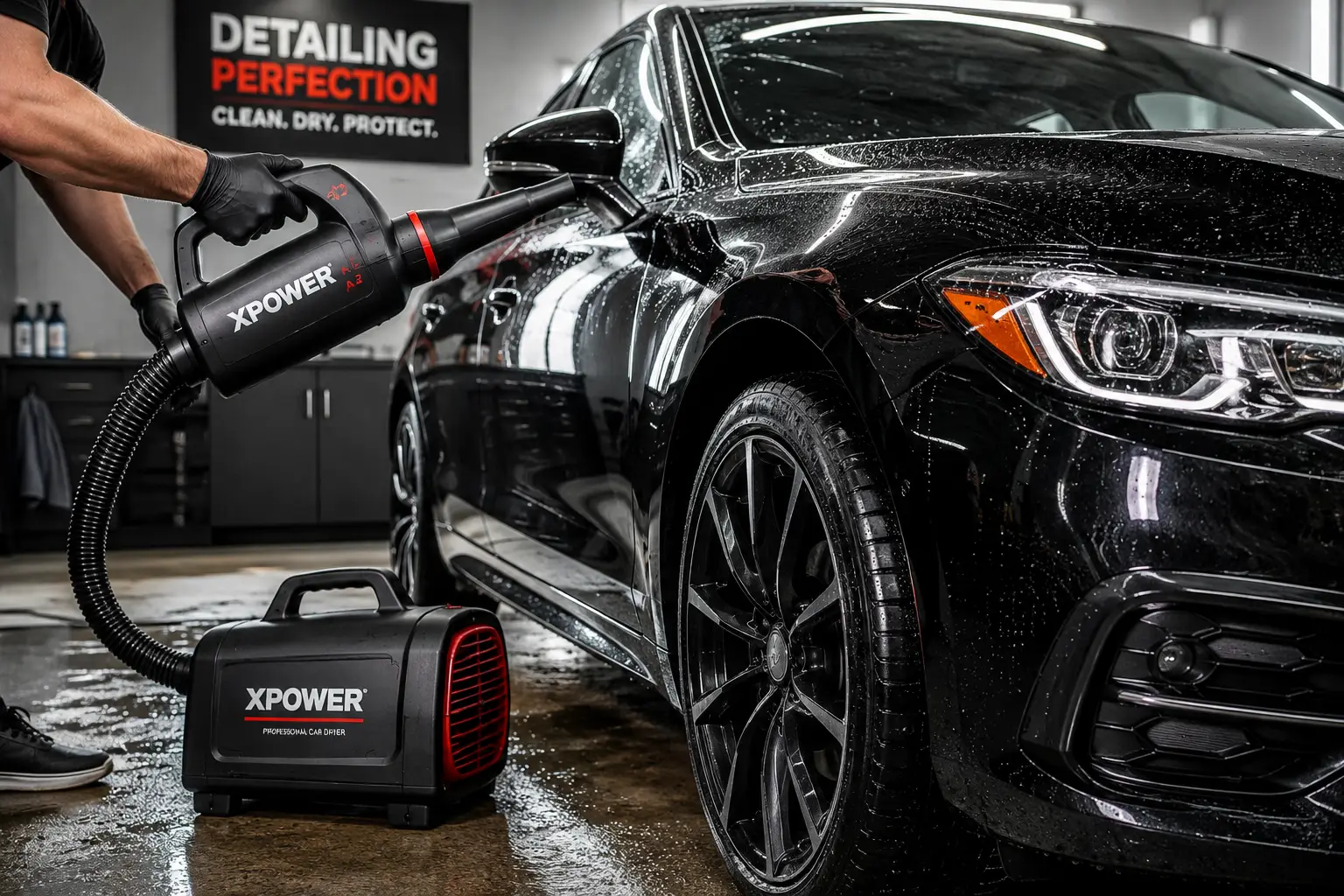
What is a car drying blower? It’s a corded or battery-powered tool that uses high-volume forced air, rather than physical contact, to push water off a vehicle’s paint, glass, and crevices. Options range from sub-$60 electric dusters to professional twin-motor units priced above $300, and CFM (airflow volume) is the single spec that matters most when comparing them.
The appeal isn’t only about dodging scratches. A blower reaches into mirror housings, door jambs, badge lettering, and wheel wells — spots a towel can’t get into without unfolding a dozen times. Left wet, those pockets are exactly where hard water leaves its calling card once it evaporates. Water itself isn’t really the problem; what’s dissolved in it is, and that distinction explains why “just towel it fast” doesn’t fully solve things. According to the U.S. Geological Survey, hard water carries elevated dissolved calcium and magnesium, and those minerals don’t evaporate along with the water — they stay behind as the chalky residue you see on hoods and windows.
This guide walks through seven real car drying blowers available in the US in 2026, spanning entry-level electric dusters to professional twin-fan units, along with the buying criteria, common mistakes, and maintenance habits that actually matter. Whether you’re drying a compact sedan in a driveway or running a mobile detailing operation, there’s a workable option below.
Quick Comparison: Car Drying Blowers at a Glance
| Product | Airflow | Power Source | Best For | Price Range |
|---|---|---|---|---|
| XPOWER A-2 Airrow Pro | 90 CFM | 500W corded | Budget multi-use dusting and drying | Under $60 |
| Adam’s Polishes Mini Air Cannon | 90 CFM | 1,200W corded | Compact handheld drying | Around $100–$140 |
| MetroVac Vac N Blo | 95 CFM | 4.0 peak HP corded | Vacuum-and-blower combo | Around $180–$230 |
| EGO POWER+ LB6500 | Up to 650 CFM | 56V cordless | Mobile, cord-free drying | Around $180–$260* |
| MetroVac Air Force Master Blaster | 114 CFM | 4.0 peak HP twin fan | Daily professional-level drying | Around $260–$320 |
| XPOWER A-12 Pro Car Dryer | 220 CFM | 4.5 HP corded | Mobile detailers, larger vehicles | Around $300–$380 |
| Adam’s Polishes Air Cannon | 392 CFM | 3.2 HP corded | Fastest full-size drying | Around $330–$400 |
*Battery and charger sold separately, which shifts the real-world price meaningfully.
Looking at the table, the split isn’t really “cheap vs. expensive” — it’s CFM tier. The XPOWER A-2 Airrow Pro and Adam’s Polishes Mini Air Cannon sit around 90 CFM, which is fine for a compact car’s exterior or for interior dusting, but you’ll be standing there a while on an SUV. The MetroVac Air Force Master Blaster, XPOWER A-12, and Adam’s Polishes Air Cannon all clear 100+ CFM, which is where drying time actually starts to drop in a way you’ll notice. The EGO POWER+ LB6500 is the wild card: its 650 CFM turbo mode beats every dedicated car dryer here, but you’re paying for a leaf blower platform, not a purpose-built detailing tool, and that shows up in the accessories you don’t get.
💬 Bookmark this table now — you’ll want to scroll back to it once you see what each of these seven can actually do.
The 7 Best Car Drying Blowers for 2026: Expert Analysis
Prices below are current-market ranges rather than fixed figures, since Amazon pricing shifts regularly — check the current price at checkout before buying, and note that prices may vary by color, bundle, or seller.
1. MetroVac Air Force Master Blaster — the daily-driver pro standard
The distinguishing benefit here is consistency: this is the blower professional detailers reach for every single day, not just for special jobs. Its twin-fan motor produces 114 CFM of airflow rated at 4.0 peak HP, running on a standard 120V outlet at 10.8 amps, and the MB-3CDSWB-30 variant ships with a 30-foot hose so you can walk the whole length of a truck without unplugging. In practice, that airflow figure means it clears standing water from a sedan’s hood and roof in under two minutes, versus five or more with a hand towel.
What most buyers overlook is the steel construction — this isn’t ABS plastic dressed up to look tough, it’s genuinely all-steel, which is why MetroVac backs the motor with a five-year limited warranty. Based on comparing the spec sheet against lighter competitors, the trade-off is weight: this unit is meant to sit on a cart or wall mount, not get carried around like a hair dryer. Reviews consistently report that the twin-motor design holds up under commercial, daily-use conditions far better than single-motor alternatives, which is exactly the audience it’s built for — mobile detailers and enthusiasts who wash multiple vehicles a week.
Pros:
- ✅ Twin-fan motor sustains commercial-grade daily use
- ✅ All-steel body backed by a 5-year motor warranty
- ✅ 30-foot hose reaches full-size trucks without repositioning
Cons:
- ❌ Heavier and bulkier than handheld alternatives
- ❌ Corded design limits use away from an outlet
At around $260–$320, the MetroVac Air Force Master Blaster earns its price if you’re drying cars often enough that a five-year warranty actually matters to you.
2. Adam’s Polishes Air Cannon — fastest full-size drying available
The standout trait is raw output: 392 CFM at 3.2 HP, which is the highest airflow of any purpose-built car dryer on this list. That number translates directly into speed — where a 90 CFM handheld might take four to five minutes per panel, this pushes over 73,000 feet per minute of air, clearing a hood or roof in a fraction of that time. It runs on a 20-amp circuit, which is worth checking against your garage’s wiring before buying.
The self-expanding 30-foot hose and rolling caster base are what separate this from a repurposed leaf blower — you’re not dragging a heavy unit around by hand, you’re wheeling it and extending a lightweight hose instead. What the spec sheet doesn’t say, but user feedback suggests, is that the noise-cut technology genuinely makes a difference; at 88 dB it’s loud but not painful, which matters if you’re drying a car in a residential driveway on a Saturday morning. Reviews consistently mention it as close to essential for anyone maintaining a ceramic coating, since hydrophobic paint beads water into large droplets that a high-CFM blast handles almost instantly.
Pros:
- ✅ Highest CFM of any dedicated car dryer here
- ✅ Rolling base and self-expanding hose ease maneuvering
- ✅ Noise-cut technology keeps operation from being punishing
Cons:
- ❌ Requires a dedicated 20-amp circuit
- ❌ Priciest option on this list
Expect to pay in the $330–$400 range. If you own multiple vehicles or maintain a ceramic coating, the Adam’s Polishes Air Cannon is genuinely worth the premium.
3. EGO POWER+ LB6500 — best cordless option, borrowed from the yard
This is a genuine leaf blower, not a dedicated detailing tool, and that’s precisely its distinguishing benefit: 650 CFM in turbo mode with air speeds up to 180 MPH, all without a cord tethering you to an outlet. The variable speed dial runs from 225 to 470 CFM for controlled work, with turbo reserved for blasting standing water off larger panels fast.
In practice, what this means is you can dry a car in a driveway, a parking garage, or anywhere else a 56V battery reaches, with none of the tripping hazards a 30-foot cord creates. Based on comparing this to purpose-built dryers, the trade-off is accessories — you get flat and tapered nozzles for yard debris, not the fine-tip attachments detailing-specific blowers include for crevices and trim. Reviews from owners routinely mention using it for drying cars alongside its intended lawn work, calling out the turbo mode specifically for blasting water off panels after a wash. Runtime is solid, at up to 90 minutes on the recommended 5.0Ah battery, though that battery and its charger are sold separately from the bare tool.
Pros:
- ✅ Cordless freedom with class-leading 650 CFM turbo
- ✅ Variable speed dial for controlled, lower-power work
- ✅ Multi-purpose: doubles as a genuine yard blower
Cons:
- ❌ Battery and charger add $100+ to the real price
- ❌ Lacks fine detailing nozzles built-in dryers include
The bare tool runs around $180–$260, but budget for a battery kit if you don’t already own the EGO 56V platform — total cost often lands closer to $300.
4. XPOWER A-12 Professional Car Dryer Blower — mobile-detailer workhorse
The defining trait is the mobile dock: this 220 CFM, 4.5 HP unit sits on a wheeled base with lockable casters, so you roll it from bay to bay instead of hauling it. Dual heat settings let you switch between cold air for quick passes and warm air that speeds evaporation in humid climates — heat can accelerate evaporation noticeably compared to cold-air-only blowers.
What most buyers overlook is the washable, reusable filter system, which XPOWER ships with two complete filter sets so one is always ready while the other dries or gets cleaned. That’s a meaningful difference from disposable-filter competitors over a few years of ownership. Based on comparing the 16-foot self-expanding hose against the Master Blaster’s 30-foot version, this is built more for a fixed detailing bay than for chasing a car around a large driveway — plan your workspace accordingly. It can also be removed from the dock entirely and used handheld, or wall-mounted with an optional kit, which adds flexibility as a shop matures.
Pros:
- ✅ Wheeled mobile dock speeds up multi-bay workflows
- ✅ Dual heat settings adapt to humid or cold climates
- ✅ Washable dual filter sets cut long-term consumable costs
Cons:
- ❌ 16-foot hose is shorter than some corded rivals
- ❌ Bulkier footprint than handheld units
Priced around $300–$380, the XPOWER A-12 Professional Car Dryer Blower targets small detailing operations more than casual weekend owners.
5. Adam’s Polishes Mini Air Cannon — best compact handheld
The Mini Air Cannon’s hook is portability without sacrificing real output: 90 CFM and 19,000 FPM from a 1,200-watt motor, in a unit weighing roughly 3 pounds 2 ounces. That’s light enough to hold one-handed through an entire detail without arm fatigue, something the full-size Air Cannon can’t claim.
Here’s what to weigh: at 90 CFM, this handles a sedan’s exterior competently and excels at interior dusting, door jambs, and vent crevices, but it will feel underpowered on a truck or SUV compared to the 200+ CFM options above. The 20-foot power cord is genuinely long for a handheld tool, letting you circle most vehicles without unplugging and repositioning. Reviews consistently praise the heated, filtered air output for leaving no lint or debris behind — a detail that matters when you’re drying right before a wax or ceramic application, since any dust the blower kicks up would otherwise embed into a fresh coating.
Pros:
- ✅ Lightweight, one-handed handling for full details
- ✅ Filtered, heated air avoids introducing new debris
- ✅ 20-foot cord covers most vehicles without repositioning
Cons:
- ❌ 90 CFM is modest for larger vehicles
- ❌ No hose — nozzle range is limited to arm’s reach
At roughly $100–$140, this is the pick for buyers who want touchless drying without committing to a full-size, higher-amperage unit.
6. MetroVac Vac N Blo — vacuum, blower, and inflator in one
The distinguishing benefit is versatility: a 4.0 peak HP motor delivering 95 CFM that works as a vacuum, a blower, and an inflator with MagicAir adapters, all in one all-steel housing. For buyers who don’t want three separate tools taking up garage shelf space, that’s a meaningful practical advantage.
In practice, the vacuum side handles interior debris and upholstery with commercial-quality suction, while flipping to blower mode clears vents, crevices, and engine bays before you even touch exterior water. What the spec sheet doesn’t say, but the steel build implies, is durability under repeated use — this isn’t a tool designed to be replaced every couple of seasons. Based on comparing it against single-purpose dryers, the 95 CFM output is respectable for exterior drying but not class-leading; if drying speed alone is your top priority, the Master Blaster or either Air Cannon will outpace it. Where the Vac N Blo wins is total value per dollar spent across multiple use cases, rather than raw airflow.
Pros:
- ✅ Three tools in one: vacuum, blower, and inflator
- ✅ All-steel construction built for repeated use
- ✅ Solid 95 CFM output for general exterior drying
Cons:
- ❌ Not the fastest option for large vehicles
- ❌ Accessories add clutter compared to single-purpose tools
Expect to pay around $180–$230 — a strong middle-ground pick if you want one machine that replaces three.
7. XPOWER A-2 Airrow Pro (Cyber Duster) — best budget multi-use pick
The hook is price-to-versatility ratio: a 3/4 HP, 500-watt motor producing 90 CFM for around a third the cost of the pricier options above, with nine nozzle attachments covering dusting, drying, and inflating. It’s ETL/CETL safety certified, which matters for anything plugged into a household outlet near water.
Here’s what to weigh: at 2.3–3.1 pounds and 90 CFM, this competes directly with the Mini Air Cannon on paper, but it’s marketed as a general-purpose electric duster first and a car dryer second — the accessory kit reflects that broader intent, with brush attachments for electronics alongside blower nozzles for automotive use. What most buyers overlook is the built-in 2-speed control and washable filter, both of which extend usable life well beyond a canned-air alternative it’s explicitly designed to replace. Reviews describe it as a genuinely useful multi-tool for anyone who also cleans keyboards, cameras, or blinds regularly, not just a single-purpose car gadget.
Pros:
- ✅ Lowest price point of any option on this list
- ✅ Nine nozzles cover drying, dusting, and inflating
- ✅ ETL/CETL certified with a washable filter
Cons:
- ❌ Corded design and shorter 10-foot cord
- ❌ 90 CFM lags well behind the professional-grade picks
At under $60, the XPOWER A-2 Airrow Pro is the sensible entry point if you’re not yet sure a dedicated dryer is worth a bigger investment.
How to Dry Your Car with a Blower: A Step-by-Step Guide
Getting a touchless dry right isn’t complicated, but skipping a step is exactly how people end up with the same water spots they were trying to avoid. Start by rinsing thoroughly with a final pass of filtered or deionized water if you have access to it — this matters more than the blower itself, since the dissolved minerals in your water source are what actually cause spotting once evaporation begins, not the water itself.
Work top-down and front-to-back, matching your blower’s motion to gravity: air pushes water off the roof and hood, and it naturally sheets downward toward the rocker panels rather than pooling. Hit high-risk crevices deliberately — mirror housings, badge lettering, the trunk seam, and wheel wells — since these areas trap standing water that a quick pass misses. If your blower has a heat setting, use it in humid climates where evaporation is naturally slower; in dry Southwestern climates, cold air alone usually finishes the job before minerals have time to concentrate.
Finish with a walk-around inspection under angled light, checking door jambs and the fuel-door recess specifically, since those spots dry unevenly and often get missed entirely. If you notice new spots forming within a minute of finishing, your water source is likely harder than average, and a rinse aid or deionization filter attached to your hose is worth the investment.
Real-World Scenarios: Matching the Right Blower to Your Situation
Picture a college student washing a compact sedan in a shared apartment parking lot twice a month, budget under $75, no dedicated 20-amp outlet available. The XPOWER A-2 Airrow Pro fits this profile precisely — low cost, standard outlet compatibility, and enough CFM for a small car’s exterior in a reasonable time.
Now picture a weekend enthusiast with a ceramic-coated daily driver, washing weekly in a home garage with standard 120V outlets. The Adam’s Polishes Mini Air Cannon or the MetroVac Air Force Master Blaster both make sense here, depending on whether portability (the Mini) or daily-use durability (the Master Blaster) matters more to that particular owner.
Finally, picture a mobile detailer running three to five vehicles a day out of a service van, often without reliable outlet access at every job site. The EGO POWER+ LB6500‘s cordless operation solves the access problem directly, while the XPOWER A-12‘s mobile dock suits a fixed-location detailing bay instead — the right choice here depends entirely on whether the work happens at a shop or on the road.
Common Car-Drying Problems and How to Solve Them
Problem: Water keeps pooling in the side mirrors and trunk seam. These recessed areas trap water that gravity won’t clear on its own. Solution: angle the nozzle directly into the recess rather than blowing across the surface, and finish with a folded microfiber corner if any moisture remains after the blower pass.
Problem: New spots appear minutes after drying. This usually means your local water is hard enough that minerals are concentrating faster than the blower can clear them. Solution: switch to a rinse-aid additive in your final rinse, or attach an inline deionization filter to your hose — both reduce the dissolved mineral load before it ever reaches the paint.
Problem: The blower feels underpowered on a larger SUV or truck. A sub-100 CFM unit simply moves less air per minute than a 200+ CFM model, and that gap becomes obvious on bigger surface areas. Solution: step up to a higher-CFM option like the XPOWER A-12 or Adam’s Polishes Air Cannon rather than fighting a mismatched tool.
Problem: Cord length keeps forcing you to unplug and reposition. Solution: either choose a longer-hose model like the MetroVac Air Force Master Blaster‘s 30-foot reach, or switch to a cordless option like the EGO POWER+ LB6500 entirely.
How to Choose a Car Drying Blower: A 7-Step Framework
- Start with CFM, not motor wattage. Airflow volume determines drying speed far more directly than horsepower or watts alone — a well-engineered lower-wattage motor can still push solid CFM.
- Match power source to your workspace. Corded units need a nearby outlet (and ideally a dedicated circuit for anything above 220 CFM); cordless units need a charged battery and shorter continuous runtime.
- Consider hose length over raw portability. A 20–30 foot hose often beats a lighter handheld unit for actually covering a full vehicle without repositioning.
- Check for heat settings if you’re in a humid region. Warm air can meaningfully speed evaporation versus cold-air-only models.
- Factor in filter maintenance. Washable, reusable filters cost less over several years than disposable equivalents.
- Weigh noise level against where you’ll use it. A driveway in a quiet neighborhood makes an 88 dB noise-cut model far more livable than a louder alternative.
- Set a realistic budget tier. Entry-level (under $75), mid-range ($100–$250), and professional ($260+) all solve the same basic problem — the difference is speed, durability, and daily-use tolerance.
Car Drying Blowers vs. Towel Drying vs. Leaf Blowers
| Method | Scratch Risk | Speed | Reaches Crevices | Upfront Cost |
|---|---|---|---|---|
| Microfiber towel | Moderate-high | Slow | Poor | Under $20 |
| Untuned yard leaf blower | Low (unfiltered air risk) | Fast | Fair | $0 (if owned) |
| Dedicated car drying blower | Very low | Fast | Excellent | $60–$400 |
The comparison isn’t as one-sided as it looks, though — a plain yard leaf blower pulls unfiltered air straight from the ground, which means dust, pollen, and grit can get flung right back onto a freshly washed panel. Dedicated units like the Adam’s Polishes Air Cannon or MetroVac Air Force Master Blaster filter incoming air specifically to avoid that problem, which is the real difference buyers are paying for, not just the “car dryer” label. Towels remain the cheapest option by far, but the scratch risk compounds every single wash, which is exactly the cost a touchless blower is designed to eliminate over the vehicle’s lifetime.
Common Mistakes to Avoid When Buying a Car Drying Blower
The biggest mistake is chasing MPH instead of CFM. A blower rated at high MPH but low CFM moves air fast in a narrow stream, which is great for blasting a small area but slow for clearing an entire hood — volume matters more than velocity for car drying specifically. Another common misstep is buying a corded unit without checking amperage draw against a garage’s existing circuits; a 20-amp requirement on a shared 15-amp circuit means tripped breakers, not a faster dry.
Buyers also frequently underestimate hose or cord length needs, assuming a 10-foot handheld tool will comfortably circle a full-size SUV — it won’t, without repeated unplugging and repositioning. Finally, skipping the noise rating is a mistake in shared housing or tight neighborhoods; an 84–95 dB unit run early on a Saturday morning is a fast way to hear from a neighbor.
What to Expect: Everyday Performance
On paper, CFM numbers look abstract, but in practice they translate to real minutes. A 90 CFM handheld typically clears a compact sedan’s exterior in 8–12 minutes of active blowing. Step up to the 114 CFM MetroVac Air Force Master Blaster and that same sedan drops to roughly 5–7 minutes, with a full-size truck landing around 10–15. At 392 CFM, the Adam’s Polishes Air Cannon can clear a sedan in under 4 minutes with a practiced technique, though crevices and trim still take deliberate, slower passes regardless of raw airflow.
Battery-powered options like the EGO POWER+ LB6500 perform comparably to their CFM rating suggests, but real-world runtime matters just as much as peak output — turbo mode at 650 CFM will drain a battery noticeably faster than the variable-speed range, so most owners use turbo in short bursts rather than continuously.
Car Drying Blowers for Different Vehicles and Drivers
For compact car and sedan owners washing weekly, a 90–120 CFM handheld like the Adam’s Polishes Mini Air Cannon or MetroVac Air Force Master Blaster covers the job efficiently without excess cost. SUV and truck owners benefit disproportionately from the jump to 200+ CFM, since larger surface area means the CFM gap becomes the dominant factor in total drying time — the XPOWER A-12 or Adam’s Polishes Air Cannon pay off fastest here. Motorcycle owners, meanwhile, often do better with a handheld unit’s precision over a high-CFM blast, since narrower panels and exposed mechanical components benefit from controlled airflow rather than sheer volume. Multi-vehicle households running two or three cars through weekly washes should weigh a corded professional unit’s durability against a cordless model’s flexibility across different parking locations.
Long-Term Cost and Maintenance
A $60 electric duster and a $380 professional dryer both dry a car — the real cost difference shows up over years, not at checkout. Corded units with washable filters, like the XPOWER A-12, avoid the recurring cost of disposable filter replacements that some competing designs require. Cordless tools carry a hidden cost most buyers miss upfront: battery packs degrade over charge cycles and eventually need replacement, adding $80–$150 to the total cost of ownership on platforms like the EGO 56V system a few years in.
Motor life is the other long-term variable. All-steel construction, as seen in the MetroVac Air Force Master Blaster and MetroVac Vac N Blo, tends to outlast ABS plastic housings under frequent use, which is reflected in MetroVac’s five-year motor warranty — a meaningful signal of expected lifespan compared to shorter one-year warranties on lighter-duty units. For anyone drying more than one vehicle weekly, the professional-tier unit’s higher upfront cost often works out cheaper per wash over a five-year span than replacing a budget unit twice in that same window.
Safety, Regulations, and Standards
Because these tools combine electricity and water by design, a few safety basics matter more than with typical household appliances. The Occupational Safety and Health Administration notes that sustained exposure above 85 decibels can contribute to hearing damage over time — worth keeping in mind if you’re running a higher-output blower regularly, since several models in this guide sit in the 84–95 dB range during operation. Casual home use for a few minutes a week isn’t a comparable exposure to an eight-hour industrial shift, but hearing protection is a reasonable habit for anyone using a professional-tier unit daily.
Electrical safety matters even more directly. The Consumer Product Safety Commission recommends ground-fault circuit interrupter (GFCI) protection for any electrical tool used outdoors or near water, and a driveway car wash is precisely that scenario. Plugging a corded blower into a GFCI-protected outlet — most modern outdoor outlets already include one — meaningfully reduces shock risk if a cord or connection gets wet. Look for ETL, UL, or CETL certification markings on any corded unit before buying, since these indicate independent third-party safety testing rather than just a manufacturer’s own claims.
Frequently Asked Questions
❓ What's the best car drying blower for a small budget?
❓ How many CFM do I actually need to dry a car?
❓ Can I just use a regular leaf blower to dry my car?
❓ Are car drying blowers safe to use on a wet driveway?
❓ How long does it take to dry a full-size truck with a blower?
Conclusion
Towel drying has always been the default because it’s cheap and familiar, not because it’s actually good for paint. Every pass introduces a real chance of swirl marks, and no amount of careful technique fully eliminates that risk. Car drying blowers solve the problem at its source by removing physical contact entirely, and the seven options covered here span every realistic budget and use case — from the sub-$60 XPOWER A-2 Airrow Pro for occasional weekend washes, to the twin-motor MetroVac Air Force Master Blaster for daily professional use, to the 392 CFM Adam’s Polishes Air Cannon for anyone who simply wants the fastest possible dry.
The right pick ultimately comes down to three questions: how often you’re washing, how large your vehicle is, and whether cord access or cordless freedom matters more in your specific driveway or shop. Answer those honestly, match the CFM tier to your actual needs rather than the highest number available, and a touchless dry becomes one less thing to worry about every time you wash.
✨ Ready to make swirl marks a thing of the past? Check current pricing on your top pick above and give your paint the touchless dry it deserves. 🚗💨
Recommended for You
- Best Microfiber Towels for Detailing: 7 Top Picks (2026)
- Best Drying Towel 2026: 7 Picks That Won’t Scratch Your Paint
- Automotive Drying Towels: 7 Best Picks Ranked for 2026
Disclaimer: This post contains affiliate links. As an Amazon Associate, I earn from qualifying purchases made through these links, at no additional cost to you.
✨ Found this article helpful? Share it with someone who needs it! 💬🤗