In This Article
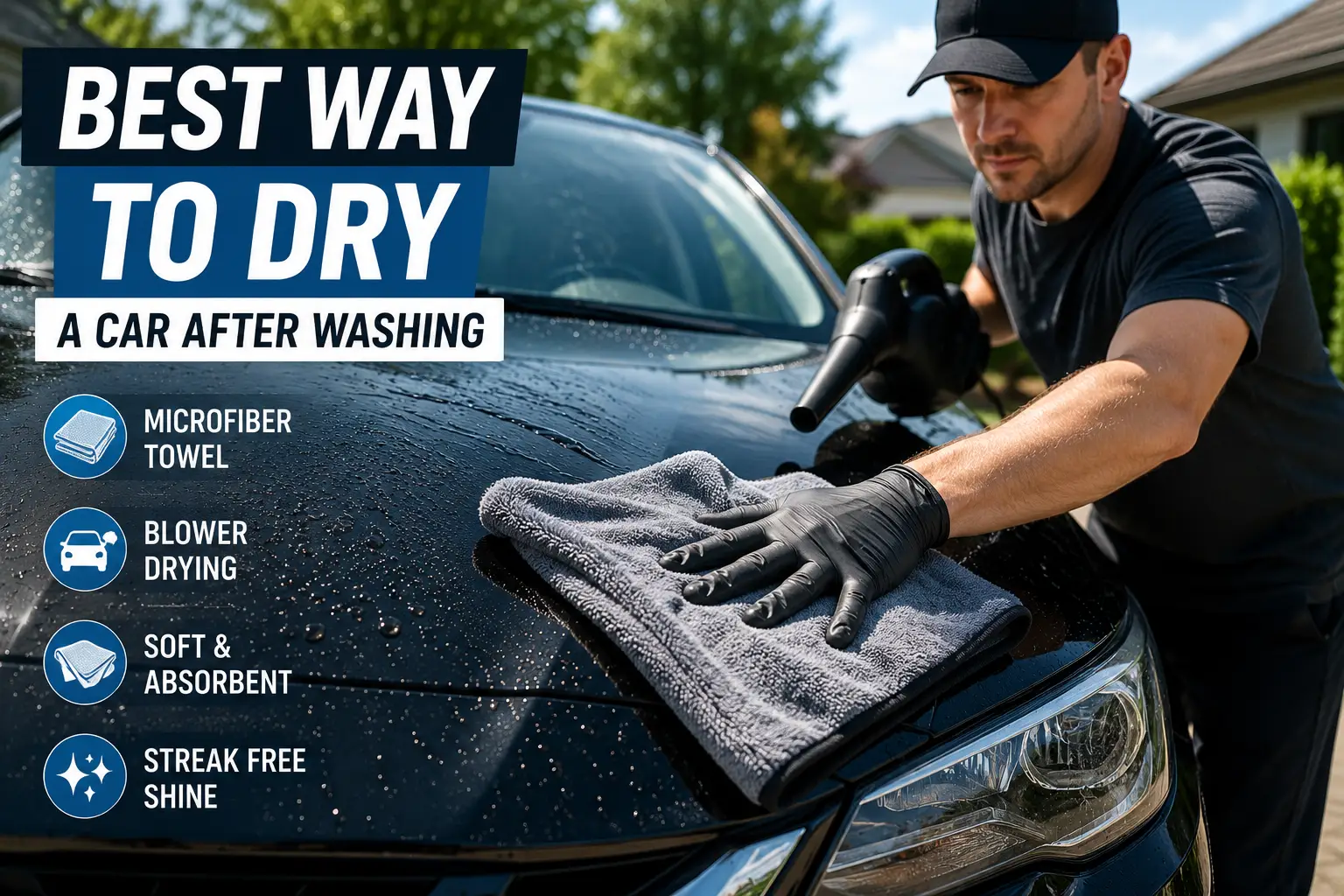
If you’ve ever stepped back from a fresh wash only to watch water spots bloom across your hood as it air-dries, you already know that rinsing your car is only half the job. The best way to dry a car after washing isn’t about speed — it’s about pulling water off the paint before it evaporates and leaves behind the mineral residue that etches into your clear coat over time. Get the drying step wrong and you can undo twenty minutes of careful washing in about ninety seconds flat.
This guide breaks down exactly how experienced detailers approach drying, why some tools genuinely outperform others, and which products are worth adding to your routine. We’ll compare seven real, currently available options — from twist-loop microfiber towels to touchless electric blowers — and explain the tradeoffs in plain English. You’ll also get a step-by-step drying method, common mistakes to avoid, and answers to the questions people search most often about how to dry a car after washing without leaving a single streak behind.
Whether you’re washing a daily driver in the driveway or maintaining a weekend project car, the right combination of tools and technique makes drying faster, safer for your paint, and genuinely satisfying to do — and it fits neatly alongside the broader expert detailing habits Consumer Reports recommends for keeping a finish looking newer, longer.
Quick Comparison: 7 Best Car-Drying Tools at a Glance
| Product | Type | Best For | Price Range |
|---|---|---|---|
| The Rag Company Gauntlet | Twist-loop microfiber towel | All-around daily drying | around $15–$25 (2-pack) |
| Meguiar’s Water Magnet | Microfiber drying towel | Budget-friendly beginners | around $12–$18 |
| The Rag Company The Liquid8r | Oversized twist-loop towel | Large vehicles, max absorbency | around $18–$28 |
| LASFIT XL Drying Towel | High-GSM twisted-loop towel | Streak-free value pick | around $14–$22 |
| MetroVac DataVac Pro Series 2 | Electric touchless blower | Zero-contact, swirl-free drying | around $90–$120 |
| Armor All PVA Synthetic Chamois | Traditional chamois | Simple, low-cost drying | around $8–$14 |
| Adam’s Polishes Detail Spray | Drying aid / quick detailer | Boosting slickness and shine | around $14–$20 |
Looking at this lineup, you’ll notice it spans four genuinely different approaches to the same problem: absorb the water with a towel, evaporate it with airflow, wick it away with a chamois, or reduce surface tension with a spray so water beads off before you even wipe. Your driveway conditions, budget, and how much time you want to spend each week should guide which category you lean toward first. Most experienced owners eventually end up combining at least two of these — typically a premium towel plus a detail spray, or a blower plus a smaller towel for tight spots the airflow can’t reach.
💬 One click helps other shoppers make an informed choice too! 😊
Top 7 Car-Drying Tools: Expert Analysis
1. The Rag Company Gauntlet — best all-around twist-loop towel
The Gauntlet earns its reputation as the default recommendation in most detailing forums, and for good reason. Its 70/30 Korean microfiber blend at roughly 900 GSM (grams per square meter) means the loops are dense enough to trap water instead of pushing it around the panel, which is exactly what causes those fine spiderweb scratches under direct sunlight. The twisted-loop weave — as opposed to a flat terry weave — keeps the fiber tips from dragging grit across the clear coat.
In practice, that GSM density translates to fewer passes per panel, which matters if you’re drying a full-size SUV before the sun bakes water spots into the paint. Reviewers consistently point out that the edges are silk-bound rather than serged, which prevents the scratchy stitched edge that shows up on cheaper towels after a few wash cycles. This is a strong pick for owners who wash weekly and want a towel that holds up over two or three years of regular use rather than fraying by month six.
Aggregated customer feedback is overwhelmingly positive, with buyers frequently noting the towel absorbs noticeably more water per pass than the towels bundled with wash kits, and that it stays soft even after dozens of machine washes.
Pros:
- ✅ Dense 900 GSM weave lifts water fast
- ✅ Silk-bound edges prevent scratches
- ✅ Holds up well after repeated washing
Cons:
- ❌ Pricier than basic terry shop towels
- ❌ Needs a dedicated microfiber-safe detergent
At around $15–$25 for a two-pack, the Gauntlet delivers professional-grade drying performance at a price that’s easy to justify once you factor in how few of these you’ll need to buy over the life of your car.
2. Meguiar’s Water Magnet — best budget-friendly beginner towel
The Water Magnet is one of the most widely available drying towels in the US, sold in most auto parts stores as well as on Amazon, which makes it a low-friction entry point if you’re building your first detailing kit. Meguiar’s markets it as absorbing roughly twice the water of a standard cotton towel, and the plush microfiber pile backs that up reasonably well for a mainstream, non-boutique product.
The practical benefit here is accessibility: because it’s a recognizable brand carried nearly everywhere, you’re not stuck waiting on a specialty shipment if your only towel wears out mid-wash. It’s a sensible pick for someone who washes their car every few weeks rather than weekly, since the fiber density, while good, doesn’t quite match the twist-loop premium towels on this list.
Reviews describe it as reliably absorbent for the price, though a subset of long-term users note the pile flattens somewhat faster than pricier twist-loop alternatives after a year of regular washing and drying.
Pros:
- ✅ Widely available at major US retailers
- ✅ Strong absorbency for a mainstream product
- ✅ Beginner-friendly price point
Cons:
- ❌ Pile flattens faster than premium towels
- ❌ Single-layer design holds less water per pass
Priced around $12–$18, it’s a genuinely solid value pick — not the best performer on this list, but a dependable choice if you’re not ready to invest in a premium twist-loop towel yet.
3. The Rag Company The Liquid8r — best for large vehicles and max absorbency
If you drive a full-size truck, three-row SUV, or anything with more real estate than a compact sedan, the Liquid8r‘s oversized 25×36-inch format and 1,100 GSM density solve a problem the smaller towels on this list can’t: running out of dry towel real estate halfway through the hood. The extra-long fibers create more surface area per swipe, meaning you cover more panel before the towel becomes saturated and needs wringing out.
What this means in practice is fewer trips back to the bucket to wring out water, which matters more than it sounds — every extra minute your paint sits wet under the sun increases the odds of spot formation. The 70/30 microfiber blend follows the same scratch-safe logic as the Gauntlet, just scaled up in size and absorbency capacity.
Aggregated reviews highlight that owners of larger vehicles specifically call out the size as the differentiator versus standard 16×24 towels, with several noting they need one Liquid8r versus two standard towels to fully dry a pickup bed and cab.
Pros:
- ✅ Oversized format covers more panel per pass
- ✅ 1,100 GSM density needs fewer wring-outs
- ✅ Ideal for trucks, SUVs, and vans
Cons:
- ❌ Bulkier and heavier when fully saturated
- ❌ Overkill for compact cars and motorcycles
At around $18–$28, the Liquid8r costs more than a standard towel, but for large-vehicle owners the time saved per wash session justifies the premium.
4. LASFIT XL Drying Towel — best high-GSM value pick
The LASFIT towel is a newer entrant that’s carved out a niche by pushing GSM density to roughly 1,300 while keeping pricing closer to the budget tier than the established premium brands. That density figure matters because, generally speaking, higher GSM correlates with more water absorbed per square inch before the towel needs wringing — a genuine performance lever, not just a marketing number.
The twisted-loop construction mirrors what you’ll find on the Gauntlet and Liquid8r, meaning the scratch-safety profile is comparable despite the lower price point. For buyers who’ve researched GSM ratings and want to maximize that spec without paying premium-tier pricing, this is one of the more compelling options currently on Amazon.
Early aggregated reviews are positive on absorbency and softness, though the brand has a shorter track record than The Rag Company or Meguiar’s, so long-term durability claims (fiber retention after 50+ wash cycles) are less established by independent long-term testing.
Pros:
- ✅ Very high 1,300 GSM density for the price
- ✅ Twisted-loop weave matches premium safety profile
- ✅ Strong value versus established premium brands
Cons:
- ❌ Shorter market track record than legacy brands
- ❌ Long-term durability less independently verified
At around $14–$22, it’s an appealing middle-ground pick for buyers chasing performance specs without committing to top-tier pricing.
5. MetroVac DataVac Pro Series 2 — best touchless electric blower
The DataVac Pro Series 2 takes an entirely different approach: instead of touching the paint at all, its 780-watt motor blasts variable-speed airflow that physically pushes water out of mirrors, badges, trim gaps, and side mirror housings — the exact spots where a towel leaves streaks or trapped moisture that later drips down your freshly dried doors. Because nothing contacts the paint, the swirl-mark risk that comes from repeated towel friction essentially drops to zero.
In practice, most owners use it as a finishing tool rather than a full replacement for towel drying — blast the big flat panels and tight crevices first, then follow up with a microfiber towel on hood and roof for a fully streak-free finish. The variable speed control matters here: full blast on delicate trim or badges can be excessive, while a lower setting handles those areas more gently.
Reviews are strongly positive on build quality and motor durability, with several users noting they’ve owned the same unit for years of regular detailing without issue, though some mention the noise level is noticeably louder than a typical shop vacuum.
Pros:
- ✅ Zero paint contact means zero swirl risk
- ✅ Clears water from gaps towels can’t reach
- ✅ Durable motor built for repeated use
Cons:
- ❌ Noticeably loud during operation
- ❌ Higher upfront cost than any towel
Expect to pay around $90–$120, which is a real investment compared to a towel, but for owners who detail regularly or maintain a showroom-condition finish, it pays for itself in reduced swirl marks over time.
6. Armor All PVA Synthetic Chamois — best budget traditional pick
The PVA Synthetic Chamois represents the old-school approach to car drying, and it’s stuck around because the core mechanism genuinely works: the spongy PVA foam material wicks water into itself through capillary action rather than just absorbing on the surface like a towel, then you wring it out and keep going. It’s a single sheet rather than a stack of towels, which some owners actually prefer for simplicity.
What this means for a first-time buyer is a lower cost of entry and a smaller storage footprint than a stack of microfiber towels, though the tradeoff is that a chamois needs to stay damp to work properly — let it dry out stiff between uses and it becomes far less effective until re-softened in water.
Aggregated reviews are mixed compared to the microfiber options on this list: many buyers appreciate the classic streak-free wipe-down feel, while others report the material cracking or degrading faster than expected if left folded and dry in a hot trunk or garage.
Pros:
- ✅ Lower price point than premium microfiber
- ✅ Classic streak-free finish when used correctly
- ✅ Compact, single-sheet storage
Cons:
- ❌ Degrades faster if stored dry and folded
- ❌ Less scratch-safe than twist-loop microfiber
At around $8–$14, it’s the most budget-accessible option here, best suited to buyers who want a simple, low-commitment entry point before investing further.
7. Adam’s Polishes Detail Spray — best drying aid to pair with a towel
The Detail Spray isn’t a drying tool by itself — it’s a lubricating spray you mist onto the paint before or during the drying step that reduces surface tension so water beads and sheets off more easily, meaning your towel or blower has noticeably less work to do. This matters because friction between a slightly dry towel and residual grit is one of the more common causes of fine scratches during drying.
Used correctly, you spray a light mist across a panel, then follow immediately with your towel or blower, and the added slickness lets the towel glide rather than drag. Several detailers layer this into their post-wash routine specifically because it also adds a temporary gloss boost, meaning drying and a mini top-up of shine happen in the same step.
Reviews consistently highlight the multi-purpose nature of the product — buyers use it for drying assistance, but also as a standalone quick detailer between full washes and as a clay bar lubricant — which is a meaningful value factor for a single bottle.
Pros:
- ✅ Reduces friction during towel drying
- ✅ Multi-purpose beyond just drying assistance
- ✅ Adds temporary gloss during the process
Cons:
- ❌ Doesn’t replace a towel or blower on its own
- ❌ Requires reapplication on larger vehicles
At around $14–$20 per bottle, it’s a smart complementary purchase rather than a standalone solution — pair it with the Gauntlet or DataVac Pro Series 2 for the most noticeable improvement in finish quality.
How to Dry a Car After Washing: A Step-by-Step Method
Getting the technique right matters as much as which tool you buy. Start by working in the shade or a covered garage whenever possible — direct sun accelerates evaporation, which is exactly what causes mineral deposits to bake onto the clear coat before you can wipe them away. If shade isn’t available, dry as quickly as you can after the final rinse rather than letting the car sit.
Begin at the roof and work downward, since gravity pulls residual water from upper panels onto lower ones as you go — drying top-down means you’re not re-wetting sections you already finished. Use the drag-and-lift technique: lay the towel flat, pull it across the panel in one direction, then lift and reposition rather than scrubbing back and forth, which regrinds any trapped grit into the paint.
Fold your towel into quarters and rotate to a dry section every panel or two, since a saturated towel stops absorbing and starts smearing water around instead. For tight areas — door jambs, mirror housings, emblem gaps, wheel wells — a blower or a dedicated smaller towel handles what a big towel physically can’t reach. Finish with a quick once-over using a spray detailer to catch any remaining streaks and add a bit of shine.
A Consumer Reports guide to washing your car reinforces this shaded, methodical approach as part of a broader routine that protects your paint’s finish over the vehicle’s lifespan, not just the drying step in isolation.
Real-World Scenarios: Matching the Method to Your Life
Consider a college student who washes their compact sedan every other weekend in a shared apartment parking lot with no covered area. Speed and portability matter most here, so a single Meguiar’s Water Magnet towel paired with the Armor All PVA Synthetic Chamois as backup covers the basics without a big upfront investment or bulky storage needs.
A suburban family with a minivan and a pickup truck faces a different problem: more surface area per wash and less patience for a two-hour Saturday chore. The Liquid8r‘s oversized format cuts wring-out trips significantly, and adding the DataVac Pro Series 2 for door jambs, mirror housings, and the truck bed rails turns a laborious process into something that fits into a lunch break.
Then there’s the enthusiast with a weekend project car who washes weekly and genuinely cares about swirl-free paint under garage lighting. For this buyer, the combination of the Gauntlet for main panels, the DataVac Pro Series 2 for zero-contact detail work, and Adam’s Polishes Detail Spray as a friction-reducing finishing step represents close to best-practice technique, and the upfront cost is easily justified by the paint protection over years of ownership.
Common Drying Mistakes That Cause Water Spots and Swirls
The single most common mistake is letting the car air-dry in direct sunlight, assuming the water will just evaporate cleanly. In reality, water carries dissolved minerals that stay behind on the paint as the water itself evaporates, forming the pale, ring-shaped spots you’ll notice under bright light — sometimes permanently etched if left too long.
A second frequent error is using an old bath towel or terry shop rag instead of a dedicated microfiber or chamois product. Cotton terry weaves have short, stiff loops that trap grit against the paint and drag it across the surface during wiping, which is a primary cause of fine swirl marks visible in direct sunlight or under garage lighting.
Third, many owners scrub in circular motions rather than using the straight-line drag-and-lift technique, which regrinds any remaining particles instead of lifting them away. And finally, reusing a single saturated towel across the entire vehicle without rotating to a dry section or rinsing it out mid-dry effectively means you’re smearing dirty water around rather than removing it — the solution is simple: keep two or three towels in rotation, or a bucket of clean water to rinse your towel between panels.
What Is the Best Way to Dry a Car After Washing?
The best way to dry a car after washing is to remove water quickly and gently, without letting it sit long enough to evaporate on its own. In practice, that means using an absorbent twist-loop microfiber towel or a touchless air blower, working in the shade, moving top to bottom, and switching to a dry towel section (or rinsing a chamois) before it becomes saturated and starts redistributing water instead of lifting it.
This approach directly addresses the two biggest risks of improper drying: mineral water spots from air-drying, and fine swirl marks from dragging a gritty or oversaturated towel across the clear coat. Combining a quality towel with a drying aid spray, as covered in the product breakdown above, further reduces friction and speeds up the whole process.
How to Choose the Right Car-Drying Tool
- Check the GSM rating on towels. Higher GSM (generally 700 and above) means denser fibers that absorb more water per pass and need fewer wring-outs during a full wash.
- Confirm twist-loop or waffle-weave construction over flat terry. These weaves trap water and grit away from the paint’s surface, dramatically reducing scratch risk compared to flat or looped terry cloth.
- Match towel size to your vehicle. A compact car does fine with a 16×24-inch towel, while trucks and SUVs benefit from oversized 25×36-inch options like the Liquid8r to reduce wring-out frequency.
- Decide if a blower fits your routine. If you detail weekly or care deeply about a swirl-free finish, an electric blower like the DataVac Pro Series 2 earns its price; occasional washers may not need one.
- Factor in storage and drying method for chamois products. A PVA chamois needs to stay slightly damp between uses, which matters if you don’t have a convenient spot to store it that way.
- Consider a drying aid spray as a force multiplier. A product like Adam’s Polishes Detail Spray reduces friction and speeds up whichever primary tool you choose, rather than replacing it.
- Budget for a rotation, not a single item. Most experienced owners keep two to three towels in circulation so a saturated towel never has to double as a dry one mid-wash.
Common Mistakes to Avoid When Buying Car-Drying Tools
One frequent misstep is buying a single towel and expecting it to dry an entire vehicle without becoming saturated. Even a premium high-GSM towel like the Gauntlet has a practical absorbency limit per session — plan on at least two towels in rotation for anything larger than a compact car.
Another common mistake is prioritizing price over weave type. A cheap flat-weave towel might cost half as much as a twist-loop option, but if it introduces swirl marks that later require professional paint correction, the “savings” evaporate fast — paint correction services often run into the hundreds of dollars, far more than the price difference between towel tiers.
Buyers also sometimes overlook GSM entirely and choose based on brand name alone. As the LASFIT towel on this list demonstrates, a less established brand with genuinely higher fiber density can outperform a familiar name at a similar price point — it pays to check the spec sheet, not just the label.
Finally, some shoppers assume an electric blower replaces towels entirely. In practice, most detailers use a blower to supplement towel drying on hard-to-reach areas, not as a standalone solution for flat body panels, where a towel is often just as fast and uses no electricity.
Car Drying Towels vs Air Blowers vs Chamois: Which Wins?
| Method | Drying Speed | Swirl Risk | Reach Into Crevices | Typical Cost |
|---|---|---|---|---|
| Microfiber towel | Moderate | Low (twist-loop) to Medium (flat weave) | Poor | $12–$28 |
| Electric blower | Fast on flat panels | Essentially none | Excellent | $90–$120 |
| PVA chamois | Moderate | Medium | Poor | $8–$14 |
This comparison makes the tradeoffs clear: towels are the most balanced, affordable choice for most owners, while a blower like the DataVac Pro Series 2 wins decisively on crevice access and swirl-free performance but costs significantly more upfront. A chamois lands in between on price and performance, appealing mainly to buyers who prefer its traditional feel over synthetic microfiber. Most detail-focused owners eventually land on a hybrid approach — towel for the majority of the vehicle, blower for gaps and trim — rather than picking a single method exclusively.
✨ Don’t miss these exclusive deals!
🔍 Take your car care routine to the next level with this carefully curated lineup. Click a highlighted item to check current pricing and availability. These picks will help you get a streak-free, swirl-free shine the whole family will notice!
Features That Actually Matter (and Ones That Don’t)
GSM density and weave type genuinely matter — they’re the two specs most directly tied to how much water a towel lifts and how safely it treats your clear coat. Motor wattage on a blower also matters in a real, measurable way, since higher wattage generally means more consistent airflow across larger panels without slowing down.
What matters far less than marketing suggests is towel color or exotic branding claims like “diamond weave” without an accompanying GSM figure — color has zero functional impact on drying performance, and vague weave names without hard specs are often just repackaged standard microfiber. Similarly, extremely high thread counts on cheap towels can be a red flag rather than a benefit if the fibers are thin and prone to matting after a handful of washes, so don’t assume “more numbers” always equals “better performance” without checking which spec is actually being advertised.
Scent additives on drying aid sprays are another feature that’s mostly cosmetic — pleasant, but not something that should factor into a purchase decision the way lubricity and residue-free formulation should.
What to Expect: Everyday Performance
In daily use, a quality twist-loop towel like the Gauntlet or Liquid8r typically dries a mid-size sedan in three to five minutes with two dry towel rotations. Larger vehicles stretch that to seven or eight minutes, especially without an oversized towel in the mix. Expect the first pass to remove roughly 80% of surface water, with a second lighter pass catching drips and streaks around edges and mirrors.
An electric blower changes that rhythm entirely — expect louder operation (comparable to a shop vacuum) and a slightly different workflow where you’re chasing water out of gaps rather than wiping surfaces. Most owners report needing three to five minutes of blower time on top of a quick towel pass for flat panels, meaning total drying time isn’t necessarily shorter, but the finish quality on trim and crevices is noticeably better.
A PVA chamois performs closest to a towel in terms of time investment, but expect to rinse and wring it more frequently since it holds less water per surface area than a dense microfiber towel.
Long-Term Cost and Maintenance
| Product | Estimated Lifespan | Replacement Frequency | Maintenance Need |
|---|---|---|---|
| The Rag Company Gauntlet | 2–3+ years | Rare with proper care | Microfiber-safe detergent wash |
| Meguiar’s Water Magnet | 1–2 years | Annual for heavy users | Machine washable |
| MetroVac DataVac Pro Series 2 | 5+ years | Rare (motor-dependent) | Occasional filter cleaning |
| Armor All PVA Chamois | 6–18 months | Frequent for heavy users | Must stay damp between uses |
Looking at total cost of ownership rather than sticker price shifts the calculus meaningfully: the DataVac Pro Series 2 costs roughly five to eight times more upfront than a single towel, but if it lasts five-plus years without replacement, its effective annual cost lands surprisingly close to buying a new budget towel every year or two. Meanwhile, a chamois’s shorter realistic lifespan means its low sticker price is partially offset by more frequent replacement, especially for owners who wash weekly.
The practical takeaway is that premium twist-loop towels like the Gauntlet or Liquid8r tend to offer the best long-term value in the towel category specifically because they resist matting and fraying far longer than budget alternatives, reducing how often you’re back on Amazon reordering.
Safety, Regulations, and Standards for Electric Car Dryers
If you’re considering an electric blower like the DataVac Pro Series 2, a few practical safety points apply. Always plug corded electric detailing tools into a GFCI-protected outlet when working outdoors or near water — the CPSC’s consumer guidance on electrical safety specifically flags this outdoor-electricity-and-water combination as a leading cause of preventable home shock injuries. Most quality electric detailing tools carry UL or ETL certification, which indicates the unit has been independently tested against US electrical safety standards — it’s worth confirming this listing before buying any electric blower or dryer.
Beyond electrical safety, it’s worth understanding what you’re actually preventing when you dry promptly. According to the USGS’s overview of water hardness, hard water contains dissolved calcium and magnesium that remain behind as the water itself evaporates — this is the direct mechanical cause of the mineral spotting you’re trying to avoid, and it explains why drying speed and shade matter more in regions with harder municipal or well water.
There’s no federal regulation mandating specific car-washing or drying practices for personal vehicles, but some municipalities do regulate driveway wash water runoff under local stormwater ordinances, since soap and residue can enter storm drains untreated — worth a quick check if you wash frequently at home rather than at a commercial car wash with a reclamation system.
Frequently Asked Questions
❓ What is the best way to dry a car after washing without water spots?
❓ Can I just let my car air dry after washing?
❓ Is a chamois or a microfiber towel better for drying a car?
❓ How many towels do I need to dry a car properly?
❓ Are electric car dryers or blowers worth the cost?
Conclusion
Drying might feel like the least glamorous step in washing your car, but it’s arguably the one with the biggest long-term impact on how your paint looks five years from now. The best way to dry a car after washing comes down to a simple formula: work fast, work in the shade, use a tool that lifts water instead of dragging it, and rotate to a dry section before your towel becomes part of the problem.
Whether you land on a premium twist-loop towel like the Gauntlet, a touchless option like the DataVac Pro Series 2, or a simple budget combination of the Meguiar’s Water Magnet and a PVA chamois, the core technique matters more than any single product. Layer in a drying aid spray like Adam’s Polishes Detail Spray if you want to speed things up and add a shine boost in the same step.
Start with the tool that fits your budget and washing frequency, apply the drag-and-lift technique covered above, and you’ll notice the difference in your paint’s finish within just a few washes.
✨ Ready to upgrade your drying routine? Check current prices on today’s featured picks and give your paint the finish it deserves!
Recommended for You
- How to Clean Lens Cloth: 7 Best Picks & Easy Care Tips (2026)
- Carbon Cloth Fabric: 7 Best Picks for DIY Composites in 2026
- Dust Rag: 7 Best Options for a Cleaner Home in 2026
Disclaimer: This post contains affiliate links. As an Amazon Associate, I earn from qualifying purchases made through these links, at no additional cost to you.
✨ Found this article helpful? Share it with someone who needs it! 💬🤗