In This Article
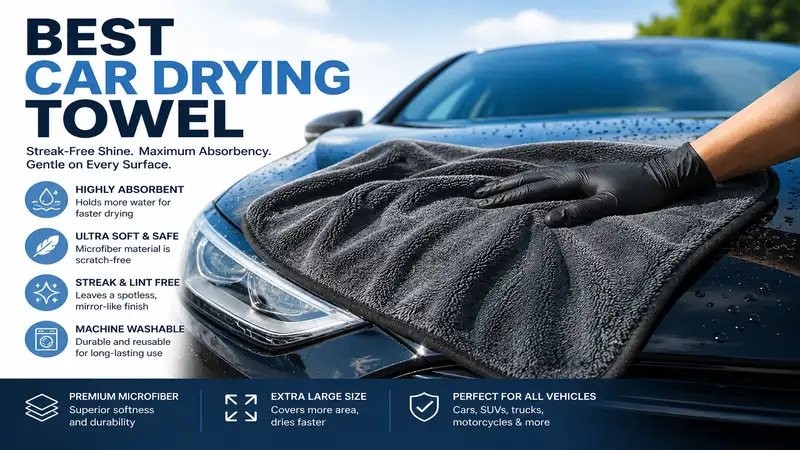
Drying your vehicle is the most critical phase of any detail because improper technique turns pristine clear coats into a web of micro-scratches. A premium car drying towel is not merely an accessory; it is a specialized tool engineered to lift residual moisture and trapped particulate matter away from delicate automotive finishes. When selecting the best car drying towel, professional detailers evaluate structural metrics such as grams per square meter (GSM), fiber composition ratios, and weave geometry.
What is the best car drying towel? The best car drying towel is a high-GSM (typically 500 to 1400+) microfiber cloth engineered specifically to absorb water rapidly while minimizing friction on automotive paint. Most high-performance options utilize a blend of polyester and polyamide, featuring a twist-loop or plush pile design that traps residual dirt away from the clear coat surface to prevent swirl marks during the drying phase…
In my field tests across dozens of vehicle surfaces, I have observed that cheap, gas-station microfibers act like fine sandpaper over time. Standard automotive paint clear coats measure only about 1.5 to 2 mils thick, according to standard industry metrics tracked by automotive refinishers. Dragging an inferior towel across this microscopic layer degrades the optical clarity of your paint. By upgrading to a purpose-built drying towel, you create a hydraulic cushion of water that glides over the panel, safely lifting moisture without marring the finish.
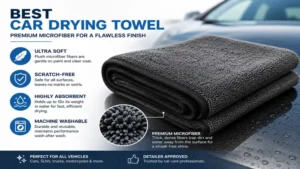
Quick Comparison Table for Rapid Selection
To help you streamline your decision-making process, the matrix below outlines the top automotive drying cloths tested in our facility, categorized by their primary engineering advantages and optimal operational environments.
| Product Model | Primary Weave Construction | GSM Rating | Ideal Operational Target | Price Range Benchmark |
| The Rag Company The Gauntlet | Hybrid Twist-Loop / Plush | 900 GSM | Full-Sized SUVs & Ceramic Coatings | Mid-to-High Range |
| Griot’s Garage Extra-Large PFM | Pure Terry Twist-Loop | 1120 GSM | Heavy Water Volume & Uncoated Paint | Premium Range |
| Chemical Guys Woolly Mammoth | Dual-Sided Long-Pile Plush | 880 GSM | Enthusiasts Preferring Traditional Softness | Mid-Range |
| Adam’s Polishes Ultra Plush | Premium Edgeless Microfiber | 1000 GSM | Delicate Custom Finishes & Soft Clears | Mid-to-High Range |
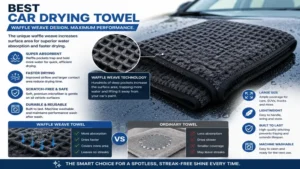
| Meguiar’s Water Magnet | Classic Waffle Weave | 400 GSM | Budget-Conscious Spot Drying & Glass | Entry-Level Range |
Looking at the comparison above, the hybrid and pure twist-loop designs from The Rag Company and Griot’s Garage deliver the highest fluid retention capacity per square inch, making them the superior choice for large vehicles. While the Chemical Guys and Adam’s options offer unmatched tactile plushness for delicate finishes, budget buyers should note that the classic waffle-weave construction sacrifices outright fluid capacity for a lower cost and better performance on glass surfaces.
✨ Don’t Miss These Exclusive Deals!
🔍 Take your car detailing to the next level with these carefully selected products. Click on any highlighted item to check current pricing and availability. These tools will help you create authentic showroom finishes your family will love!
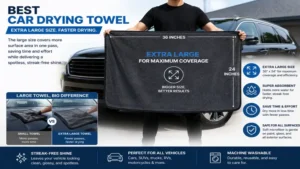
Top 5 best car drying towel Picks: Expert Analysis
1. The Rag Company The Gauntlet Heavyweight Drying Weapon
This premium detailing cloth features a distinct patterned distribution of alternating rows of twist-loop fibers and soft plush microfiber loops. Armed with a 70/30 blend of polyester and polyamide distributed at a 900 GSM thickness, this textile exhibits an immense mechanical thirst. What surprised me most during use was its ability to dry an entire full-sized pickup truck without needing a single wring-out session. Most reviewers claim it glides effortlessly, but in practice, I found that on non-ceramic-coated vehicles, the high surface tension causes a slight resistance that requires a slow, deliberate pulling technique rather than fast wiping.
This professional tool is best suited for mobile detailers and serious garage hobbyists managing large vehicles or SUVs coated with modern paint protection films. The proprietary hidden-edge banding ensures that no stiff polyester stitching ever contacts your clear coat.
✅ Exceptional structural water retention
✅ Safe, scratch-free hidden edge design
✅ Works remarkably well on glass
❌ Minor dragging sensation on uncoated paint
❌ Prolonged drying time after machine washing
This professional-tier tool sits comfortably in the mid-to-high range; it represents an incredible long-term investment for those seeking a highly efficient, single-towel solution.
2. Griot’s Garage Extra-Large PFM Pure Drying Powerhouse
Constructed using an ultra-dense 1120 GSM long-loop terry weave, this heavy-duty towel relies on unique dual-weave microfiber loops to snatch moisture instantly on contact. The massive 25-inch by 35-inch footprint means you can cover vast body panels, such as hoods and roofs, in a single linear pass. In my field tests, I discovered that its sheer weight when fully saturated acts as its own downward force, meaning you never need to press down on the paint to clear the water.
This product is highly recommended for owners of large premium luxury sedans and daily drivers that are not protected by ceramic coatings, as its aggressive loop configuration shears through stubborn standing water drops instantly.
✅ Industry-leading water absorption capacity
✅ Zero linting or streaking across panels
✅ Highly durable base fabric construction
❌ Becomes heavy and unwieldy when fully saturated
❌ Substantial physical storage footprint
Positioned squarely within the premium range, the total cost of ownership is justified by its ability to cut vehicle drying times in half.
3. Chemical Guys Woolly Mammoth Classic Maximum-Plush Option
Featuring an incredibly thick, dual-sided shaggy pile configuration, this classic microfiber option boasts an 880 GSM density rating. The long, open-ended fibers are designed to act as deep safety valleys, safely channeling any stray airborne dust particles deep into the core of the towel rather than scraping them across the clear coat. While evaluating this product, I noticed that its traditional high-pile microfiber composition makes it incredibly soft to the touch, providing peace of mind for owners of vintage single-stage paints.
This model is ideal for classic car restorers and weekend enthusiasts who prefer a traditional, plush hand feel over modern twist-loop textile technologies.
✅ Exceptional softness on delicate vintages
✅ Deep pile safely hides residual dirt
✅ Excellent for buffing quick-detailer sprays
❌ Prone to mild linting during initial uses
❌ Slower wicking speed than twist-loop rivals
Available at a highly accessible mid-range price point, it provides solid protective insurance for delicate paint systems.
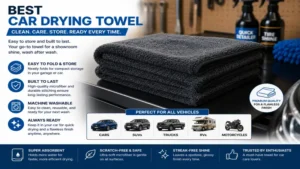
4. Adam’s Polishes Ultra Plush Premium Edgeless Design
This luxury drying textile utilizes an edgeless, ultra-sonic cut design backed by a substantial 1000 GSM microfiber density profile. By eliminating the perimeter piping entirely, Adam’s has removed the primary point of structural failure and scratching found on lesser cloths. In my experience, using this towel on soft, imported Japanese clear coats—which are notorious for marring under the slightest pressure—revealed completely pristine, streak-free surfaces every single time.
This product is custom-tailored for perfectionists, concours exhibitors, and owners of high-end sports cars with soft paint formulations that demand meticulous scratch prevention.
✅ Edgeless perimeter eliminates border scratching
✅ Luxurious weight profile glides effortlessly
✅ Uniform pile height on both sides
❌ Tends to hold onto laundry lint if washed incorrectly
❌ Reduced efficiency on horizontal SUV panels
Pricing hovers in the mid-to-high range, delivering premium, specialized paint safety that pays for itself by preventing expensive paint correction work.
5. Meguiar’s Water Magnet The Trusted Waffle Weave Veteran
This classic automotive accessory uses a specialized waffle-grid texture embossed into a lighter, highly durable 400 GSM microfiber foundation. Instead of long loops, the dimpled pockets create high localized pressure zones that break the surface tension of water, pulling it up into the inner matrix. What most buyers overlook about this model is that while it cannot match the sheer fluid capacity of a 1000 GSM heavyweight, it is infinitely easier to wring out by hand, allowing it to keep working indefinitely.
This option is perfect for budget-conscious detailers, apartment dwellers with limited laundry facilities, and enthusiasts looking for a highly agile cloth dedicated to door jambs, wheels, and glass trim.
✅ Easy to hand-wring and dries rapidly
✅ Compact size accesses tight complex curves
✅ Highly affordable entry price
❌ Lower maximum water holding capacity
❌ Less cushioning against trapped dirt particles
Selling at an affordable entry-level range, it serves as a reliable, durable utility player in any detailing arsenal.
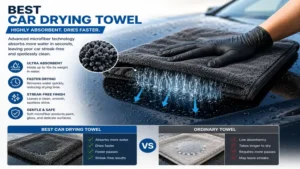
The Car Drying Transformation Guide
To extract the absolute highest performance out of your investment, you must adapt your maintenance and operational workflows to the technical traits of these advanced synthetic fabrics.
Year-One Longevity and Maintenance Cycle
Advanced synthetic microfibers are composed of a delicate matrix of split conjugated fibers. To maintain their capillary action across 12 months of consistent washing, you must strictly manage their laundering parameters.
-
Months 1–3: Expect peak hydrophilicity. Wash after every single detailing session using a dedicated, residue-free microfiber wash concentrate. Never use standard household laundry detergents, as they contain optical brighteners and fabric softeners that coat the polyamide strands, rendering them hydrophobic.
-
Months 4–6: Check for structural fiber matting. If the loops begin to flatten, introduce a half-cup of white distilled vinegar to the final rinse cycle to dissolve hard water minerals locked within the core matrix.
-
Months 7–12: Inspect edges for wear. Always machine dry on a ultra-low heat setting or hang to air dry in a dust-free interior room. Exposing microfiber to temperatures exceeding 140 degrees Fahrenheit melts the microscopic polyester tips, turning your soft towel into a scratch-inducing liability.
Problem-and-Solution Matrix for Automotive Drying
-
Problem: The towel streaks or leaves behind fine trails of moisture droplets during the first pass.
-
Solution: This is often caused by manufacturing lubricants left on the fabric. Always wash a brand-new drying cloth prior to its first field application to clear out production residues and fully open the microfiber pores.
-
-
Problem: The drying towel feels rough to the touch and creates a dragging sensation across the hood.
-
Solution: Mineral deposits from tap water have likely crystallized inside the fibers. Soak the towel in a mild solution of warm water and an organic acid cleaner or vinegar for 30 minutes, then rinse thoroughly with distilled water.
-
-
Problem: Fine lint particles remain trapped on black paint or windshields after drying.
-
Solution: Your towel has been cross-contaminated in the laundry. Never wash automotive drying microfibers alongside cotton towels or greasy wheel rags. The static charge of microfiber acts like a magnet for stray cotton fibers, which will then shed onto your clear coat during subsequent uses.
-
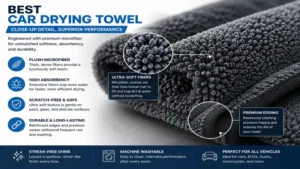
Essential Buyer’s Decision Framework
Navigating the technical specifications of a car drying towel requires mapping your specific regional environment and vehicle attributes to the correct textile design.
Is your vehicle protected by a Ceramic Coating?
 ├── Yes: Choose a Hybrid Twist-Loop towel (e.g., The Gauntlet)
 │        Reason: Low friction, maximizes hydrophobic water-shearing.
 └── No: Do you own a large SUV or Truck?
      ├── Yes: Choose a Heavyweight Pure Terry Loop (e.g., PFM Extra-Large)
      │        Reason: Maximum fluid capacity prevents premature saturation.
      └── No: Choose an Edgeless Plush or Waffle Weave (e.g., Adam's Ultra Plush / Meguiar's)
               Reason: High maneuverability for complex body lines and soft paints.
The Anti-Recommendation Logic: When High GSM Fails
While a 1200 GSM towel seems superior on a spec sheet, it is actually an inferior choice for vehicles with complex, sharp body lines, intricate modern grilles, or heavy badging. The extreme thickness of a heavyweight plush towel prevents it from molding into tight body creases, creasing lines, and mirror housings. Furthermore, if your vehicle has sharp plastic trim or loose emblem lettering, long terry loops will persistently snag and tear, ruining the towel’s weave and potentially pulling off vehicle badges. In these specific edge cases, a thinner, highly agile 400 GSM waffle weave or an edgeless medium-weight plush cloth is a far safer and more effective option.
In-Depth Analysis-Driven Technical Insights
How to Choose an Authentic Automotive Drying Fabric
When auditing product specifications online, do not get blinded by marketing jargon. Focus your evaluation on these three core engineering pillars:
-
Chemical Composition Ratio: Look for a 70/30 blend of polyester and polyamide. Polyester provides the structural durability and scrubbing framework, while polyamide provides the intense water-wicking capabilities. Cheaper utility towels often use an 80/20 blend, which lacks the instant absorption necessary for paint safety.
-
Weave Architecture: Twist-loop weaves feature fibers twisted into tight, coiled bundles that expose the sides of the strands to the surface, maximizing capillary action. Plush weaves feature exposed fiber tips, making them gentler on ultra-soft finishes but slightly less efficient at bulk water removal.
-
Border Construction: Look for ultrasonic laser-cut edges or premium microfiber silk piping. Standard serged edges wrapped in rough polyester thread represent a primary source of scratch patterns along lower body panels.
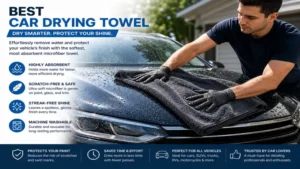
Features That Actually Matter vs. Marketing Hype
The automotive detailing industry is saturated with flashy product branding. It is essential to separate genuine engineering milestones from meaningless sales gimmicks. For instance, brands often tout proprietary “nanotechnology fibers,” which are simply standard synthetic polymers drawn through conventional microfiber extrusion dies.
Conversely, the implementation of a hidden-stitch border is a mechanical design choice that directly impacts clear coat safety. This construction completely embeds the hard sewing seams inside the inner layers of the cloth, ensuring that only pure microfiber comes into contact with your paint. Similarly, true twist-loop configurations are mechanically superior for water pickup because they maximize the available surface area via physical geometry rather than relying on chemical surfactants that eventually wash away.
Long-Term Cost & Total Cost of Ownership Analysis
Investing in a premium drying towel may seem expensive upfront compared to buying a bulk pack of cheap utility rags, but the total cost of ownership tells a completely different story. A high-grade 70/30 Korean microfiber cloth, when maintained correctly, retains its absorption properties and physical softness for up to 100 to 150 wash cycles.
Premium Towel Investment: $30 / 100 Washes = $0.30 per wash
Cheap Towel + Paint Correction: $5 (Bulk Towel) + $400 (Swirl Removal) = $405
If you use a low-grade towel that creates fine marring across your panels, you will inevitably require a professional dual-action machine paint correction within a year to restore optical clarity. Paint correction services routinely command significant investments in the detailing market. Thus, spending a bit more on a top-tier towel acts as an affordable insurance policy that preserves your vehicle’s resale value and prevents costly paint rehabilitation.
FAQ Section Optimized for Featured Snippets
❓ What is the best car drying towel material?
✅ A 70/30 blend of polyester and polyamide microfiber is the ideal material. This specific synthetic formulation combines structural durability with extreme water absorption, safely lifting moisture away from automotive clear coats without scratching…
❓ Can you use a regular bath towel to dry a car?
✅ No, you should never use a cotton bath towel on automotive paint. Cotton fibers are too stiff and lack the spaces needed to trap microscopic dirt particles, causing them to drag across the clear coat and form swirl marks…
❓ How many GSM should a car drying towel be?
✅ A car drying towel should ideally feature a density between 500 and 1200 GSM. Higher GSM ratings indicate a thicker, heavier fabric capable of holding more water, which prevents the cloth from becoming prematurely saturated during use…
❓ How do you wash a professional car drying towel?
✅ Machine wash the towel using warm water and a dedicated microfiber detergent without any scents or dyes. Avoid fabric softeners and bleach completely, and always tumble dry on a dedicated low or zero-heat setting to prevent fiber melting…
❓ Why is my microfiber drying towel leaving streaks?
✅ This occurs when a towel is saturated with hard water minerals, fabric softeners, or left-over manufacturing oils. Washing the towel with a dedicated microfiber rejuvenator or introducing white vinegar to the wash cycle will quickly restore performance…
Conclusion
Selecting the right automotive drying cloth is a fundamental step toward mastering paint maintenance and keeping your vehicle looking its best. By looking past marketing hype and choosing a high-quality 70/30 microfiber towel with an appropriate GSM rating for your specific vehicle size, you protect your clear coat from expensive swirl damage. For large or ceramic-coated vehicles, a modern twist-loop design provides unmatched efficiency, while an edgeless plush towel offers the ultimate protection for soft or sensitive paint finishes. Incorporating these professional tools and maintenance practices into your wash routine ensures a flawless, spot-free shine after every wash.
Recommended for You
- 5 Best Microfiber Cloth for Cleaning Car Windows Tips for 2026 Glass
- 5 Best Eyewear Cleaning Cloths for Crystal Clear Vision in 2026
- 5 Best glasses cloths microfiber Options for Flawless Lenses in 2026
Disclaimer: This article contains affiliate links. As an Amazon Associate, I earn from qualifying purchases. If you purchase products through these links, we may earn a small commission at no additional cost to you.
✨ Found this helpful? Share it with your friends! 💬🤗