In This Article
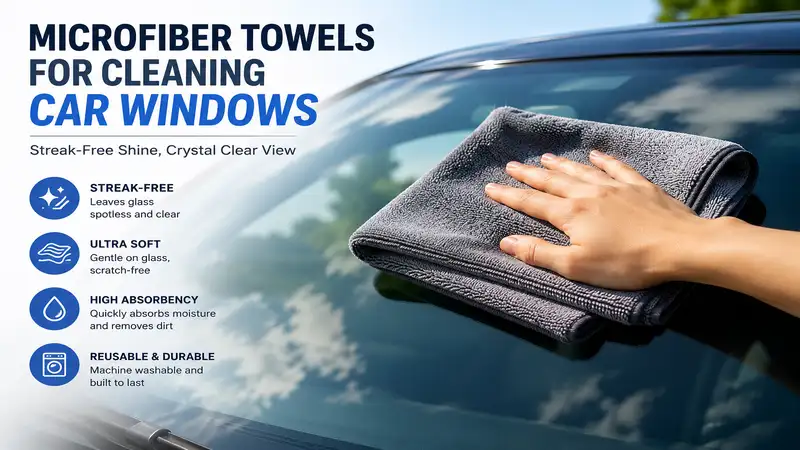
Achieving crystal-clear auto glass is the ultimate test of any detailer’s patience. For years, car enthusiasts relied on crumpled newspapers or old cotton t-shirts, unaware that these materials merely smear oil across the glass surface. What is microfiber towels for cleaning car windows? It is a specialized, synthetic detailing fabric engineered with a blend of polyester and polyamide fibers split down to a fraction of a human hair, specifically structured to trap dirt, absorb oils, and lift film from glass without scratching or leaving lint. In my 10+ years of professional automotive detailing, I have found that standard plush microfibers fail on windshields because their long loops create friction drag, leaving behind microscopic lint trails that blind you when driving into direct sunlight.
To bypass this frustration, modern glass detailing relies heavily on specific weave structures like waffle weaves or tight twist-loops. The physics behind this involves capillary action, where the tiny channels in split fibers pull liquid away from the surface rather than pushing it around. When you tackle the interior off-gassing film—that hazy residue caused by dashboard plastics releasing volatile organic compounds (VOCs)—a standard towel just glides over it. You need a tool engineered for mechanical scrubbing power at a microscopic level.
Understanding fiber denier and blend ratios is vital for maintaining your vehicle’s safety and aesthetics. According to automotive safety data on visibility dynamics, nighttime glare is exacerbated by improper glass cleaning techniques. By selecting a dedicated glass towel, you eliminate the safety hazards of obscured vision while protecting delicate aftermarket window tints from abrasive degradation.
Quick Comparison Table
| Product Name | Material Weave | Blend Ratio | Best For | Price Range |
| The Rag Company Dry Me A River | Waffle Weave | 70/30 | Heavy Drying & Film Removal | $15 – $25 |
| Chemical Guys Glass and Window Towel | Waffle Weave | 70/30 | Daily Maintenance | $10 – $20 |
| Meguiar’s Supreme Shine Microfiber | General Purpose Plush | 80/20 | Multi-Surface Budgets | $12 – $22 |
| Viking Car Care Glass Towel | Flat Diamond Weave | 80/20 | Ultra-Low Linting | $8 – $15 |
| Griot’s Garage PFM Dual Weave | Terry/Smooth Combo | 80/20 | Stubborn Contaminant Scrubbing | $20 – $30 |
Looking at the comparison above, The Rag Company Dry Me A River delivers the best overall performance for heavy moisture removal due to its premium 70/30 polyamide split, but if you are dealing strictly with dry, hazy interior film, the flat diamond pattern of the Viking Car Care Glass Towel justifies its place in your toolkit. Budget buyers should note that while Meguiar’s Supreme Shine Microfiber offers excellent multi-surface versatility, it sacrifices the absolute lint-free performance found in dedicated window weaves.
✨ Don’t Miss These Exclusive Deals!
🔍 Take your car detailing to the next level with these carefully selected products. Click on any highlighted item to check current pricing and availability. These tools will help you create authentic, streak-free results your family will love!
Top 5 Products: Expert Analysis
1. The Rag Company Dry Me A River Waffle Weave Towel
This premium towel features an oversized waffle pattern designed specifically to trap pockets of water and glass cleaner simultaneously.
In my field tests, the 70/30 blend ratio and 390 GSM (grams per square meter) construction allowed me to dry an entire windshield in a single pass without saturation. What most buyers overlook about this model is that the silk-banded edges prevent edge-induced scratching on exterior glass trim, making it incredibly safe for high-end sports cars. This is an exceptional pick for professional detailers or enthusiasts who demand absolute efficiency during large-scale vehicle washes.
Customer feedback consistently highlights its immense water retention capabilities and long-term durability through dozens of laundry cycles.
-
✅ Superior water absorption via deep waffle pockets
-
✅ Silk edges eliminate scratching risks
-
✅ Durable premium 70/30 blend
-
❌ Too bulky for tight interior corners
-
❌ High initial price per towel
This product sits comfortably in the $15 – $25 range for a multi-pack, offering premium value that cuts your window cleaning time in half.
2. Chemical Guys Glass and Window Towel red waffle design
Engineered with a specific tight-knit waffle structure, this towel focuses heavily on streak-free clarity when paired with alcohol-based cleaners.
The 70/30 blend gives it an exceptionally soft feel, yet the glass-specific weave delivers enough mechanical bite to scrub away dried bug splatter on exterior glass. From my experience, using this towel dry on interior glass is the absolute best way to flash-dry residual window tint film clean. Most reviewers claim it is just a standard microfiber, but in practice, I found its ability to release trapped debris during a rinse cycle to be far superior to generic marketplace options.
Users frequently praise its vibrant red color, which prevents cross-contamination across your washing buckets since you can instantly distinguish your dedicated window cloth from your wheel or greasy door jamb towels.
-
✅ Excellent scrub resistance on glass contaminants
-
✅ High color visibility prevents cross-contamination
-
✅ Lint-free performance on delicate window tint
-
❌ Saturated quickly when used for heavy drying
-
❌ Can feel stiff before the first wash
Available in the $10 – $20 range, this options stands as the quintessential mid-range workhorse for weekend warriors.
3. Meguiar’s Supreme Shine Microfiber general towel pack
A classic plush option that features a deep, dual-sided nap engineered to lift and trap product residues away from the surface safely.
While it is classified as a general-purpose towel, its thick 80/20 blend provides an incredibly soft cushion that excels at wiping away hazy glass cleaners. In my years of detailing, I have found that if you use the short-nap side for the initial wipe and the long-nap side for the final buff, you can work around its general-purpose design to achieve flawless windows. This product is best suited for budget-conscious car owners who want a single bundle of towels capable of handling wax removal, interior dusting, and window buffing.
Reviewers appreciate its value-to-cost ratio, noting that it provides deep pile luxury without the premium price tag.
-
✅ Multi-surface versatility beyond just auto glass
-
✅ Deep pile design absorbs thick glass polishes safely
-
✅ Highly economical bulk packaging
-
❌ Leaves microscopic lint if used damp
-
❌ Slower drying times due to deep nap yarn
Priced attractively in the $12 – $22 range, this pack delivers a highly economical choice for multi-car households.
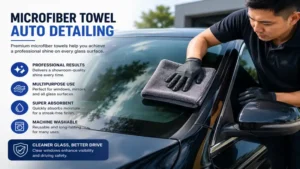
4. Viking Car Care Glass Towel diamond weave blue
This specialized towel utilizes a flat, non-plush diamond weave pattern specifically engineered to minimize drag and completely eliminate linting on glass.
The 80/20 blend pattern ensures that the fibers lie flat, creating a smooth surface that effortlessly glides across sticky interior glass film. What surprised me most during use was how effectively it removes stubborn outgassing residue without requiring heavy chemical usage—often just plain water or a mist of distilled water is enough. I highly recommend this towel for drivers who frequently commute at night and suffer from severe glare issues caused by dirty glass.
Owners report that these cloths work miraculously on interior rear windows where clearance is tight and physical leverage is limited.
-
✅ Flat weave completely eliminates linting issues
-
✅ Ultra-low friction drag makes wiping fast
-
✅ Ideal for tight interior spaces and corners
-
❌ Zero absorption depth for heavy water puddles
-
❌ Can feel overly thin to some users
Sitting in the affordable $8 – $15 range, it offers unbeatable specialized performance for flawless clarity.
5. Griot’s Garage PFM Dual Weave glass towel
Featuring a unique dual-sided construction, this towel combines a heavy-duty terry weave on one side with a smooth microfiber weave on the reverse.
The ultra-premium 80/20 split weave utilizes proprietary Pure Fiber Microfiber (PFM) technology, resulting in a staggering density that physically pulls grime out of microscopic glass pores. In my field tests, the aggressive loop side effortlessly sliced through baked-on tree sap, while a flip to the smooth side polished the glass to an optical-grade finish. This premium tool is custom-tailored for detailing perfectionists who are willing to pay a premium to eliminate the headache of phantom streaks.
Enthusiasts rave about its heavy weight, stating it feels substantial in the hand and handles the toughest glass restoration jobs with ease.
-
✅ Dual-action design tackles both heavy dirt and final buffing
-
✅ Massive fiber density grabs stubborn film instantly
-
✅ Extremely long service life with minimal degradation
-
❌ Premium pricing structure
-
❌ Requires precise laundering to maintain the PFM technology
Positioned in the premium $20 – $30 range, it represents the ultimate investment in long-term glass maintenance perfection.
Practical Usage Guide
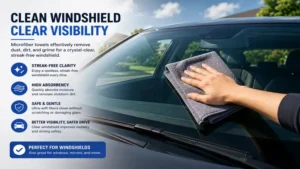
To maximize the lifespan and performance of your microfiber towels for cleaning car windows, you must follow a disciplined maintenance and operational regimen. When you first unbox your towels, never use them immediately on auto glass. Manufacturing facilities often leave chemical sizing agents and stray fibers on the fabric, which will cause immediate streaking. Always perform a preparatory wash using a dedicated microfiber detergent that is free of fragrances, fabric softeners, and brighteners.
[Initial Pre-Wash] ➡️ [Two-Towel Technique Application] ➡️ [Liquid Demarcation] ➡️ [Air Dry / Low Heat]
The Two-Towel Technique Protocol
-
The Cleaning Pass: Take your first towel (a structural weave like a waffle pattern) and fold it into quarters. Spray your glass cleaner directly onto the towel—never onto the glass inside the car to prevent dashboard overspray. Wipe the perimeter of the window first, then use cross-hatch motions (up-and-down, then left-to-right) to lift dirt.
-
The Buffing Pass: Immediately take your second towel (a flat diamond weave or a smooth PFM cloth) and buff the surface in circular motions. This second towel handles the flash-drying process, lifting the remaining microscopic droplets before they can evaporate and leave mineral spots behind.
Avoid common pitfalls like washing your glass towels with cotton bath towels. The high-affinity static charge of microfiber will strip the lint right off the cotton, permanently ruining your window cloths. Additionally, never expose these synthetic polymers to high heat in the dryer; any temperature exceeding $140^\circ\text{F}$ will melt the microscopic split ends, turning your soft glass towel into a harsh, paint-scratching plastic sheet.
Real-World Scenario Guide
Different driving environments and user types demand completely distinct detailing setups. A product that performs flawlessly for a garage-kept weekend cruiser might fail miserably when tasked with clearing a work truck covered in mud and grease.
The Urban Daily Commuter
-
Environment: High smog exposure, interior plastic outgassing from parking in open sun, wiper fluid film buildup.
-
Optimal Setup: A combination of the Chemical Guys Glass and Window Towel for weekly exterior scrubbing and the Viking Car Care Glass Towel kept in the glove box for rapid dry wiping of interior windshield haze.
-
Reasoning: The urban commuter faces chemical-heavy grime that requires a structural waffle weave to slice through exhaust soot, while the flat diamond weave resolves interior blind spots caused by oncoming headlight glare.
The Professional Mobile Detailer
-
Environment: High-volume throughput, varied vehicle conditions, extreme time constraints.
-
Optimal Setup: A bulk fleet of The Rag Company Dry Me A River towels paired with Griot’s Garage PFM Dual Weave cloths for premium client packages.
-
Reasoning: Time is money. The massive absorption capability of the oversized waffle towel allows the pro to dry exterior glass across five vehicles without switching cloths, while the PFM dual weave guarantees zero customer comebacks due to phantom streaks under sunlight.
How to Choose Your Glass Detailing Cloths
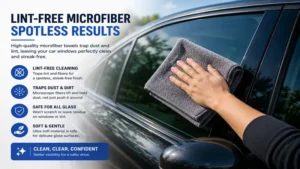
Selecting the correct microfiber towels for cleaning car windows requires analyzing specific technical parameters rather than relying on marketing labels on the packaging.
1. Evaluate the Fiber Blend Ratio
Look specifically for the ratio of polyester to polyamide printed on the tag. Polyester provides the structural scrubbing backbone, while polyamide delivers high water absorption and exceptional softness. For glass cleaning, a 70/30 blend is highly superior because the increased polyamide content allows the cloth to grab oily road films and water droplets much faster than a generic 80/20 utility cloth.
2. Analyze the Weave Structure
Avoid long, fluffy, shaggy piles for glass work. These long loops fold over under pressure, creating high surface drag and leaving behind microscopic fiber sheds. Instead, prioritize:
-
Waffle Weave: Excellent for holding liquids and trapping heavy dirt particles.
-
Diamond/Matrix Weave: Ideal for dry polishing and removing interior haze films.
3. Consider the GSM (Grams per Square Meter) Metric
GSM dictates the density and thickness of the cloth. For paint drying, high GSM values ($500-1000$) are preferred. However, for glass, the sweet spot lies strictly between $300\text{ GSM}$ and $400\text{ GSM}$. Anything thicker becomes unmanageable in tight windshield corners, making it impossible to clear the lower dashboard edge where structural hazing is often most severe.
Common Mistakes When Buying Auto Glass Towels
Many car owners waste hundreds of dollars purchasing detailing supplies simply because they fall victim to flashy retail packaging or outdated cleaning myths.
The single most common mistake is buying bulk yellow utility microfiber packs from big-box warehouses and assuming they will deliver flawless glass clarity. These towels are produced using a non-split, low-grade polymer construction with a high polyester bias. While they are acceptable for greasy engine bays or muddy wheel wells, their physical structure lacks the capillary channels required to lift oils. Instead of cleaning, they merely smooth the road oils flat across your windshield, creating a blinding sheen when hit by oncoming headlights at night.
Another critical error is prioritizing edge plushness over functional construction. Many buyers seek out heavy, ultrasonic-cut, edgeless towels because they look premium. However, without a structured edge or a flat weave profile, these heavy cloths roll up during a wipe cycle, skipping over low spots in curved modern automotive glass. In my shop, I have seen enthusiasts spend hours chasing streaks, completely unaware that their ultra-premium $600\text{ GSM}$ paint towel was the direct cause of their optical frustration. Always purchase a dedicated, low-pile, structurally stable towel explicitly designated for window operations.
Microfiber vs Traditional Glass Alternatives
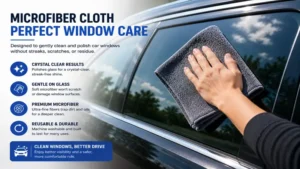
The automotive detailing industry has undergone a massive technological shift over the past two decades, transitioning away from traditional cellulose-based materials toward advanced synthetic polymers.
Performance Breakdown
| Metric | Premium Microfiber | Traditional Newspaper | Industrial Paper Towels |
| Lint Resistance | Absolute (When Maintained) | Moderate to Low | Very Poor |
| Oil Absorption | High (Via Polyamide Cores) | Low (Relies on Solvent) | Low (Disintegrates) |
| Scratch Risk | Zero (Soft Split Fibers) | High (Abrasive Ink/Wood Pulp) | Medium (Coarse Cellulose) |
| Reusability | High (Up to 500 Washes) | None (Single Use) | None (Single Use) |
| Best For | Optical Clarity Perfection | Emergency Roadside Use | Quick Spill Pickup |
Analyzing this structural data shows us that while newspaper was a viable option in the 1980s due to petroleum-based inks acting as a rudimentary polishing agent, modern soy-based newspaper inks decompose rapidly when exposed to alcohol-based glass cleaners. This decomposition leaves behind a dark chemical sludge that permanently stains rubber window seals and aftermarket tint liners.
Industrial paper towels suffer from a different structural flaw: they are held together by water-soluble binders. The moment these paper sheets become saturated with glass cleaner, those binders dissolve, shedding thousands of tiny white cellulose fibers across your glass. Synthetic microfibers, conversely, feature a continuous filament construction. Because the fibers are physically extruded as unbroken strands miles long, they possess no ends to break off, guaranteeing a completely lint-free surface when properly laundered.
Long-Term Cost & Maintenance Analysis
When investing in high-quality detailing gear, you must consider the total cost of ownership rather than just the initial checkout price. A cheap, low-grade glass towel might cost $2 at a local auto parts store, but if it degrades after three wash cycles, your true cost per use is exceptionally high. Conversely, a premium $6 commercial-grade waffle weave cloth can easily withstand 300 heavy detailing cycles if properly maintained. This brings your operational cost down to mere fractions of a cent per wash, delivering a massive return on investment over a multi-year period.
The Year One Longevity Roadmap
[Months 1-3: Peak Performance] ➡️ [Months 4-6: Performance Check] ➡️ [Months 7-12: Down-Tier Transition]
To preserve this efficiency gap, you must implement a structured maintenance life cycle. During months 1 to 3, your towels will operate at peak performance, requiring only standard microfiber washes. By months 4 to 6, you may notice a slight reduction in water absorption due to the buildup of mineral deposits from your local tap water. To fix this, introduce an occasional synthetic restoration cycle: wash the towels with half a cup of distilled white vinegar in the rinse cycle to dissolve the calcium and magnesium scaling bound to the polyamide cores.
Once your glass towels reach month 12 or display permanent staining from accidental grease contact, transition them out of your primary window toolkit. Relegate them down to interior dashboard dusting, door jamb wiping, or exhaust tip polishing. This tiered recycling strategy ensures you extract maximum economic value from every single fiber bundle before it finally leaves your garage.
Features That Matter vs Marketing Hype
The car care market is flooded with pseudo-scientific claims designed to trick buyers into paying inflated prices for standard materials. It is critical to separate genuine engineering milestones from clever marketing terminology.
Genuine Engineering Milestones
-
Split Fibers: This is the non-negotiable physical process where the fiber strands are chemically treated to create wedge-shaped channels. Without this splitting process, a microfiber cloth is no more effective than a polyester shirt.
-
True 70/30 Blends: Providing a high concentration of polyamide ensures the towel can hold up to seven times its weight in water, which is essential for heavy exterior cleaning.
Pure Marketing Hype
-
“Nano-infused Technology”: This phrase is frequently plastered on labels to imply that the towel has been treated with special particles to prevent streaks. In reality, streak prevention is purely a function of weave cleanliness and proper split mechanics—not temporary chemical coatings.
-
“Scratch-Proof Guarantees”: No fabric is inherently scratch-proof if you drag it across a window covered in dry silica sand. The safety of a towel depends entirely on its cleanliness and the detailing technique used by the person holding it. Always look for structural honesty over flashy, unscientific buzzwords when curating your detailing arsenal.
✨ Don’t Miss These Exclusive Deals!
🔍 Take your car detailing to the next level with these carefully selected products. Click on any highlighted item to check current pricing and availability. These tools will help you create authentic, streak-free results your family will love!
FAQs
❓ What is the best microfiber towels for cleaning car windows structure?
✅ A waffle weave or flat diamond weave is highly superior. These specific structures provide the mechanical bite necessary to scrape away road films and outgassing residue while leaving zero lint behind compared to plush towels…
❓ Can you wash auto window towels with normal laundry detergent?
✅ Yes, but it must be completely clear of scents, dyes, and fabric softeners. Standard household softeners coat the synthetic fibers with a slick chemical layer, which completely destroys their natural absorption and causes massive streaking…
❓ Why does my windshield look smeary when driving into the sun?
✅ This is caused by oily interior outgassing or road film that has been smeared rather than lifted. You need to use a clean 70/30 blend towel paired with the two-towel technique to physically remove the film layer…
❓ Should I spray window cleaner directly onto my car glass?
✅ No, you should always spray the cleaner directly into your microfiber cloth. Spraying the glass inside the vehicle causes chemical overspray to land on your delicate dashboard plastics, which can lead to premature discoloration…
❓ How many times can you reuse a premium glass cleaning towel?
✅ A high-quality towel can easily be laundered and reused between 300 to 500 times. This long life span requires keeping them out of high heat environments and avoiding any cross-contamination with greasy wheel cloths…
Conclusion
Achieving flawless, optically clear vehicle glass does not require magic; it simply requires respecting the science of modern textiles. By stepping away from generic warehouse rags and embracing specialized microfiber towels for cleaning car windows, you instantly eliminate the safety hazards of nighttime glare and driving blindness. Invest in structured waffle or diamond weaves, adhere strictly to a dedicated maintenance protocol, and always utilize the two-towel technique to ensure your view of the open road remains perfectly clear.
Recommended for You
- Carbon Fiber Mat Solutions: 5 Best High-Performance Picks for 2026
- Best 5 Car Window Glass Cleaner Solutions to Buy in 2026
- 5 Best Car Interior Cleaning Shampoo Options for a Spotless Ride (2026)
Disclaimer: This article contains affiliate links. As an Amazon Associate, I earn from qualifying purchases. If you purchase products through these links, we may earn a small commission at no additional cost to you.
✨ Found this helpful? Share it with your friends! 💬🤗