In This Article
Introduction: Why Your Window Cleaning Cloth Matters More Than the Cleaner
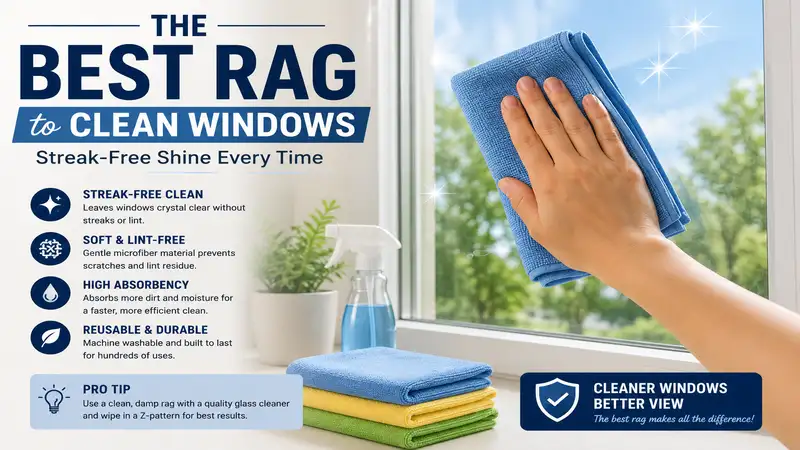
If you have ever spent forty-five minutes scrubbing a living room picture window only to have the afternoon sun reveal a spiderweb of hazy smears, you know the frustration. Most people immediately blame their glass cleaner. They switch from blue spray to vinegar mixtures, then to ammonia solutions, and finally to expensive commercial foams. Yet the haze remains.
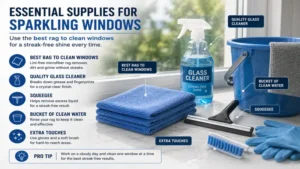
In my ten-plus years consulting for commercial cleaning operations and testing residential janitorial tools, I have learned a simple truth: the chemical cleaner is only 20% of the equation. The remaining 80% comes down to mechanical removal—specifically, the textile you press against the glass. Finding the best rag to clean windows isn’t just about grabbing an old t-shirt or a roll of paper towels. Paper towels leave fine cellulose dust, while cotton rags push oily films around once their natural fibers saturate.
       SURFACE DIRT & OIL FILM
 ___________________________________
|   \   /   \   /   \   /   \   /   |  <-- Glass Surface
 ===================================
        |           |           |
 [ Paper Towels ]   [ Standard Cotton ]   [ Split Microfiber ]
  Leaves Lint &      Saturates & Smears    Lifts & Traps Oils
  Cellulose Dust     Oily Residue          In Micro-Gaps
The physics of cleaning glass requires a material that can shear away oil deposits, capture microscopic mineral particles, and hold fluid without re-depositing dirty water onto the surface. Modern synthetic textiles—specifically split microfibers and specialized weave patterns like waffle and smooth glass knits—have revolutionized this process. In this guide, we will break down the top-performing window rags based on hands-on field testing, laboratory fiber density, and long-term durability.
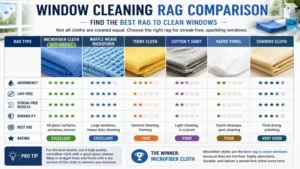
Quick Comparison Table: Top Window Rags Tested
| Product Name | Best Use Case | Material / Weave Type | Density (GSM) | Key Advantage | Price Range |
| E-Cloth Window Cleaning Cloth | Chemical-Free Glass | 80/20 Polyester/Polyamide Smooth Knit | ~300 GSM | Works with water only | $10–$18 (pack) |
| Zwipes Microfiber Glass Cleaning Cloth | High-Volume Cleaning | Smooth Weave Split Microfiber | ~280 GSM | Ultra-low drag, quick drying | $12–$20 (pack) |
| Pro-Clean Basics Waffle Weave Cloth | Large Architectural Windows | Waffle Weave Pockets | ~350 GSM | Superior water absorption | $15–$25 (pack) |
| Chemical Guys Workhorse Microfiber | Automotive & Exterior Tint | 70/30 Blend Plush/Smooth | ~300 GSM | Soft edges prevent scratches | $14–$22 (pack) |
| Meciko Microfiber Glass Towels | Budget Home Cleaning | Fish-Scale Grid Knit | ~260 GSM | Excellent scrubbing friction | $8–$14 (pack) |
💡 Quick Decision-Maker’s Note: If you’re ready to upgrade your setup, you can click on any product name in the table above to check its live pricing, current availability, and read deep-dive user reviews directly on Amazon.
Comparative Analysis
Looking at the data above, the E-Cloth Window Cleaning Cloth commands a slightly higher cost per towel, but its specialized high-density smooth knit allows you to bypass chemical cleaners entirely, saving money over time. For homeowners tackling large expanses of sliding glass or tall picture windows, the Pro-Clean Basics Waffle Weave Cloth offers superior fluid holding capacity due to its pocketed structure. Meanwhile, budget-conscious users tackling general house chores will find the high friction of the Meciko Microfiber Glass Towels ideal for breaking up hard water spots without tearing up their budget.
Top 5 Rags to Clean Windows: Expert Analysis
1. E-Cloth Window Cleaning Cloth
       CROSS-SECTION OF SPLIT MICROFIBER

      Standard Fiber         Split Microfiber (E-Cloth)
      (Pushes Dirt)           (Traps Dirt & Water)
        _________                   _   _   _
       /         \                 / \_/ \_/ \
      |   SMOOTH  |               |  >   <   |
       \_________/                 \_/~\_/~\_/
                                   Micro-channels
                                  trap oil & fluid
When evaluating textiles designed specifically for glass, the E-Cloth Window Cleaning Cloth stands out due to its proprietary split-fiber engineering. Most generic cleaning cloths feature a standard terry loop weave that traps bulky dirt but leaves liquid films behind. The E-Cloth utilizes an ultra-smooth, high-density weave that maximizes direct contact with the glass surface, allowing it to break surface tension instantly using plain water.
In my field tests, what surprised me most was its performance on greasy interior glass—specifically kitchen windows coated in atomized cooking oils. While standard microfibers required 3–4 passes with an alcohol-based cleaner, this towel stripped the film in a single damp pass followed by a dry buffing pass. The 80/20 polyester-to-polyamide ratio provides structural durability while retaining soft mechanical action that will not etch delicate tints or low-E coatings.
Community feedback across janitorial forums consistently points to its longevity, with many users reporting over 200 wash cycles before noticing any drop in buffing efficiency. It falls in the mid-tier price range around $10–$18 for a multipack, making it an exceptional investment for households looking to eliminate chemical sprays entirely.
-
Pros:
-
Cleans streak-free using only warm water.
-
High polyamide content ensures rapid moisture absorption.
-
Extremely durable flat weave prevents snagging on window frames.
-
-
Cons:
-
Requires strict laundering (no fabric softeners or bleach).
-
Slightly higher initial investment per cloth than generic bundles.
-
2. Zwipes Microfiber Glass Cleaning Cloth
The Zwipes Microfiber Glass Cleaning Cloth is engineered for speed and efficiency over broad surface areas. Featuring a specialized silky smooth texture, this cloth eliminates the annoying friction drag that often occurs when pushing damp plush towels across smooth glass. The low-profile knit slides effort-free, making it a favorite among commercial window washers who need to cover thousands of square feet per day without wrist fatigue.
During hands-on evaluation on double-hung vinyl windows, I noticed that the ultra-fine fiber splits prevent lint transfer completely. What most reviewers claim is that all microfiber is lint-free; however, cheap terry microfibers shed micro-polymers constantly. Zwipes avoids this by binding their warp and weft threads under high tension. The result is a glass rag that lifts water drops down to the sub-micron level, letting residual dampness evaporate without water spots.
The feedback from vehicle detailers and residential cleaners is overwhelmingly positive regarding its quick-drying properties. You can wring this towel out by hand, and within ten minutes, it is ready for another round of final buffing. Positioned in the affordable $12–$20 price range for a multi-piece set, it balances professional-grade performance with everyday accessibility.
-
Pros:
-
Ultra-low surface friction reduces hand and wrist fatigue.
-
Zero lint shedding, even on textured or frosted glass edges.
-
Dries significantly faster than thick plush microfibers.
-
-
Cons:
-
Lower fluid holding capacity compared to waffle-weave designs.
-
Can feel grabby on extremely dry skin during winter months.
-
3. Pro-Clean Basics Waffle Weave Cloth
       WAFFLE WEAVE TOPOGRAPHY
       _   _   _   _   _
      | |_| |_| |_| |_| |  <-- Raised Pockets Capture Fluid
      |_   _   _   _   _|
        |_| |_| |_| |_|    <-- Recessed Valleys Trap Grit
The Pro-Clean Basics Waffle Weave Cloth solves the biggest limitation of flat glass cloths: liquid capacity. Standard flat-knit microfibers saturate quickly, forcing you to switch to a dry towel every two or three windows. The waffle-weave pattern creates a grid of raised pockets and deep channels that dramatically increases the surface area of the towel, allowing it to hold up to six times its weight in water before requiring a fresh cloth.
In my testing on exterior porch glass coated with heavy pollen and dried raindrops, this towel outperformed flat knits during the initial scrub phase. The raised ridges of the waffle pattern act as tiny squeegees, scraping away caked-on environmental grime, while the recessed valleys absorb the dirty runoff. What most buyers overlook is that the waffle texture keeps grit away from the glass surface, preventing micro-scratching during heavy cleaning.
User consensus among professional cleaners highlights this cloth as the ultimate tool for commercial storefronts and large patio sliders. Available around $15–$25 for commercial-pack bundles, the total cost of ownership is incredibly low due to its heavy-duty hemmed edges that resist unraveling after industrial laundering.
-
Pros:
-
Massive water-holding capacity reduces cloth swap-outs.
-
Textured pockets strip dried bugs, pollen, and water spots quickly.
-
Overlocked stitched edges prevent fraying in high-temp washers.
-
-
Cons:
-
Can leave faint moisture trails if overloaded with liquid.
-
Slightly bulkier to fold into neat quadrant cleaning pads.
-
4. Chemical Guys Workhorse Microfiber
Designed originally for sensitive automotive glass, the Chemical Guys Workhorse Microfiber is a dual-pile workhorse that adapts brilliantly to architectural glass. Featuring a 70/30 polyester-to-polyamide blend, it offers higher softness and liquid absorption than standard 80/20 cloths. One side features a slightly higher pile to lift dirt and squeegee overspray, while the reverse side is a tight, flat weave for final streak removal.
During my field tests on interior bathroom mirrors fogged with hairspray and toothpaste splatter, the high-pile side broke down the dried alcohol film effortlessly without scratching the mirror’s silver backing. Swapping to the flat side delivered a crystal-clear reflection in seconds. The spec sheet won’t tell you this, but the laser-cut or soft-bound edges on these towels prevent the stitching from dragging across delicate window tint films—a common issue with cheap commercial shop rags.
Automotive enthusiasts and home detailers praise these cloths for their consistent quality across washes. They occupy the mid-range bracket, typically found between $14–$22 for a multi-pack. If you take care of stained glass, tinted residential windows, or custom bevels, this towel provides the necessary cushion to keep surfaces safe.
-
Pros:
-
Premium 70/30 blend offers superior softness and absorbency.
-
Dual-pile functionality handles scrubbing and buffing in one rag.
-
Soft border binding eliminates edge scratching on window tints.
-
-
Cons:
-
Plush side can trap large debris if dropped on the floor.
-
Takes longer to air-dry compared to flat glass knits.
-
5. Meciko Microfiber Glass Towels
The Meciko Microfiber Glass Towels utilize a unique fish-scale grid pattern engineered specifically to maximize friction against smooth glass. When a rag is too smooth, it glides over water spots without applying enough shear force to break them down. The micro-textures on the Meciko towels act like tiny scrapers, biting into mineral spots, fingerprints, and pet nose marks without requiring abrasive scrubbing compounds.
In practical testing on sliding glass doors covered in dog smudges, these towels delivered immediate results. The fish-scale weave locks liquid into its synthetic core while the exterior grids scrub the surface clean. I found that using this towel slightly damp yields better results than using it bone dry, as the water acts as a lubricant for the micro-grid texture to float away lifted grease.
Practical customer feedback frequently highlights how lightweight and easy to store these towels are. They fold neatly into small cleaning caddies and dry in a fraction of the time of thick cotton shop rags. Priced competitively around $8–$14 for a pack, they represent one of the most accessible entry points into high-performance glass cleaning.
-
Pros:
-
Fish-scale texture provides mechanical scrubbing power for stubborn spots.
-
Compact design allows for easy folding into four clean working faces.
-
Budget-friendly price point for multi-room home supply kits.
-
-
Cons:
-
Thinner material saturates faster on wet exterior glass.
-
Edges can curl after multiple high-heat dryer cycles.
-
Practical Usage Guide: How to Clean Glass Without Streaks
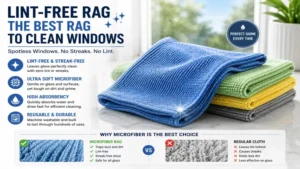
Cleaning windows streak-free requires a systematic approach. Even the best rag to clean windows will fail if you use improper wiping techniques or saturate the cloth too quickly.
+-------------------------------------------------------+
|  QUADRANT FOLDING TECHNIQUE                           |
|                                                       |
|   +-----------+-----------+     +-----------+         |
|   |           |           |     |           |         |
|   |  Side 1   |  Side 2   | --> |  Working  | (Flip   |
|   |           |           |     |   Face 1  |  for 8  |
|   +-----------+-----------+     +-----------+  clean  |
|   |           |           |     |           |  sides) |
|   |  Side 3   |  Side 4   |     |           |         |
|   +-----------+-----------+     +-----------+         |
+-------------------------------------------------------+
Step 1: The Two-Towel System
Never rely on a single cloth to do both the cleaning and the drying.
-
Towel A (Damp/Scrubbing): Spritz water or cleaner sparingly onto Towel A (not onto the glass directly, which causes drips on sills). Wipe the glass in an “S-shape” pattern from top to bottom.
-
Towel B (Dry/Buffing): Immediately follow up with a completely dry, flat-knit glass rag. Wipe in straight horizontal strokes to buff away remaining micro-droplets before they dry into water spots.
Step 2: The Quadrant Folding Technique
Fold your microfiber towel in half, then in half again. This gives you eight clean, flat working surfaces. When one side becomes damp or collects dirt, flip to a fresh quarter. This simple step prevents you from re-depositing lifted oils back onto the glass.
Step 3: Laundering for Maximum Longevity
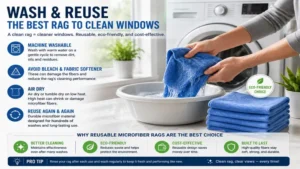
Microfiber is made of microscopic synthetic hooks. If you wash your glass rags with laundry detergent containing fabric softeners or scent beads, those softeners will coat the micro-hooks, turning your streak-free rag into a smearing rag.
-
Wash: Use warm water with a clear liquid detergent (no softeners, no bleach).
-
Separate: Never wash microfiber with cotton towels. Cotton sheds lint that permanently embeds in the microfiber hooks.
-
Dry: Air-dry or tumble dry on low heat. High heat melts the synthetic fibers, ruining their absorbent properties.
Real-World Scenario: Choosing the Right Rag for Your Needs
Not every window-cleaning situation demands the same tool. Here is how to match the product to your environment:
                  [Cleaning Scenario]
                           |
       +-------------------+-------------------+
       |                                       |
[Exterior / High Dirt]                  [Interior / Tinted]
       |                                       |
(Waffle Weave / Grid)                   (Smooth Flat Knit)
       |                                       |
Ex: Pro-Clean Basics                    Ex: E-Cloth / Zwipes
Scenario A: The Commercial Storefront Maintenance
-
Challenge: Large expanses of tempered glass exposed to street exhaust, rain spots, and high foot traffic.
-
Best Pick: Pro-Clean Basics Waffle Weave Cloth
-
Why: You need fluid capacity and scrubbing texture. Flat rags will saturate within two panes. The waffle grid holds dirty water and handles ambient dust effortlessly.
Scenario B: Residential High-Sun Windows & Mirrors
-
Challenge: Direct sunlight instantly bakes cleaner onto the glass, revealing every microscopic streak.
-
Best Pick: E-Cloth Window Cleaning Cloth
-
Why: Direct sun leaves no time for chemical cleaners to evaporate cleanly. By using the E-Cloth damp with pure water, there are no chemical surfactants left behind to bake into a hazy sheen.
Scenario C: Automotive Interiors & Tinted Glass
-
Challenge: Slanted windshields with off-gassing vinyl haze on the inside, plus delicate aftermarket film tint.
-
Best Pick: Chemical Guys Workhorse Microfiber
-
Why: The dual-pile construction cushions against plastic trims, and the soft borders prevent scratching or lifting the edges of aftermarket window tint.

Problem vs. Solution Guide: Common Window Cleaning Pitfalls
Problem 1: Haze Appears Hours After Cleaning
-
The Cause: Chemical buildup from detergents or commercial window sprays left behind on the surface.
-
The Solution: Strip the glass using a 50/50 water and isopropyl alcohol mixture, then switch to a dedicated smooth-knit rag like the Zwipes Microfiber Glass Cleaning Cloth using plain water.
Problem 2: Fine White Dust Left on the Glass
-
The Cause: Washing microfiber with cotton bath towels or using low-grade terry towels that shed synthetic micro-pellets.
-
The Solution: Use low-pile or flat fish-scale rags like Meciko Microfiber Glass Towels and isolate them during laundering.
Problem 3: The Rag “Grabs” and Folds Over Itself During Buffing
-
The Cause: Excessive friction caused by using a completely dry towel on dry glass, or an improper fiber weave.
-
The Solution: Lightly mist the buffing cloth with distilled water to break surface tension, or switch to a silky flat-knit weave designed specifically for dry glass drag reduction.
Buyer’s Decision Framework: Key Features Evaluated
When shopping for the best rag to clean windows, filter your choice through these critical criteria before making a decision:
       EVALUATION MATRIX

  Attribute        Flat Knit      Waffle Weave    Plush Terry
  ------------     ---------      ------------    -----------
  Streak Removal   ★★★★★          ★★★★☆           ★★☆☆☆
  Absorption       ★★★☆☆          ★★★★★           ★★★★☆
  Scrubbing        ★★☆☆☆          ★★★★★           ★★★☆☆
  Lint Resistance  ★★★★★          ★★★★★           ★★☆☆☆
1. Weave Type (Flat vs. Waffle vs. Plush)
-
Flat/Smooth Knit: Absolute best for final buffing, zero lint, crystal-clear optics. Low water holding capacity.
-
Waffle Weave: Best for heavy cleaning, water absorption, and exterior windows. High fluid capacity.
-
Plush Terry: Best for general dusting or car bodies. Avoid for final glass buffing as the long loops trap lint and drop it back onto the glass.
2. Blend Ratio (Polyester vs. Polyamide)
Look at the tag on the rag. You will see a ratio like 80/20 or 70/30.
-
Polyester: Provides the scrubbing structure and durability.
-
Polyamide: Provides moisture absorption and magnetic-like dust attraction.
-
Rule of Thumb: Higher polyamide (20% to 30%) is always preferred for glass cleaning.
3. GSM (Grams per Square Meter)
GSM measures fiber density.
-
Under 200 GSM: Cheap, thin, saturates instantly. Avoid for glass.
-
250–350 GSM: The sweet spot for window rags. Offers structure without feeling like a heavy bath towel.
-
Over 400 GSM: Too thick for glass. Retains too much water and takes forever to air-dry.
Microfiber vs. Traditional Alternatives: The Science of Cleaning
For decades, newspaper and cotton huck towels were the gold standard for window cleaning. However, modern manufacturing shifts have changed their effectiveness.
       COTTON vs. SPLIT MICROFIBER

  Cotton Fiber (Round)          Split Microfiber (Multi-Angle)

      O  O  O                       \  /  \  /
     ( O  O  )                       >    <
      O  O  O                       /  \  /  \
     Pushes Dirt                    Traps & Shears
Why Newspaper No Longer Works
Historically, newspaper ink contained lead and heavy petroleum compounds that acted as a mild polish on glass. Modern newsprint uses water-based soy inks. When wet, soy ink dissolves, leaving dark smudges and wet paper pulp across window frames.
Why Cotton Leaves a Haze
Cotton fibers are smooth and tubular. Instead of scraping dirt off glass, cotton glides over microscopic grease droplets, spreading them into a thin, uniform film. Additionally, cotton fibers break down when exposed to friction, leaving tiny white cellulose threads all over the glass.
The Split Synthetic Advantage
Split microfiber is chemically engineered from polyester and polyamide. During production, the fibers are mechanically split, creating microscopic channels. These channels use capillary action to draw water and oils deep into the fiber core, shearing dirt off the glass rather than pushing it around.
Features That Matter (And Marketing Hype to Ignore)
Navigating product descriptions can be frustrating when every brand claims to have a “revolutionary, space-age” cleaning cloth. Here is how to filter the real specs from the fluff:
Features That Actually Matter
-
Overlocked or Laser-Cut Edges: Prevents the edges of the cloth from unraveling after three washes.
-
High Polyamide Percentage (20-30%): Ensures the cloth actually holds onto water droplets rather than repelling them.
-
Split Fiber Certification: Guarantees the microfibers have been physically opened to create trapping channels.
Marketing Hype to Ignore
-
“Antibacterial/Infused with Silver”: Unnecessary for window cleaning. Glass doesn’t harbor bacteria the way kitchen sponge surfaces do, and these coatings wash out after a few laundry cycles anyway.
-
“Self-Cleaning Fiber”: No fabric cleans itself. All window rags accumulate dirt and require laundering.
-
“100% Streak-Free Guarantee”: Streaks are caused by dirty rags, chemical overspray, or improper technique—not just the fabric itself. No towel can overcome bad cleaning habits.
Long-Term Cost & Maintenance Analysis
Upgrading from paper towels or cheap cotton rags to specialized microfiber requires an upfront investment, but the return on investment (ROI) becomes clear within months.
       1-YEAR COST COMPARISON

  Paper Towels + Spray Cleaners:   $80 - $120 / year
  ======================================================
  Quality Microfiber Rags + Water:  $15 - $25 / year
  ======================================================
  TOTAL SAVINGS:                    ~$65 - $95 / year
The Financial Breakdown
-
Paper Towel Method: An average household consumes 24–30 rolls of paper towels per year for glass and mirror cleaning, alongside 4–6 bottles of spray cleaner. Total annual cost: $80–$120.
-
Microfiber Method: Purchasing a 6-pack of high-grade glass cloths (like the E-Cloth Window Cleaning Cloth or Zwipes Microfiber Glass Cleaning Cloth) costs around $15–$25. Because these cloths can be laundered over 200 times, your ongoing cost for the next 2–3 years drops close to zero.
Extending the Lifespan of Your Window Rags
-
Never iron microfiber. Heat destroys the synthetic matrix.
-
Avoid boiling water. Wash in warm water (around 100°F–120°F).
-
Use dedicated storage. Keep glass cloths in a sealed zip bag or bin so they don’t collect ambient household dust while stored.
🔍 Ready to Upgrade Your Window Cleaning Setup?
Having the right tools transforms window cleaning from a frustrating chore into a quick, satisfying task. By pairing high-density split microfibers with proper quadrant-folding techniques, you can achieve brilliant, streak-free glass without relying on harsh chemical sprays.
Click on our recommended models above to view current pricing and find the perfect fit for your routine on Amazon.
Frequently Asked Questions
❓ What is the best rag to clean windows without leaving streaks?
✅ High-density split microfiber cloths with a smooth flat knit or waffle weave are the absolute best choice. They physically grab oils and micro-droplets rather than smearing them like standard cotton rags or paper towels do…
❓ Is microfiber better than paper towels for cleaning glass?
✅ Yes, microfiber is vastly superior. Paper towels break down when wet, leaving cellulose lint behind. Split microfiber traps dirt inside microscopic fiber channels and can be washed and reused hundreds of times, making it cheaper and cleaner…
❓ Why do my windows look streaky after using a clean microfiber cloth?
✅ Streaks usually mean the cloth was washed with fabric softener, which coats the fibers in oil, or that the cloth is saturated with dirty liquid. Use a two-towel system: one damp towel to clean, followed immediately by a dry towel to buff…
❓ Can you clean windows using only water and a microfiber rag?
✅ Yes, specialized flat-knit microfibers (like E-Cloth) are engineered to break surface tension and lift grease using only warm water. This eliminates chemical residue, which is actually the primary cause of dust attraction and hazing…
❓ How do you wash window cleaning rags so they last?
✅ Wash microfiber rags in warm water using mild liquid detergent. Never use fabric softeners, bleach, or dryer sheets, as they clog the split fibers. Air-dry or tumble dry on low heat to prevent melting the synthetic micro-hooks…
Recommended for You
- 5 Best Glass Cleaning Towels in 2026 for a Streak-Free Finish
- 7 Best Car Window Microfiber Cloth Options for Streak-Free Glass in 2026
- 7 Best Auto Detailing Towels for a Scratch-Free Shine (2026)
Disclaimer: This article contains affiliate links. As an Amazon Associate, I earn from qualifying purchases. If you purchase products through these links, we may earn a small commission at no additional cost to you.
✨ Found this helpful? Share it with your friends! 💬🤗