In This Article
If you’ve ever finished washing your car only to watch water spots bloom across the hood while you fumble for a towel, you already know that automotive drying towels are not an afterthought — they’re half the job. A great wash can be undone in about ninety seconds by the wrong drying cloth: a flat, thin towel that drags grit across your clear coat and leaves a constellation of fine swirls behind. That’s the quiet reason so many “freshly washed” cars still look tired under direct sun.
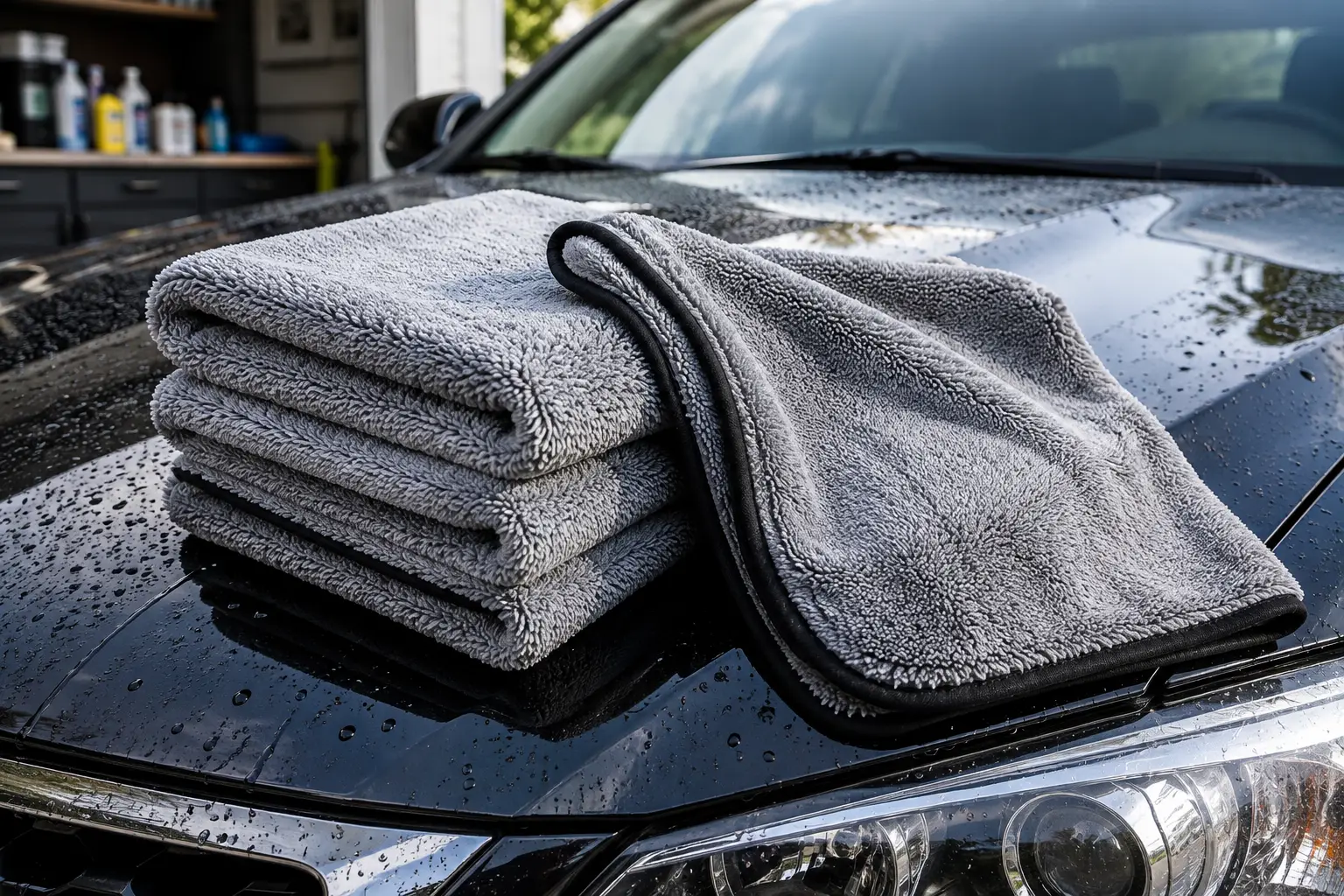
Automotive drying towels are purpose-built microfiber cloths designed to lift sheeting water off paint, glass, and trim in as few passes as possible, without scratching the surface underneath. Unlike a bath towel or a cotton rag, a real drying towel uses long, looped, or twisted microfiber strands that create far more surface area, so it can hold several times its own weight in water instead of just pushing it around. That’s the whole game: more absorbency, less friction.
In this guide, we’re comparing seven real automotive drying towels currently sold on Amazon, from budget-friendly waffle weaves to plush, professional-grade twisted-loop towels. We looked at real spec sheets — GSM (grams per square meter), weave type, size, and blend ratio — and cross-referenced them against aggregated customer feedback to figure out which towel actually earns its price tag, and which is just marketing. Whether you’re drying a sedan in the driveway every Sunday or maintaining a ceramic-coated daily driver, there’s a pick here that fits your routine and your budget.
Affiliate Disclosure: This post contains affiliate links. As an Amazon Associate, I earn from qualifying purchases made through these links, at no additional cost to you.
Quick Comparison: Automotive Drying Towels at a Glance
Before diving into full reviews, here’s a fast snapshot of how the seven picks stack up on the specs that matter most for drying performance.
| Towel | Weave | Size | GSM | Best For |
|---|---|---|---|---|
| Meguiar’s Water Magnet | Waffle weave | 22″ x 30″ | ~350 | Budget-friendly first towel |
| LASFIT XL Drying Towel | Twisted loop | 28″ x 35″ | 1,300 | Best value on large surfaces |
| Chemical Guys Waffle Weave Gray Matter | Waffle weave | 25″ x 36″ | ~400 | Glass and trim detailing |
| Adam’s Great White Drying Towel | Waffle weave | 24″ x 36″ | ~380 | Mid-size cars, dye-free safety |
| Chemical Guys Woolly Mammoth | Twisted loop | 36″ x 25″ | ~1,100 | Trucks and SUVs |
| The Rag Company Liquid8r | Twisted loop | 16″ x 16″ (2-pack) | 1,100 | Ceramic-coated, swirl-sensitive paint |
| Griot’s Garage PFM Terry Weave | Terry loop | 25″ x 35″ | 1,120 | Overall best performance |
Looking at the table, the split between waffle-weave and twisted-loop towels is really a split between budget and performance: waffle weave towels are thinner and cheaper to manufacture, while twisted-loop and terry-loop towels use denser, longer fibers that hold dramatically more water per pass. If you only take away one thing, take this: GSM (fiber density) and weave type matter more than brand name when you’re predicting how a towel will actually perform in your driveway.
💬 One click helps other shoppers make an informed choice too! 😊
Top 7 Automotive Drying Towels: Expert Analysis
We picked these seven towels to cover the full range a real buyer will encounter — from a $12 waffle weave you grab on a budget run to a $35 professional-grade towel that pros actually keep in their kits. Every one of these is a genuine, purchasable product; we’re not aware of any independently verified lab data comparing their exact water-absorption numbers side by side, so where we cite absorbency claims, they’re the manufacturers’ own figures, clearly marked as such.
1. Meguiar’s Water Magnet — best classic waffle weave for beginners
If you’ve never bought a real drying towel before, Meguiar’s Water Magnet is the low-risk, high-familiarity entry point. Its 22″ x 30″ waffle-weave texture creates small raised pockets across the surface that increase the towel’s contact area with water, letting it hold roughly double what a traditional cotton terry towel can manage per the brand’s own testing. In practice, that translates to fewer wring-outs mid-dry, which matters most on a hot day when water spots form fast.
The edgeless design and soft microfiber threads are meant to reduce the odds of picking up a stray piece of grit and dragging it across the clear coat — a reasonable safety margin, though no waffle-weave towel is as scratch-resistant as a plush twisted-loop design, since the flatter weave has less cushioning between the fiber tips and the paint. Reviewers consistently report that it “grabs” water noticeably better than the shop towels many people started with, and it remains one of the most recognized names in the category, which matters if you want a towel sold at nearly every auto parts store for quick replacement. The main complaint that surfaces in aggregated feedback is that the waffle weave saturates faster than premium twisted-loop towels on larger vehicles, so SUV and truck owners often want a second one on hand.
Pros:
- ✅ Absorbs roughly double a standard terry towel
- ✅ Widely available and easy to replace
- ✅ Edgeless design reduces scratch risk
Cons:
- ❌ Saturates quickly on full-size SUVs
- ❌ Thinner pile than twisted-loop competitors
Priced in the $10 to $15 range at the time of writing, the Meguiar’s Water Magnet is a smart, low-commitment upgrade from a shop rag — just budget for a second towel if your vehicle is larger than a sedan.
2. LASFIT XL Drying Towel — most surface area for the money
The LASFIT XL Drying Towel takes a different approach: instead of a thin waffle texture, it uses a twisted-loop microfiber construction at a dense 1,300 GSM, packed into an oversized 28″ x 35″ panel. The twisted-loop technology extends the effective length of each individual fiber, which is why the brand claims it can absorb up to 6.5 times its own dry weight in water — around 1.2 gallons per towel by their measurement.
What that means in practice is fewer total passes over the vehicle and less time spent wringing the towel out mid-job, since a twisted-loop weave simply holds more before it’s saturated than a flat or waffle weave of similar size. For anyone drying a two-row SUV or a extended-cab truck, that extra capacity is the difference between finishing in one lap versus stopping twice to wring. Reviewers describe it as noticeably plusher than typical budget towels in this price bracket, and several note it handles a full-size vehicle in a single towel where their old waffle weave couldn’t. The trade-off worth flagging: at this price point, stitching and edge finishing tend to be less refined than towels from dedicated detailing brands, so expect a slightly more basic hem.
Pros:
- ✅ Large 28″ x 35″ panel covers big vehicles fast
- ✅ 1,300 GSM twisted-loop holds more water per pass
- ✅ Comes with a manufacturer warranty
Cons:
- ❌ Less refined edge stitching than premium brands
- ❌ Only available in a limited color option
At around $15 to $20, the LASFIT XL Drying Towel is arguably the best GSM-per-dollar pick on this list if size and raw capacity are your priority.
3. Chemical Guys Waffle Weave Gray Matter — best for glass and trim
The Chemical Guys Waffle Weave Gray Matter towel leans into what waffle weave actually does best: streak-free glass and trim work, rather than pure bulk-water removal. Its 25″ x 36″ waffle pattern with soft-banded edging is built to wring out easily and dry cleanly, which is exactly the behavior you want on windshields and mirrors where lint and residual streaks are the enemy, not raw absorbency.
Where a twisted-loop towel can occasionally leave faint fiber marks on glass if it’s overloaded with water, a waffle weave like this one tends to finish cleaner on hard, non-porous surfaces because the weave releases water more evenly as you wipe. Reviewers who use it specifically for glass and chrome trim report a genuinely streak-free result, while those trying to use it as their sole full-body drying towel note it saturates faster than a twisted-loop pick on larger panels — which tracks with what the underlying textile science would predict. Think of this less as a full replacement for a plush drying towel and more as the specialist tool in a two-towel system.
Pros:
- ✅ Streak-free performance on glass and mirrors
- ✅ Soft-banded edges reduce scratch risk
- ✅ Wrings out quickly between passes
Cons:
- ❌ Saturates faster than twisted-loop towels
- ❌ Not ideal as a sole full-vehicle drying towel
Priced in the $12 to $18 range, the Chemical Guys Waffle Weave Gray Matter earns its spot as the dedicated glass-and-trim companion to a larger plush towel, not a standalone workhorse.
4. Adam’s Great White Drying Towel — best dye-free option for sensitive paint
The Adam’s Great White Drying Towel solves a problem most buyers never think to ask about: dye transfer and dye-related stiffness in colored microfiber. Adam’s Polishes deliberately left this 24″ x 36″ waffle-weave towel undyed after finding that the coloring process in their earlier towels was quietly reducing softness and absorbency — a small but honest bit of engineering reasoning that’s worth taking at face value.
In practical terms, that means the fiber itself is doing the work rather than a dye coating potentially stiffening the weave, and the brand states the towel can be pulled across a hood or trunk in a single motion while it “vacuums” water away, holding a spot-free finish behind it. Reviews consistently describe it as genuinely gentler on delicate or freshly coated paint than many colored competitors, and more than a few owners use it as a dual-purpose glass towel when slightly damp, extending its value beyond pure body drying. On the downside, the plain white-gray colorway shows dirt and staining faster than darker towels, so you’ll want to wash it more proactively to keep it looking fresh.
Pros:
- ✅ Undyed fiber preserves softness and absorbency
- ✅ Doubles as a glass towel when damp
- ✅ Guaranteed swirl-free by the manufacturer
Cons:
- ❌ Light color shows dirt and staining quickly
- ❌ Needs more frequent washing to stay effective
At around $20 to $25, the Adam’s Great White Drying Towel is the pick for anyone prioritizing paint safety on a newer or recently corrected finish.
5. Chemical Guys Woolly Mammoth — best for trucks and full-size SUVs
True to its name, the Chemical Guys Woolly Mammoth is built for vehicles that make smaller towels look silly. At 36″ x 25″ with a thick, one-inch pile made from a 70/30 polyester-polyamide microfiber blend, this is one of the largest single-panel drying towels widely available on Amazon, and Chemical Guys states it holds over a gallon of water before you need to wring it out.
That capacity is the entire value proposition: on a full-size pickup or three-row SUV, a smaller towel forces you into a stop-wring-repeat cycle that lets water start beading and spotting on the panels you already dried. A single-pass towel this large keeps you moving fast enough to beat spot formation, especially in warm or dry climates where water evaporates unevenly and leaves mineral deposits behind. Aggregated customer feedback highlights the plush feel and genuine size as standout traits, with several reviewers specifically noting it replaced two smaller towels in their routine; the more common complaint is that a towel this thick takes noticeably longer to dry between uses, so owners without a second towel on standby can find themselves waiting on laundry day.
Pros:
- ✅ Massive 36″ x 25″ single-pass coverage
- ✅ 70/30 blend is gentle on paint, glass, and chrome
- ✅ Genuinely reduces total wring-out interruptions
Cons:
- ❌ Long dry time between washes
- ❌ Overkill for compact cars and small sedans
Typically priced in the $18 to $28 range, the Chemical Guys Woolly Mammoth is the clear pick if your vehicle — or your driveway full of vehicles — is on the larger side.
6. The Rag Company Liquid8r — best for ceramic coatings and swirl-sensitive paint
The Rag Company Liquid8r is the towel enthusiasts in online detailing communities tend to reach for once they’ve had a scare with a lesser towel. Built from a 70/30 blend Korean split microfiber at a dense 1,100 GSM with a twisted-loop pile and a hidden-hem edge (rather than a traditional stitched border), it’s engineered specifically to avoid the one seam type most likely to trap grit and drag it across a panel.
The hidden-hem construction matters more than it sounds: a raised, stitched edge is a common — if underappreciated — source of fine scratching on drying towels, because it’s stiffer than the surrounding pile and can act like a tiny squeegee blade if debris gets caught in it. On a ceramic-coated vehicle, where the whole point of the coating is a slicker, more hydrophobic surface that beads and sheets water fast, a towel like this one is built to glide with minimal drag rather than fight the coating’s natural water behavior. Reviews of The Rag Company’s towel lineup broadly praise the plushness and construction quality relative to size, and note the smaller 16″ x 16″ panels (sold as a 2-pack) are easier to control precisely around mirrors, door handles, and other tight areas than a single oversized towel — though that also means more total wringing on a larger vehicle compared to something like the Woolly Mammoth.
Pros:
- ✅ Hidden-hem edge reduces scratch risk from seams
- ✅ Dense 1,100 GSM twisted-loop pile for real capacity
- ✅ Excellent control on tight areas like mirrors and handles
Cons:
- ❌ Smaller panel size means more wring-outs on big vehicles
- ❌ Premium construction comes at a premium price
Expect to pay around $20 to $28 for the 2-pack, making The Rag Company Liquid8r the pick for anyone protecting a coating or a recent paint correction.
7. Griot’s Garage PFM Terry Weave — best overall drying performance
If the goal is simply “the most water removed in the fewest passes with the lowest risk to the paint,” the Griot’s Garage PFM Terry Weave is the towel that keeps showing up at the top of enthusiast and professional detailer lists. Its long-loop terry weave is double-sided and built to a dense 1,120 GSM, with radiused, satin-bound edges specifically engineered to eliminate the stiff-edge scratching risk found on cheaper towels.
The long, looped fiber structure creates dramatically more surface area than a flat or short-pile weave, and Griot’s states the towel can hold up to five pounds of water — around half a gallon — while still gliding across the surface with minimal drag rather than dragging like thicker, denser plush towels sometimes do. That combination of high capacity and low surface tension is the actual engineering reason detailers prefer terry-loop construction for full-body drying over both waffle weave and standard twisted loop: it’s the rare case of getting more absorbency without sacrificing glide. Aggregated reviews consistently rate it as one of the most effective single towels these buyers have used, frequently citing it as a direct upgrade from whatever drying towel they started with, and the double-sided construction means you effectively get two clean surfaces from one towel between washes. The main drawback is straightforward: this is the most expensive towel on our list, and the premium construction doesn’t leave much room for a budget-conscious buyer.
Pros:
- ✅ Radiused satin edges virtually eliminate seam-scratch risk
- ✅ Holds up to five pounds of water per the brand’s spec
- ✅ Double-sided design offers two clean surfaces per wash
Cons:
- ❌ The highest price point in this lineup
- ❌ Premium feel comes with a premium replacement cost
At roughly $30 to $40, the Griot’s Garage PFM Terry Weave is the towel to buy once and stop shopping — assuming your budget allows for the upfront cost.
Getting the Most Out of Your New Drying Towel
Buying a great towel is only half the equation; how you use and maintain it determines whether it performs like new after wash number one or wash number fifty. Start by washing any new microfiber towel — including any of the seven above — before its first use, since manufacturing residue and loose fibers can otherwise transfer onto your paint. Use a dedicated microfiber detergent or a dye-free liquid detergent, never fabric softener or dryer sheets, both of which coat the fibers in a film that kills absorbency almost immediately.
For the drying technique itself, the “lay and drag” method beats wiping in circles: lay the towel flat across a panel, let it soak in for a second, then gently pull it toward you rather than scrubbing. This minimizes the friction that actually causes swirl marks, regardless of which towel you’re using. Wring the towel out over a bucket, not onto the driveway or into a storm drain — untreated wash water carries detergent, road grime, and sometimes brake dust, and the EPA specifically recommends directing car-wash runoff onto grass or a landscaped area rather than pavement to reduce pollutant flow into local waterways. Dedicate separate towels to separate tasks (one for the body, one for wheels, one for glass) so grit from a dirtier surface never ends up on your clear coat, and always wash your microfiber separately from cotton towels, since cotton lint clings to microfiber loops and ruins the lint-free finish you paid for.
Real-World Scenarios: Which Towel Fits Your Garage
Not every driveway has the same needs, so here’s how three common situations map onto the lineup above. A student commuting to campus in a compact sedan, washing every other weekend on a tight budget, is well served by the Meguiar’s Water Magnet paired with the Chemical Guys Waffle Weave Gray Matter for glass — a sub-$30 combo that covers a small car’s surface area without excess capacity going to waste.
A family with a three-row SUV or a work truck, washing weekly and fighting hard water spots in a sunny climate, gets more value from the sheer capacity of the Chemical Guys Woolly Mammoth or the LASFIT XL Drying Towel, either of which can realistically finish a large vehicle in one pass before spots start forming. Finally, an enthusiast running a ceramic coating or a recent paint correction, washing every one to two weeks and genuinely worried about introducing swirl marks, should prioritize the seam construction and glide behavior of The Rag Company Liquid8r or the Griot’s Garage PFM Terry Weave over raw size — on coated paint, how a towel behaves matters more than how much it holds.
✨ Don’t miss these exclusive deals! 🔍 Take your car care routine to the next level with this carefully curated lineup. Click a highlighted towel to check current pricing and availability — these picks will help you get a streak-free, swirl-free finish every time you wash.
How to Choose Automotive Drying Towels
Picking the right towel comes down to a handful of concrete criteria, not brand reputation alone.
- Weave type first. Twisted-loop and terry-loop towels hold significantly more water than flat or waffle weaves; waffle weave still wins for glass and trim precision.
- GSM as a capacity signal. Towels below roughly 400 GSM are lighter-duty; 1,000 GSM and above indicates a genuinely plush, high-capacity towel built for full-body drying.
- Size relative to your vehicle. A compact car is well served by a 24″x36″ towel; trucks and SUVs benefit from 28″x35″ or larger single panels to minimize wring-outs.
- Edge construction. Edgeless or hidden-hem designs reduce the risk of a stiff, stitched border dragging grit across delicate paint.
- Blend ratio. A 70/30 polyester-to-polyamide blend is the industry-standard sweet spot for softness paired with absorbency.
- Color and dye. Undyed or light-colored towels avoid dye-related stiffness but show dirt faster, so factor in your washing habits.
- Budget for at least two towels. A dedicated glass towel plus a dedicated body towel outperforms one towel doing every job.
Common Mistakes to Avoid When Buying Automotive Drying Towels
The single most common mistake is buying based on size alone and ignoring GSM — a huge, thin towel can actually hold less water than a smaller, denser one, because capacity is a function of fiber density and loop length, not surface area by itself. A close second is assuming any “microfiber” label guarantees quality; the category spans everything from thin, flat dusting cloths to dense professional terry weaves, and the difference in real-world drying performance between the two extremes is enormous even though both are technically microfiber.
Buyers also frequently skip a dedicated wheel or trim towel, using their best paint-drying towel on brake dust and grime instead — a habit that embeds abrasive particles into the pile and turns a premium drying towel into a scratch risk the next time it touches paint. Finally, many people wash new microfiber with fabric softener out of habit, not realizing that softener coats the fibers in a residue that measurably reduces absorbency; this is arguably the fastest way to make a genuinely great towel perform like a cheap one within a few washes.
Waffle Weave vs. Twisted-Loop Drying Towels
The waffle weave drying towel and the twisted-loop drying towel solve the same problem — removing sheeting water — through genuinely different textile structures, and picking between them isn’t just a preference call. A waffle weave uses a grid of raised squares to create pockets that trap water; it’s thinner, dries faster between uses, and tends to finish streak-free on hard, non-porous surfaces like glass. A twisted-loop weave instead extends individual fiber length by twisting the loops, which multiplies surface area far more aggressively — the reason twisted-loop towels like the LASFIT XL Drying Towel and The Rag Company Liquid8r can hold multiple times their dry weight in water.
In practice, waffle weave wins for glass, mirrors, and trim work where you want a fast-wringing, low-lint finish, while twisted loop wins for full-body drying on larger vehicles where raw capacity determines how many passes you’ll need. Most serious detailers end up owning both types rather than picking a single winner, using each where it performs best rather than forcing one towel to do every job on the vehicle.
Drying Towel vs. Chamois: Which Should You Use?
Before microfiber dominated the category, the natural or synthetic chamois was the default car-drying tool, and it’s still sold in most auto parts stores today — but the comparison isn’t close anymore for most buyers. A genuine leather chamois is thin, has essentially no cushioning pile, and needs to stay damp to remain pliable, which means a dry or stiff chamois can drag grit across paint in a way a plush microfiber towel is specifically engineered to avoid. Synthetic (PVA) chamois cloths solve some of that stiffness problem but still lack the deep pile that gives twisted-loop and terry-weave microfiber its scratch-reducing cushion.
| Attribute | Microfiber Drying Towel | Chamois (Leather/PVA) |
|---|---|---|
| Water capacity | High (varies by GSM) | Moderate |
| Scratch risk | Low with edgeless/hidden-hem design | Higher when dry or dirty |
| Maintenance | Machine washable | Requires careful rinsing and drying |
| Longevity | Years with proper care | Cracks or hardens over time |
Reading through independently compiled cleaning-cloth comparisons, the consensus among cleaning experts is that split microfiber consistently outperforms older materials at trapping debris rather than just moving it around, which is exactly the behavior you want when the surface underneath is a $30,000 paint job rather than a kitchen counter — a point echoed in Consumer Reports’ own testing of cleaning cloth materials. For most buyers today, a quality twisted-loop or waffle-weave microfiber towel is simply the safer, longer-lasting choice, and chamois has become more of a specialty or nostalgia purchase than a serious recommendation.
What to Expect: Everyday Performance
On a typical two-bucket wash, expect a quality twisted-loop or terry-weave towel to clear roughly 80 to 90 percent of standing water in a single lay-and-drag pass across each panel, with a second light pass picking up the rest before you move to trim and glass. Waffle weave towels usually need one additional pass on larger panels since they saturate faster, but they finish glass and mirrors cleaner than most twisted-loop towels will on the first try. Expect any towel — regardless of price — to need wringing out roughly every one to two panels on a full-size vehicle unless it’s one of the higher-capacity picks like the Griot’s Garage PFM Terry Weave or Chemical Guys Woolly Mammoth.
Climate changes this calculus meaningfully: in hot, dry regions, water evaporates and leaves mineral spots faster than you can dry with a slow towel, which pushes the case toward higher-capacity twisted-loop or terry options regardless of vehicle size. In humid climates, evaporation is slower and a mid-tier waffle weave towel is often perfectly adequate, since spotting risk is lower even with a couple of extra wring-outs.
Long-Term Cost and Maintenance
A drying towel is a recurring cost disguised as a one-time purchase, because pile, absorbency, and edge integrity all degrade gradually with washing — the real total cost of ownership includes both the towel and years of gentle, dedicated laundering. A $12 waffle weave washed correctly (cold water, dye-free detergent, no fabric softener, low heat) can realistically last one to two years of regular use before absorbency noticeably drops; a $30-plus terry weave or twisted-loop towel from a brand like The Rag Company or Griot’s Garage, cared for the same way, often lasts three to five years or longer because the denser, higher-quality fiber resists matting and pile collapse far better under repeated washing.
Run the math over five years and the premium towel is frequently the cheaper option per wash, even before factoring in the reduced risk of paint correction costs from a scratch-prone budget towel. The one universal rule that protects your investment regardless of price tier: never use bleach, never use fabric softener, and always wash microfiber separately from cotton or lint-shedding fabrics.
Features That Actually Matter (and Ones That Don’t)
GSM, weave type, edge construction, and blend ratio are the features that reliably predict real-world performance — everything else in a typical Amazon listing is closer to marketing polish. A flashy color, for instance, has zero measurable effect on absorbency and, as covered in the Adam’s Great White review above, an undyed fiber can actually outperform a dyed one of similar construction. Branding claims like “ultra-premium” or “professional-grade” aren’t independently regulated, so they should be treated as a starting point for research, not a substitute for checking the actual GSM and weave spec.
What genuinely does matter but rarely gets marketing attention: hem construction (hidden-hem beats stitched-edge for scratch reduction), country of manufacture consistency (South Korean split microfiber has an especially strong reputation among enthusiasts for fiber quality), and whether the manufacturer publishes a specific GSM number at all — vague listings that only say “premium microfiber” without a GSM figure are usually lower-density towels the seller would rather you not compare directly.
Safety, Regulations, and Standards
Automotive drying towels aren’t subject to a dedicated federal safety standard the way, say, child car seats are, but general consumer-product textile rules still apply, and the U.S. Consumer Product Safety Commission oversees flammability and labeling requirements for textile products sold nationally. From a buyer-protection standpoint, the more relevant regulation is on the content side: under the FTC’s rules for reviews and affiliate content, any site recommending products it earns a commission from — including this one — is required to clearly disclose that relationship, which is exactly what the disclosure at the top and bottom of this article does, in line with the FTC’s published endorsement guidance for affiliate marketers.
On the product side, reputable manufacturers like Griot’s Garage, The Rag Company, and Chemical Guys publish their blend ratios and GSM figures openly, which is itself a reasonable proxy for transparency — brands unwilling to state basic fiber specs are harder to hold accountable for absorbency and durability claims. If a listing can’t tell you the GSM or blend, treat any performance claim on that towel with extra skepticism.
Best Car Drying Towel for Every Budget
What’s the best car drying towel? There isn’t one universal answer — the best car drying towel for a compact sedan on a tight budget is different from the best one for a ceramic-coated daily driver. For a first towel under $15, the Meguiar’s Water Magnet remains a safe, widely available choice. For the best capacity-per-dollar on a larger vehicle, the LASFIT XL Drying Towel at 1,300 GSM is hard to beat. For buyers protecting a coating or recent paint correction who want the lowest possible scratch risk, The Rag Company Liquid8r or the Griot’s Garage PFM Terry Weave justify their higher price with genuinely different edge construction and fiber density.
| Budget Tier | Pick | Why |
|---|---|---|
| Under $15 | Meguiar’s Water Magnet | Familiar, widely stocked, solid entry performance |
| $15–$25 | LASFIT XL Drying Towel / Adam’s Great White | Best size-to-price or paint-safety ratio |
| $25 and up | Griot’s Garage PFM Terry Weave / The Rag Company Liquid8r | Premium construction for coated or corrected paint |
Looking at the tiers side by side, the jump from entry to mid-range buys you meaningfully more capacity, while the jump from mid-range to premium mostly buys you better edge safety and longevity rather than dramatically more absorbency — worth knowing before you assume the most expensive towel is automatically the best fit for your car.
Microfiber Drying Towel for Cars: GSM, Weave, and Size Explained
Not every microfiber drying towel for cars is built the same way, and understanding the underlying construction options helps explain why prices swing so widely across this category.
Chenille Drying Towels: A Softer, Bulkier Alternative
Chenille is best known from wash mitts, but chenille-style drying towels exist too, using thick, yarn-like fibers arranged in a fuzzy, caterpillar-textured pile rather than a flat knit or twisted loop. The upside is exceptional softness and a genuinely plush feel; the downside is that chenille traps and holds more embedded grit than a tighter twisted-loop weave, making it better suited to lighter-duty drying or interior use than to a daily full-body dry on a heavily driven vehicle.
Large Microfiber Towels for Cars: When Bigger Is Better
A large microfiber towel for cars — generally anything at or above 28″x35″ like the LASFIT XL Drying Towel or Chemical Guys Woolly Mammoth — earns its size premium specifically on trucks, SUVs, and minivans, where a smaller panel forces constant repositioning and wringing. On a compact sedan, though, an oversized towel is genuinely harder to control precisely around mirrors and door handles, so bigger isn’t automatically better; it’s better for bigger vehicles specifically.
GSM in Plain English
GSM measures the weight of fiber packed into one square meter of fabric. A 350 GSM waffle weave is intentionally light and fast-drying; a 1,100+ GSM twisted-loop or terry towel is dense enough to genuinely feel heavy when wet. Neither number is “better” in isolation — it’s a trade-off between speed and raw capacity that should match your vehicle size and climate, not a simple bigger-is-always-better spec.
Frequently Asked Questions
❓ What GSM is best for a car drying towel?
❓ Can I use a regular bath towel to dry my car?
❓ How often should I wash my car drying towel?
❓ Is a waffle weave or twisted-loop towel better for a ceramic-coated car?
❓ How many drying towels do I actually need?
Conclusion
The right automotive drying towel comes down to matching weave type and GSM to your actual vehicle and routine, not chasing the biggest or priciest option on the shelf. If you’re just building your first car-care kit, the Meguiar’s Water Magnet or Chemical Guys Waffle Weave Gray Matter gets you a real upgrade over a shop rag without a big investment. If your driveway holds a truck or SUV, the extra capacity in the LASFIT XL Drying Towel or Chemical Guys Woolly Mammoth will save you real time on every wash. And if you’re protecting a ceramic coating or a paint correction you paid good money for, The Rag Company Liquid8r and the Griot’s Garage PFM Terry Weave are worth the higher price tag for their scratch-conscious construction alone.
Whichever you choose, remember that the towel is only as good as the care you give it: wash it separately, skip the fabric softener, and dedicate specific towels to specific jobs. Do that, and even a budget pick from this list will keep your paint looking better, longer, than any towel you’re currently using.
Recommended for You
- How to Polish Plexiglass: 7 Proven Methods for 2026
- Best Non Toxic Bathroom Cleaner: 7 Safe & Effective Picks for 2026
- Best Microfiber Specific Detergent: 7 Picks for Cleaner Towels
Disclaimer: This post contains affiliate links. As an Amazon Associate, I earn from qualifying purchases made through these links, at no additional cost to you.
✨ Found this article helpful? Share it with someone who needs it! 💬🤗