
In This Article
If you’ve ever watched a truck limp into a shop with frozen brake lines in January, you already understand why an automotive air dryer isn’t an optional accessory — it’s the component standing between your air brake system and a very bad day. An automotive air dryer sits between the compressor and the air tanks, stripping moisture, oil vapor, and contaminants out of compressed air before that air ever reaches your valves and brake chambers. Skip this step, or run it on a saturated desiccant cartridge, and you’re inviting corrosion, valve freeze-ups, and the kind of roadside inspection that puts a truck out of service.
This guide walks through seven real, currently available automotive air dryer options — from full OEM-grade remanufactured units to budget-friendly cartridge rebuild kits — so you can match the right part to your truck, your budget, and your climate. We’ll also cover how these units actually work, what separates a genuinely good air brake system air dryer from a part that fails in eighteen months, and the maintenance habits that keep moisture out of your system for good. Compressed-air brake systems like these are standard equipment on trucks, buses, trailers, and semi-trailers, using compressed air to both release the parking/emergency brakes and apply the service brakes — which is exactly why the dryer feeding that system matters so much.
As an Amazon Associate, this article contains affiliate links, and we may earn a commission from qualifying purchases at no extra cost to you.
What Is an Automotive Air Dryer?
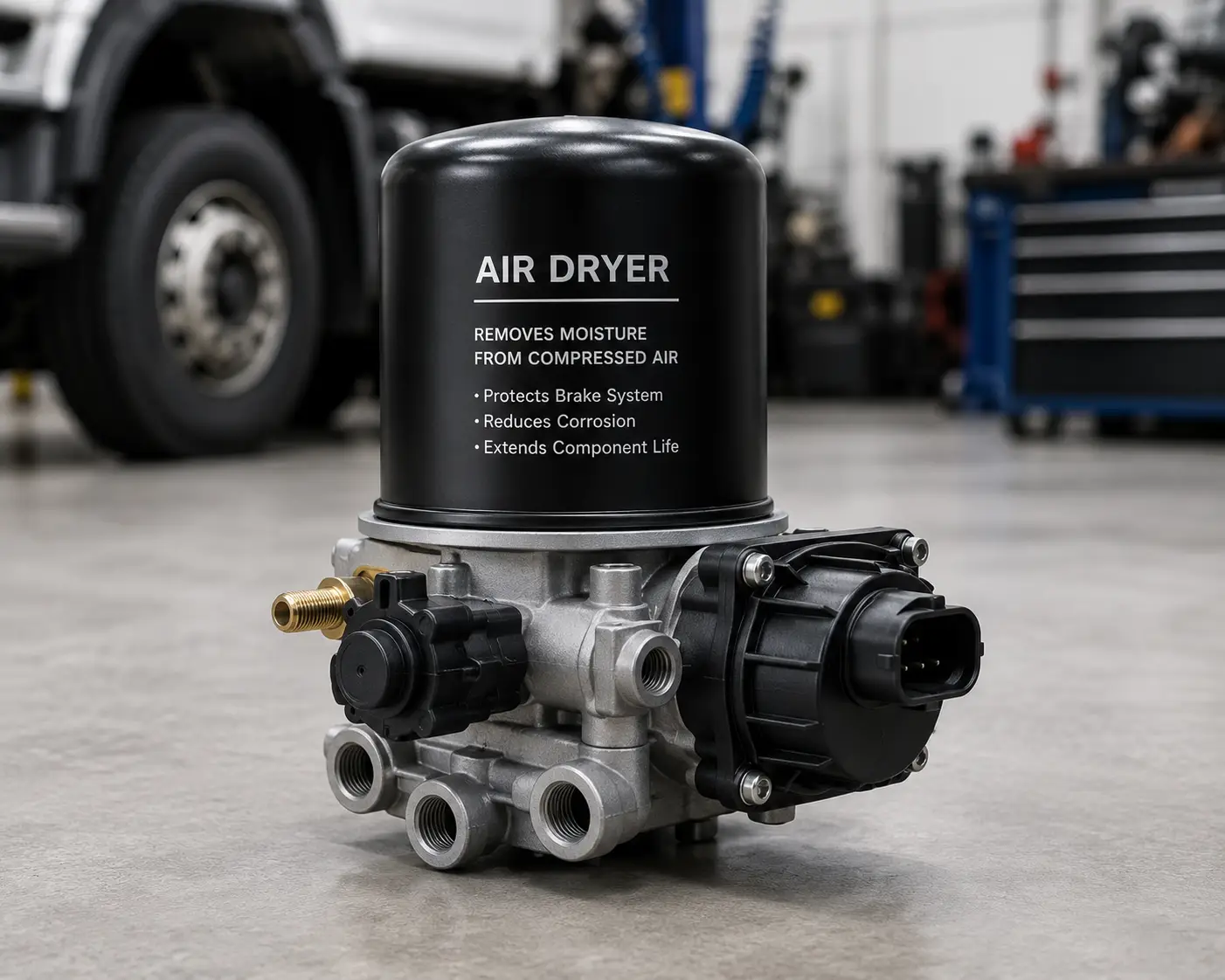
An automotive air dryer is a canister-style filtration device installed between a vehicle’s air compressor and its air brake reservoirs. It uses a desiccant cartridge to absorb moisture and a purge valve to expel that moisture (along with oil and particulate contaminants) every time the compressor cycles off, keeping the downstream brake system dry, corrosion-free, and freeze-resistant in cold weather.
Most drivers first encounter the term on a Class 7 or 8 truck, but the same basic technology shows up on buses, RVs, and any air-braked trailer combination. The core job never changes: catch water before it reaches a brake chamber, a relay valve, or an ABS modulator. Air brake systems rely on compressed air rather than hydraulic fluid, with an engine-driven compressor building pressure in wet and dry reservoir tanks — tanks the dryer is directly responsible for protecting.
Quick Comparison: Top Automotive Air Dryer Picks
| Product | Type | Price Range | Best For |
|---|---|---|---|
| Bendix 5009378X AD-9 Air Dryer | Full remanufactured unit | $200–$280 | Fleets that want OEM-verified reliability |
| RADHLBNIU R955205 Air Dryer Assembly | Full aftermarket unit | $110–$160 | Multi-brand trucks (Volvo, Freightliner, Kenworth) |
| TORQUE TR065225 AD-9 Kit | Full unit + bracket kit | $90–$130 | Owner-operators wanting a bolt-on kit |
| World American WA109994 Cartridge | Desiccant cartridge only | Under $60 | Rebuilding an otherwise healthy AD-SP/AD-IS dryer |
Looking at this snapshot, the pattern is clear: a full remanufactured unit like the Bendix 5009378X AD-9 Air Dryer costs more up front but carries OEM engineering and a factory-grade rebuild, while a cartridge-only option like the World American WA109994 Cartridge is the smarter buy when the housing, purge valve, and heater are still functioning fine. Fleet managers juggling multiple truck brands tend to gravitate toward cross-compatible assemblies like the RADHLBNIU R955205 Air Dryer Assembly, since one SKU covers several makes. We’ll break down all seven picks — plus three more options — in full detail below.
💬 Bookmark this comparison — it’ll save you a return trip to the parts counter when you’re staring at a rusted-out air dryer housing at 6 a.m.
Top 7 Automotive Air Dryers: Expert Analysis
1. Bendix 5009378X AD-9 Air Dryer, Remanufactured — genuine OEM reliability
The Bendix 5009378X AD-9 Air Dryer is a factory-remanufactured version of the industry-standard AD-9, and it’s the closest thing to a “safe default” pick in this category. Bendix engineers the AD-9 with an integral heater and thermostatically controlled purge valve, which means the unit actively fights ice formation in the purge line during winter operation rather than relying on desiccant alone. That heater cycling is what most buyers overlook — it’s the difference between a purge valve that free-flows at 10°F and one that freezes shut and dumps pressure through a stuck-open valve.
Because this is a remanufactured Bendix part rather than a generic aftermarket clone, it ships already calibrated to OEM cut-in and cut-out tolerances, which matters if your truck’s governor and dryer need to talk to each other precisely. Fleet maintenance managers consistently favor genuine Bendix components for tractors running interstate routes, since a single air-system failure can trigger a roadside out-of-service order. Reviews aggregated across major retailers describe the unit as a “drop-in” replacement with minimal fitment issues, though a handful of buyers note that a core exchange or return of the old unit is sometimes required. On paper, this is the pick for anyone who wants factory-level confidence without paying full price for a brand-new dryer.
Pros:
- ✅ OEM-calibrated cut-in/cut-out pressure settings
- ✅ Integrated heater reduces winter purge-valve freeze-ups
- ✅ Backed by Bendix’s remanufacturing quality standards
Cons:
- ❌ Highest price point among the picks in this guide
- ❌ Some listings require a core return or deposit
Expect this unit to run in the $200–$280 range at the time of writing — check the current price before ordering, since availability and core charges shift often. For a truck that can’t afford downtime, the value-for-money case is strong: you’re paying a premium to avoid a repeat repair six months later.
2. RADHLBNIU R955205 Air Dryer Assembly — broadest cross-brand fit
The RADHLBNIU R955205 Air Dryer Assembly is built to the Meritor WABCO System Saver 1200 footprint, and its biggest selling point is compatibility breadth: it’s cross-referenced to fit Bendix, Mack, Haldex, Meritor, Midland, Volvo, Freightliner, and International applications from a single part number. For a shop that services a mixed fleet, that kind of interchange list saves real shelf space and ordering headaches.
Functionally, it includes the same core elements as an OEM System Saver 1200 — desiccant cartridge, heater, and purge valve in one housing — engineered as a direct bolt-in rather than requiring a rebuild. What most buyers overlook with cross-brand aftermarket units is that fit doesn’t guarantee identical purge timing to the OEM part; it’s close, but a technician should still verify the purge cycle after installation. Aggregated buyer feedback on this style of unit tends to be positive for straightforward compressor-to-tank plumbing, with the most common complaint being variability in mounting bracket hole spacing across trailer generations. If your dryer housing is corroded or a cartridge rebuild clearly isn’t enough, this is a sensible mid-tier swap.
Pros:
- ✅ Cross-compatible with eight major truck and trailer brands
- ✅ Includes integrated heater and purge valve as one unit
- ✅ Straightforward bolt-in replacement for System Saver 1200 mounts
Cons:
- ❌ Mounting bracket fitment can vary by trailer generation
- ❌ Not a genuine WABCO or Meritor-branded part
Pricing typically lands between $110 and $160 — always confirm the exact listing before buying, since price ranges shift with supply. For mixed fleets, the value here is in reduced parts-inventory complexity as much as raw dollar savings.
3. TORQUE TR065225 AD-9 Air Dryer Kit — complete bolt-on convenience
The TORQUE TR065225 AD-9 Air Dryer Kit bundles a full AD-9-style dryer with its mounting bracket, which sounds like a small thing until you’re the technician who ordered a dryer only to discover the old bracket is too rusted to reuse. This kit is built to the same footprint as the Bendix 065225/107695 and Haldex 109685X/107695K cross-references, so it slots into the same mounting points as the OEM part it’s replacing.
Feature-wise, it’s a conventional AD-9-style unit: desiccant cartridge, purge valve, and a heater assembly sized for the same duty cycle as the original. In practice, what that means for a buyer is a genuine like-for-like swap without needing to source a separate bracket kit or fabricate a mount. Reviews aggregated from parts retailers describe the kit as good value for owner-operators doing their own maintenance, since the included hardware shortens the job. A few buyers note the purge valve’s heater draws slightly more current than some OEM equivalents, which is worth checking against your truck’s electrical load if you’re already running a heavily accessorized cab. This is a strong pick for anyone replacing a corroded bracket alongside the dryer itself.
Pros:
- ✅ Includes mounting bracket, avoiding a separate purchase
- ✅ Matches OEM AD-9 bolt pattern and cross-references
- ✅ Popular with owner-operators doing DIY installs
Cons:
- ❌ Heater current draw runs slightly higher than some OEM units
- ❌ Aftermarket cartridge life can vary by climate and duty cycle
Expect a price in the $90–$130 range — prices may vary by seller, so check the current price before checkout. For the money, bundling the bracket in with the dryer is what makes this kit stand out from otherwise similar competitors.
4. GETOPAUTO 065225 AD-9 Air Dryer Kit — best value for owner-operators
The GETOPAUTO 065225 AD-9 Air Dryer Kit occupies the entry-level slot in this lineup, and it earns that spot honestly: it’s a complete AD-9-style dryer and bracket kit cross-referenced to Bendix 065225, Haldex 109685X, and 107695K, aimed squarely at budget-conscious owner-operators and independent shops.
The feature set mirrors the mid-tier kits above — desiccant cartridge, heater, purge valve — but the components are sourced to hit a lower price point, which is the honest trade-off with any budget aftermarket dryer. Here’s what to weigh: a lower-cost dryer isn’t necessarily a worse dryer, but the manufacturing tolerances and desiccant bead quality on budget units are less consistent than what you’ll find in an OEM remanufactured part, which can shorten service intervals in high-humidity regions. Aggregated review sentiment for this class of budget kit tends to skew positive for basic regional trucking, with occasional reports of shorter desiccant life in Gulf Coast or Southeast humidity compared to drier climates. For a truck that’s not running interstate long-haul in brutal winters, this is a reasonable way to keep a repair budget in check.
Pros:
- ✅ Lowest entry price among full-unit kits in this guide
- ✅ Includes bracket, avoiding a separate hardware purchase
- ✅ Straightforward for DIY installation on AD-9 mounts
Cons:
- ❌ Desiccant may need earlier replacement in humid climates
- ❌ Build tolerances are less consistent than OEM remanufactured units
You’ll typically find this kit priced under $90 — always verify current pricing, since budget aftermarket listings fluctuate. It’s genuinely good value for light-duty and regional operations, less so for extreme climates or heavy interstate duty cycles.
5. maXpeedingrods Meritor System Saver 1200 Air Dryer — budget-friendly backup unit
The maXpeedingrods Meritor System Saver 1200 Air Dryer is built to the same footprint as the R955205/4324130010 reference numbers, positioning it as a lower-cost alternative to full-price Meritor or WABCO replacements. It’s a 12V unit designed as a direct swap for System Saver 1200-style housings on Peterbilt and similar cab-over and conventional trucks.
In terms of what the spec sheet doesn’t say but is worth knowing: budget System Saver-style clones are functionally capable dryers, but the purge valve response time and desiccant bead density are where manufacturers cut costs first. That translates to slightly less aggressive moisture stripping under continuous-duty conditions — noticeable mainly on trucks that idle for extended periods with the compressor cycling frequently. Reviews aggregated from buyers running this style of unit as a secondary or spare-truck part tend to be favorable, particularly from fleets that keep a spare on the shelf for emergency swaps rather than as their primary long-haul dryer. It’s a smart pick for a backup unit or a truck with lighter annual mileage.
Pros:
- ✅ Direct-fit replacement for System Saver 1200 housings
- ✅ Noticeably lower cost than OEM Meritor/WABCO parts
- ✅ Well-suited as a fleet spare-parts shelf item
Cons:
- ❌ Purge response is less aggressive under continuous duty
- ❌ Less ideal as a primary unit for heavy long-haul use
Pricing generally falls in the $80–$120 range — check the current price, as budget listings shift often. As a value play for a backup dryer or lighter-duty truck, it holds up well against pricier alternatives.
6. RADHLBNIU AD-9 Air Dryer Purge Valve with Heater — targeted fix for cold-weather failures
Not every air dryer problem calls for a full teardown, and the RADHLBNIU AD-9 Air Dryer Purge Valve with Heater exists for exactly that scenario. It’s a component-level replacement — purge valve and integrated heater only — cross-referenced to Bendix 5004341 and 800405, designed for AD-9 housings where the desiccant cartridge and housing are still sound but the purge valve or its heater has failed.
This matters more than it sounds like: a stuck-closed purge valve traps moisture in the housing indefinitely, while a stuck-open valve bleeds air pressure continuously, and a dead heater is often the root cause of winter freeze-ups even when the desiccant itself is fine. Replacing just the purge valve, rather than the whole unit, is the kind of targeted repair that saves real money when a full teardown isn’t warranted. Aggregated buyer feedback describes it as an easy install with basic hand tools, generally under 30 minutes for a technician familiar with AD-9 housings. The main caveat, repeated across several reviews, is that buyers must confirm their exact housing generation before ordering, since AD-9 purge valve designs have shifted slightly over the years.
Pros:
- ✅ Fixes the single most common point of AD-9 failure
- ✅ Far cheaper than replacing the entire dryer assembly
- ✅ Straightforward install with basic hand tools
Cons:
- ❌ Must be matched precisely to your AD-9 housing generation
- ❌ Doesn’t address a saturated or failing desiccant cartridge
Expect a price under $50 at the time of writing — prices may vary, so confirm before ordering. Dollar for dollar, this is one of the best value-for-money repairs available if the diagnosis points specifically to the purge valve.
7. World American WA109994 Desiccant Cartridge — smartest rebuild-over-replace option
Rounding out the lineup is the World American WA109994 Desiccant Cartridge, built for Meritor WABCO 1200-series and Bendix AD-SP/AD-IS-style dryers, cross-referenced to Bendix R950011, Haldex 109994K, Volvo 20410155, Mack 745109994, and Bosch 1487434901. This is a pure consumable — the desiccant cartridge that actually does the moisture-absorbing work inside a healthy housing — rather than a full assembly.
The practical case for a cartridge-only rebuild is straightforward: desiccant beads have a service life, typically recommended for replacement on an annual basis or roughly every 100,000 miles, and swapping just the cartridge on an otherwise functional housing is dramatically cheaper than replacing the entire dryer. What most buyers overlook is that a housing showing no external corrosion or leaks almost never needs full replacement — the cartridge is usually the actual point of failure once a system starts allowing moisture through. Reviews aggregated from fleet maintenance buyers who stock this cartridge as a routine PM item describe it as a reliable, predictable part of scheduled maintenance rather than an emergency purchase, which is exactly how it should be used. This is the pick for anyone thinking proactively about air brake system air dryer upkeep rather than reacting to a failure.
Pros:
- ✅ Dramatically cheaper than a full assembly replacement
- ✅ Cross-compatible with multiple major OEM cartridge references
- ✅ Ideal for scheduled preventive maintenance programs
Cons:
- ❌ Doesn’t fix a failed purge valve, heater, or cracked housing
- ❌ Requires the housing to already be in good condition
This cartridge typically runs under $60 — check current pricing before you buy, since consumable-part pricing shifts with supply. For fleets running a proactive PM schedule, this is arguably the single best value item in the entire lineup.
Full 7-Product Comparison Table
| # | Product | Component Type | Price Range | Best For |
|---|---|---|---|---|
| 1 | Bendix 5009378X AD-9 Air Dryer | Full remanufactured unit | $200–$280 | OEM-grade reliability, interstate fleets |
| 2 | RADHLBNIU R955205 Air Dryer Assembly | Full aftermarket unit | $110–$160 | Mixed-brand fleets |
| 3 | TORQUE TR065225 AD-9 Kit | Full unit + bracket | $90–$130 | DIY owner-operators |
| 4 | GETOPAUTO 065225 AD-9 Kit | Full unit + bracket | Under $90 | Budget regional trucking |
| 5 | maXpeedingrods System Saver 1200 | Full aftermarket unit | $80–$120 | Backup/spare unit |
| 6 | RADHLBNIU Purge Valve with Heater | Component (purge valve) | Under $50 | Targeted cold-weather repair |
| 7 | World American WA109994 Cartridge | Component (desiccant) | Under $60 | Scheduled preventive maintenance |
Interpreting this table, the clearest split is between full-unit replacements (rows 1–5) and component-level fixes (rows 6–7) — and picking the wrong category wastes money either way. If your housing is corroded, cracked, or the whole assembly is original-equipment-old, a full unit like the Bendix 5009378X AD-9 Air Dryer or RADHLBNIU R955205 Air Dryer Assembly is the right call. If the housing is sound and you’re chasing a specific symptom — winter freeze-ups or gradually rising moisture in the tanks — the RADHLBNIU AD-9 Air Dryer Purge Valve with Heater or World American WA109994 Desiccant Cartridge will fix it for a fraction of the cost.
<button style=”display:none”></button>
✨ Ready to stop chasing moisture problems?
🔍 Match your truck’s mounting footprint against the cross-reference numbers above, then click through to check current pricing and availability on the pick that fits. A properly matched automotive air dryer means fewer roadside surprises and a brake system that stays dry through every season.
How to Choose an Automotive Air Dryer
Picking the right unit isn’t just about brand loyalty — it comes down to matching a handful of technical and practical factors to your specific truck and duty cycle.
- Confirm your housing style first. AD-9, AD-IS, AD-SP, and System Saver 1200 housings are not interchangeable without adapter hardware, so identify your existing part number before shopping.
- Match voltage to your electrical system. Nearly all modern semi truck air dryer units run on 12V, but always verify against your truck’s spec sheet, especially on older or converted vehicles.
- Decide between full replacement and component repair. A cracked or heavily corroded housing needs full replacement; a healthy housing with a specific symptom often just needs a cartridge or purge valve.
- Weigh OEM versus aftermarket based on duty cycle. Long-haul interstate trucks benefit from OEM-calibrated reliability; regional or backup trucks can often run a quality aftermarket unit without issue.
- Check your climate. Trucks operating in the upper Midwest or mountain routes benefit more from a robust heater assembly than trucks running warm-climate regional routes.
- Verify the cross-reference numbers, not just the brand name. Aftermarket parts list their OEM equivalents (Bendix, Haldex, Meritor, WABCO) — cross-check every number against your truck’s original part tag.
- Factor in installation complexity. A kit that includes the mounting bracket saves labor time versus sourcing a bracket separately, which matters if you’re paying shop labor by the hour.
Automotive Air Dryer vs. Manual Tank Draining
Before dedicated air dryers became standard equipment, drivers relied on manually draining moisture from wet tanks at the end of every shift — and some older or simpler systems still lean on that habit as a backup. It’s worth understanding why a proper air brake system air dryer is a meaningfully better solution than manual draining alone.
Manual draining only removes water that has already pooled in the tank; it does nothing to stop moisture from reaching downstream valves, ABS modulators, and brake chambers between drain cycles. An automotive air dryer, by contrast, intercepts moisture continuously at the compressor outlet, before it ever spreads through the system. It also removes compressor oil vapor that manual draining can’t touch, which matters because oil contamination degrades rubber seals throughout the brake system over time.
| Factor | Automotive Air Dryer | Manual Tank Draining Only |
|---|---|---|
| Moisture removal timing | Continuous, at the source | Periodic, after water pools |
| Oil vapor removal | Yes | No |
| Freeze protection | Yes, with integrated heater | No |
| Labor required | Minimal (automatic cycling) | Daily manual task |
| Regulatory reliability | Meets modern fleet expectations | Higher moisture-related failure risk |
The table makes the practical case obvious: manual draining is a mitigation, not a solution, while a dryer addresses the root cause continuously and automatically. Fleets that rely solely on manual draining tend to see more corrosion-related valve failures over a vehicle’s lifespan, according to aggregated maintenance-industry reporting, simply because moisture has more opportunities to reach sensitive components between drain cycles.
Common Mistakes to Avoid When Buying an Automotive Air Dryer
Even experienced buyers get tripped up by a few recurring mistakes in this category. Here’s what to watch for.
Buying by brand name alone, without verifying the cross-reference part numbers against your truck’s original tag, is the single most common error — AD-9-style housings look similar across brands, but bolt patterns and electrical connectors aren’t always identical. A second frequent mistake is replacing a full unit when only the desiccant cartridge or purge valve actually failed, which wastes money on components that were never the problem. Skipping the mounting bracket check is another one: some kits include it, some don’t, and discovering a rusted, incompatible bracket mid-installation turns a one-hour job into a half-day one.
Buyers also frequently underestimate climate as a purchasing factor, opting for the cheapest available unit regardless of whether they run mountain passes in January or flat regional routes in Florida. Finally, ignoring the annual roadside inspection reality is a costly oversight — certified commercial motor vehicle enforcement personnel apply out-of-service criteria specifically to catch conditions that present an imminent hazard, and a demonstrably compromised air system is exactly the kind of finding that can pull a truck off the road mid-route.
What to Expect: Everyday Performance
On paper, a functioning automotive air dryer is invisible — that’s the whole point. In daily operation, you should notice the compressor cycling normally, air pressure building to governor cutout within roughly two minutes at idle, and an audible, brief purge sound every time the compressor unloads. That purge sound is the system doing its job, venting accumulated moisture before it can travel further into the brake circuit.
What you shouldn’t notice is water or oil sheen when you open a tank drain cock, ice forming around the dryer housing in winter, or a slow, unexplained drop in tank pressure overnight. A degrading desiccant cartridge often shows up first as a subtle change: drains that used to run clear start showing a faint milky discharge, which is your early signal that the cartridge is losing its absorption capacity before a full failure occurs. Catching that early is the difference between a scheduled $60 cartridge swap and an unscheduled full-unit replacement six weeks later.
Long-Term Cost and Maintenance
Total cost of ownership for an automotive air dryer isn’t just the purchase price — it’s purchase price plus desiccant cartridge replacements plus labor plus the far larger cost of a preventable roadside failure. Desiccant cartridges are generally recommended for replacement annually or every 100,000 miles, whichever comes first, which puts routine maintenance cost for most trucks in the same ballpark as a couple of oil changes per year.
| Cost Category | Full Unit Replacement | Cartridge-Only Rebuild |
|---|---|---|
| Upfront part cost | $80–$280 | Under $60 |
| Typical labor time | 45–90 minutes | 20–30 minutes |
| Frequency needed | Every 3–6 years (avg.) | Annually or 100,000 miles |
| Best used when | Housing damaged/corroded | Housing still sound |
The math strongly favors staying ahead of cartridge life rather than waiting for a full failure: a proactive annual cartridge swap on a healthy housing costs a fraction of an emergency full-unit replacement, plus the towing, downtime, and potential out-of-service costs that come with an unplanned brake-system failure on the road. Fleets that track dryer maintenance on a set PM interval consistently report fewer emergency air-system repairs than fleets that replace reactively.
Features That Actually Matter (and Ones That Don’t)
Marketing copy on aftermarket air dryer kits tends to emphasize things that sound impressive but don’t move the needle much, while underselling the details that actually determine reliability. Here’s the honest breakdown.
What genuinely matters: an integrated heater with reliable thermostatic control (this is the single biggest predictor of winter reliability), a purge valve that seats cleanly without leaking air between cycles, and accurate cross-reference documentation so you know exactly what you’re buying compatibility-wise. Housing material quality also matters more than most buyers realize — a housing prone to surface corrosion in road-salt environments will outlive its usefulness faster than the internal components will wear out.
What matters less: cosmetic finish on the housing exterior, and marketing claims about “extended desiccant life” without a specific mileage or duty-cycle backing behind the claim. A dryer’s real-world performance comes down to engineering fundamentals — heater response time, purge valve seal quality, and desiccant bead density — not paint color or box copy.
Automotive Air Dryer for Fleet Maintenance Managers vs. Owner-Operators
The right buying strategy genuinely differs depending on who’s making the call. Fleet maintenance managers overseeing dozens of trucks are optimizing for standardization and predictable PM scheduling — which usually means favoring OEM or OEM-cross-compatible units like the Bendix 5009378X AD-9 Air Dryer or RADHLBNIU R955205 Air Dryer Assembly, ordered in bulk against a fixed replacement interval, with desiccant cartridges like the World American WA109994 Desiccant Cartridge stocked as routine shelf inventory.
Owner-operators, by contrast, are typically optimizing for immediate cost control and DIY-friendly installation. A complete kit with the mounting bracket included — like the TORQUE TR065225 AD-9 Air Dryer Kit or the budget-friendly GETOPAUTO 065225 AD-9 Air Dryer Kit — reduces both the parts list and the labor time for someone doing the swap in their own driveway or a small independent shop. Neither approach is wrong; they’re solving for different constraints, and the right pick genuinely depends on which situation you’re in.
Safety, Regulations, and Standards
Air brake system components, including the dryer, fall squarely under federal oversight in the United States. Every commercial motor vehicle must meet applicable service, parking, and emergency brake system requirements set out in federal regulation, and those requirements extend to the moisture-control components that keep the whole system functioning as designed. You can review the governing rules directly at 49 CFR Part 393, Subpart C — Brakes, the section of the Code of Federal Regulations that covers brake system requirements for commercial motor vehicles.
Roadside enforcement adds a practical layer on top of the written regulation. Every year, CVSA’s Brake Safety Week puts thousands of commercial vehicles through targeted brake inspections across North America, and air system defects — including compromised dryers — are a recurring category of violation. For fleets and owner-operators, treating your automotive air dryer as a compliance-critical component, not just a maintenance nicety, is the difference between a clean inspection and an out-of-service order that strands a load.
Installing and Maintaining Your Automotive Air Dryer: A Step-by-Step Guide
Whether you’re doing a full swap or a cartridge rebuild, the process follows a predictable sequence. Getting it right the first time saves a callback.
First, fully drain the air system and confirm zero residual pressure in every tank before disconnecting any fittings — compressed air lines under pressure can cause serious injury if disturbed carelessly. Next, disconnect the electrical connector to the dryer’s heater and purge valve, then remove the mounting bolts and the air line fittings, noting their positions or labeling them if your housing has multiple ports.
For a full unit swap, mount the replacement dryer using the same bracket points (or the included bracket, if your kit provides one), reconnect air lines in their original positions, and reattach the electrical connector securely. For a cartridge-only rebuild, remove the retaining bolt or clip on the cartridge housing, extract the old desiccant cartridge, inspect the housing bore for corrosion or debris, and seat the new cartridge with a fresh O-ring if one is provided.
Once reassembled, rebuild air pressure gradually and check every fitting with a soapy-water spray to confirm there are no new leaks at the connections you disturbed. Listen for a clean purge cycle when the compressor first unloads — a weak or silent purge suggests a fitting issue or a valve that isn’t seating. Log the installation date and mileage so your next cartridge replacement lands on schedule rather than by guesswork.
A few habits extend service life well past the baseline: draining tanks daily if your truck lacks automatic tank drains, avoiding extended idling in freezing conditions where possible, and inspecting the purge valve outlet for ice buildup during the first hard freeze of the season rather than waiting for a failure to tell you something’s wrong.
Real-World Scenarios: Matching the Right Air Dryer to Your Situation
The regional box truck driver. Running daily 150-mile routes in a moderate climate, replacing a corroded original-equipment dryer on a budget. The GETOPAUTO 065225 AD-9 Air Dryer Kit fits this profile well — full replacement, bracket included, priced for a budget-conscious single-truck operation that isn’t chasing extreme winter conditions.
The interstate long-haul fleet. Running dozens of tractors through Midwest winters and needing predictable, standardized parts across the fleet. This is where the Bendix 5009378X AD-9 Air Dryer earns its higher price tag — OEM calibration and heater reliability reduce the odds of a winter roadside failure across a large fleet, and standardizing on one part number simplifies inventory.
The owner-operator on a tight maintenance budget. Housing still looks sound, no corrosion, but tanks have started showing faint moisture on drain. Rather than replacing the whole unit, this driver is better served by the World American WA109994 Desiccant Cartridge — a proactive, low-cost swap that likely solves the problem outright.
The mixed-brand small fleet. Running a handful of trucks across different manufacturers (a Freightliner, a Kenworth, a Volvo) and wanting to minimize the number of distinct parts stocked. The RADHLBNIU R955205 Air Dryer Assembly, with its broad cross-brand compatibility, cuts down on inventory complexity better than sourcing brand-specific OEM parts for each truck.
Automotive Air Dryer Problems and Solutions
Problem: Ice forms around the dryer housing in cold weather. This usually points to a failed or weak heater, or a thermostat that isn’t cycling correctly. Solution: test the heater circuit for continuity and proper voltage; if it’s dead, a targeted fix like the RADHLBNIU AD-9 Air Dryer Purge Valve with Heater resolves it without a full unit swap.
Problem: Milky or discolored discharge from the tank drain cocks. This is the classic sign of a saturated or failing desiccant cartridge that’s no longer absorbing moisture effectively. Solution: replace the cartridge on schedule — the World American WA109994 Desiccant Cartridge is built for exactly this rebuild.
Problem: Slow, unexplained overnight air pressure loss. This can stem from a purge valve that isn’t sealing, rather than a leak elsewhere in the system. Solution: isolate the dryer with a soapy-water test at the purge outlet; a leaking valve typically means a purge valve replacement or full unit swap depending on housing condition.
Problem: Compressor cycles excessively without reaching cutout pressure. While this often traces to the governor, a clogged or failing desiccant cartridge can also restrict airflow enough to slow pressure buildup. Solution: check cartridge age and condition first, since it’s the cheaper and more common culprit compared to compressor issues.
Problem: Corrosion visible on the dryer housing exterior. External corrosion, especially in road-salt regions, often signals internal corrosion is further along than it appears. Solution: a full-unit replacement, such as the TORQUE TR065225 AD-9 Air Dryer Kit or maXpeedingrods Meritor System Saver 1200 Air Dryer, is the safer call rather than attempting a cartridge-only fix on a compromised housing.
FAQs
❓ How often should I replace my automotive air dryer's desiccant cartridge?
❓ Can I install an automotive air dryer myself?
❓ What's the difference between an AD-9 and a System Saver 1200 air dryer?
❓ Do I need a full air dryer replacement or just a new cartridge?
❓ Will a failing air dryer cause my truck to fail a roadside inspection?
Conclusion
A healthy automotive air dryer is one of those parts nobody thinks about until it fails at the worst possible moment — usually the first hard freeze of the season or a roadside inspection you weren’t expecting. The good news is that matching the right part to your situation isn’t complicated once you know what to look for: identify your housing type, decide honestly whether you need a full unit or just a cartridge rebuild, and weigh OEM reliability against aftermarket savings based on how hard and how far your truck actually runs.
Whether that means the OEM-grade confidence of the Bendix 5009378X AD-9 Air Dryer, the budget-friendly practicality of the GETOPAUTO 065225 AD-9 Air Dryer Kit, or a simple proactive swap with the World American WA109994 Desiccant Cartridge, the goal is the same: dry air, protected valves, and a brake system that performs the way it’s supposed to, season after season. Treat the dryer as a scheduled maintenance item rather than an emergency purchase, and you’ll spend a lot less time — and a lot less money — dealing with moisture problems down the road.
Recommended for You
- Auto Air Dryer: 7 Best Car Dryers That Stop Water Spots (2026)
- 7 Best Car Drying Blowers for Fast and Safe Vehicle Drying
- Air Dry Auto: 7 Best Car Dryer Blowers for a Spot-Free Finish (2026)
Disclaimer: This post contains affiliate links. As an Amazon Associate, I earn from qualifying purchases made through these links, at no additional cost to you.
✨ Found this article helpful? Share it with someone who needs it! 💬🤗