
In This Article
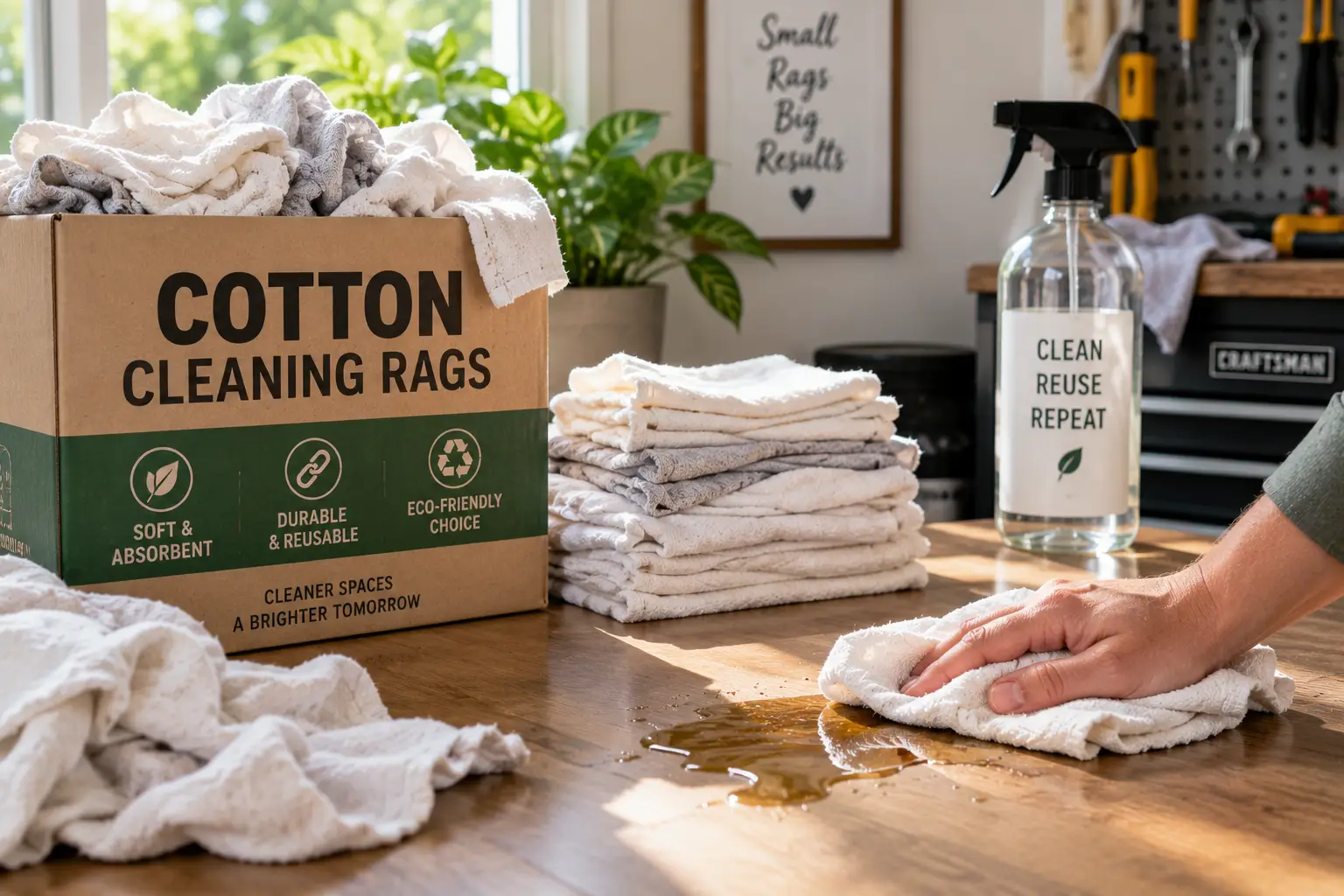
If you’ve ever grabbed a paper towel to wipe up a coffee spill and watched it disintegrate into soggy confetti, you already understand why cotton cleaning rags remain a staple in millions of American homes, garages, and commercial kitchens. Cotton cleaning rags are reusable, absorbent cloths cut or woven from cotton fiber, prized for their softness, low static, and ability to soak up liquid without leaving lint or streaks behind. Unlike disposable wipes, a good cotton rag can survive hundreds of wash cycles, which makes it one of the few cleaning products that genuinely pays for itself over time.
This guide exists because “just buy some rags” turns out to be more complicated than it sounds. Walk into any big-box store or scroll through Amazon, and you’ll find reclaimed T-shirt knits, woven flour sack towels, ribbed bar mop cloths, and blended shop rags — all labeled “cotton,” all priced differently, and all suited to different jobs. A rag built for soaking up dishwater isn’t necessarily the right choice for wiping down a car engine or buffing out a wood stain.
Below, we’ve researched and compared seven real cotton cleaning rags currently sold on Amazon, spanning budget bags of reclaimed T-shirt scraps to professional-grade shop rag boxes. Every recommendation is grounded in actual product specifications and aggregated customer feedback rather than guesswork, and every price is expressed as a range rather than a fixed dollar figure — because Amazon pricing shifts daily, and this article is built to stay useful no matter when you’re reading it. This post also contains affiliate links, so purchases made through them may earn a small commission at no extra cost to you.
Whether you’re stocking a kitchen drawer, a garage workbench, or a commercial mop closet, you’ll walk away from this guide knowing exactly which cotton cleaning rags fit your specific situation — and why.
What Is a Cotton Cleaning Rag?
A cotton cleaning rag is a reusable cloth made from woven or knit cotton fiber, used to wipe, absorb, dust, or polish surfaces without chemical pre-treatment. Cotton’s natural fiber structure holds more liquid per square inch than most synthetics, resists melting near heat, and softens with repeated washing rather than degrading — which is why it remains a workhorse material even in the age of microfiber. Cotton itself is a natural fiber harvested from the Gossypium plant, and its absorbency and breathability come directly from the fiber’s hollow, twisting cellulose structure.
Quick Comparison: Best Cotton Cleaning Rags at a Glance
| Product | Best For | Pack Size | Price Range |
|---|---|---|---|
| Pro-Clean Basics A99305 | Budget starter pack | 1 lb bag | Under $15 |
| VALENGO Lint Free Rags | General household use | 7-pack, 17″x17″ | Around $15–$20 |
| Ritz White Flour Sack Towel | Streak-free glass & polishing | 3-pack | Around $10–$15 |
| Ritz Pebble Bar Mop Towels | Kitchen counters & spills | 6-pack, 12″x12″ | Around $12–$18 |
| Buffalo Industries 10085PB | Bulk garage/industrial use | 50 lb bag | Between $60 and $90 |
| Softolle Bar Mop Towels | Everyday multi-purpose | 12-pack, 16″x19″ | Around $20–$28 |
| PRO SOURCE Low Lint Shop Rags | Professional auto/shop work | 25 lb box | Between $45 and $70 |
Looking at the table above, the Pro-Clean Basics A99305 and Ritz White Flour Sack Towel are your entry points if you just want a reliable starter supply, while the Buffalo Industries 10085PB and PRO SOURCE Low Lint Shop Rags are built for buyers who go through rags by the pound rather than the piece. If your rags need to double as kitchen linens as much as cleaning tools, the Ritz Pebble Bar Mop Towels and Softolle Bar Mop Towels split the difference nicely with more polished designs.
💬 Ready to stock up? Scroll down to see which cotton rag fits your cleaning routine best!
Top 7 Cotton Cleaning Rags for 2026: Expert Analysis
1. Pro-Clean Basics A99305 — best low-cost starter pack
If you just need a reliable bag of everyday wiping cloths without committing to a bulk order, the Pro-Clean Basics A99305 is the sensible entry point. It’s a one-pound bag of reclaimed white cotton T-shirt-style rags, sold under R&R Textile Mills’ Pro-Clean Basics line. Each rag is cut cotton material in varied, irregular sizes rather than a uniform cut, which means you get a mix of larger wiping cloths and smaller detail pieces in a single bag — practical for spot-cleaning tasks like wiping down small appliances or dusting shelves. Based on comparing the specs against other reclaimed-rag bags, the appeal here is volume-for-price rather than polish: you’re paying for functional absorbency, not a matching, symmetrical set. This makes it a smart pick for renters, first apartments, or anyone testing whether cotton rags suit their routine before buying in bulk. Reviews consistently report that the rags arrive soft and pre-washed with minimal lint shedding, though a common complaint is that the irregular sizing means a portion of each bag is genuinely too small to be useful for anything beyond quick spot wipes.
Pros:
- ✅ Inexpensive way to try cotton rags before buying bulk
- ✅ Pre-washed, soft texture straight out of the bag
- ✅ Mixed sizes suit both big spills and small detail jobs
Cons:
- ❌ Irregular cuts mean some pieces are too small to be useful
- ❌ Smaller bag size means frequent reordering for regular use
Priced under $15, it’s an easy, low-risk way to see whether cotton rags fit your cleaning habits before spending more.
2. VALENGO Lint Free Rags — best all-around household rag
The VALENGO 100% cotton T-shirt rags come in a pack of seven, cut to a generous 17″ x 17″ — noticeably larger than most competing multi-packs, which matters more than it sounds. What most buyers overlook with rag sizing is that a bigger cloth means fewer rags needed per job and more surface area to fold into a clean section as one side gets dirty. These are marketed for staining wood, cast iron seasoning, dusting, polishing, and painting, and the soft T-shirt knit construction is genuinely versatile across all of those uses without needing a different rag for each task. On paper, this means VALENGO functions as a true multi-purpose household rag rather than a specialist tool, which is exactly what most home users actually need. Reviews consistently describe the fabric as noticeably softer than shop-style rags, with users praising the size for jobs like waxing furniture and wiping down large countertops in fewer passes.
Pros:
- ✅ Larger 17″x17″ size covers more surface per rag
- ✅ Soft knit works well for polishing and staining wood
- ✅ Reusable and washable without losing softness
Cons:
- ❌ Only 7 rags per pack, which some households find limiting
- ❌ Not intended for heavy-duty grease or automotive work
In the $15–$20 range, this is one of the best value-for-versatility picks if you want one rag type for nearly everything around the house.
3. Ritz White Cotton Flour Sack Towel — best for streak-free glass and polishing
Flour sack towels have a long history in American kitchens, and the Ritz White Cotton Flour Sack Towel 3-pack keeps that tradition alive with a tightly woven, lint-free weave rather than the looser knit you’ll find on T-shirt-style rags. Each towel measures roughly 28″ x 28″, made from 100% cotton and designed for polishing crystal, glassware, and mirrors without leaving fibers behind. What the spec sheet doesn’t say, but reviews reveal, is that this weave also makes flour sack towels unusually good at drying dishes and glassware to a streak-free shine, which is why bartenders and home cooks alike keep a stack on hand. Based on comparing the fabric weight to bar mop towels, flour sack towels are thinner and dry faster between uses, but they hold slightly less liquid per wipe — a fair trade if streak-free polishing is your priority over raw absorbency. Reviews consistently report that these towels soften significantly after the first few washes and hold up well over years of regular laundering.
Pros:
- ✅ Tight weave leaves no lint on glass or mirrors
- ✅ Dries faster than thicker terry cloth alternatives
- ✅ Softens with each wash instead of wearing thin
Cons:
- ❌ Lower liquid capacity than terry or bar mop towels
- ❌ Only three towels per pack for the price point
Priced around $10–$15, this is a smart pick for anyone prioritizing a polished, streak-free finish over maximum absorbency.
4. Ritz Pebble Bar Mop Towels — best for kitchen counters and spills
The Ritz Pebble Bar Mop Towels bring 100% cotton, ribbed terry construction in a 12″ x 12″ size, sold in a six-pack of coordinated colors. The ribbed terry weave is the key feature here: it creates more surface texture than a flat flour sack towel, which translates directly into faster liquid absorption for everyday counter wipe-downs. Here’s what to weigh: bar mop towels like this one are purpose-built for commercial bar and restaurant use, so the fabric is engineered to handle frequent washing at high heat without breaking down, a detail that matters if you’re tossing rags in the laundry weekly rather than occasionally. On paper, the smaller 12″x12″ size means less coverage per wipe compared to the VALENGO rags, but it also makes these towels easier to wring out one-handed while holding a dish in the other. Reviews consistently praise the color-coding for keeping bathroom and kitchen cleaning cloths visually separated, and note the towels remain absorbent even after dozens of hot washes.
Pros:
- ✅ Ribbed terry weave absorbs spills quickly
- ✅ Commercial-grade durability for frequent washing
- ✅ Color options make cross-contamination easy to avoid
Cons:
- ❌ Smaller size covers less area per wipe
- ❌ Colors may fade slightly faster than white towels
At around $12–$18 for six, these towels strike a strong balance between kitchen-ready style and genuine cleaning performance.
5. Buffalo Industries 10085PB — best for bulk garage and industrial use
For buyers who go through rags fast — mechanics, painters, woodworkers, or anyone running a small shop — the Buffalo Industries 10085PB delivers a 50-pound bag of recycled, multicolored T-shirt cloth rags. This is the definition of buying in bulk: rather than a curated pack, you get a mixed, irregular assortment of reclaimed cotton knit rags sized for wiping down tools, mopping up paint spills, staining, polishing, and general dusting. What most buyers overlook with rag bulk-buying is the true cost math: at 50 pounds, the per-rag price drops dramatically compared to small retail packs, which matters if rags are treated as semi-disposable in your workflow (used hard, then discarded rather than laundered). Because these are recycled T-shirt material, expect some pre-existing seams, hems, and printed logos scattered through the bag — a minor cosmetic issue that doesn’t affect absorbency. Reviews consistently describe the bag as excellent value for shop use, though several note that quality varies rag to rag since the source material is genuinely reclaimed rather than manufactured specifically as cleaning cloths.
Pros:
- ✅ Dramatically lower cost per rag at 50-pound bulk volume
- ✅ Ideal for treat-and-toss shop or garage cleaning tasks
- ✅ Soft cotton knit is gentle on painted and finished surfaces
Cons:
- ❌ Inconsistent sizing and occasional seams or logos
- ❌ Overkill volume for typical household cleaning needs
In the $60–$90 range for 50 pounds, this is the strongest value pick for anyone running through rags at industrial volume.
6. Softolle Bar Mop Towels — best everyday multi-purpose pack
The Softolle Bar Mop Towels land in a useful middle ground: a 12-pack of 100% cotton towels sized at 16″ x 19″, larger than the Ritz Pebble bar mops but still built with the same absorbent ribbed terry weave. Based on comparing the specs across bar mop brands, this larger dimension gives Softolle an edge for jobs that need broad coverage — mopping up a bigger spill, wiping down a full countertop, or drying a stack of dishes — while retaining the fast-drying, machine-washable durability that defines the bar mop category. The pack size of twelve also means you can dedicate specific towels to specific rooms (kitchen, bathroom, garage) without running short during a busy week. Reviews consistently highlight the thickness and softness as standout qualities compared to thinner big-box-store alternatives, with several buyers specifically noting the towels held their absorbency even after dozens of hot-water wash cycles.
Pros:
- ✅ Larger 16″x19″ size covers more area per towel
- ✅ Thick terry weave stays absorbent after repeated washing
- ✅ Twelve-pack is enough to rotate across multiple rooms
Cons:
- ❌ Bulkier size takes up more drawer or closet space
- ❌ Higher price per towel than smaller bar mop packs
At roughly $20–$28 for twelve towels, this is a strong pick for households that want fewer laundry cycles and more coverage per rag.
7. PRO SOURCE Low Lint Reclaimed Cotton Polo Shop Rags — best for professional auto and shop work
The PRO SOURCE Low Lint Reclaimed Cotton Polo Shop Rags ship in a 25-pound box, made from reclaimed cotton polo-knit fabric specifically processed to minimize lint shedding — a critical feature for automotive detailing, machine shop wiping, and any task where stray fibers on a finished surface are a real problem. Unlike standard T-shirt knit rags, polo-knit fabric has a slightly heavier, more structured weave, which on paper translates to better durability under repeated scrubbing against rough or textured surfaces like engine bays or workbenches. Here’s what to weigh: this is explicitly a washable and reusable product line, positioning it as a middle ground between disposable shop towels and premium branded microfiber — you get low-lint performance without the cost of specialty automotive cloths. Reviews consistently describe the low-lint claim as accurate even compared to competing reclaimed rag boxes, with mechanics and DIY auto enthusiasts specifically calling out the reduced fiber shedding on glass and painted panels.
Pros:
- ✅ Genuinely low lint shedding compared to standard T-shirt rags
- ✅ Heavier polo-knit weave holds up to rough surfaces
- ✅ Reusable and washable for repeated shop use
Cons:
- ❌ Premium pricing relative to standard reclaimed rag boxes
- ❌ 25-pound volume is excessive for casual home users
Between $45 and $70 for the box, this is the pick to reach for if lint-free performance on finished surfaces is non-negotiable.
Feature-by-Feature Comparison of the Top 7 Cotton Rags
| Product | Fabric Type | Best Feature | Rating Trend | Best For |
|---|---|---|---|---|
| Pro-Clean Basics A99305 | Reclaimed T-shirt knit | Low cost of entry | Generally positive | First-time buyers |
| VALENGO Lint Free Rags | T-shirt knit, 17″x17″ | Large surface area | Generally positive | Everyday household use |
| Ritz White Flour Sack Towel | Tight woven cotton | Streak-free polish | Consistently strong | Glass, mirrors, crystal |
| Ritz Pebble Bar Mop Towels | Ribbed terry | Fast absorption | Generally positive | Kitchen counters |
| Buffalo Industries 10085PB | Reclaimed T-shirt knit | Lowest per-rag cost | Generally positive | Garage/industrial bulk use |
| Softolle Bar Mop Towels | Ribbed terry, 16″x19″ | Coverage + durability | Consistently strong | Multi-room daily use |
| PRO SOURCE Shop Rags | Reclaimed polo knit | Low lint shedding | Consistently strong | Auto detailing, shop work |
Looking at this comparison, a clear pattern emerges: reclaimed T-shirt knit rags (Pro-Clean Basics A99305, VALENGO Lint Free Rags, Buffalo Industries 10085PB) trade a little bit of surface refinement for lower cost, while woven and terry options (Ritz White Flour Sack Towel, Ritz Pebble Bar Mop Towels, Softolle Bar Mop Towels) trade a slightly higher price for more consistent sizing and finish. The PRO SOURCE Low Lint Shop Rags stand apart as the only entry engineered specifically to minimize lint transfer, which explains its premium positioning among buyers doing detail-sensitive work.
How to Choose the Right Cotton Cleaning Rags
Picking the right cotton rag isn’t about finding the “best” one overall — it’s about matching fabric type and pack size to your actual cleaning tasks. Here’s how to think through it:
- Identify your primary use case first. Kitchen counters and dishes call for terry or flour sack weaves, while garage and auto work call for low-lint knit or polo-knit rags.
- Match fabric weight to absorbency needs. Heavier ribbed terry towels like the Softolle Bar Mop Towels hold more liquid per wipe than thinner flour sack weaves.
- Consider lint sensitivity. If you’re working near glass, mirrors, paint, or automotive finishes, prioritize low-lint options like the Ritz White Flour Sack Towel or PRO SOURCE Low Lint Shop Rags.
- Calculate real cost per rag, not just pack price. A $70 box of 25 pounds can work out cheaper per rag than a $15 seven-pack — do the math before assuming small packs are the “budget” choice.
- Think about wash frequency. If rags will be laundered weekly, prioritize commercial-grade construction like bar mop towels, which are built to withstand frequent hot washing.
- Check fiber content labeling. U.S. sellers of textile products are required to disclose fiber content accurately under the Textile Fiber Products Identification Act, so a listing claiming “100% cotton” should genuinely be all-cotton — worth double-checking if lint-free performance matters to you.
- Buy in a volume that matches your usage rate, not your aspirational cleaning habits — an unused 50-pound bag isn’t a bargain.
Cotton Rags vs Microfiber Cleaning Cloths: Which Wins?
Cotton and microfiber both dominate the cleaning-cloth market, but they behave differently enough that picking the wrong one for a task can genuinely cost you results.
| Factor | Cotton Rags | Microfiber Cloths |
|---|---|---|
| Absorbency per wipe | Very high | High, but slower to saturate |
| Streak-free glass cleaning | Good (flour sack) | Excellent |
| Heat resistance | High, safe near warm surfaces | Can melt or glaze near high heat |
| Lint shedding | Varies by weave | Very low |
| Cost per cloth | Generally lower | Generally higher |
| Best for | Spills, polishing, general wiping | Glass, electronics, delicate finishes |
Based on comparing the two materials directly, cotton rags win on raw absorbency and heat tolerance, which is exactly why bar mop towels and shop rags remain standard in kitchens and garages rather than being replaced outright by microfiber. Microfiber, on the other hand, edges out cotton for streak-free glass and screen cleaning because its split fibers physically trap smaller dust particles that cotton’s looser weave can miss. Most well-stocked households end up using both: cotton for the heavy lifting, microfiber for the finishing touches.
Common Mistakes to Avoid When Buying Cotton Cleaning Rags
Even seasoned buyers trip up on a few predictable issues when stocking up on cleaning rags:
- Buying by price-per-pack instead of price-per-rag. A cheaper small pack often costs more per cloth than a larger box — always divide total price by rag count before comparing.
- Ignoring flammability and heat exposure near stoves or space heaters. Textile products sold for household use are generally required to meet baseline flammability standards under the Flammable Fabrics Act, but that doesn’t mean any rag is safe to leave draped over an active burner — check care labels and keep rags away from open flame regardless.
- Choosing reclaimed rags for lint-sensitive tasks. Reclaimed T-shirt knits are great value but not ideal for glass, mirrors, or automotive clear coats — reach for a low-lint or woven option instead.
- Overbuying bulk without a storage plan. A 50-pound bag sounds efficient until it’s sitting in a damp corner attracting mildew; make sure you have dry, ventilated storage before buying bulk.
- Assuming all “cotton” rags perform the same. Weave type (knit, terry, or flour sack) affects absorbency and lint far more than fiber content alone.
Getting the Most from Your Cotton Rags: A Practical Care Guide
Buying the right rag is only half the equation — how you wash and store it determines whether it lasts six months or six years.
First 30 days: Wash new cotton rags before first use to remove manufacturing residue and improve absorbency; most users notice cotton actually gets softer and more absorbent after the first two or three washes, not less. Avoid mixing brand-new rags with your regular laundry the first time, since loose lint and dye can transfer to other fabrics.
Ongoing maintenance: Wash cleaning rags separately from clothing and towels to avoid cross-contaminating fabrics with cleaning chemical residue. Skip fabric softener — it coats cotton fibers and actually reduces absorbency over time, which defeats the purpose of the rag. Hot water and a standard detergent are usually sufficient; add oxygen bleach periodically for rags used with grease or oil to prevent buildup and odor.
Common early mistakes to avoid: Don’t let oil- or solvent-soaked rags pile up in a closed container without ventilation, and never toss automotive or wood-finishing rags directly in the trash while still damp with oil-based products — this is a genuine fire risk, covered in more detail in the safety section below. Also avoid over-drying cotton rags on high heat repeatedly, which shortens fiber lifespan faster than air drying or a lower dryer setting.
Real-World Scenarios: Which Cotton Rags Fit Your Life?
The apartment renter starting from scratch: If you’re setting up a first apartment and need general-purpose cleaning cloths without a big upfront investment, the Pro-Clean Basics A99305 or VALENGO Lint Free Rags cover most weekly cleaning needs — counters, spills, dusting — without committing to bulk storage you don’t have room for.
The home cook who entertains often: For someone regularly polishing glassware and wiping down a busy kitchen, the Ritz White Flour Sack Towel paired with the Ritz Pebble Bar Mop Towels covers both the streak-free finishing work and the everyday spill absorption, at a combined cost usually under $30.
The weekend mechanic or woodworker: If you’re staining furniture, changing oil, or detailing a car on weekends, the PRO SOURCE Low Lint Shop Rags minimizes the risk of lint transfer onto finished surfaces, while the Buffalo Industries 10085PB handles the messier, disposable-style wiping that doesn’t need to look pretty.
The small business or shop owner: A restaurant, salon, or repair shop going through dozens of rags weekly benefits most from bulk buying — the Buffalo Industries 10085PB or PRO SOURCE Low Lint Shop Rags bring the per-rag cost down enough to make frequent replacement financially painless.
Problem → Solution: Fixing Common Cotton Rag Cleaning Headaches
Problem: Rags smell musty even after washing. Solution: Bacteria trapped in damp cotton fiber causes odor. Run rags through a hot wash with a small amount of white vinegar or oxygen bleach, and make sure they dry fully — ideally in direct air rather than balled up in a hamper — before storage.
Problem: Rags feel stiff and less absorbent over time. Solution: This is usually a fabric softener or hard-water mineral buildup issue. Skip softener entirely on cleaning rags and periodically run a vinegar rinse cycle to strip residue.
Problem: Rags shed excessive lint on glass or car finishes. Solution: Switch fabric types — reclaimed T-shirt knits like the VALENGO Lint Free Rags are softer but not always the lowest-lint option; a woven flour sack towel or the PRO SOURCE Low Lint Shop Rags will perform noticeably better on finished surfaces.
Problem: Bulk rag bags develop uneven quality. Solution: This is inherent to reclaimed-material products like the Buffalo Industries 10085PB — sort rags by size and condition once when the bag arrives, setting aside the best pieces for detail work and the rest for heavy-duty wiping.
Problem: Rags used with solvents or oil are piling up unsafely. Solution: Store them in a labeled, sealed metal container away from heat sources rather than a plastic bin or open pile, and dispose of them according to local hazardous waste guidance rather than regular household trash.
Cotton Cleaning Rags for Every Use Case: Kitchen, Garage, and Beyond
Kitchen use calls for absorbency and food-safe washing more than lint-free perfection — the Ritz Pebble Bar Mop Towels and Softolle Bar Mop Towels are purpose-built for this environment, standing up to frequent hot-water laundering without breaking down.
Garage and automotive use prioritizes low lint and durability against rough, textured surfaces, making the PRO SOURCE Low Lint Shop Rags the strongest fit, with the Buffalo Industries 10085PB as the budget-conscious backup for messier, non-cosmetic tasks.
General household dusting and spot cleaning is where budget-friendly, versatile rags like the VALENGO Lint Free Rags and Pro-Clean Basics A99305 shine — you don’t need specialty performance for wiping down a shelf or mopping up a spilled drink.
Fine surfaces — glass, mirrors, crystal, and polished wood — benefit most from the tight, lint-free weave of the Ritz White Flour Sack Towel, which is specifically engineered for a streak-free finish rather than raw absorbency.
Long-Term Cost and Maintenance: Are Cotton Rags Worth It?
| Product | Approx. Rags per Pack/Box | Estimated Cost per Rag |
|---|---|---|
| Pro-Clean Basics A99305 | ~15–20 rags (1 lb) | Under $1.00 |
| VALENGO Lint Free Rags | 7 rags | Around $2.00–$2.80 |
| Ritz White Flour Sack Towel | 3 towels | Around $3.50–$5.00 |
| Buffalo Industries 10085PB | ~500 rags (50 lb) | Around $0.12–$0.18 |
| PRO SOURCE Low Lint Shop Rags | ~350–400 rags (25 lb) | Around $0.13–$0.20 |
Looking at the cost-per-rag breakdown, bulk buying dramatically changes the math: the Buffalo Industries 10085PB and PRO SOURCE Low Lint Shop Rags cost pennies per rag compared to dollars per rag in small retail packs. The catch is that bulk only pays off if you actually use the volume before rags degrade in storage or you run out of dry storage space — for households using a handful of rags weekly, smaller packs like the VALENGO Lint Free Rags remain the more practical total cost of ownership, since unused bulk inventory isn’t really “value” if it never gets used.
Washable cotton rags also compare favorably to disposable paper towels over time: even a modest pack replaces hundreds of paper towel sheets across its usable life, assuming reasonable laundering care, which is where the genuine long-term savings show up on a household budget.
Safety, Regulations, and Standards for Cleaning Rags
Most everyday cotton cleaning rag use carries minimal risk, but a few regulatory and safety points are worth knowing, especially for garage, shop, or DIY use. Cotton rags soaked in oil-based products — linseed oil, certain stains, and some paints — can undergo spontaneous combustion if left balled up in a pile, because the oxidation process generates heat that has nowhere to dissipate. OSHA’s flammable liquids standard addresses safe handling of flammable and combustible materials in workplace settings, and the same basic principle applies at home: oil-soaked rags should be laid flat to dry outdoors, or stored submerged in water inside a sealed metal container, rather than left crumpled in a bin.
For everyday household rags with no oil or solvent exposure, this risk simply doesn’t apply — a rag used for dusting or wiping counters poses no fire hazard beyond normal fabric flammability, which is a separate, lower-stakes consideration covered under general textile flammability standards. As always, keep any fabric — cotton included — a safe distance from open flames, stovetops, and space heaters as a matter of basic household practice.
Features That Actually Matter (and Ones That Don’t)
What actually matters: Fabric weave (knit vs. terry vs. woven) has the biggest real-world impact on absorbency and lint. Pack size relative to your actual usage rate matters more than headline price. Wash durability — whether a rag holds up to dozens of hot-water cycles — determines true long-term value far more than initial softness.
What matters less than marketing suggests: Color variety is a convenience feature for task separation, not a performance factor — plain white rags clean identically to colorful ones. “Premium” branding on basic reclaimed rags often reflects packaging and marketing more than material quality; the underlying reclaimed cotton is frequently similar across budget brands. Thread count-style marketing language borrowed from bedding doesn’t translate meaningfully to cleaning rag performance the way weave type and fabric weight do.
Frequently Asked Questions
❓ Are cotton cleaning rags better than paper towels for the environment?
❓ Can I use old T-shirts as cleaning rags instead of buying them?
❓ How many cotton cleaning rags does an average household need?
❓ Do cotton rags shrink after washing?
❓ Can cotton cleaning rags be used with bleach and other cleaning chemicals?
Conclusion
Cotton cleaning rags aren’t a one-size-fits-all purchase, and that’s actually good news — it means there’s a genuinely right answer for your specific situation rather than a single “best” product everyone should buy. If you’re just getting started, the Pro-Clean Basics A99305 or VALENGO Lint Free Rags offer low-risk, versatile entry points. If your priority is a streak-free finish on glass and fine surfaces, the Ritz White Flour Sack Towel earns its spot through weave quality alone. Kitchens leaning heavily on daily counter and spill cleanup are well served by the Ritz Pebble Bar Mop Towels or Softolle Bar Mop Towels, while anyone working through serious volume — garages, shops, or small businesses — will find real savings in the Buffalo Industries 10085PB or professional-grade performance in the PRO SOURCE Low Lint Shop Rags.
Whichever you choose, remember that fabric weave and pack size matter more than marketing claims, and a little care in washing — no fabric softener, proper drying, safe storage for anything oil-soaked — will stretch your investment across years rather than months. A well-chosen stack of cotton rags is one of the rare cleaning purchases that actually gets better with use.
✨ Ready to build a smarter cleaning kit? Check current pricing and availability on today’s picks, and stock up on the cotton cleaning rags that actually fit how you clean!
Recommended for You
- Cleaning Rags Bulk: 7 Best Picks That Won’t Fall Apart (2026)
- Glass Cleaner for Windshield: 7 Best Streak-Free Picks for 2026
- Microfiber Cloth to Wash Car: 7 Best Picks You Need in 2026
Disclaimer: This post contains affiliate links. As an Amazon Associate, I earn from qualifying purchases made through these links, at no additional cost to you.
✨ Found this article helpful? Share it with someone who needs it! 💬🤗