In This Article
How to Clean Acrylic Glass the Right Way (and Why It’s So Easy to Get Wrong)
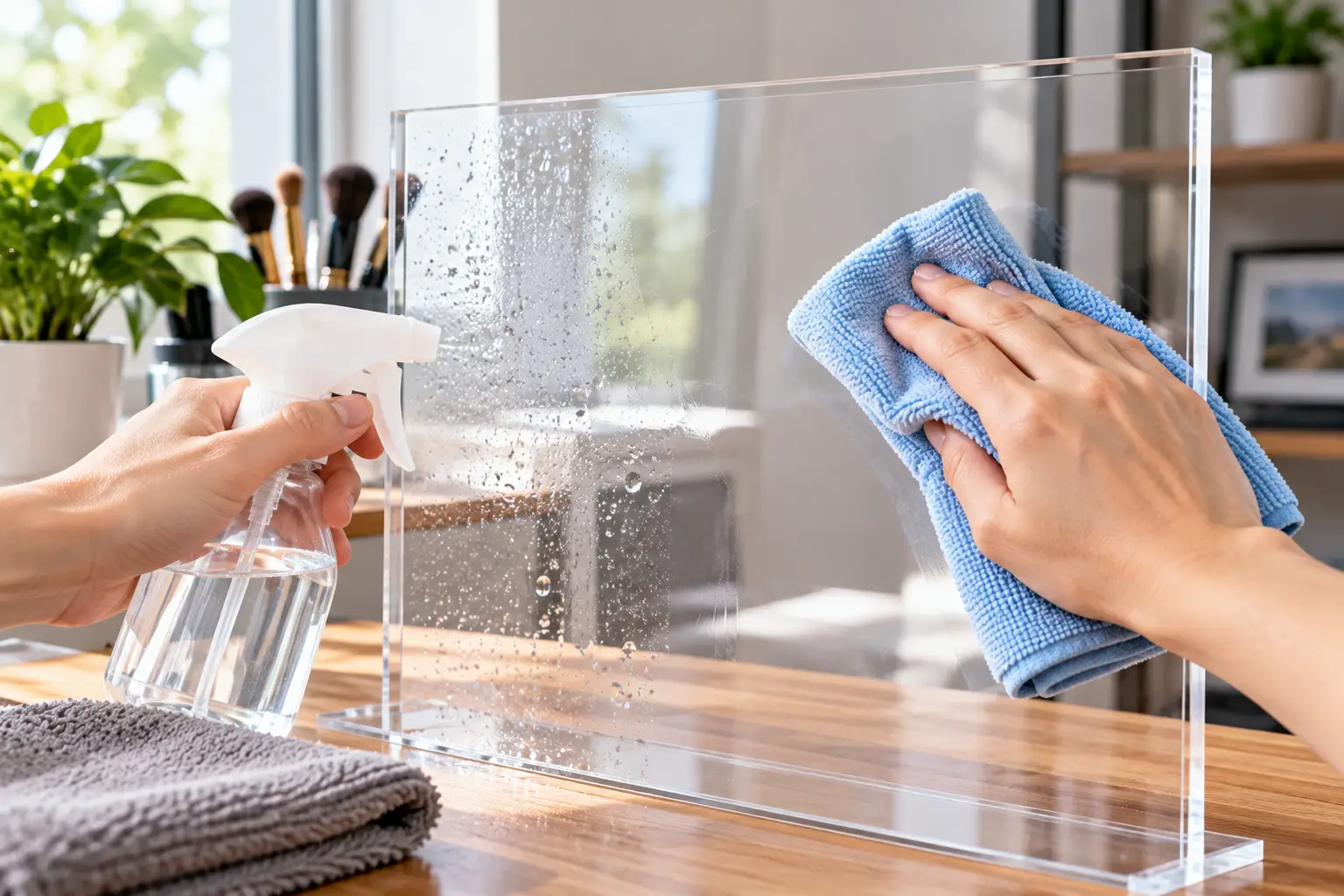
Knowing how to clean acrylic glass means washing a PMMA plastic surface with a gentle, ammonia-free cleaner and a damp microfiber cloth, blotting rather than scrubbing, so you remove dirt without scratching, clouding, or crazing the sheet. Grab the wrong spray, and one wipe can dull a panel you paid good money for.
Here’s the frustrating part: acrylic looks like glass, so most of us treat it like glass. We reach for the blue window spray and a roll of paper towels, and within a few months that crystal-clear display case, aquarium, or shower panel looks foggy and faintly scratched. The truth is that acrylic is a completely different material. As the Wikipedia entry on poly(methyl methacrylate) explains, “acrylic glass” is a trade-name family (Plexiglas, Acrylite, Lucite, Perspex) for a lightweight, shatter-resistant plastic that is often used in place of real glass. Lightweight and shatter-resistant, yes — but also far softer on the surface and more sensitive to solvents.
So learning how to clean acrylic glass properly isn’t fussy perfectionism. It’s the difference between a sneeze guard, picture frame, or boat windshield that stays clear for a decade and one you replace in two years.
In this guide, you’ll get:
- ✅ A quick comparison of 7 real acrylic cleaners you can order on amazon.com
- ✅ Honest analysis of each — based on spec sheets and aggregated customer reviews, not invented “tests”
- ✅ A step-by-step routine, a problem-solving guide, and user scenarios
- ✅ Clear advice on how to clean acrylic without scratching, and when a scratch remover makes sense
Heads-up: this post contains affiliate links. If you buy through them, we may earn a small commission at no extra cost to you.
Quick Comparison: The Best Cleaners for Acrylic Glass at a Glance
| Product | Type | Main Job | Approx. Price Range | Best For |
|---|---|---|---|---|
| NOVUS No. 1 Plastic Clean & Shine | Spray liquid | Everyday cleaning, anti-static | $10–$20 | NOVUS No. 1 — daily/weekly upkeep |
| Brillianize Anti-Static Cleaner | Spray liquid | Cleaning + dust repelling | $12–$22 | Brillianize — display cases, frames |
| Plexus Plastic Cleaner, Protectant & Polish | Aerosol foam | Clean + thin protective wax | $15–$25 | Plexus — windshields, visors, outdoor acrylic |
| NOVUS 7136 Plastic Polish Kit | 3-step kit | Clean, fine & heavy scratch removal | $15–$30 (2 oz kit) | NOVUS Kit — scratched or hazy panels |
| Meguiar’s PlastX (G12310) | Gel polish | Remove haze, oxidation, light scratches | $8–$15 | Meguiar’s PlastX — cloudy, weathered plastic |
| Invisible Glass Clear Plastic Cleaner (92084) | Spray liquid | Streak-free cleaning, big bottle | $8–$15 | Invisible Glass Clear Plastic — large surfaces on a budget |
| Blue Ribbon Plexi-Clean | Liquid | General acrylic & vinyl cleaning | $12–$20 | Blue Ribbon Plexi-Clean — multi-surface households |
Prices are approximate ranges at the time of writing; check the current price on Amazon, as prices may vary.
Reading the table, a pattern jumps out: these products split into two camps. NOVUS No. 1, Brillianize, Invisible Glass Clear Plastic, and Blue Ribbon Plexi-Clean are cleaners — safe to use every week. Plexus sits in the middle with its protective wax layer, while the NOVUS Kit and Meguiar’s PlastX are restorers containing fine abrasives that you should only reach for when something is actually wrong. Most households need one cleaner and, maybe, one restorer — not all seven.
💬 One click helps other shoppers make an informed choice too! 😊
Top 7 Acrylic Glass Cleaners: Expert Analysis
1. NOVUS No. 1 Plastic Clean & Shine — the everyday benchmark
If one product shows up in almost every acrylic supplier’s care guide, it’s NOVUS No. 1. Plastics distributors like TAP Plastics, A&C Plastics, and Acme Plastics all recommend it as a go-to maintenance cleaner.
The formula is non-abrasive and leaves no greasy residue, which matters more than it sounds: residue attracts dust, and dust is exactly what scratches acrylic on the next wipe. It also carries an anti-static effect and resists fingerprints — in practice, that means your display case stays presentable a few days longer between cleanings.
Based on comparing it with the rest of this list, NOVUS No. 1 is the safest “default” for beginners. It won’t fix scratches (that’s the job of NOVUS No. 2 and No. 3), but it also can’t make things worse when used with a clean microfiber cloth. It’s ideal for picture frames, aquariums (exterior), sneeze guards, and furniture.
Customer reviews and long-time forum users (including aircraft owners who clean plexiglass canopies) consistently report years of reliable, streak-free use; the most common complaint is simply that the small bottle runs out quickly on large panels.
Pros:
- ✅ Recommended by major acrylic suppliers
- ✅ No greasy film left behind
- ✅ Anti-static effect slows dust buildup
Cons:
- ❌ Won’t remove scratches on its own
- ❌ Small 8 oz bottle is pricey per ounce
Price and value: Typically in the $10–$20 range for 8 oz; excellent value if you clean small-to-medium surfaces weekly.
2. Brillianize Anti-Static Cleaner — best for dust-magnet displays
Brillianize is the other name acrylic fabricators recommend alongside NOVUS, and its biggest selling point is dust control. The formula is alcohol-free and ammonia-free, and it’s marketed as non-toxic, which makes it an easy pick for homes with kids or pets.
What does “anti-static” actually mean for you? Acrylic builds a static charge when you wipe it, and that charge pulls dust right back onto the surface. Brillianize helps neutralize that, so collectible cases, record frames, and retail displays look clean longer. Because it’s also safe on glass, mirrors, and many high-gloss finishes, it can replace two or three bottles under your sink.
Here’s what to weigh: Brillianize is a pure cleaner and polish. It won’t touch real scratches or heavy oxidation. If your acrylic is already hazy, you’ll want a restorer first, then Brillianize for upkeep.
Aggregated review sentiment is strongly positive around streak-free results and noticeably less dust; the recurring caveat is that it’s best for light cleaning rather than deep grime.
Pros:
- ✅ Alcohol- and ammonia-free formula
- ✅ Visibly reduces dust on display cases
- ✅ Works on glass and mirrors too
Cons:
- ❌ No scratch or haze repair ability
- ❌ Needs thorough buffing to avoid streaks
Price and value: Usually between $12 and $22 for 8 oz; great value for collectors and anyone fighting constant dust.
3. Plexus Plastic Cleaner, Protectant & Polish — a protective layer on every wipe
Plexus is a foaming aerosol with roots in aviation, and you’ll still find it recommended in pilot forums for canopies and windshields. Its defining feature is a micro-thin protective wax that it leaves on the surface.
In practice, that wax layer does three things: it helps water and bugs slide off, it fills the finest micro-marring so the surface looks clearer, and it adds a buffer against the next cleaning. That makes Plexus especially appealing for motorcycle windscreens, helmet visors, boat windows, and outdoor acrylic. Some users also report that it lifts stubborn adhesive residue, such as old tape.
The honest tradeoff: that wax is a coating, not a repair. Detailing enthusiasts often describe Plexus as an upkeep product rather than a scratch fixer, and they reach for NOVUS when real damage needs to go. Also, check your visor’s manual — some anti-fog or coated lenses have their own cleaning rules.
Reviews consistently praise the clarity and bug-release on windshields; a common complaint is that the aerosol can is used up faster than expected.
Pros:
- ✅ Leaves a protective, water-shedding film
- ✅ Great for windshields and visors
- ✅ Helps lift sticky residue
Cons:
- ❌ Aerosol empties quickly on large surfaces
- ❌ Coating can mask, not fix, damage
Price and value: Typically $15–$25 per can; worth it for vehicles and outdoor acrylic, overkill for a single picture frame.
4. NOVUS 7136 Plastic Polish Kit — the fix for scratched panels
When acrylic is already scratched, the NOVUS Kit is the classic answer. It bundles three bottles: No. 1 (cleaner), No. 2 (fine scratch remover), and No. 3 (heavy scratch remover).
The key word is remover. Rather than filling scratches with wax, No. 2 and No. 3 use fine abrasives to level the surface around the scratch, so the damage is actually gone rather than temporarily hidden. The workflow is simple: No. 3 for heavier marks, No. 2 to refine, No. 1 to clean and shine. With a power buffer and separate pads for each polish, larger panels go much faster.
Two important cautions: always test on a hidden corner first, and don’t use No. 2 or No. 3 on coated plastics (anti-glare, anti-scratch, mirrored) or eyeglass lenses — abrasives can strip those coatings. Also note that NOVUS polishes are designed for plastic; they aren’t hard enough to repair real glass.
Aggregated reviews are enthusiastic about restoring cloudy tables, aquarium panels, and headlight-style haze; the most common complaint is that deep gouges still need sanding and patience.
Pros:
- ✅ Actually removes scratches instead of hiding them
- ✅ Three steps cover light-to-heavy damage
- ✅ Works by hand or with a buffer
Cons:
- ❌ Not safe on coated acrylic or lenses
- ❌ Real elbow grease needed for deep marks
Price and value: The 2 oz trial kit usually runs $15–$30, with larger kits in the $40–$60 range; excellent value compared with replacing a panel.
5. Meguiar’s PlastX (G12310) — best for cloudy, weathered plastic
Meguiar’s PlastX comes from the car-care world, and it shows: it’s a gel cleaner-polish built for clear plastics like headlights, golf cart windshields, and instrument clusters.
Its “diminishing abrasive” technology means the particles break down as you work them, starting with some cut and finishing with a fine polish. For you, that translates to one bottle that can remove light oxidation, water spots, and light scratches, then leave a water-resistant protective layer. On a hazy, sun-weathered acrylic panel, that’s a big win at a low price.
On paper, Meguiar’s PlastX is less a routine cleaner and more a periodic restorer. Its technique matters: reviewers note that working it in thoroughly (by hand or with a random-orbit polisher) gives far better clarity than a quick wipe.
Customer reviews on major retailers are largely positive for headlights and plastic windshields, with users reporting near-new clarity; negatives include occasional leftover haze when not fully buffed and some complaints about bottles cracking or suspected counterfeit units from third-party sellers.
Pros:
- ✅ Removes haze, oxidation, and water spots
- ✅ Very affordable for a restorer
- ✅ Leaves a durable, water-resistant finish
Cons:
- ❌ Can leave haze if under-buffed
- ❌ Buy from reputable sellers to avoid fakes
Price and value: Usually in the $8–$15 range; arguably the best value restorer on this list.
6. Invisible Glass Clear Plastic Cleaner (92084) — the big-bottle budget pick
Stoner’s Invisible Glass Clear Plastic is a separate formula from its famous glass cleaner, designed specifically for acrylic and vinyl windows, windshields, and helmet visors. Don’t confuse the two cans on the shelf.
The 22 oz bottle is the headline: it covers far more square footage per dollar than the 8 oz boutique bottles. The formula is marketed as streak-free, haze-free, and static-reducing, which lines up with what you want on acrylic. For RV windows, boat enclosures, golf carts, and large shower panels, that volume makes a real difference.
Here’s what to weigh: it’s a cleaner, not a restorer, so it won’t repair damage, and it doesn’t have the long supplier-endorsement track record NOVUS and Brillianize have. Some buying guides rank it very highly for everyday streak-free results, though.
Aggregated review sentiment highlights easy, streak-free cleaning on vehicle plastics; the recurring caution from buyers is picking the correct “Clear Plastic” version rather than the standard glass formula.
Pros:
- ✅ Large 22 oz bottle, low cost per ounce
- ✅ Made specifically for plastic surfaces
- ✅ Streak-free, static-reducing finish
Cons:
- ❌ Easy to confuse with the glass formula
- ❌ No scratch or haze repair
Price and value: Typically $8–$15; the best cost-per-ounce pick for big surfaces.
7. Blue Ribbon Plexi-Clean — a flexible multi-surface option
Blue Ribbon Plexi-Clean is a lesser-known option positioned as an all-in-one acrylic cleaner, plastic polish, and vinyl cleaner for household and automotive surfaces, sold in a 16 oz bottle.
The multi-surface angle is the practical appeal: one bottle for acrylic furniture, vinyl boat windows, and plastic dashboards. The larger bottle also gives it a better cost-per-ounce than 8 oz premium brands.
Now, the honest part: Blue Ribbon Plexi-Clean has a much smaller review base than NOVUS or Brillianize, and we couldn’t verify detailed, consistent review patterns about long-term results. That doesn’t make it a bad product — but if your acrylic is expensive (a custom aquarium or museum-grade frame), a cleaner with a longer track record is the lower-risk choice. As with any new cleaner, test a hidden area first.
Available review sentiment appears generally positive on ease of use, but the limited volume of verified feedback means you should treat it as a solid alternative rather than a proven benchmark.
Pros:
- ✅ Works on acrylic, vinyl, and plastics
- ✅ Larger bottle than premium brands
- ✅ Simple, single-bottle routine
Cons:
- ❌ Smaller, less-verified review history
- ❌ Not a scratch or haze repair product
Price and value: Usually $12–$20 for 16 oz; decent value, best for low-stakes surfaces.
Cleaner, Protectant, or Restorer? Matching the Product to the Job
| Your Situation | Product Type | Top Pick | Best For |
|---|---|---|---|
| Dust and fingerprints | Gentle cleaner | NOVUS No. 1 / Brillianize | Weekly upkeep |
| Rain, bugs, outdoor grime | Cleaner + protectant | Plexus | Windshields, visors |
| Hazy or yellowed surface | Cleaner-polish | Meguiar’s PlastX | Weathered plastic |
| Visible scratches | Abrasive scratch remover | NOVUS Kit | Tables, aquariums, frames |
| Very large surfaces | Big-bottle cleaner | Invisible Glass Clear Plastic | RVs, boats, panels |
The table makes one thing clear: most damage comes from using a restorer when you needed a cleaner — or scrubbing a dirty panel dry. Start with the gentlest product that solves your problem, and only escalate to Meguiar’s PlastX or the NOVUS Kit when a cleaner can’t bring back the clarity. That order protects your acrylic and your wallet.
Step-by-Step: How to Clean Acrylic Glass Without Scratching 🧽
This is the routine that acrylic suppliers like TAP Plastics recommend in their plexiglass cleaning guide, translated into a simple checklist you can follow today.
What you’ll need
- A blow dryer (cool setting) or can of compressed air
- 2–3 clean microfiber cloths (never paper towels)
- Lukewarm water with a few drops of mild dish soap
- An acrylic-safe cleaner such as NOVUS No. 1 or Brillianize
The routine
- Blow off loose dust first. Dry dust is sandpaper in miniature. Removing it before you touch the surface prevents the most common fine scratches.
- Rinse or flood heavy dirt. For grimy panels, rinse with lukewarm water or lay a soapy cloth over the area to soften grime, rather than rubbing it off.
- Wash gently with soapy water. Use light pressure and straight-line strokes. Circles can create visible swirl marks under direct light.
- Blot, don’t rub dry. Plexiglas maker Röhm is explicit: never rub acrylic completely dry, because friction builds static and scratches. Blot with a damp microfiber or chamois instead.
- Apply your acrylic cleaner. Spray generously, wipe with a fresh microfiber, then buff lightly to a shine. Work in sections so the product doesn’t dry unevenly.
- Store cloths carefully. Wash microfibers without fabric softener, and keep them in a clean bag. One grain of grit trapped in a cloth can scratch everything you touch next.
Common mistakes in the first 30 days
New acrylic owners tend to over-clean. Wiping a display every day with a dry cloth creates micro-scratches faster than dust ever would. Instead, dust with a damp microfiber and do a full clean weekly or as needed. Also, peel protective film slowly, and don’t drag new sheets across a table — lift them.
✨ Keep your acrylic crystal clear for years!
🔍 The right cleaner turns a 20-minute chore into a 2-minute wipe. Click a highlighted product above to check current pricing and availability — your frames, cases, and windshields will thank you!
Problem → Solution: Fixing the 5 Most Common Acrylic Headaches
Even with good habits, acrylic throws curveballs. Here’s how to handle each one without making it worse.
1. Cloudy haze after cleaning. This is usually either residue from a household cleaner or micro-marring from dry wiping. Wash with mild soap and water, rinse, blot, and follow with NOVUS No. 1. If haze remains, the surface is lightly abraded — step up to Meguiar’s PlastX or NOVUS No. 2.
2. Dust that returns within hours. That’s static. Switch to an anti-static cleaner like Brillianize or NOVUS No. 1, and stop wiping with dry cloths, which recharge the surface every time.
3. Streaks and smears. You’re likely using too little product or letting it dry before buffing. Clean in smaller sections, flip to a fresh side of the microfiber, and buff until the surface looks dry and clear.
4. Sticky tape or label residue. Soften it with soapy water first. Plexus is often reported to lift adhesive residue well. For tough grease, oil, or tar, A&C Plastics’ acrylic maintenance guide notes that hexane or kerosene can be used sparingly — followed by a fresh-water rinse and blotting. Never use acetone, gasoline, or lacquer thinner.
5. Fine scratches or scuffs. Test the NOVUS Kit on a hidden spot, then work No. 2 (or No. 3 for heavier marks) with firm, even pressure, and finish with No. 1. Deep scratches you can catch with a fingernail may need wet sanding first (covered below).
A quick rule of thumb: if the problem is on the surface (dust, film, residue), use a cleaner. If the problem is in the surface (haze, scratches), you need a polish or restorer.
Real-World Scenarios: Which Product Fits Your Situation?
Advice sticks better when it sounds like your life, so here are three typical buyer profiles.
🐠 The aquarium keeper. You have a 55-gallon acrylic tank and clean the outside glass every week. Budget: modest. Priority: nothing toxic near the water. Brillianize is the natural fit because it’s alcohol- and ammonia-free and controls dust on the exterior panels. For interior algae, use an acrylic-safe algae pad or plastic scraper — never a razor blade or melamine sponge, both of which can scratch acrylic. Keep a NOVUS Kit on hand for the inevitable scratch from a stray pebble.
🏍️ The motorcycle commuter. You ride 25 miles a day, your windscreen collects bugs, and your helmet visor fogs up. Priority: visibility and speed. Plexus is built for this — the wax layer helps bugs and rain release, and one can covers both screen and (uncoated) visor. Budget roughly $20–$25 every few months. Soak dried bugs with a wet cloth first before wiping to avoid dragging grit.
🏠 The family with acrylic furniture and a shower panel. You clean every few days, you have large surfaces, and you want low cost per use. Invisible Glass Clear Plastic covers the most area per dollar, and a mild dish-soap solution handles daily splashes. Once a year, a pass with Meguiar’s PlastX can remove water spotting and restore sparkle to the coffee table.
Notice the pattern: the frequency and size of your cleaning job matter as much as the product’s formula.
How to Choose an Acrylic Cleaner: 7 Steps
- Confirm it’s ammonia-free. Ammonia is the number-one cause of clouding and fine cracking on acrylic, according to multiple sheet suppliers.
- Check for alcohol and solvents. Small amounts in some specialty products are tolerated, but avoid high-alcohol household sprays on stressed or laser-cut parts, which can craze.
- Decide: cleaner or restorer. Pick a gentle cleaner for routine care; buy an abrasive polish only when you actually have scratches or haze.
- Look for anti-static performance. If dust is your main annoyance, this feature saves the most time.
- Match the size to the surface. Big panels and vehicles favor 16–22 oz bottles; small frames can happily use 8 oz.
- Check for coatings. Anti-glare, mirrored, or hard-coated acrylic needs the gentlest cleaner — no abrasives.
- Favor proven track records for expensive pieces. For custom tanks or museum frames, stick with widely recommended brands like NOVUS No. 1 and Brillianize.
These seven steps also answer the question of how to clean acrylic without scratching: gentle formula, clean microfiber, no dry rubbing, and no abrasives unless you’re deliberately repairing.
Acrylic Cleaner vs. Household Glass Cleaner: Why It Matters
It’s tempting to think “a cleaner is a cleaner.” With acrylic, that assumption is expensive.
| Factor | Acrylic-Specific Cleaner | Ammonia Glass Cleaner | Dish Soap + Water | Best For |
|---|---|---|---|---|
| Safe for acrylic | Yes | No — risks clouding/cracks | Yes | NOVUS No. 1 for routine care |
| Anti-static effect | Often | Rarely | No | Brillianize for dusty displays |
| Removes grease | Good | Good | Good | Soap for heavy grime |
| Leaves protection | Some (e.g., Plexus) | No | No | Plexus outdoors |
Household glass sprays are formulated for hard, chemically resistant glass. Many contain ammonia or strong solvents, which can attack the acrylic surface over time, leaving a milky haze or tiny networks of cracks known as crazing. Acrylic suppliers repeatedly warn against using standard window cleaners, and Bob Vila’s guide sums up the rule neatly: avoid ammonia, abrasives, and aromatics.
Dish soap and lukewarm water, on the other hand, is perfectly safe and often the best first step for heavy dirt. The advantage of a dedicated cleaner like NOVUS No. 1 or Brillianize is the finish: they add anti-static and anti-fingerprint properties that soap can’t. In short, soap cleans, and acrylic cleaners maintain. Use both, and put the ammonia glass cleaner back in the cabinet — it’s for real glass only.
Features That Actually Matter (and Ones That Don’t)
Marketing labels on acrylic cleaners can get noisy. Here’s how to cut through them.
Features that matter:
- ⚡ Ammonia-free and solvent-light formulas. This is non-negotiable. Everything else is secondary.
- 🔋 Anti-static action. It directly reduces how often you clean, which means fewer chances to scratch.
- ✅ Residue-free finish. Oily residue collects dust and fingerprints; a clean finish stays clearer longer.
- ✅ Diminishing or fine abrasives (for restorers only). In products like Meguiar’s PlastX or the NOVUS Kit, abrasives that refine as you work reduce the risk of leaving new haze.
Features that matter less than you’d think:
- ❌ “Streak-free” claims. Nearly every product says this. Streaks usually come from technique — too little product, a dirty cloth, or letting it dry — not the formula.
- ❌ Fragrance. Scent adds nothing to cleaning, and some sources warn that aromatic additives may linger on plastic.
- ❌ “Multi-surface” versatility. It’s convenient, but it doesn’t make a cleaner better on acrylic specifically.
The takeaway: choose based on ammonia-free chemistry, anti-static performance, and whether you need cleaning or restoration. Ignore the shiny adjectives.
How to Remove Scratches from Acrylic Glass
Sometimes cleaning isn’t enough. Here’s the honest escalation ladder for how to remove scratches from acrylic.
Light scratches and scuffs
If you can’t catch the scratch with a fingernail, a polish is usually enough. Clean the area with NOVUS No. 1, then apply NOVUS No. 2 (from the NOVUS Kit) or Meguiar’s PlastX with a soft cloth. Work in straight lines with moderate pressure, wipe off, and inspect under angled light. Repeat as needed.
Moderate scratches
Use NOVUS No. 3 first to cut the scratch down, then refine with No. 2 and finish with No. 1. A low-speed buffer with separate pads for each polish saves time on large areas, but keep it moving to avoid heat buildup — acrylic softens with heat.
Deep scratches
According to Röhm’s official Plexiglas cleaning guidance, deeper scratches can be wet-sanded with 240-grit paper, then refined with 400 or 600 grit, before polishing with an acrylic polish, car polish, or a buffing wheel. Always sand wet, keep the sandpaper flat, and feather the edges of the repair so you don’t create a visible dip.
When not to DIY
Coated acrylic (anti-glare, anti-scratch, or mirrored) generally can’t be sanded or abrasively polished without destroying the coating. For those, and for structural cracks, contact the manufacturer or a local plastics fabricator. A cracked panel under stress can fail; don’t rely on polish to fix it.
How to Clean Plexiglass on Specific Items
Plexiglass is just a common name for acrylic sheet, so the same rules apply — but each item has quirks worth knowing about.
🐟 Aquariums: Clean the outside with Brillianize or plain water and microfiber. Inside, use only acrylic-safe algae pads, and rinse the pad often, since trapped sand is the top scratch culprit. Never spray any cleaner inside the tank.
🚿 Shower panels: Squeegee or blot after showers to prevent hard-water spots. Weekly, wash with diluted dish soap. Avoid bathroom sprays with bleach, ammonia, or strong solvents. For mineral spots, Meguiar’s PlastX used occasionally can restore clarity.
🚗 Windshields, visors, and boat windows: Soak bugs and salt with a wet cloth before wiping, then clean with Plexus or Invisible Glass Clear Plastic. Check helmet manuals first; anti-fog inserts and coated visors may need water only.
🖼️ Picture frames and display cases: Dust with a slightly damp microfiber, then use NOVUS No. 1 or Brillianize. The anti-static finish keeps collectibles looking sharp between cleanings.
🪑 Acrylic furniture: Use soapy water for spills, then a cleaner for shine. Use coasters — hot mugs and abrasive ceramic bottoms leave marks that need polishing later.
🛡️ Sneeze guards and protective barriers: High-touch shields in shops and offices need frequent cleaning; soap and water plus NOVUS No. 1 is a common workflow. See the safety section below for disinfecting.
Long-Term Cost and Maintenance
| Approach | Upfront Cost | Ongoing Cost (per year) | Risk to Acrylic | Best For |
|---|---|---|---|---|
| Household glass cleaner + paper towels | Very low | Low | High (clouding, scratches) | Nothing — avoid |
| Soap + microfiber only | Very low | Very low | Low | Basic upkeep |
| NOVUS No. 1 or Brillianize + microfiber | Low ($10–$22) | Low–moderate | Very low | Most homes |
| Add NOVUS Kit or Meguiar’s PlastX yearly | Moderate | Moderate | Low (if tested) | Scratch-prone surfaces |
The cheapest-looking option in the table is actually the most expensive over time. A replacement acrylic tabletop, large aquarium panel, or custom display case can easily cost hundreds of dollars — far more than years of a dedicated cleaner. For most households, a bottle of NOVUS No. 1 or Brillianize plus a few quality microfibers is the best total cost of ownership.
A realistic maintenance schedule looks like this:
- Weekly: Dust with a damp microfiber; spot-clean fingerprints.
- Monthly (or as needed): Full wash with soapy water, then an acrylic cleaner.
- Yearly: Inspect under strong, angled light; polish haze or light scratches with Meguiar’s PlastX or the NOVUS Kit.
- Always: Replace microfibers that have been dropped on the floor or used with polishes.
Outdoor acrylic also benefits from UV and heat awareness. Keep sheets away from direct heat sources, and consider a protectant like Plexus for panels that see sun and rain. Small habits here add years to the material’s life.
Safety, Standards, and Disinfecting Acrylic
Acrylic cleaning is low-risk, but a few safety points deserve attention.
Chemical compatibility. Sheet suppliers consistently list ammonia, acetone, carbon tetrachloride, gasoline, benzene, and lacquer thinner as substances to avoid. These can dissolve, cloud, or craze the surface. When you’re unsure, check the Safety Data Sheet (SDS) for your cleaner — US manufacturers are required to provide one under OSHA’s Hazard Communication Standard.
Disinfecting high-touch acrylic. Since 2020, many businesses have needed to sanitize acrylic barriers. Röhm’s Plexiglas guidance addresses disinfection and indicates suitable agents exist that don’t attack the surface, but compatibility varies by product and sheet. As a practical approach, clean with soap and water first, use a disinfectant that the sheet maker or product label lists as acrylic-compatible, keep contact time to the label’s guidance, and rinse or wipe afterward. Stressed parts (drilled, bent, or laser-cut edges) are more prone to crazing from alcohol-heavy products, so test on an edge first.
Coated and specialty sheets. Non-glare, abrasion-resistant, and mirrored acrylic often require manufacturer-specific care. Suppliers warn that abrasive or solvent products can damage these coatings quickly.
Kids, pets, and aquariums. For surfaces near pets or aquarium water, choose non-toxic, alcohol- and ammonia-free options like Brillianize, and never spray near the water surface.
Physical safety. Acrylic is shatter-resistant, not unbreakable. Sharp impacts can crack panels, and cracked sheets under load can fail suddenly. Inspect barriers and shelves regularly.
FAQ: How to Clean Acrylic Glass
❓ Can I use Windex to clean acrylic glass?
❓ What is the best cleaner for acrylic glass?
❓ Does rubbing alcohol damage acrylic?
❓ How do I get cloudiness out of acrylic?
❓ Can you use Magic Eraser on acrylic?
Conclusion: Clear Acrylic Is a Habit, Not a Miracle Product
Once you understand how to clean acrylic glass, the whole job gets simpler. Acrylic isn’t delicate so much as different: it hates ammonia, abrasives, dry wiping, and dirty cloths. Treat it with soapy water, a clean microfiber, and a proper cleaner, and it will stay beautifully clear for years.
To recap your options:
- NOVUS No. 1 — the trusted everyday benchmark.
- Brillianize — best for dust-prone displays and pet-friendly homes.
- Plexus — protection for windshields, visors, and outdoor acrylic.
- NOVUS Kit — the go-to fix for actual scratches.
- Meguiar’s PlastX — affordable haze and oxidation remover.
- Invisible Glass Clear Plastic — most coverage per dollar for large surfaces.
- Blue Ribbon Plexi-Clean — a flexible multi-surface alternative for lower-stakes jobs.
If you only buy one thing, make it a gentle, ammonia-free cleaner plus a pack of good microfibers. Add a restorer only when scratches or haze show up. That’s the smart, low-cost path to acrylic that looks as good in five years as it does today.
🚀 Ready to bring back that crystal-clear shine?
🔍 Pick the cleaner that matches your surface and click a highlighted product to check current pricing and availability on Amazon. Your frames, tanks, and windshields will look brand-new — and stay that way!
Recommended for You
- Clean Car Spray: 7 Best Picks That Actually Work in 2026
- Dusting Supplies: 7 Best Picks That Actually Trap Dust in 2026
- Best Cloth to Clean Windows: 7 Streak-Free Picks for 2026
Disclaimer: This post contains affiliate links. As an Amazon Associate, I earn from qualifying purchases made through these links, at no additional cost to you.
✨ Found this article helpful? Share it with someone who needs it! 💬🤗