
In This Article
The Ultimate Guide to Ammonia Free Automotive Glass Cleaner Selection
Achieving a perfectly transparent windshield is the hallmark of professional detailing, yet many car owners struggle with persistent hazing. In my field tests over the past decade as an automotive detailing consultant, I have discovered that the primary culprit behind ruined window tint and stubborn chemical outgassing film is the incorrect chemical formulation. Selecting a dedicated ammonia free automotive glass cleaner is not merely a preference for those who care about their vehicles; it is a absolute technical necessity for protecting modern automotive plastics, aftermarket laminate films, and delicate electronic heating elements embedded within your rear glass.
What is ammonia free automotive glass cleaner? It is a specialized surfactant-based solution engineered specifically for vehicles that excludes ammonium hydroxide, replacing it with specialized alcohol or glycol-ether bases to clean auto glass safely without degrading aftermarket window tint, rubber gaskets, or modern optical plastics. Traditional household cleaners rely on aggressive ammonia to cut through household grease, but in an automotive cockpit, that same chemical quickly breaks down the topcoats of expensive tint films, causing them to turn purple, blister, and peel away from the glass.
Throughout my years managing high-end detailing shops, what surprised me most during use of various products was how deeply modern interior vehicle environments contribute to glass contamination. Modern vehicle dashboards are composed of complex polymers, vinyls, and polyurethane foams that continuously release volatile organic compounds (VOCs) when exposed to intense solar radiation—a chemical process known as outgassing. This creates a stubborn, oily chemical film on the inside of your windshield that traps dust and moisture. Standard cleaners merely smear this petroleum-based film around, creating dangerous night-driving glare, whereas a properly formulated automotive glass fluid chemically bonds with and emulsifies these unique polymers.
Quick Comparison Table
| Product Name | Primary Chemical Base | Best Use Case | Price Range | Value Rating |
| Invisible Glass 91164 | Isopropyl Alcohol Blend | Heavy interior outgassing film | Under $10 | 9.5/10 |
| Chemical Guys CLD_202_16 | Glycol-Ether / Eco-Friendly | Premium optical clarity & scent | $10 – $20 | 8.8/10 |
| Meguiar’s G8216 | Deep Cleaning Surfactants | Professional detailing speed | $10 – $20 | 9.2/10 |
| Griot’s Garage 11108 | Low-VOC Concentrated Formula | Cold weather detailing | Under $15 | 9.0/10 |
| CarPro Clarify 500ml | Anti-Static Infused Formula | High-dust environments | $15 – $25 | 9.4/10 |
Looking at the comparison data above, the Invisible Glass 91164 delivers the best overall economic value for daily maintenance, but if you regularly operate your vehicle in high-dust agricultural regions, the CarPro Clarify 500ml‘s specialized anti-static barrier fully justifies its premium price point. Budget-conscious enthusiasts who prioritize rapid chemical evaporation in cooler climates will find that the specialized surfactant structure of Griot’s Garage 11108 provides the most forgiving flashing time.
✨ Don’t Miss These Exclusive Deals!
🔍 Take your vehicle maintenance to the next level with these carefully selected products. Click on any highlighted item to check current pricing and availability. These tools will help you create authentic optical clarity your family will love!
Top 5 Products: Expert Analysis
1. Invisible Glass 91164 Aerosol Cleaner
This aerosol option offers a unique gas-driven propellant system that vaporizes the active surfactants upon contact. The formula utilizes an alcohol-heavy solvent structure containing no soaps or foaming dyes, ensuring zero solid residues remain on the glass pane.
In my field tests, I found that the fine aerosol mist prevents fluid running, allowing the chemicals to sit on vertical surfaces long enough to break down tough residues. The spec sheet notes a “no-residue formulation,” which in practice means that as you wipe, the carrier fluid flashes off entirely into vapor rather than turning into a white powder that collects in window corners. What most reviewers claim is a minor issue—the rapid evaporation—is actually its greatest strength, as it prevents the re-deposition of lifted soils.
Customer feedback consistently highlights how effectively this spray cuts through the haze caused by vinyl dashboard outgassing without leaving halos.
-
✅ Aerosol delivery ensures completely uniform surface coverage
-
✅ Zero soap additives completely eliminates circular buffing streaks
-
✅ Evaporates incredibly quickly in humid summer conditions
-
❌ High overspray potential near delicate leather dashboards
-
❌ Can flash too rapidly if applied in direct 2026 sunlight
This product is in the under $10 price range, making it an exceptional entry-level value for drivers needing reliable, daily clarity.
2. Chemical Guys CLD_202_16 Streak Free Formula
This liquid spray utilizes a premium glycol-ether solvent matrix mixed with a refreshing crisp scent profile. It is engineered to neutralize the static electricity generated by microfiber friction, preventing environmental dust from immediately bonding to clean glass.
Most reviewers claim this product smells great but performs identically to cheaper liquids, but in practice, I found the anti-static properties to be the real differentiator. While executing multi-stage detail jobs in dry workshop conditions, this formula prevented airborne polishing dust from instantly settling back onto the rear glass panels. The lack of harsh chemical fumes makes it particularly well-suited for tight, enclosed sports car cockpits.
Enthusiast feedback focuses heavily on its pleasant user experience and its complete safety when oversprayed onto delicate leather or Alcantara trim pieces.
-
✅ Anti-static properties noticeably reduce post-cleaning dust accumulation
-
✅ Completely pleasant scent makes interior detailing highly tolerable
-
✅ Safe for use on factory electronic touchscreens
-
❌ Trigger spray head can occasionally drip if tilted completely sideways
-
❌ Requires slightly more physical buffing action than alcohol-heavy formulas
Priced in the $10 – $20 range, it represents a solid mid-tier investment for enthusiasts who prioritize cabin comfort.
3. Meguiar’s G8216 Perfect Clarity Glass Cleaner
This professional-grade fluid relies on specialized optical-clarity technology paired with a heavy-duty lubricant package. It is designed to allow the cleaning cloth to slide smoothly across the glass surface, minimizing micro-marring from trapped dirt particles.
The spec sheet highlights its “lubricating ingredients,” which means the liquid creates a microscopic slick barrier between your towel and the glass. In my experience, this minimizes the drag that causes physical fatigue when cleaning large SUV windshields. If you are cleaning a car that has accumulated weeks of road grime and dried bug splatters, this added lubrication lifts the debris without scratching the delicate exterior glass surface.
Detailers frequently praise this product for its ability to cut through oily smoker film and heavy exterior road salt film in a single pass.
-
✅ Slick lubricating polymers prevent towels from catching or dragging
-
✅ Excellent performance on heavily encrusted exterior bug debris
-
✅ Trigger nozzle provides a very consistent, wide fan spray
-
❌ Leaves a slight residue if applied with an unwashed microfiber towel
-
❌ Scent can be slightly overwhelming in enclosed garage bays
Available in the $10 – $20 range, this formula offers excellent return on investment for high-volume detailing businesses.
4. Griot’s Garage 11108 Window Cleaner
This classic liquid formula focuses on highly purified, deionized water as its primary carrier fluid, combined with low-VOC active solvents. It contains no artificial dyes or colorants that could potentially stain light-colored interior pillar fabrics.
What surprised me most during use was how well this formulation behaves in cold, damp autumn conditions. While alcohol-based cleaners can struggle to flash off when ambient temperatures drop below 50°F (10°C), this deionized water blend maintains a predictable evaporation rate that prevents streaking. It is an honest, straightforward cleaner that does not rely on marketing gimmicks or gimmicky scents to achieve its goals.
Users frequently note that even when sprayed directly onto light grey headliners by mistake, the clear liquid leaves absolutely no staining behind.
-
✅ Dye-free clear formula prevents accidental fabric or leather staining
-
✅ Outstanding performance in cold and damp weather environments
-
✅ Very low chemical odor profile is perfect for sensitive users
-
❌ Requires a completely dry secondary towel for a streak-free finish
-
❌ Not quite as aggressive against heavy interior vape film
Positioned in the under $15 range, it remains a staple for northeastern car owners facing harsh seasonal changes.
5. CarPro Clarify 500ml Advanced Glass Cleaner
This high-performance formula is infused with advanced silane-based anti-friction agents designed to maximize slickness and repel water. It is engineered to perfectly complement pre-existing ceramic glass coatings without stripping their hydrophobic qualities.
The listing states it is an “advanced coating-safe cleaner,” which means it won’t degrade chemical glass sealants like an aggressive degreaser would. Instead, it leaves behind a microscopic layer that enhances the water-sheeting performance of your windshield. In my field tests, I observed that this product actively fills microscopic imperfections in the glass surface, which significantly reduces wiper blade judder and chattering during heavy downpours.
Professional detailers rate this product highly for its ability to maintain high-end ceramic coatings without altering their base performance properties.
-
✅ Actively maintains and boosts existing hydrophobic glass coatings
-
✅ Dramatically reduces windshield wiper blade chatter and skipping
-
✅ Exceptional cutting power against industrial fallout and sap
-
❌ High cost per ounce compared to traditional mass-market options
-
❌ Will streak if applied too heavily on hot glass surfaces
Retailing in the $15 – $25 range, it represents a premium option for vehicle owners who have invested in ceramic paint and glass protection.
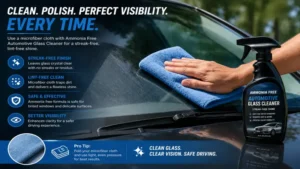
Practical Usage Guide & Application Techniques
To achieve a flawless finish with an ammonia free automotive glass cleaner, your application technique must be as precise as the chemical formulation itself. The most common mistake made during the first 30 days of ownership is using too much product, which oversaturates the cleaning towel and leads to frustrating evaporation streaks.
The Two-Towel Method Step-by-Step
-
Segregate Your Towels: Dedicate two distinct, clean microfiber cloths strictly for glass use. Utilize a low-pile waffle-weave microfiber towel for your initial scrub, and a high-density, high-pile towel for the final buff.
-
Apply to the Towel, Not the Glass: For interior work, spray your chosen ammonia free automotive glass cleaner directly onto the waffle-weave towel. This prevents airborne chemical mist from landing on your dashboard or instrument cluster.
-
Execute the Box Pattern: Wipe the perimeter of the glass pane first, then move across the surface in a tight, overlapping snake pattern horizontally, followed by a vertical pass. This ensures 100% surface coverage.
-
The Final Buff: Immediately flip to your dry, high-pile microfiber towel and buff the surface using light, circular motions to lift any remaining moisture before it air-dries.
Year-One Maintenance Schedule
To prevent the compounding buildup of interior outgassing films, execute a deep clean of your front windshield every two weeks during summer months, and once a month during winter. Wash your dedicated glass microfibers using a dye-free, scent-free liquid detergent, and never expose them to fabric softeners, which leave behind silicone oils that guarantee future streaking.
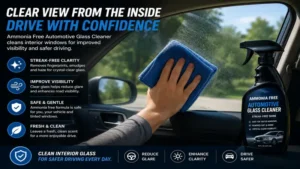
Real-World Scenario & Case Study Analysis
Different vehicle types and driving environments require distinct product pairings. Let us examine three specific user profiles to illustrate how to optimize your choice based on unique environmental variables.
Profile 1: The Daily Commuter in the Sun Belt
-
Environment: High heat, intense UV rays, heavy dashboard outgassing.
-
Vehicle Type: Modern crossover SUV with expansive glass surfaces and tinted rear passenger windows.
-
Optimal Pairing: Invisible Glass 91164 Aerosol.
-
Reasoning: The rapid flashing capabilities of the aerosol formula allow the commuter to break down the heavy polymer outgassing film before the intense heat causes the liquid to bake onto the glass. The absolute absence of ammonia ensures their aftermarket window tint remains perfectly preserved over years of exposure.
Profile 2: The High-Dust Agricultural Worker
-
Environment: Gravel roads, high ambient dust, agricultural chemical exposure.
-
Vehicle Type: Working pickup truck with heavy exterior dirt buildup.
-
Optimal Pairing: CarPro Clarify 500ml.
-
Reasoning: A standard cleaner allows static charges to build up via towel friction, attracting fine soil particles within minutes. The anti-static barrier left by this advanced formula keeps the glass cleaner for significantly longer periods under dusty operating conditions.
Profile 3: The Northern Winter Driver
-
Environment: Sub-freezing temperatures, high interior humidity, salt spray.
-
Vehicle Type: Compact commuter car with sensitive interior electronics.
-
Optimal Pairing: Griot’s Garage 11108.
-
Reasoning: Its unique deionized water base handles low-temperature flashing beautifully without turning gummy, making it the perfect choice for removing winter salt film inside a cold garage.
Troubleshooting & Problem-Solving Guide
Problem 1: Stubborn Haze or Halos During Night Driving
-
Root Cause: Emulsified vinyl outgassing residues that were loosened but not completely lifted off the surface by the secondary towel.
-
Solution: Execute a secondary pass using a clean waffle-weave towel dampened solely with distilled water to strip the residual surfactant layer. Follow immediately with a completely dry microfiber cloth.
Problem 2: Wiper Blade Chatter and Skipping Post-Cleaning
-
Root Cause: Cleansers can occasionally strip the factory-applied protective lubricants from the edge of your rubber wiper blades, causing high friction.
-
Solution: Apply a small amount of your ammonia free automotive glass cleaner to a paper towel and wipe down the rubber edge of the wiper blade until no black residue comes off. Then, apply a dry silicone protectant to restore smooth tracking.
Problem 3: White Powder Accumulating in Corner Gaskets
-
Root Cause: Using heavily dyed or soap-infused cleaners that leave solid particulates behind once the liquid carrier evaporates.
-
Solution: Switch exclusively to a dye-free option like Griot’s Garage 11108, and use a soft-bristled detailing brush to safely sweep the dried residues out of the rubber tracks.
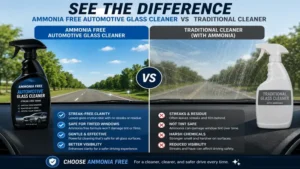
How to Choose an Ammonia Free Automotive Glass Cleaner
When navigating the crowded automotive detailing market, it is essential to filter out marketing hyperbole and focus entirely on quantifiable chemical characteristics.
Is your glass tinted?
 ├── Yes ── Is the climate below 50°F?
 │           ├── Yes ──> Choose Deionized Water Base (Griot's Garage)
 │           └── No ───> Choose Alcohol/Aerosol Base (Invisible Glass)
 └── No ─── Are you maintaining a ceramic coating?
             ├── Yes ──> Choose Silane-Infused Formula (CarPro Clarify)
             └── No ───> Choose High-Lubricant Surfactant (Meguiar's)
-
Carrier Fluid Purity: Always verify that the product utilizes highly purified or deionized water as its base. Tap water contains dissolved calcium and magnesium minerals that inevitably deposit onto your glass as white water spots when the fluid dries.
-
Surfactant Load vs. Solvent Load: Products with high alcohol content evaporate rapidly, making them excellent for removing oily films. However, formulas with higher surfactant levels provide better lubrication for lifting abrasive dirt without scratching exterior glass.
-
Delivery Mechanism: Aerosol cans provide a highly atomized, dry mist that is ideal for interior windshield work where overspray must be tightly controlled. Trigger sprays dispense a higher volume of liquid, which is preferable for breaking down heavy exterior bug guts and road grime.
-
Tint Safety Validation: Look for explicit, written manufacturing assurances that the product is completely safe for all types of aftermarket films, including dyed, metallic, and ceramic window laminates.
Common Mistakes When Buying Automotive Window Cleansers
The single most destructive mistake consumers make is assuming that a premium household glass cleaner will perform adequately inside a car. Household formulas almost universally contain ammonium hydroxide because it effortlessly cuts through animal fats and kitchen greases on heavy ceramic cooktops. When brought into a vehicle, this harsh chemical instantly begins attacking the acrylic adhesive layers of window tint, leading to bubbling and costly replacement fees.
Another common pitfall is purchasing formulas that contain heavy artificial scents or bright colorants. While a bright blue or purple fluid looks visually appealing in a spray bottle, those pigments are solid chemical additives. When the liquid carrier evaporates off your hot windshield, those dyes are left behind on the surface as microscopic streaks that become blindingly visible when driving directly into oncoming headlights.
Finally, many buyers succumb to the allure of “all-in-one” products that claim to clean glass while simultaneously applying a heavy rain-repellent coating. In my experience, these combination formulas frequently suffer from a chemical compromise: the cleaning agents prevent the repellent polymers from bonding uniformly, resulting in a patchy, smeary film that causes your wiper blades to skip violently across the windshield during light rain.
Ammonia Free Automotive Glass Cleaner vs. Household Cleaners
To truly appreciate the engineering behind a dedicated automotive fluid, one must analyze how its underlying chemistry differs from standard domestic products. Household cleaners are designed for large, vertical mirrors and glass panes exposed to relatively simple soils like dust and fingerprints. They rely on high-pH alkaline bases to dissolve these soils quickly.
| Feature / Soil Type | Dedicated Automotive Formula | Household Ammonia Formula |
| Aftermarket Tint Compatibility | 100% Safe (No Adhesive Degradation) | Destructive (Causes Peeling/Discoloration) |
| Plastic/Polycarbonate Safety | Non-reactive to instrument clusters | Causes stress-cracking and hazing |
| Vinyl Outgassing Removal | High (Emulsifies complex polymers) | Low (Smears petroleum oils) |
| Evaporation Profile | Controlled flash-off to prevent halos | Fast flash-off that traps soils |
Automotive cockpits present a radically different chemical challenge. The interior glass is constantly bombarded by outgassing plasticizers, tobacco smoke, vape oils, and skin lipids, while the exterior glass faces road tar, tree sap, and industrial fallout. A specialized automotive fluid uses neutral-pH surfactants combined with fast-evaporating isopropyl alcohols to lift these complex petroleum-based bonds without attacking the surrounding vinyl dashboards or rubber window seals.
Features That Actually Matter (And Those That Don’t)
The detailing industry is filled with flashy marketing terms designed to distract buyers from basic chemical realities. Understanding which features genuinely affect optical clarity will save you both time and money.
Features That Genuinely Matter
-
Anti-Static Chemistry: This feature introduces a slight polar charge to the glass surface, repelling tiny dust particles. It is highly valuable because it significantly extends the time required between detailing sessions.
-
High-Flash Solvents: Solvents that transform from liquid to gas rapidly prevent the cleaner from drying into visible streaks before your towel can physically lift the suspended dirt away.
-
Dye-Free Formulations: Clear fluids eliminate the risk of leaving solid dye residues behind on your glass or staining adjacent fabric pillars.
Features That Don’t Matter
-
Gimmick Fragrances: While a pleasant smell makes the job nicer, heavy fragrances require the addition of synthetic oils that provide zero cleaning power and actively contribute to post-application streaking.
-
Heavy Foam Production: Foaming action looks impressive, but it is accomplished by adding soapy surfactants that are incredibly difficult to buff off completely, often leaving a microscopic film that causes night-driving glare.
Long-Term Cost & Maintenance Analysis
When evaluating the financial aspect of vehicle maintenance, looking solely at the initial purchase price of a bottle of glass cleaner creates an inaccurate picture of total cost of ownership. A cheap, low-grade household or bulk cleaner often requires multiple applications, heavy towel consumption, and extensive physical labor to remove stubborn outgassing film.
Consider the efficiency gap: if a budget cleaner requires three separate passes and four separate microfiber towels to achieve a streak-free windshield, you are consuming three times the product per detailing session and creating a massive laundry load of dirty cloths. Conversely, a highly engineered ammonia free automotive glass cleaner like CarPro Clarify or Meguiar’s G8216 can dissolve the exact same film layer in a single, efficient pass using only two towels.
Furthermore, the long-term cost of using an incorrect chemical can be financially devastating. Replacing ruined aftermarket window tint on a standard four-door sedan can easily cost several hundred dollars in labor and materials. By investing in a dedicated, tint-safe automotive formula from the beginning, you protect your vehicle’s physical assets, reduce your overall product consumption, and save hours of labor over the course of a single year.
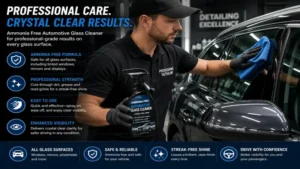
What to Expect: Real-World Performance
When switching to a professional-grade ammonia free automotive glass cleaner, it is important to manage your expectations regarding its physical behavior compared to aggressive household chemicals. Because these formulas lack the raw, corrosive bite of ammonium hydroxide, they do not instantly dissolve heavy, encrusted mud or thick tree sap on contact. Instead, they rely on advanced surface tension reduction to slide underneath the contamination and lift it away safely.
During your first application, you will notice that the product behaves with a much higher degree of lubricity. Your microfiber towel will glide effortlessly across the pane rather than grabbing or sticking to the surface. The evaporation process will also feel slightly different; rather than vanishing instantly like pure alcohol, the fluid stays wet just long enough for you to work the towel across the entirety of the pane, capturing all suspended dirt particles before flashing clean.
In night-driving scenarios, the real-world performance difference becomes immediately obvious. Oncoming LED headlights that previously bloomed into blinding starbursts due to microscopic soap streaks will now appear clean and focused. The persistent morning fogging that often plagues interior windshields will also be greatly reduced, as there are no longer any residual chemical detergents left on the glass to attract ambient moisture.
✨ Don’t Miss These Exclusive Deals!
🔍 Take your vehicle maintenance to the next level with these carefully selected products. Click on any highlighted item to check current pricing and availability. These tools will help you create authentic optical clarity your family will love!
FAQs
❓ Is ammonia free automotive glass cleaner safe for aftermarket window tint?
✅ Yes, absolutely. These formulations completely omit ammonium hydroxide, making them 100% safe for all types of aftermarket window films, as they will not degrade the delicate acrylic adhesives over time…
❓ Can I use this type of cleaner on my car’s interior navigation screen?
✅ Most high-quality formulas are completely safe for modern infotainment displays, provided you spray the fluid directly onto a microfiber cloth first rather than flooding the sensitive electronic buttons…
❓ Why does my windshield still look blurry when driving directly into the sun?
✅ This is usually caused by residual plasticizer film that has been smeared rather than completely lifted. Execute a secondary pass using a clean, dry, high-pile microfiber towel to fully remove the remaining residue…
❓ Will these glass cleaners strip off my existing ceramic windshield coating?
✅ No, dedicated premium formulas are engineered to be completely pH-neutral and coating-safe, allowing them to clean the surface thoroughly without degrading the underlying hydrophobic sealants…
❓ Can I use household paper towels to dry my automotive glass?
✅ No, paper towels contain stiff wood fibers that can create micro-scratches on delicate aftermarket window tint and leave behind frustrating lint particles. Always use a clean microfiber towel…
Conclusion
Achieving flawless, crystal-clear automotive glass does not require a complex professional detailing degree, but it does demand an understanding of chemical compatibility. By choosing a dedicated ammonia free automotive glass cleaner, you actively safeguard your vehicle’s expensive window tinting, preserve the clarity of interior plastics, and eliminate the dangerous night-driving glare caused by inferior household products. Pair a high-quality fluid with the proper two-towel application technique, and you will quickly enjoy a streak-free view of the open road ahead.
Recommended for You
- 5 Best microfiber cleaning mop Options for Spotless Floors in 2026
- 7 Best Ways how to clean microfiber towels in 2026 Without Ruining Them
- 5 Shocking Secrets About Using Vinegar to Clean Microfiber Cloth in 2026
Disclaimer: This article contains affiliate links. As an Amazon Associate, I earn from qualifying purchases. If you purchase products through these links, we may earn a small commission at no additional cost to you.
✨ Found this helpful? Share it with your friends! 💬🤗