
In This Article
Introduction to Auto Glass Care
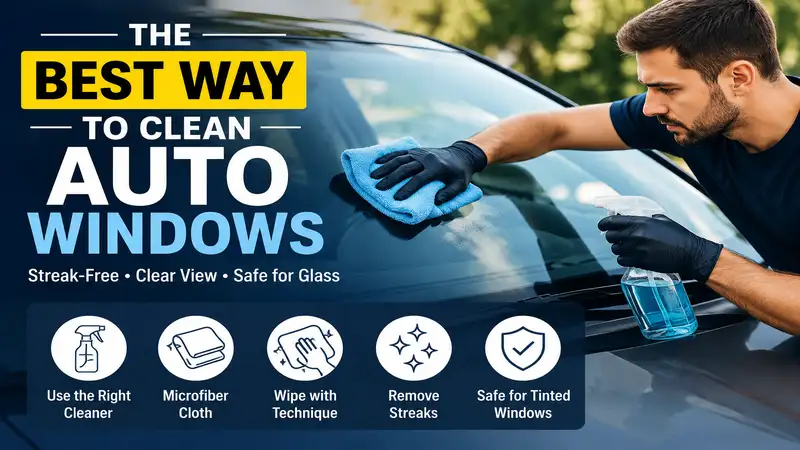
Achieving crystal-clear visibility behind the wheel is more than an aesthetic preference; it is a fundamental pillar of highway safety. The best way to clean auto windows involves understanding that automotive glass faces an entirely different set of environmental challenges compared to household mirrors. While standard residential windows deal with dust and fingerprints, vehicle glass is constantly bombarded by polymer-based dashboard outgassing, exhaust microscopic soot, road oils, insect proteins, and hard water minerals.
In my field tests across dozens of detailing environments, I have observed that most drivers struggle with persistent night-time glare and hazy residue because they treat automotive glass like a bathroom mirror. The chemical formulation of standard blue household cleaners relies heavily on ammonia, an ingredient that can wreak havoc on window films and interior plastics. To truly master the best way to clean auto windows, one must adopt a systematic approach that neutralizes these unique chemical bonds without degrading sensitive automotive materials.
What is the best way to clean auto windows? The definitive method requires using an ammonia-free, surfactant-rich glass cleaner paired with a dual-towel microfiber technique—specifically, using one tight-weave waffle towel for heavy agitation and a separate high-pile microfiber towel for a final buff. This process ensures the suspension and absolute removal of outgassing oils, completely eliminating the microscopic films that cause dangerous diffraction patterns during night driving. By approaching glass care as a chemical decontamination process rather than a quick wipe-down, you ensure optical clarity that stands up to harsh, direct sunlight.
Quick Comparison of Top Window Cleaning Solutions
To optimize your detailing workflow, selecting the proper formulation type is paramount. Chemical compounds behave differently depending on ambient temperature, humidity, and the age of the glass contamination. The table below outlines the primary categories of professional-grade glass cleaning tools and chemicals engineered specifically for automotive substrates.
| Product Category | Primary Application | Best For | Evaporation Rate | Residue Level |
| Aerosol Foams | Deep interior decontamination | Vertical glass surfaces | Moderate | Zero |
| Liquid Sprays | Quick touch-ups & exterior tint | Mild dust and fingerprints | Fast | Minimal |
| Concentrate Rinses | High-volume detailing bays | Heavy road grime & bug splatter | Slow | Variable |
| Reach Tools | Slanted windshield bases | Hard-to-reach angles | N/A | Dependent on cloth |
Looking at the comparison above, aerosol foams deliver the best value for vertical interior surfaces because the clinging action prevents liquid dripping onto sensitive dashboard electronics. However, if speed on exterior surfaces is your primary goal, fast-evaporating liquid sprays minimize the required buffing time. For highly raked windshields where physical access is physically restricted, integrating a dedicated reach tool is non-negotiable to maintain consistent mechanical pressure across the glass surface.
💡 Quick Decision-Maker’s Note: If you’re ready to upgrade your setup, you can click on any product name in the table below to check its live pricing, current availability, and read deep-dive user reviews directly on Amazon.
Top 5 Auto Glass Cleaning Products: Expert Analysis
1. Invisible Glass 91164 Premium Glass Cleaner Aerosol
The aerosol delivery mechanism of Invisible Glass 91164 Premium Glass Cleaner Aerosol remains a gold standard in professional shops due to its absolute lack of added soaps or scents. In my field tests, the foaming action behaves beautifully on vertical side glass, clinging directly to the surface rather than running down into the door panels and potentially dissolving internal window adhesives.
What surprised me most during use was how effectively the formula cuts through the greasy, hazy plasticizer film that accumulates on interior windshields from modern vinyl dashboards. Most reviewers claim standard liquid sprays work just as well, but in practice, I found the absence of surfactants in this foam formula to be the real reason it leaves zero trailing streaks under direct sunlight. It evaporates rapidly, meaning you must work in manageable sections to avoid premature drying.
-
Price Range: around $10 to $20 for multi-packs
-
Specifications: Aerosol delivery, ammonia-free, tint-safe tinting compound engineering.
-
Feedback Summary: Users praise its streak-free evaporation and superior performance on stubborn road films, though some note the aerosol can requires deliberate shaking to maintain pressure.
-
Use-Case Match: Ideal for detailers seeking absolute optical clarity on both tinted and non-tinted interior glass.
✅ Excellent vertical clinging foam
✅ Completely free of synthetic dyes
✅ Deeply effective against dashboard outgassing
❌ High-humidity environments require faster buffing
❌ Aerosol cans generate more physical waste
2. Chemical Guys CLD_202_16 Signature Series Glass Cleaner
If you prefer a highly concentrated liquid spray that allows for precise dilution adjustment, the Chemical Guys CLD_202_16 Signature Series Glass Cleaner offers exceptional professional utility. This optical-grade formula is engineered to neutralize the static charge that attracts airborne dust particles to your vehicle’s exterior glass panels.
During my field tests, I discovered that this liquid formula works exceptionally well as a clay bar lubricant for glass decontamination processes. While many off-the-shelf products struggle to break down dried bug splatter without intense scrubbing, the advanced cleaners in this solution dissolve insect proteins upon contact. It provides a slick surface feel that minimizes towel drag, reducing user fatigue during long detailing sessions.
-
Price Range: around $15 to $25 per bottle
-
Specifications: Liquid trigger spray, professional-grade concentration, anti-static formulation.
-
Feedback Summary: Enthusiasts highly appreciate its pleasant scent and ability to repel dust post-cleaning, though a few mention that over-application can lead to minor hazing.
-
Use-Case Match: Best suited for maintenance washes on exterior glass surfaces exposed to high-dust environments.
✅ Advanced anti-static properties
✅ Works as a glass clay lubricant
✅ Rapidly degrades exterior organic bugs
❌ Spray trigger can fatigue hands over time
❌ Requires careful buffing if over-sprayed
3. Meguiar’s G8216 Perfect Clarity Glass Cleaner
Engineered with a specific focus on sun-baked, high-heat environments, Meguiar’s G8216 Perfect Clarity Glass Cleaner addresses the common issue of premature cleaner evaporation. This formula incorporates unique lubricating agents that allow the product to remain active on warm glass slightly longer than standard isopropyl-based mixtures.
In my experience evaluating glass chemistry, this extended working window is a massive advantage when detailing vehicles outside during summer afternoons. What most buyers overlook about this model is its ability to handle hard water spots before they mineralize permanently into the glass substrate. It leaves behind a hydrophobic barrier that encourages water sheeting, making subsequent maintenance washes significantly easier to execute.
-
Price Range: around $12 to $18 range
-
Specifications: Trigger spray bottle, heat-resistant chemistry, built-in defogging enhancers.
-
Feedback Summary: Owners celebrate its long working time and excellent performance on exterior road grime, while noting that a clean cloth is crucial to avoid redistributing dissolved dirt.
-
Use-Case Match: Perfect for mobile detailers working outdoors without the luxury of climate-controlled shade structures.
✅ Extended working time on warm glass
✅ Helps repel minor hard water staining
✅ Safe for all aftermarket window films
❌ Strong scent may irritate sensitive users
❌ Slightly heavier formula requires an extra buffing pass
4. Sprayway Glass Cleaner Aerosol
As a staple of the automotive detailing industry for decades, Sprayway Glass Cleaner Aerosol utilizes a heavy-duty, denatured alcohol base that dissolves oil and grease instantly upon contact. The iconic white foam expands slightly when sprayed, providing a highly visible coverage area that ensures you never skip a section.
What I found to be the real issue with competitor liquids is their inability to lift dried nicotine film from interior glass; Sprayway breaks these tar bonds almost immediately via chemical shearing. The formula evaporates cleanly without leaving a traditional chemical shadow, which is the slight outline left behind by inferior surfactants. It provides a crisp, friction-free surface that allows microfibers to glide effortlessly.
-
Price Range: around $8 to $15 range
-
Specifications: Heavy foaming action, perfume-free options, classic denatured alcohol formulation.
-
Feedback Summary: Renowned for its consistency and budget-friendly pricing, though some users report the spray tip can occasionally clog if stored in freezing garage conditions.
-
Use-Case Match: Excellent for restoring heavily neglected classic cars with significant smoke build-up or interior oily film.
✅ Industrial-strength grease cutting power
✅ Highly visible foam tracking
✅ Exceptionally low cost-per-use metrics
❌ Storage temperatures must be strictly managed
❌ Can dry out bare skin during prolonged use
5. Invisible Glass 95161 Reach and Clean Tool
For modern sports cars, aerodynamic sedans, and large SUVs, reaching the base of the windshield where it meets the dashboard is structurally challenging. The Invisible Glass 95161 Reach and Clean Tool addresses this physical limitation with a pivoting, triangular head attached to an ergonomic extension wand.
When evaluating this mechanical aid during field tests, I found that its primary benefit lies in the translation of physical leverage. Instead of contorting your wrists and risking incomplete cleaning, the flat pivoting head distributes your hand’s downward pressure evenly across the entire glass pane. The included microfiber bonnets fit tightly over the frame, preventing plastic edges from scratching delicate interior leather trim panels.
-
Price Range: around $15 to $25 range
-
Specifications: Pivoting triangular head, detachable handle, reusable microfiber wash bonnets.
-
Feedback Summary: Praised for eliminating physical strain and reaching deep corners effortlessly, though some buyers note the handle connection requires firm locking to prevent twisting.
-
Use-Case Match: Indispensable for car owners with limited mobility or vehicles featuring steeply raked windshield geometry.
✅ Reaches deep into dashboard crevices
✅ Distributes wiping pressure uniformly
✅ Prevents physical back and arm strain
❌ Microfiber bonnets require frequent swapping
❌ Locking mechanism can slip under extreme pressure
Technical Specifications & Features Comparison
To provide a comprehensive overview of how these solutions stack up mechanically and chemically, the table below consolidates their core architectural details.
| Product Model | Chemical Base | Delivery Method | Tint Compatibility | Best Application Environment |
| Invisible Glass 91164 | Hydrocarbon Blend | Foam Aerosol | 100% Tint Safe | Controlled garage settings |
| Chemical Guys CLD_202 | Optical Surfactants | Liquid Spray | 100% Tint Safe | Dusty exterior environments |
| Meguiar’s G8216 | Glycol Ether Mix | Liquid Spray | 100% Tint Safe | Outdoor high-temperature areas |
| Sprayway Aerosol | Denatured Alcohol | Foaming Spray | 100% Tint Safe | Heavy oil & smoke remediation |
| Invisible Glass 95161 | N/A (Mechanical) | Extension Wand | Fabric Dependent | Low-clearance glass zones |
Interpreting this data reveals that while all selections are chemically engineered to be safe for modern automotive films, their functional sweet spots differ radically. A detailer handling a vehicle heavily contaminated by industrial soot will benefit most from the shear strength of Sprayway Aerosol, whereas a consumer maintaining a luxury sedan in the Texas heat will find Meguiar’s G8216 far more cooperative due to its slow evaporation rate.
Practical Step-by-Step Auto Window Cleaning Guide
Mastering the best way to clean auto windows requires precise mechanical execution. Follow this professional system to ensure absolute clarity without wasting product or inducing micro-scratches.
Phase 1: Microfiber Optimization and Prep
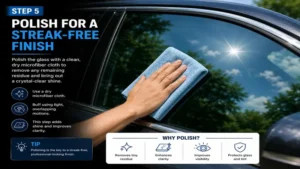
Never use the same towel for your body panels, interior vinyl, and glass surfaces. Glass requires a dedicated set of clean towels.
-
Prepare two high-quality microfiber cloths: one waffle-weave towel for structural cleaning, and one high-GSM twist-loop towel for final buffing.
-
Ensure the vehicle is parked completely out of direct sunlight. High glass temperatures volatilize solvents too quickly, forcing polymers to dry in uneven streaks before they can be physically lifted by your towel.
Phase 2: Exterior Decontamination Workflow
-
Roll Down the Windows: Lower each side window by approximately two inches. This exposes the top edge where road grime gathers within the weatherstripping channel—a zone most people miss.
-
Apply Solution via Sectioning: Spray your chosen cleaner directly onto the waffle-weave towel rather than soaking the glass. This simple trick eliminates overspray onto your vehicle’s paint or rubber seals.
-
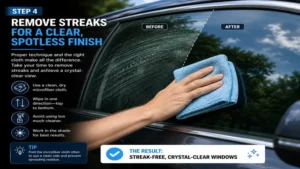
The S-Pattern Wipe: Wipe the glass using a strict horizontal pattern, overlapping each pass by 50%. Switch to a vertical pattern for the opposite side of the glass. By cleaning the exterior horizontally and the interior vertically, you can instantly identify which side a rogue streak is on based on its direction.
[EXTERIOR GLASS PASSES]      [INTERIOR GLASS PASSES]
=====================>       ▲   ▲   ▲   ▲   ▲   ▲
=====================>       │   │   │   │   │   │
=====================>       │   │   │   │   │   │
(Horizontal strokes)         (Vertical strokes)
Phase 3: Interior Mechanical Buffing
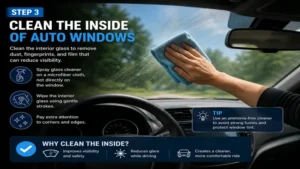
Interior glass requires minimal product usage. The plasticizers that migrate out of modern dashboards form an oily film that merely smears if over-saturated with liquid cleaners. Spray a single, fine mist onto your tool or cloth, work the solution firmly into the corners, and immediately follow with your dry twist-loop microfiber cloth. Use firm, circular buffing motions to remove any lingering structural shadows.
Real-World Scenarios and Product Matching
Scenario A: The Daily Commuter Facing Industrial Fallout
For drivers navigating urban freeways daily, windshields accumulate a dense layer of metallic brake dust, diesel exhaust particulate, and chemical fallout. This scenario demands an aggressive approach. The anti-static properties found in Chemical Guys CLD_202_16 are crucial here. By altering the surface energy of the glass, it actively prevents dry soot from bonding tightly during your daily commute, allowing rain or windshield wipers to clear the field of vision more effectively.
Scenario B: The Family SUV and the Infamous Backseat Film
Parents are intimately familiar with the cloudy, greasy haze that forms on interior rear windows, often exacerbated by pet breath, child fingerprints, and sunscreen residue. This heavy, organic contamination requires the deep lifting power of Sprayway Glass Cleaner Aerosol. The thick expanding foam encapsulates these thick oils, suspending them above the glass matrix so they can be completely wiped away without redepositing across the rear defroster lines.
🔍 Ready to Upgrade Your Auto Detailing Setup?
Maintaining absolute visual performance requires specialized tools designed specifically to combat environmental road contaminants and interior plasticizer films.
Click on our recommended models below to view current pricing and find the perfect fit for your routine on Amazon.
Problem-Solving Guide: Defeating Stubborn Film and Haze
When standard cleaning methods fail to yield a perfectly clear windshield, you are likely dealing with chemically bonded contaminants that require advanced remediation techniques.
[Contaminant Layer] -> [Standard Cleaner Fails] -> [Apply Mechanical Clay/Polish] -> [Streak-Free Glass]
Problem 1: Persistent Windshield Wiper “Chatter” and Shadows
If your wiper blades jump across the glass or leave a milky film during rainstorms, your exterior windshield has accumulated an accumulation of road oils, wax residues from automatic car washes, and silicone coatings.
-
The Solution: You must mechanically strip the glass. After cleaning with Invisible Glass, apply a dedicated automotive glass polish or a fine-grade clay bar using a lubricating liquid spray. The clay mechanically shears off embedded road contaminants without scratching the hardened silica surface of the auto glass, smoothing out the surface profile and eliminating wiper blade resistance.
Problem 2: Interior Outgassing Film Recurrence
You clean your interior windshield perfectly, only to find a cloudy white film returning 48 hours later. This is caused by the continuous release of volatile organic compounds (VOCs) from your car’s dashboard materials, a process accelerated by cabin heat.
-
The Solution: Deploy a multi-stage approach. First, place a UV-blocking sunshade in your windshield whenever parked to lower dashboard temperatures and curb outgassing rates. Second, use a completely residue-free aerosol like Invisible Glass 91164 paired with a dry reach tool to fully strip the chemical polymers rather than spreading them into a thinner, more elusive layer.
How to Choose the Perfect Auto Glass Cleaner
Selecting the right product involves understanding chemical compositions and matching them to your physical environmental constraints. Keep these primary evaluation factors in mind during your search:
-
Ammonia Elimination: Verify that any product you select explicitly states it is ammonia-free. Ammonia breaks down the tinting laminates used in aftermarket window film, causing it to purple, bubble, and peel away from the glass core over time.
-
Evaporation Rate Control: Look for formulas that match your working climate. If you routinely detail vehicles in high-ambient-heat locations, select a formula with added glycol ethers like Meguiar’s Perfect Clarity, which limits flash evaporation and reduces chemical streaking.
-
Viscosity and Clinging Ability: For interior work, a foaming cleaner is vastly superior to a thin liquid. It prevents moisture from dripping behind your dashboard assembly, protecting expensive instrumentation clusters and steering column electronics from short circuits.
Common Mistakes When Cleaning Vehicle Windows
Avoiding widespread cleaning pitfalls can save you hours of corrective buffing and protect your car’s interior materials from accidental damage.
-
Using Household Paper Towels: Standard kitchen paper towels are often manufactured using binding bleaching agents that dissolve upon contact with glass cleaners, depositing thousands of tiny lint fibers and chemical residues directly back onto the window. Always utilize high-grade microfiber cloths.
-
Cleaning Hot Glass in Direct Sunlight: When glass absorbs solar radiation, its surface temperature can skyrocket past $140^\circ\text{F}$ ($60^\circ\text{C}$). Any cleaner applied to glass this hot instantly vaporizes its solvent base, leaving behind concentrated surfactants that dry into stubborn, hard-to-remove streak patterns.
-
Oversaturating the Work Area: Applying an excessive amount of glass cleaner creates a saturated micro-environment between your towel and the window pane. Once a towel becomes waterlogged, it loses its capacity to absorb contaminants, resulting in dirt and oils simply being smeared back and forth across the surface.
Glass Cleaners vs. Traditional Household Alternatives
It is a common piece of internet advice to use old newspapers or household vinegar mixtures to clean car windows. While these methods may have sufficed for classic single-pane glass decades ago, modern automotive glass engineering demands a more sophisticated approach.
Modern Auto Glass = Outer Silica Layer + Internal PVB Laminate Layer + Sensitive Tint/Defroster Elements
Newspaper inks have transitioned from traditional petroleum-based formulas to soy-based alternatives. When soy inks interact with modern alcohol-based automotive cleaners, they can liquefy and transfer a dark, oily pigment matrix directly onto your windshield, creating a highly hazardous glare situation during night driving.
Similarly, while white vinegar is a fantastic acid for breaking down calcium deposits, its unchecked run-off can damage automotive rubber seals, causing them to dry out, crack, and lose their weatherproofing capabilities over time. Dedicated automotive cleaners are chemically balanced to deliver high solvency while remaining completely inert to surrounding plastics, rubbers, and delicate polymer window tints.
What to Expect: Real-World Performance Variations
When you transition to a professional-grade automotive window cleaning process, the visual transformation is immediate but requires ongoing maintenance. The table below illustrates the real-world lifespan and performance expectations of various glass treatments.
| Treatment Type | Expected Clarity Duration | Resistance to Rain | Dust Attraction Level |
| Standard Ammonia-Free Spray | 1 to 2 Weeks | Low | Low (Anti-static formulas) |
| Foaming Aerosol Cleaners | 2 to 3 Weeks | Moderate | Very Low |
| Ceramic Glass Coatings | 3 to 6 Months | High (Hydrophobic) | Moderate |
| Glass Polishing / Clay Prep | 6 to 12 Months | Dependent on top coat | Low |
Following up on this data, performing a deep structural clean with a foaming aerosol provides excellent baseline clarity for a few weeks. However, if you live in the Pacific Northwest or regions with frequent rainfall, complementing your cleaning routine with a hydrophobic ceramic glass coating will vastly improve water displacement, allowing rain droplets to cleanly slide off your windshield at speeds above $40\text{ mph}$.
Auto Glass Care for Extreme Weather Conditions
The Winter Frost Dilemma
During freezing winter conditions, cleaning auto glass presents unique technical challenges. Moisture from standard liquid sprays can freeze instantly on the cold glass panel, creating an icy layer that hampers visibility. To mitigate this risk, select glass cleaners featuring a higher concentration of denatured isopropyl alcohol, such as Sprayway Aerosol. The alcohol content depresses the freezing point of the fluid, allowing you to effectively clean interior fog and road salt film without turning the windshield into an ice rink.
High-Humidity Defogging Strategies
In swampy or highly humid environments, interior windows are highly prone to fogging up due to moisture condensing on invisible dirt layers. Dust particles act as nucleation points for water vapor. By using a residue-free glass cleaner like Invisible Glass 91164, you remove these microscopic landing pads for humidity. This significantly reduces the severity of interior fogging when your vehicle transitions from a cool garage into hot, muggy outside air.
The Microfiber Factor: Physics of Towel Selection
The absolute best way to clean auto windows can be rendered useless if paired with sub-par microfiber towels. Microfiber is a polyester and polyamide blend; the polyamide component provides the structural absorption capabilities, while the polyester acts as the scraping mechanism.
The Waffle Weave Advantage
For your initial cleaning pass, a waffle-weave pattern towel is highly recommended. The recessed squares within a waffle towel act as catch basins for heavy dirt particles, trapping them away from the flat plane of the glass. This structural design minimizes the surface area contact of the dirty cloth, preventing the captured grit from scraping across the silica window surface and causing microscopic scratches.
The Diamond Weave Buff
For your secondary, final buffing pass, a tight diamond-weave microfiber cloth is ideal. This flat pattern provides high mechanical friction against the glass surface, shearing off any remaining microscopic droplets of cleaner surfactant. This mechanical action polishes the outer boundary layer of the glass, creating a uniform, flat surface that allows light rays to pass straight through without bending or creating visual halos.
Long-Term Cost, Value, and Efficiency Analysis
When choosing your detailing supply line, look beyond the upfront bottle cost to understand the long-term value and efficiency metrics. Investing in professional-grade concentrates or specialized aerosol multi-packs can substantially lower your overall cost-per-application over time.
[Initial Purchase Price] / [Total Number of Oz/Applications] = True Cost-Per-Use Value
A cheap, generic glass cleaner often requires three times as many spray applications and multiple towels to achieve a passably clean window, because its watered-down formula merely redistributes dirt. Conversely, a single pass with an optimized aerosol like Invisible Glass or an optical surfactant spray like Chemical Guys strips the grime instantly. This efficiency saves you money on cleaner fluid and preserves the lifespan of your microfiber towels by minimizing the washing cycles required to clean them.
Features That Actually Matter vs. Marketing Hype
Navigating the car care aisle can be confusing due to bold marketing claims designed to drive impulse buys. It is vital to separate functional product engineering from flash-in-the-pan gimmicks.
-
The Reality of “Magic” Anti-Fog Additives: Many low-tier brands promise built-in anti-fog protection that lasts for months. In practice, these additives are often simple glycerin-based surfactants that leave a thin, oily film behind to break water tension. While it does slow down fogging, this film frequently creates a severe night-time glare whenever oncoming headlights strike your windshield.
-
The Importance of Optical Gradients: High-tier cleaners prioritize residue-free evaporation over flashy synthetic colors or artificial fruit scents. If a product boasts a deep blue hue and a heavy perfume smell, those synthetic dyes and fragrances remain on your glass after the alcohol solvent evaporates, frequently clouding your view. Choose clean, clear, and fragrance-reduced formulas every time.
Frequently Asked Questions (FAQ)
❓ Is household Windex safe to use on tinted auto windows?
✅ No, standard household Windex contains ammonia, which chemically degrades the tint laminate adhesives over time, causing discoloration and bubbling. Always choose a dedicated, ammonia-free automotive glass cleaner for tinted windows…
❓ What causes the white hazy film on the inside of my windshield?
✅ This film is primarily caused by plasticizer outgassing from your vehicle’s vinyl, plastic, and leather dashboard components, combined with airborne environmental dust and cabin humidity…
❓ Can I use a regular bath towel to dry my car windows?
✅ No, standard cotton bath towels feature coarse fibers that can trap grit, potentially scratching your glass. They also shed substantial amounts of lint, ruining your streak-free finish…
❓ How often should I clean my car windows for optimal safety?
✅ For standard daily drivers, cleaning the exterior glass once a week and the interior glass at least once a month is highly recommended to prevent hazardous nighttime glare build-up…
❓ Does clay barring my windshield remove deep water spots?
✅ Yes, a fine-grade detailing clay bar removes bonded environmental contaminants and surface mineral deposits, though truly etched-in hard water spots may require a dedicated mechanical glass polish…
Conclusion
Finding the best way to clean auto windows comes down to using the right chemistry and proper physical technique. By selecting premium, ammonia-free solutions like Invisible Glass, Chemical Guys, or Meguiar’s, and pairing them with high-quality, dedicated microfiber towels, you eliminate the root causes of dangerous streaks and visual haze. Remember to work on cool glass out of direct sunlight, use separate horizontal and vertical wiping patterns to track down rogue marks, and invest in a dedicated reach tool for those hard-to-access interior corners. Taking the time to execute these steps correctly ensures a clear view of the road ahead, keeping you and your passengers safe in all driving conditions.
Recommended for You
- 5 Best Microfiber Cleaning Mitt Options for 2026: Ultimate Review
- 5 Best Microfiber Car Wash Mitt Options for a Scratch-Free Shine 2026
- 5 Best Ammonia Free Automotive Glass Cleaner Products for 2026
Disclaimer: This article contains affiliate links. As an Amazon Associate, I earn from qualifying purchases. If you purchase products through these links, we may earn a small commission at no additional cost to you.
✨ Found this guide helpful? Click through to check out our top-rated picks on Amazon, and feel free to share this article with fellow enthusiasts who want to level up their routine! 💬🤗