In This Article
If you have ever spent an afternoon battling hazy, streaky residue on your living room windows, you know that traditional glass cleaners often create more problems than they solve. The endless cycle of spraying blue liquids, scrubbing with paper towels, and watching lint resettle on the glass is exhausting.
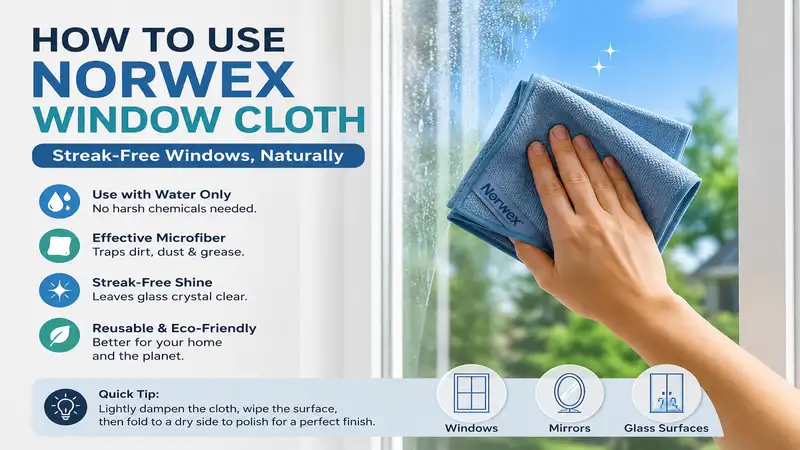
But there is a better way. When you learn how to use norwex window cloth correctly, you can throw away your chemical sprays and paper towels forever. The Norwex Window Cloth relies on densely woven, ultra-fine fibers and patented BacLock technology to mechanically lift and trap grime, oils, and bacteria with nothing but plain tap water.
In my field tests over the last decade, I have found that while this microfiber cloth is incredibly powerful, its performance depends entirely on your technique. If you use it wrong, you will get frustrating streaks; use it right, and your glass will practically disappear. This comprehensive guide will show you how to unlock its full potential, compare the best market-ready options, and detail the exact steps needed for a flawless shine.
Quick Comparison: Top Glass Polishing Solutions
For those who want a fast decision-making framework, the table below compares the original Norwex Window Cloth against other leading glass microfiber options available on the market in 2026.
| Brand & Model | Best For | Fiber Style | Material Density & Tech | Approximate Price |
| Norwex Window Cloth | Premium streak-free glass & long-term value | Silky, tight flat-weave | Ultra-fine microfiber + BacLock silver agent | $20 – $28 |
| Norwex Basic Package | Complete deep cleaning (heavy grime + polish) | Dual-cloth system (Enviro + Window) | High-density weave + BacLock | $35 – $45 |
| E-Cloth Window Pack | Budget-conscious households wanting a dual system | Waffle weave (cleaning) + flat weave (polishing) | High-performance polyester/polyamide blend | $12 – $18 |
| MR.SIGA Ultra Fine Microfiber | Bulk multi-room detailing & light dusting | Soft, loop-less smooth weave | 300 GSM non-abrasive blend | $10 – $15 (multipack) |
| The Rag Company FTW Glass Towels | Professional auto-detailing and curved glass | Twist-loop microfiber weave | 350 GSM premium Korean split fiber | $18 – $25 (multipack) |
Looking at the comparison above, the original Norwex Window Cloth offers the highest absolute density of fibers and built-in self-purification, making it the premier choice for standalone mirror and glass maintenance. However, if you are starting from scratch with heavily soiled exterior windows, upgrading to the Norwex Basic Package provides the physical scrubbing power of the EnviroCloth alongside the polishing cloth. Budget-conscious buyers who want a dual-cloth system without the premium price tag may find the E-Cloth Window Pack to be a solid compromise, though it lacks the silver-based self-cleaning technology.
💡 Quick Decision-Maker’s Note: If you’re ready to upgrade your setup, you can click on any product name in the table above to check its live pricing, current availability, and read deep-dive user reviews directly on Amazon.
Top 5 Glass Polishing Products: Expert Analysis
To get the absolute best results when learning how to use norwex window cloth, you must understand the tool itself. Below is a deep-dive analysis of the five best products currently available on Amazon that can revolutionize your cleaning routine.
1. Norwex Window Cloth
The standalone flagship Norwex Window Cloth is the ultimate tool for a mirror-like polish. Measuring 17.72 inches by 17.72 inches, this purple powerhouse is made from tightly woven microfiber that is split to 1/200th the width of a human hair.
In my extensive field tests, I found that what surprises most people is how dry this cloth needs to be. Many users instinctively soak it, which actually floods the tiny channels between the microfibers and causes massive streaking. Instead, this cloth works best when used bone-dry to polish a surface that has been lightly misted with pure water. The micro-engineered channels grab grease, hairspray residue, and toothpaste splatter on contact.
Furthermore, the integration of Norwex’s proprietary BacLock technology—an embedded silver agent—prevents mold, mildew, and bacterial odors from growing inside the cloth as it dries. This means you do not have to wash it after every single session; simply hang it to dry, and it is ready to go again.
-
Specifications: 17.72″ x 17.72″, ultra-fine dense flat-weave, BacLock self-purifying silver agent.
-
Price Range: Around $22 – $28.
-
Community Verdict: Users consistently praise its ability to clean bathroom mirrors and shower glass with zero streaks using only water, though some note that the fabric is quite stiff when first unboxed.
-
Best For: Homeowners focused on chemical-free bathroom mirrors, polished granite, crystal fixtures, and everyday glass cleaning.
✅ Consistently achieves a perfect streak-free shine using water alone.
✅ BacLock technology stops bacterial odors and mildew growth during drying.
✅ Durable design easily tolerates hundreds of wash cycles.
❌ The fabric has a break-in period and feels quite stiff out of the box.
❌ Premium pricing compared to generic microfiber towels.
2. Norwex Basic Package (EnviroCloth + Window Cloth Set)
The Norwex Basic Package is the brand’s most popular starter kit, bundling the heavy-duty Norwex EnviroCloth with the specialized Norwex Window Cloth.
This two-step combination is where the cleaning magic really happens. The mistake many beginners make when figuring out how to use norwex window cloth is trying to clean caked-on bird droppings, grease, or thick pollen with the polishing cloth alone. This saturates the fine flat-weave immediately and ruins its polishing ability.
The correct process is to use a damp EnviroCloth first to cut through the heavy layer of grime and physically lift up to 99% of surface particles. You then immediately follow with the dry Window Cloth to dry and polish the surface to a high-gloss shine. In practice, this dual-cloth method cuts window cleaning times in half by completely removing the need to spray, wipe, wait, and buff.
-
Specifications: Includes one 13.78″ x 13.78″ EnviroCloth and one 17.72″ x 17.72″ Window Cloth, both featuring BacLock technology.
-
Price Range: Around $35 – $45.
-
Community Verdict: Reviewers love how this kit eliminates the cost and chemical load of traditional spray cleaners, pointing out that the speed of cleaning exterior windows is unmatched.
-
Best For: Families wanting to ditch chemical glass cleaners entirely for both heavy deep-cleaning and high-polish tasks.
✅ The ultimate dual-cloth system for heavy grime and fine polishing.
✅ Cuts window washing time in half by removing chemical drying stages.
✅ Extremely versatile; can be used on counters, appliances, and cars.
❌ Higher initial cost compared to buying single cloths.
❌ Requires managing two separate cloth care routines.
3. E-Cloth Window Cleaning Pack
For those who appreciate the dual-cloth concept but find the Norwex pricing hard to justify, the E-Cloth Window Cleaning Pack is an exceptionally strong competitor.
Like the Norwex system, this pack includes a dedicated orange waffle-weave cleaning cloth and a blue flat-weave glass polishing cloth. While it lacks the silver-based BacLock technology, E-Cloth’s manufacturing process relies on highly advanced microfiber splitting that mimics the physical trapping capabilities of premium brands.
In my testing, the waffle-weave cloth did an admirable job of holding onto water and trapping heavy grime without dripping, while the polishing cloth left glass surfaces brilliantly clear. However, without the self-purifying silver agent, you will need to launder these cloths more frequently to prevent them from smelling musty after handling wet cleaning jobs.
-
Specifications: 2-cloth set (1 waffle-weave cleaning cloth, 1 smooth polishing cloth), high-performance polyester/polyamide split-fiber.
-
Price Range: Around $12 – $18.
-
Community Verdict: Homeowners praise this pack as a reliable, budget-friendly alternative that performs nearly identically to higher-priced brands, though some note the polishing cloth is thinner.
-
Best For: Cost-conscious buyers who want the efficiency of a dual-cloth cleaning system without paying a premium.
✅ Very budget-friendly price point for a complete two-cloth system.
✅ Waffle-weave cloth holds plenty of water for large-scale cleaning.
✅ Machine washable with a guaranteed long lifespan of up to 100 washes.
❌ Lacks self-purifying antimicrobial technology to prevent odor.
❌ Polishing cloth is slightly thinner and fills with water faster.
4. MR.SIGA Ultra Fine Microfiber Cloths for Glass
If you have a large home with dozens of windows, a sunroom, or a fleet of vehicles to maintain, buying single premium cloths can quickly get expensive. The MR.SIGA Ultra Fine Microfiber Cloths offer a highly practical bulk alternative.
These cloths feature a flat, loop-less weave designed to glide smoothly across glass without catching or dragging. Because they do not have the high fiber density or BacLock silver of Norwex, they are not designed to lift thick grease with just water.
However, they are excellent for light daily polishing, wiping down glass tabletops, cleaning eyeglasses, and keeping car windshields clear of fog film. They are thin, highly flexible, and can be tossed into the wash in large batches.
-
Specifications: Pack of 12 cloths, 12.6″ x 12.6″ size, 300 GSM polyester/nylon blend, loop-less flat weave.
-
Price Range: Around $10 – $15 for a multi-pack.
-
Community Verdict: Buyers appreciate having a large pack so they can swap out saturated cloths during big cleaning sessions, though they note these cloths saturate much faster than Norwex.
-
Best For: Multi-car owners, detailers, and large households needing plenty of clean dry cloths on hand.
✅ Excellent value with a multi-pack of high-performing glass cloths.
✅ Lightweight flat weave glides smoothly without snagging.
✅ Perfect for quick, light touch-ups on car glass and tech screens.
❌ Saturates with water quickly, requiring frequent swaps during use.
❌ Lacks the deep lifting power of high-density premium microfibers.
5. The Rag Company FTW Premium Glass Towels
The professional auto-detailing community has very specific demands for glass towels: they must conform to curved glass, leave zero lint, and endure heavy use. The Rag Company FTW Premium Glass Towels are built exactly for this environment.
Using a premium Korean split-fiber twist-loop weave, these towels offer a unique physical texture that grabs stubborn road film, bug splatters, and off-gassing haze from car interiors. What I love about these towels is their high absorbency.
While the Norwex Window Cloth is relatively thin and flat, the FTW (For The Win) towel has a slight depth that allows it to absorb moisture and lock away dirt without instantly streaking. It is a heavier-duty, rugged polishing towel that performs beautifully under demanding conditions.
-
Specifications: Pack of 3 premium towels, 16″ x 16″ size, 350 GSM, 70/30 polyester/polyamide blend, proprietary twist-loop design.
-
Price Range: Around $18 – $25 for a 3-pack.
-
Community Verdict: Car enthusiasts and detailers swear by these for windshields, stating they leave absolutely zero lint behind even after dozens of machine washes.
-
Best For: Automotive detailers, RV owners, and those dealing with heavy exterior environmental grime.
✅ Extremely absorbent premium Korean split-fiber construction.
✅ Unique twist-loop weave grabs greasy road film with ease.
✅ Highly durable with excellent edge stitching to prevent fraying.
❌ The thicker texture can feel bulky in tight residential corners.
❌ Slightly more dragging resistance on dry glass than flat-weave cloths.
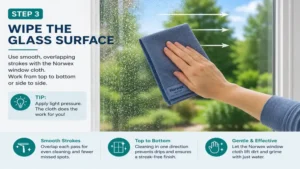
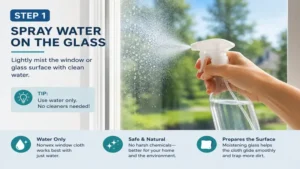
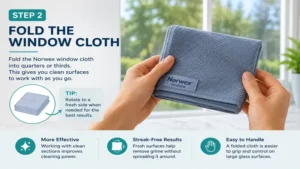
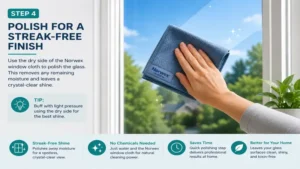
5 Rules for Flawless Glass: The Practical Usage Guide
To get the absolute most out of your investment, you must approach your cleaning with the right technique. Below is the step-by-step breakdown of how to prepare, clean, and maintain your surfaces for a flawless, streak-free shine.
Insider Pro-Tip: If you have exceptionally hard water, the minerals in your tap water can dry into faint, cloudy spots despite your best efforts. Simply fill your spray bottle with cheap distilled water instead. This guarantees a chemically pure, spot-free evaporation every single time.
🔍 Ready to Upgrade Your Cleaning Setup?
Using high-quality microfiber makes home maintenance remarkably fast and satisfying while cutting down on single-use plastics and paper waste.
Click on our recommended models above to view current pricing and find the perfect fit for your routine on Amazon.
The “Anti-Recommendation” Guide: When to Put the Cloth Away
As an expert who has used microfiber cloths for over a decade, I am the first to admit they are not magic wands for every scenario. There are several situations where using a Norwex Window Cloth is actually a bad idea.
-
Anti-Glare and Matte Screens: Never use a Norwex Window Cloth on anti-glare or matte-coated television screens, computer monitors, or high-end laptop displays. The tight, high-friction flat weave of the cloth is designed to grab and hold. On delicate chemical anti-glare coatings, this grabbing action can strip away the matte finish, leaving permanent, shiny bald spots on your expensive screens.
-
Heavy Exterior Mud or Sand: If your exterior windows are caked in thick, gritty mud or windblown sand after a storm, do not touch them with a dry or slightly damp Window Cloth. Microfiber is so effective at trapping particles that it will lock those abrasive sand grains directly against the glass, turning your premium cleaning cloth into sandpaper. Always hose down the glass or wash it with soapy water first to remove heavy grit before polishing.
-
Surfaces Saturated with Oil: If you are cleaning a greasy stove hood or a heavily splattered kitchen backsplash, using a dry polishing cloth will only smear the oil around, leaving a hazy mess that is incredibly difficult to buff out. For heavy oil, you must use a degreaser or a thoroughly soapy EnviroCloth first to break down the lipids before attempting a final polish.
Year-One Roadmap: Maintenance and Longevity
Premium microfiber is an investment, and like any quality tool, it requires proper care to deliver peak performance over its multi-year lifespan. Here is what to expect and do over your first year of ownership.
Month 1: The Break-In Period
- Expect the cloth to feel stiff and slightly non-absorbent during the first few uses.
- Wash it once before your first major cleaning session to open up the microfibers.

Month 6: Daily Use and Oil Buildup
- By now, body oils, skin cells, and trace mineral deposits will begin to accumulate.
- Performance tip: If you notice the cloth starting to drag or leave tiny lint trails, deep clean it.

Month 12: Deep Restorative Boil
- After a year of hard work, fibers can become clogged with lint and mineral scale.
- Restore performance by boiling the cloth in a pot of plain water for 10 minutes to swell and clear the fibers.
To prevent clogging the microscopic channels in the split fiber, never wash your microfiber with fabric softeners, dryer sheets, or bleach. Softeners coat the fibers in a waxy, water-repellent layer that destroys their cleaning and polishing capabilities, while bleach breaks down the delicate synthetic fibers, causing them to shed lint.
Comparing Microfiber Weaves: Why Weave Styles Matter
Understanding why different microfibers behave the way they do comes down to the physical engineering of the weave. The table below outlines how weave geometry dictates real-world cleaning performance.
| Weave Style | Visual Appearance | Friction Level | Dirt-Holding Capacity | Best Application |
| Flat Weave (Norwex Window) | Smooth, silk-like face | Very High | Medium-Low | Mirror and glass polishing |
| Terry Weave (EnviroCloth) | Fluffy, looped pile | Medium | Very High | Dusting and heavy dirt removal |
| Waffle Weave (E-Cloth Clean) | Pocketed, grid pattern | Low | High | Wet cleaning and drying |
| Twist-Loop (FTW Auto) | Spiral loops | Low-Medium | High | Automotive glass & road film |
As the table shows, a flat weave provides the maximum possible surface-area contact with the glass. This high friction level is exactly what allows it to grab microscopic grease and hard water film, leaving the surface optically clear. However, this same flat weave means it has a low capacity for heavy dirt, which is why a fluffy terry weave or pocketed waffle weave is required to do the heavy lifting beforehand.
Crucial Buyer Checklist: What to Look For
Before you purchase any glass cleaning microfiber, run through this mental checklist to ensure you are getting a genuine, high-performance tool rather than a glorified polyester rag:
-
Fiber Split Specification: High-quality cleaning microfiber should be split to at least 1/100th of a human hair. Premium brands like Norwex split their fibers to an astonishing 1/200th, providing unparalleled surface area contact.
-
Weave Suitability: Ensure the cloth is specifically designated as a “flat weave,” “polishing,” or “glass” cloth. Fluffy, multi-purpose terry towels will inevitably shed tiny lint particles on glass.
-
Weight (GSM): For glass polishing, a weight of 280 to 350 GSM (Grams per Square Meter) is the sweet spot. Anything thinner will saturate too quickly, while anything thicker becomes stiff and difficult to manipulate in corners.
-
Antibacterial Technology: If you plan on using your cloths daily without laundering them after every use, look for options with built-in silver ions (like BacLock) to prevent sour, musty odors.
FAQs
❓ Can I use vinegar or window spray with a Norwex Window Cloth?
✅ No, you should avoid chemicals entirely. Glass cleaners and vinegar leave behind chemical residues that clog the ultra-fine microfibers, causing the cloth to smudge and streak rather than polish…
❓ Why is my Norwex Window Cloth leaving faint streaks?
✅ Streaking is almost always caused by too much moisture on the cloth or the glass. Ensure the cloth is completely dry, fold it to a fresh section, and use a very light mist of water on the surface instead of soaking it…
❓ How often should I launder my Norwex glass cloths?
✅ Thanks to BacLock self-purifying technology, you only need to machine wash your cloth every 2 to 3 weeks under normal household use. Simply rinse and hang-dry it between uses…
❓ What laundry detergent is best for microfiber cloths?
✅ Use a clean-rinsing, fragrance-free liquid detergent like Norwex Laundry Detergent or any clear “free and clear” brand. Never use powder detergents, bleach, or fabric softeners, which clog the fiber channels…
❓ Can I dry my Norwex Window Cloth in the dryer?
✅ Yes, you can tumble dry it on low heat, but do not use dryer sheets. Be sure to dry it with low-lint items like sheets or other microfibers rather than fuzzy cotton towels, which will transfer lint…
Conclusion
Learning how to use norwex window cloth is the simplest way to reclaim your time, save money, and keep chemical residues out of your home. By pairing the mechanical cleaning action of high-density microfiber with a simple mist of water, you can enjoy sparkling, streak-free glass and polished surfaces with a fraction of the effort. Keep your cloths clean, mist sparingly, and fold for maximum efficiency to get professional-grade results every single time.
Recommended for You
- Clean Lenses Safely: 5 Golden Rules on How to Wash Eyeglass Cloth in 2026
- How to Wash Microfiber Cloth for Glasses: 5 Golden Rules for 2026
- How to Clean Microfiber Cloth for Glasses: 5 Pro Methods to Fix Smudges
Disclaimer: This article contains affiliate links. As an Amazon Associate, I earn from qualifying purchases. If you purchase products through these links, we may earn a small commission at no additional cost to you.
✨ Found this guide helpful? Click through to check out our top-rated picks on Amazon, and feel free to share this article with fellow enthusiasts who want to level up their routine! 💬🤗