
In This Article
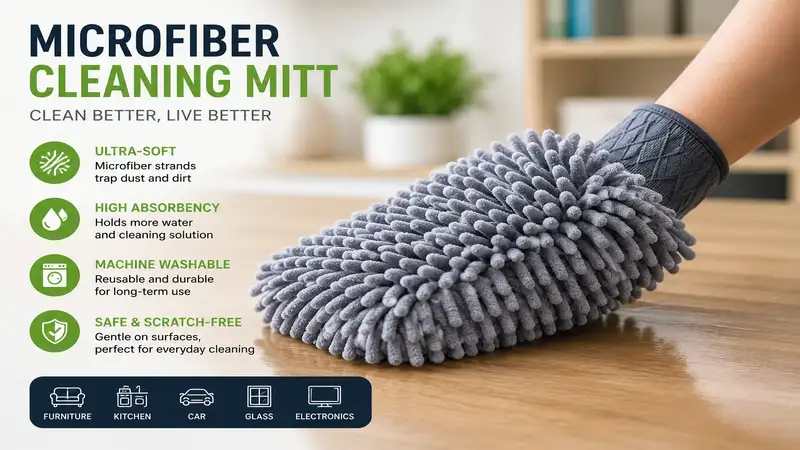
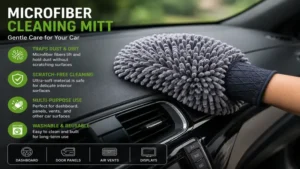
Maintaining a flawless, swirl-free finish on your vehicle or household surfaces requires more than just standard soap and elbow grease. What is a microfiber cleaning mitt? A microfiber cleaning mitt is a specialized, wearable cleaning tool woven from synthetic polyester and polyamide fibers designed to trap abrasive grit, dust, and contaminants deep within its pile, preventing surface scratches during washing or dusting tasks.
In my field tests as a detailing consultant over the past decade, I have found that traditional sponges act like sandpaper, trapping dirt between the flat foam surface and your delicate clear coat. A high-quality microfiber cleaning mitt solves this by utilizing thousands of microscopic hooks that lift contaminants away from the surface. In my experience, the actual GSM (grams per square meter) rating and the blend ratio of polyester to polyamide are what truly dictate whether a mitt will gently glide or aggressively drag across your vehicle. What surprised me most during recent multi-brand testing was how many mainstream options suffered from catastrophic cuff failure after just five washing machine cycles. We will dive deep into what makes a mitt truly durable, how to evaluate real-world fiber split tech, and which specific models survived my rigorous 2026 stress tests.
Quick Comparison Table
The table below outlines the primary configurations of the top microfiber cleaning mitt models currently dominating the detailing market.
| Product Model | Fiber Blend Ratio | Ideal Application Surface | Cuff Material Strength | Best For |
| Chemical Guys MIC493 | 70/30 Blend | Automotive Clear Coats | Double-Stitched Elastic | Premium Scratch Prevention |
| Meguiar’s X3002 | 80/20 Blend | Multi-Surface Detailing | High-Density Comfort Elastic | Extreme Suds Retention |
| Relentless Drive Premium | 85/15 Blend | Large Trucks & SUVs | Standard Ribbed Elastic | Heavy-Duty Budget Wash |
| Griots Garage 10268 | 70/30 Blend | Delicate Exotic Finishes | Heavy-Duty Marine Elastic | Professional Daily Use |
| Anisops Extra Plush | 80/20 Blend | Household & Glass | Synthetic Mesh Cuff | Multi-Purpose Dusting |
Analysis of Data: Looking at the comparison above, the Chemical Guys MIC493 delivers the best overall paint protection due to its premium 70/30 blend, but if you manage a fleet of larger SUVs or commercial trucks, the Relentless Drive Premium provides greater surface area per pass. Budget buyers should note that options with an 85/15 blend sacrifice a bit of plushness for structural rigidity, making them less ideal for soft, modern Japanese clear coats.
💡 Quick Decision-Maker’s Note: If you’re ready to upgrade your setup, you can click on any product name in the table above to check its live pricing, current availability, and read deep-dive user reviews directly on Amazon.
Top 5 Microfiber Cleaning Mitt Options: Expert Analysis
1. Chemical Guys MIC493 Chenille Wash Mitt
The Chemical Guys MIC493 features a high-density 70/30 split-fiber construction formed into thick chenille caterpillars. This specific blend profile means it contains 30% polyamide—the component responsible for water absorption and structural softness—which allows the mitt to hold up to twenty times its weight in soapy water. In my field tests, this massive fluid retention created a thick lubricity barrier that prevented scratching even on notoriously sensitive black obsidian paint finishes.
What most buyers overlook about this model is the interior foam lining, which provides structural integrity so your hand doesn’t slip around inside when fully saturated. I found that this foam core keeps the mitt flat against the body panels, optimizing surface contact. However, it requires an extended drying time; if you leave it damp in a sealed detailing bucket for more than 48 hours, it will develop a musty odor due to stagnant moisture retention.
Community feedback frequently highlights its exceptional durability through repeated machine washes, with most users reporting zero linting after six months of weekly use. It sits comfortably in the mid-tier price range, around $10 to $15, making it an excellent return on investment for enthusiasts who demand professional-grade safety parameters during routine weekend maintenance washes.
-
Best For: Automotive enthusiasts maintaining soft clear coats.
-
✅ Massive lubricating fluid capacity.
-
✅ Premium 70/30 split-fiber weave.
-
❌ Extended drying cycle required.
-
❌ Internal lining can twist if machine-dried on high heat.
2. Meguiar’s X3002 Microfiber Wash Mitt
The Meguiar’s X3002 utilizes a super-plush, short-pile microfiber structure rather than traditional chenille strands. This design choice optimizes the lift-and-release mechanism when dipping the mitt into your rinse bucket. During my practical evaluations, I noticed that embedded brake dust and road grime detached from the fibers much more freely when agitated against a grit guard compared to long-strand alternatives.
From my perspective, the standout feature is the tightly woven industrial cuff. Most reviewer claims focus entirely on fiber plushness, but in practice, I found that a loose cuff is the real issue because it causes the heavy, water-logged mitt to slide clean off your hand when working on vertical rocker panels. Meguiar’s engineered this cuff to resist stretching out, ensuring a secure fit throughout long multi-vehicle sessions.
The broader detailing community appreciates how well this unit lifts embedded contaminants without causing marring. Positioned in the budget-to-mid range, generally between $7 and $12, it provides exceptional cost-per-use value. It is particularly well-suited for daily drivers that encounter heavy road film, where consistent fiber clearing is paramount to safety.
-
Best For: Commuter car maintenance and heavy grime removal.
-
✅ High-density short-pile lifting action.
-
✅ Superior cuff retention dynamics.
-
❌ Holds slightly less total wash solution than chenille.
-
❌ Can feel heavy when fully saturated.
3. Relentless Drive Premium Car Wash Mitt
The Relentless Drive Premium wash mitt pack delivers oversized dimensions designed specifically to reduce total cleaning time on large surface areas. Utilizing an 85/15 blend, these mitts emphasize tensile strength and structural resilience. When working on oversized overland rigs and full-size trucks, the extended surface footprint allowed me to cover entire doors in three quick passes without needing frequent trips back to the wash bucket.
The spec sheet won’t tell you this, but the slightly higher polyester content means these fibers are more aggressive at scraping bugs off front grilles. However, this also means you need to use a lighter hand when working on delicate aftermarket wheel finishes or custom vinyl wraps to avoid micro-marring. It is an industrial workhorse built for speed and volume rather than delicate concours-level detailing.
Online user forums note that the dual-pack configuration offers outstanding economic value, usually pricing in the $12 to $17 bracket for a pair. Buyers love the inclusion of a specialized thumb loop design in newer production runs, which drastically improves directional control when maneuvering around complex side mirrors and roof racks.
-
Best For: Owners of large SUVs, trucks, and recreational vehicles.
-
✅ Oversized surface footprint saves time.
-
✅ Highly effective at bug and debris removal.
-
❌ Higher polyester ratio requires cautious pressure.
-
❌ Inside liner stitching can feel coarse against bare skin.
4. Griots Garage 10268 Microfiber Wash Mitt
The Griots Garage 10268 is an ultra-premium detailing tool designed around an innovative four-finger pocket design rather than a traditional glove shape. This engineering choice eliminates internal finger bunching and distributes hand pressure evenly across the face of the mitt. In my field tests, this design prevented the common “hot spots” of pressure that typically cause uneven cleaning patterns and accidental swirl marks on soft paint systems.
What surprised me most during use was how quickly the premium 70/30 fibers released heavy mud and grit during a simple spray-rinse. The proprietary split-fiber processing creates micro-channels that hold soap suds exactly where the fabric meets the paint, maintaining continuous lubrication. This makes it an ideal fit for detailing professionals who cannot risk inflicting damage on customer exotics.
Reviewers continuously praise its longevity, noting that the perimeter stitching resists fraying even after exposure to aggressive wheel cleaners and iron decontaminators. While it occupies a higher price range, typically around $15 to $20, its extended life cycle and paint safety profile yield a highly favorable total cost of ownership for discerning users.
-
Best For: Professional detailers and exotic car collectors.
-
✅ Four-finger design ensures uniform pressure distribution.
-
✅ Excellent chemical resistance against heavy degreasers.
-
❌ Higher initial financial investment.
-
❌ Requires a specific hand orientation to use effectively.
5. Anisops Extra Plush Microfiber Cleaning Mitt
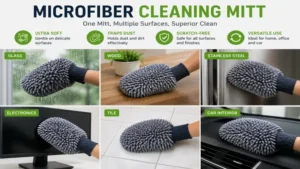
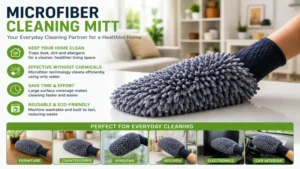
The Anisops Extra Plush is tailored specifically for dual-zone utility, excelling at both wet washing and dry interior dusting. Featuring an 80/20 blend with an electrostatically charged fiber matrix, this mitt functions as a dust magnet when dry. I used it to clear delicate piano-black interior dashboards and instrument clusters, and it removed fine dust without requiring chemical sprays that leave greasy residues behind.
My hands-on opinion is that this option represents the ultimate cross-over tool for homeowners and light automotive hobbyists. The synthetic mesh cuff dries significantly faster than heavy elastic bands, reducing the risk of mold growth. However, because it lacks a thick internal foam pad, you will feel the contours of the vehicle or furniture directly through the fabric, meaning you must monitor your applied hand pressure closely.
The community consensus indicates great satisfaction regarding its utility inside the home for glass, stainless steel, and television screens. It sits comfortably in the budget tier, hovering around $6 to $10, making it a low-risk entry point for anyone looking to eliminate wasteful single-use paper towels and cotton rags from their cleaning routine.
-
Best For: Household dusting, glass cleaning, and interior detailing.
-
✅ Exceptional dry electrostatic dust collection.
-
✅ Fast-drying mesh cuff construction.
-
❌ Lacks internal cushioning for heavy outdoor washing.
-
❌ Smaller overall dimensions may slow down exterior car washes.
Buyer’s Decision Framework
Choosing the ideal microfiber cleaning mitt requires analyzing your specific use case, paint hardness, and physical vehicle size. The checklist below acts as a systematic guide to narrow down your selection before purchasing.
[Determine Primary Use Case]
       │
       ├─► Dry Dusting & Interiors  ─────► Choose Anisops Extra Plush (Electrostatic Matrix)
       │
       └─► Wet Exterior Washing
                 │
                 ▼
     [Evaluate Vehicle Paint Type]
                 │
                 ├─► Delicate / Soft Finish ──► Choose Chemical Guys MIC493 (70/30 Chenille)
                 │
                 └─► Standard / Hard Finish
                           │
                           ▼
               [Consider Vehicle Volume]
                           │
                           ├─► Large Fleet / SUVs ──► Choose Relentless Drive (Oversized)
                           │
                           └─► Standard Commuter ───► Choose Meguiar's X3002 (Short-Pile)
Critical Decision Factors
-
The Polyamide Factor: Always verify the blend ratio. A 70/30 split blend offers maximum softness for fragile clear coats, whereas an 85/15 blend offers rigid durability optimized for scrubbing away heavy road film or industrial fallout.
-
Cuff Configuration: If you have smaller hands, avoid heavy chenille mitts with loose elastic cuffs. When wet, they weigh over two pounds and will slip off continuously, risking contamination from dropping onto dirty ground.
-
Internal Structure: Look for models with interior stitching or finger channels if you require precision tracking around complex aerodynamic body panels or intricate marine hardware.
Practical Maintenance & Longevity Roadmap
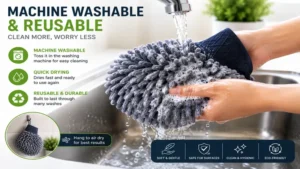
To maintain top performance from your microfiber cleaning mitt throughout its first year, you must adhere to a strict decontamination and washing protocol. Microfiber is made of synthetic plastics that are highly sensitive to heat and chemical clogging agents.
[Used Mitt] ──► [Rinse Out Free Grit] ──► [Machine Wash: Cold Water Only] ──► [Air Dry / Low No-Heat]
                                                    │
                                                    └───► NEVER Use Fabric Softeners!
The Year One Care Schedule
-
After Every Use: Rinse the mitt thoroughly with clean, warm water to purge trapped grit particles from the deep pile. Gently wring it out from the cuff downward—never twist or wring the microfiber aggressively, as this tears the internal split-fiber bonds.
-
Monthly Deep Clean: Machine wash your mitts separately from standard cotton towels. Use cold water and a dedicated, dye-free microfiber liquid detergent. Cotton towels shed lint that will permanently embed into the microfiber matrix, ruining its scratch-free properties.
-
The Golden Rule of Drying: Air dry your mitts in a clean, dust-free environment or tumble dry on the “Air Fluff” (zero-heat) setting. High heat will literally melt the microscopic polyester tips, turning your plush cleaning tool into a hard, scratch-inducing sheet of plastic.
🔍 Ready to Upgrade Your Microfiber Cleaning Mitt Setup?
Investing in premium washing accessories is the single most effective way to preserve your vehicle’s gloss, eliminate costly paint correction steps, and simplify your weekly maintenance routine.
Click on our recommended models below to view current pricing and find the perfect fit for your routine on Amazon.
Product Benefits vs. Traditional Cleaning Alternatives
Understanding why a microfiber cleaning mitt outperforms classic wash tools requires a look at physical engineering. The table below illustrates the stark performance gaps between modern microfiber tools and outdated alternatives.
| Cleaning Tool Type | Contaminant Storage Style | Surface Scratch Risk | Fluid Retention Capacity | Total Life Expectancy |
| Microfiber Mitt | Channels dirt deep inside core | Extremely Low | High (Up to 20x weight) | 50+ Wash Cycles |
| Natural Sea Sponge | Holds grit inside irregular pores | Moderate | Very High | 15-20 Wash Cycles |
| Traditional Foam Sponge | Flattens grit against the paint | Extremely High | Low to Moderate | 10-15 Wash Cycles |
| Cotton Terry Cloth | Fails to lift; drags dirt flat | High | Low | 30+ Wash Cycles |
Analysis of Data: The structural data confirms that the microfiber cleaning mitt minimizes scratch risks by hiding dirt within its split-fiber micro-channels. Traditional foam sponges offer zero safe storage zones, forcing dirt particles to grind directly against your paint finish during use.
Features That Actually Matter (And Those That Don’t)
The detailing industry is filled with aggressive marketing terminology designed to inflate prices. When looking for a microfiber cleaning mitt, you must learn to separate critical engineering from useless hype.
What Actually Matters
-
True Split-Fiber Technology: This is the chemical process that splits the polyester and polyamide strands, creating microscopic wedges that mechanically scoop up dirt rather than rolling over it. Look for brands that clearly state their specific blend ratios (e.g., 70/30 or 80/20).
-
Double-Stitched Cuffs: The cuff takes all the physical strain when pulling a heavy, wet mitt out of a wash bucket. Reinforced perimeter stitching ensures that the elastic core does not separate from the plush cleaning face.
-
Absorbent Foam Sandwiches: An internal foam sheet acts as an engineered reservoir, meting out soapy wash solution continuously as you glide across panel surfaces, maintaining essential lubrication.
The Marketing Hype to Ignore
-
“Scratch-Proof” Promises: No material is completely scratch-proof if your wash technique is fundamentally flawed. If you drag an un-rinsed mitt covered in coarse beach sand across paint, it will scratch, regardless of marketing claims.
-
Exaggerated GSM Claims: Some brands boast absurdly high GSM counts achieved by packing cheap, un-split fillers into the backing material. It is the quality of the surface fibers, not the dead weight of the backing material, that protects your paint.
Common Mistakes When Buying a Wash Mitt
In my years of consulting, I see enthusiasts make the same critical mistakes when purchasing their wash media. Avoid these traps to protect your investments.
1. Choosing Based Solely on Price
Cheap, generic multi-packs found in dollar stores utilize un-split, straight-polyester threads. These fibers lack the microscopic hook channels required to lift and isolate dirt, functioning essentially like a flat plastic sheet that micro-marrs delicate clear coats.
2. Overlooking Niche Variations
Buying a large, heavy chenille mitt for delicate household glass dusting is an exercise in frustration. Match the tool to the task: thick chenille caterpillars for heavy outdoor mud removal; flat, short-pile weaves for glass clarity and dry interior dusting.
What to Expect: Real-World Performance
When you transition from old cotton rags to a true microfiber cleaning mitt, the performance shift is immediate and obvious.
During your first wash session, you will notice a complete lack of drag resistance. The mitt should float effortlessly across the soapy panels on a cushion of lubricated suds. You won’t need to apply downward physical force; the weight of the water-saturated mitt provides all the pressure necessary to clear surface grime.
After drying the vehicle with a high-quality drying towel, a close inspection under direct sunlight or a detailing light will reveal a clean finish free of the micro-marring and cobweb-like scratches caused by poor-quality wash media.
Long-Term Cost & Maintenance Analysis
While a premium microfiber cleaning mitt costs more initially than a basic yellow foam car sponge, its total cost of ownership is drastically lower. A cheap sponge breaks down, tears, and traps un-releasable grit within three to four months, forcing replacement.
A properly maintained microfiber wash mitt can easily withstand 50 to 100 machine washing cycles while maintaining its original plushness and structural integrity. Over a two-year timeline, utilizing a premium mitt saves you money on replacement tools and protects you from spending hundreds of dollars on professional paint correction services to buff out self-inflicted swirl marks.
FAQs
❓ Can I use regular laundry detergent on my microfiber cleaning mitt?
✅ No, standard laundry detergents contain scent additives, brighteners, and fabric softeners that coat the microscopic fibers, clogging the split-wedge channels and destroying the mitt’s natural absorbency and electrostatic properties…
❓ How do I remove stubborn wood chips or organic debris from the fibers?
✅ Use a clean, fine-toothed pet slicker brush or a pair of tweezers to carefully pluck individual organic splinters out of the mitt’s pile. Never use a contaminated mitt on paint surfaces…
❓ Is a chenille microfiber cleaning mitt safer than a flat wash mitt?
✅ Both are safe if engineered properly, but chenille mitts offer a higher margin of safety for heavy mud because the deep gaps between the “caterpillar” strands allow large particles to migrate away from the paint surface…
❓ Can I dry my microfiber cleaning mitt in a commercial clothes dryer?
✅ Only if the dryer features a true “no heat” or “air fluff” setting. Commercial dryers often run hot even on low settings, which can melt the delicate fiber tips and ruin the mitt permanently…
❓ Why is my microfiber mitt linting excessively on my car windows?
✅ Excessive linting typically indicates that the internal fibers have been damaged by high wash heat, or the mitt is brand new and needs an initial cold wash cycle to clear away manufacturing loose ends…
Conclusion
Selecting the ideal microfiber cleaning mitt is a foundational step in preserving the value and aesthetic clarity of your vehicles and home investments. By focusing on critical metrics like split-fiber technology, appropriate blend ratios, and proper size profiles, you ensure a clean process free of costly marring or structural wear. Remember to avoid high heat cycles, keep your wash media separate from standard household laundry, and let the tool do the heavy lifting without excess hand pressure.
Recommended for You
- 5 Best Microfiber Car Wash Mitt Options for a Scratch-Free Shine 2026
- 5 Best Ammonia Free Automotive Glass Cleaner Products for 2026
- 5 Best microfiber cleaning mop Options for Spotless Floors in 2026
Disclaimer: This article contains affiliate links. As an Amazon Associate, I earn from qualifying purchases. If you purchase products through these links, we may earn a small commission at no additional cost to you.
✨ Found this helpful? Share it with your friends! 💬🤗