In This Article
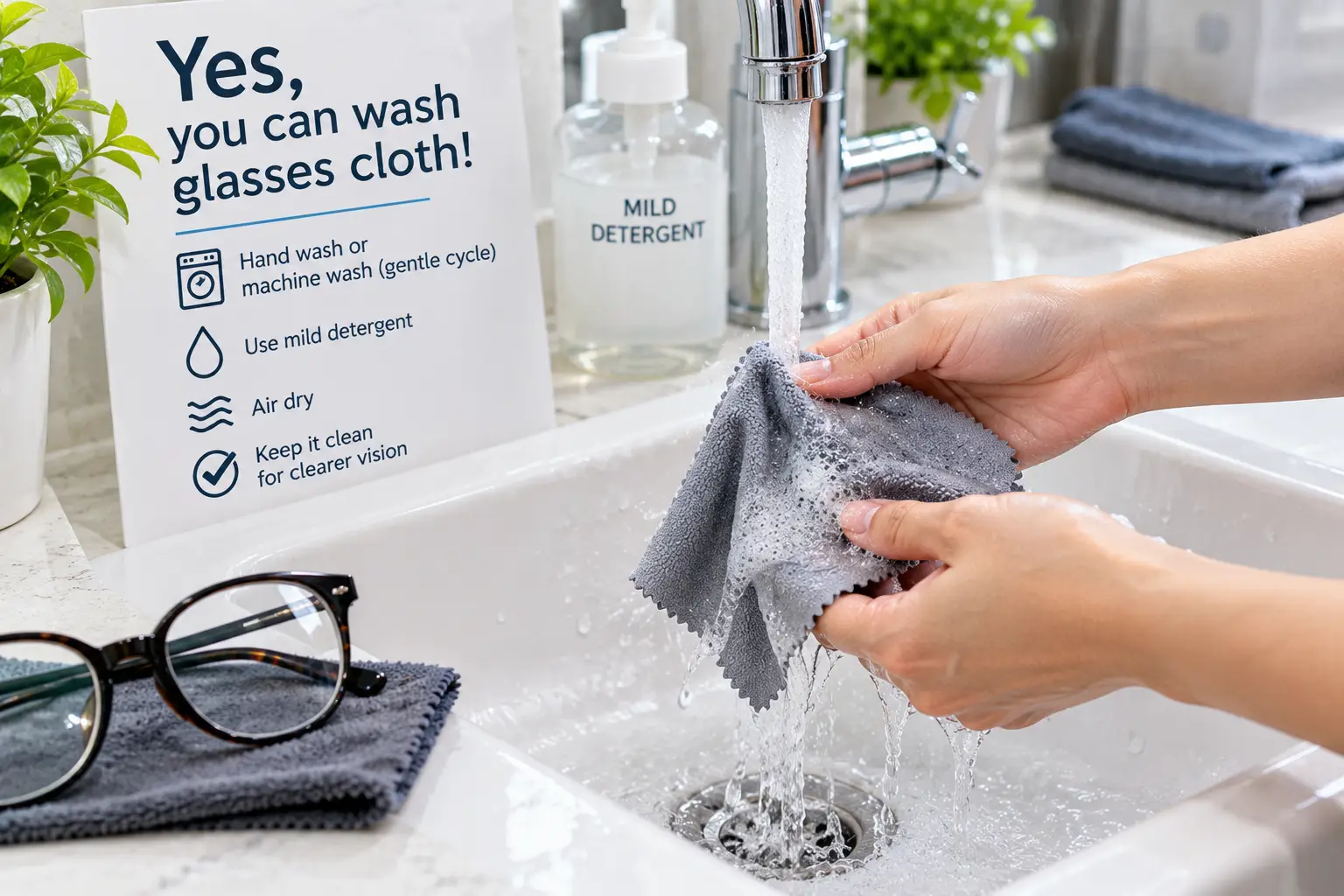
Can you wash glasses cloth? Yes — in fact, you should. A microfiber lens cloth is designed to trap oil, dust, and skin residue, and once it’s saturated, it stops cleaning your lenses and starts smearing them around instead. Washing it regularly (by hand or, with most brands, in the machine) restores its grip on grime without damaging the delicate weave. That said, how you wash it matters just as much as whether you wash it — the wrong detergent or a hot dryer cycle can flatten the microfibers and quietly ruin a cloth that still looks fine.
This guide walks through the full picture: the safest way to wash a glasses cloth, how often to do it, which mistakes wreck cloths early, and — since not every cloth is built the same — seven real, currently available options worth having in rotation. Some are built for anti-reflective (AR) coatings specifically, some are bulk value packs for households with multiple wearers, and a couple are designed to survive a backpack, a gym bag, or a glovebox. By the end, you’ll know exactly which cloth fits your routine and how to keep it performing for years instead of months.
Quick Comparison: Best Glasses Cleaning Cloths at a Glance
| Product | Pack Size | Best For | Machine Washable | Price Range |
|---|---|---|---|---|
| ZEISS Microfiber Lens Cleaning Cloth (Jumbo/XL) | 2 cloths | AR-coated lenses | Yes | $10–$15 |
| Crizal Microfiber Eyeglass Cleaning Cloth | 4 cloths | Premium coated lenses | Yes | $15–$20 |
| MagicFiber Microfiber Cleaning Cloth | 6 cloths | All-around daily use | Yes | $9–$13 |
| Koala Kloth Jumbo XL Cloth | 3 cloths | Large-lens glasses & multiple devices | Yes | $12–$18 |
Looking at this shortlist, the split comes down to lens coating versus budget. If your glasses have anti-reflective or blue-light coatings, the ZEISS and Crizal cloths are engineered specifically around those surfaces, while the MagicFiber and Koala Kloth options are more general-purpose and stretch further across a household with mixed eyewear, screens, and camera gear. Coverage of all seven picks — including two genuinely budget-friendly bulk packs — follows below.
💬 Found a cloth you like here? One click to check current pricing helps you compare options fast — no commitment needed. 😊
Top 7 Microfiber Cleaning Cloths for Glasses
1. ZEISS Microfiber Lens Cleaning Cloth (Jumbo/XL, 2-Pack) — best for AR-coated lenses
Built by one of the biggest names in optics, this jumbo-size cloth is the safe default when you’re not sure what your lenses can handle. The extra-large format (roughly 12 x 16 inches, depending on the listing) means you’re not constantly hunting for a clean corner mid-wipe, which matters more than it sounds once a cloth has picked up a few days of oil. ZEISS markets this as safe for anti-reflective, blue-light, and standard coated lenses, and the company’s own lens-care guidance backs up using a dry or lightly dampened microfiber cloth as the everyday standard for coated glass. What most buyers overlook is that size directly affects cleaning quality — a bigger cloth gives you more dry surface area per wipe, so you’re less likely to drag the same smudged patch back across the lens. Reviews and retailer listings for this cloth consistently describe it as soft, durable through repeated washing, and a trusted travel-ready option, which tracks with ZEISS’s own instructions to machine wash it occasionally without fabric softener.
Pros:
- ✅ Jumbo size covers large lenses in fewer passes
- ✅ Backed by ZEISS’s own coated-lens engineering
- ✅ Machine washable without losing effectiveness
Cons:
- ❌ Only two cloths per pack limits backup coverage
- ❌ Premium branding pushes the price above generic packs
At around $10 to $15 for the pack, the value here is really in trust: you’re paying a bit more for a brand that designs specifically around coated optical lenses. For anyone with a recent AR-coated prescription, that’s a reasonable trade.
2. Crizal Microfiber Eyeglass Cleaning Cloth (4-Pack) — best for advanced lens coatings
Crizal cloths exist for one specific reason: Crizal is also a major manufacturer of anti-reflective lens coatings, so this cloth is designed and tested against the exact surfaces it’s meant to clean. The honeycomb-style weave is built to lift fingerprints and facial oils without a cleaning spray, which is genuinely useful for quick touch-ups at a desk or in a car. In practice, that means less risk of streaking on premium coated lenses compared with a generic cloth that wasn’t tested against that surface type. This is the pick for anyone who paid extra for anti-glare or anti-smudge coatings and wants a cloth that won’t undo that investment — a detail beginners with their first pair of coated glasses often don’t think about until the coating starts looking hazy. Independent gear roundups covering eyeglass cloths have specifically called out the value of getting four cloths in one pack, and note the honeycomb design’s grip on dirt particles as a standout feature versus flatter-weave alternatives.
Pros:
- ✅ Developed and tested by a leading coating manufacturer
- ✅ Honeycomb weave grips dirt more effectively
- ✅ Four cloths per pack for easy rotation
Cons:
- ❌ Independent reviewers note it can struggle on heavily greasy lenses without a spray
- ❌ Slightly pricier per cloth than bulk generic packs
Priced around $15 to $20 for four cloths, the Crizal cloth earns its premium if your lenses carry the coating it’s built for; otherwise, the difference over a general-purpose cloth is smaller than the price tag implies.
3. MagicFiber Microfiber Cleaning Cloth (6-Pack) — best all-around versatile pick
This is the cloth most people should default to if they don’t have a specific coating concern. MagicFiber individually packages each cloth in its own polybag, which sounds minor until you realize that’s what keeps a spare cloth in your bag from picking up lint and grit before you’ve even used it once. The material itself is a tightly woven microfiber rated for glasses, phone screens, camera lenses, and watch faces, so one pack covers essentially every glass or plastic surface in a household. What the spec sheet doesn’t say, but aggregated reviews consistently mention, is that the cloth handles daily fingerprints and light smudging well but starts to lose effectiveness on heavily greasy lenses — at that point, reviewers note, pairing it with a lens spray or a quick soap-and-water rinse first gets noticeably better results than the cloth alone.
Pros:
- ✅ Individually wrapped cloths stay cleaner in transit
- ✅ Works across glasses, screens, cameras, and watches
- ✅ Six-pack means a spare in every bag
Cons:
- ❌ Reviewers report reduced performance on heavy grease without a spray
- ❌ No specialized coating formulation like Crizal or ZEISS
At roughly $9 to $13 for six cloths, this is one of the strongest value-per-cloth ratios on this list, and it’s the pick most reviewers point to as the reliable, no-frills option.
4. Koala Kloth Jumbo XL Microfiber Cleaning Cloth (3-Pack) — best for large lenses and multi-device households
Koala Kloth leans on a densely woven microfiber construction and a noticeably larger format than most competitors, which is the main selling point here. For anyone with oversized or wraparound frames — a growing category as bigger lens shapes have trended back into fashion — a standard 6×6-inch cloth just doesn’t cover the surface in one pass, and this jumbo format solves that directly. Independent reviewers testing multiple eyewear cloths have specifically singled out Koala Kloth’s density and its ability to tackle stubborn smudges that thinner cloths tend to leave behind, describing consistent performance across repeated washes without the fabric going stiff or scratchy. It’s marketed for glasses, camera lenses, and VR/AR headset lenses too, so if your household has a mix of eyewear and larger optical gear, one pack of three does a lot of work.
Pros:
- ✅ Jumbo size suited to oversized or wraparound frames
- ✅ Dense weave rated effective on stubborn oil and smudges
- ✅ Holds up well through repeated washing, per reviewer feedback
Cons:
- ❌ Only three cloths per pack for the price point
- ❌ Larger size is less pocket-friendly for quick errands
Expect to pay somewhere in the $12 to $18 range, which lands mid-pack — reasonable given the larger cloth size, but worth comparing against six-packs if raw cloth count matters more to you than surface area.
5. K&F Concept Microfiber Cleaning Cloths (6-Pack) — best budget multi-purpose pack
K&F Concept built its reputation in camera gear, and that photography-grade pedigree shows up here: these cloths are engineered to be safe on lens filters and coatings, which is a higher bar than most glasses-only cloths are held to. Each cloth ships vacuum-sealed in its own bag with a laser-fused, jagged edge specifically designed to resist fraying and shedding fibers — a small detail that matters because loose threads are one of the more common causes of lens scratches over time. The line covers glasses, phone screens, tablets, and camera equipment, so it’s a genuinely practical grab for anyone juggling several types of optics in one household. Listings and buyer feedback consistently describe the cloths as lint-free and gentle enough for daily use, with no reports of streaking on treated lens surfaces when used dry.
Pros:
- ✅ Camera-grade construction rated safe for coated lenses
- ✅ Fused edges resist fraying and fiber shedding
- ✅ Individually sealed for cleanliness before first use
Cons:
- ❌ Standard 6×6-inch size is small for oversized frames
- ❌ Six cloths go quickly in a multi-person household
At around $8 to $12 for six cloths, this is one of the most budget-friendly options on the list without cutting the corners that matter for coated lenses — a smart pick for anyone who wants photography-grade quality without the photography-gear price.
6. Ablethe 18-Pack Premium Microfiber Cleaning Cloths — best bulk value pack
If you lose cloths constantly, leave one in every bag, coat pocket, and desk drawer, or you’re stocking a household with several glasses wearers, this is the pack built for that reality. Eighteen cloths at roughly 6×7 inches each means you can treat individual cloths as semi-disposable — using one at the office, one in the car, one in a gym bag — without worrying about running out. The tightly woven microfiber is rated to avoid scratches, streaks, and lint, and the sawtooth-fused edges are specifically designed to prevent fraying, a common failure point on cheaper bulk cloths. It’s also positioned for broader use beyond glasses — camera lenses, phone screens, and TVs — so the value extends past eyewear alone. The honest tradeoff: at this price point, individual cloths tend to be thinner than premium single-purpose options, so they’re better suited to frequent replacement than long-term daily heavy use.
Pros:
- ✅ Eighteen cloths cover every bag, room, and vehicle
- ✅ Fused edges reduce fraying versus typical bulk cloths
- ✅ Doubles as a screen and camera-lens cloth
Cons:
- ❌ Thinner material than premium single-purpose cloths
- ❌ Best suited to frequent rotation, not one long-term cloth
Priced under $15 for the full pack, the Ablethe set has the lowest cost per cloth on this list by a wide margin, making it the practical pick for households, offices, or anyone tired of losing their only cloth.
7. Carson Stuff-It Microfiber Lens Cloth Cleaning System — best for on-the-go protection
The Carson Stuff-It solves a problem the other six cloths on this list don’t: keeping a cloth clean between uses. It’s a 6.25 x 6.25-inch microfiber cloth housed inside a protective neoprene pouch with a built-in carabiner clip, so it can hang off a backpack, belt loop, or keychain without the cloth itself ever touching a dirty pocket or bag interior. To use it, you simply pull the cloth out and stuff it back in when finished — no separate case to misplace, no loose cloth picking up lint from your bag. Carson has built optics accessories for over three decades, and that experience shows in small functional details, like the drawstring connection that keeps the cloth from ever fully detaching from its pouch. For commuters, hikers, or anyone who takes glasses on and off constantly throughout the day, this design solves the single biggest reason cloths stop working well: they get dirty from where they’re stored, not from what they clean.
Pros:
- ✅ Neoprene pouch keeps the cloth clean between uses
- ✅ Carabiner clip attaches to bags, belts, or keys
- ✅ Compact, single-cloth design built for daily carry
Cons:
- ❌ One cloth per unit, so replacements mean buying again
- ❌ Smaller cloth size than jumbo XL alternatives
At roughly $8 to $12 per unit, it’s priced close to a single premium cloth — but you’re really paying for the storage system, which is what keeps that cloth effective for longer than a loose one tossed in a bag.
Looking across all seven, the ZEISS and Crizal cloths make the most sense if you paid for anti-reflective or blue-light coatings, the MagicFiber, Koala Kloth, and K&F Concept picks cover general daily use at different price and size points, and the Ablethe and Carson Stuff-It options solve two very different logistics problems — one through sheer volume, the other through built-in protection. None of these is universally “best”; the right pick depends on your lens coating, how many cloths you actually keep track of, and whether the cloth needs to survive a backpack.
Full Product Comparison: Features, Price, and Best Use
| Product | Cloth Size | Coating-Safe | Notable Extra | Price Range | Best For |
|---|---|---|---|---|---|
| ZEISS Microfiber Lens Cleaning Cloth | ~12″ x 16″ | Yes (AR-specific) | Brand-tested on coated optics | $10–$15 | AR-coated lenses |
| Crizal Microfiber Eyeglass Cleaning Cloth | Standard | Yes (coating-specific) | Honeycomb dirt-grip weave | $15–$20 | Advanced coatings |
| MagicFiber Microfiber Cleaning Cloth | Standard | General | Individually polybagged | $9–$13 | Everyday multi-device use |
| Koala Kloth Jumbo XL Cloth | Jumbo/XL | General | Dense weave, large surface | $12–$18 | Oversized frames |
| K&F Concept Microfiber Cloths | 6″ x 6″ | Yes (camera-grade) | Fused, fray-resistant edges | $8–$12 | Budget coating-safe use |
| Ablethe 18-Pack Cloths | 6″ x 7″ | General | Bulk 18-cloth value | Under $15 | Households, offices |
| Carson Stuff-It System | 6.25″ x 6.25″ | General | Built-in protective pouch | $8–$12 | Daily carry / commuters |
The table above makes the coating question the real dividing line: the ZEISS, Crizal, and K&F Concept cloths are explicitly built or tested around coated lenses, while the MagicFiber, Koala Kloth, Ablethe, and Carson Stuff-It picks are general-purpose but still gentle enough for most everyday eyewear. If cost-per-cloth is your deciding factor, the Ablethe pack wins outright; if protection between uses matters more than raw count, the Carson Stuff-It system is the only one built specifically for that.
✨ Don’t miss the details above! 🔍 Compare current pricing on the pick that fits your lenses, and check availability before it changes.
How to Wash a Glasses Cloth the Right Way (Step-by-Step)
Washing a microfiber glasses cloth is simple, but the details separate a cloth that lasts years from one that stops working after a month.
- Shake off loose dust first. A quick shake removes grit that could otherwise grind into the fibers during washing and dull the weave.
- Hand wash in warm water with a drop of mild, lotion-free dish soap. This is the method most eye care sources point to — for a full breakdown of gentle lens and cloth cleaning, Healthline’s guide to cleaning glasses lays out the safest warm-water-and-soap routine step by step.
- Rub gently, then rinse thoroughly. Any leftover soap residue on a “clean” cloth will just get smeared back onto your lenses next time you use it.
- Air dry flat or hang it up. Skip the dryer’s heat setting if you can — high heat can melt or fuse the ultra-fine synthetic fibers that make microfiber effective in the first place.
- If the label allows machine washing, use cold or warm water, no fabric softener, and skip the dryer — ZEISS’s own care instructions for its cloths explicitly warn against washing above 104°F and against fabric softener, since both leave residues that cause streaking on the next use.
Most brands on this list — MagicFiber, Koala Kloth, K&F Concept, ZEISS, Ablethe, and Crizal — confirm their cloths are machine washable, but nearly all of them specify no fabric softener and a gentle, low-heat cycle. Softener coats the fibers in a waxy residue that kills their static charge and grip on dust, which is the entire reason microfiber works in the first place.
Can You Machine Wash a Glasses Cleaning Cloth?
For most microfiber cloths, yes — but with real caveats worth taking seriously. Machine washing is fine as a periodic deep clean, especially for a bulk pack like the Ablethe set where you’re cycling through many cloths at once. The risk isn’t the washing machine itself; it’s what goes in with it. Mixing microfiber cloths with cotton towels or lint-heavy fabrics in the same load transfers lint onto the microfiber, and once that happens, the cloth picks up that lint and smears it right back onto your lenses. The safer approach is a dedicated small load — just microfiber items together — on a gentle, cold-to-warm cycle, followed by air drying rather than tumble drying on high heat.
If a specific cloth’s packaging says “hand wash only,” that’s usually about fiber density rather than fragility — a very high-density weave (like the ones K&F Concept and Koala Kloth use) can mat down under a machine’s agitation in a way a hand wash won’t. When in doubt, hand washing is the universally safe choice across every product on this list.
Real-World Scenarios: Matching Cloth and Routine to Your Life
The commuter who wears glasses all day. Someone who’s constantly taking glasses on and off for meetings, masks, or a phone call needs a cloth that doesn’t pick up pocket lint between uses. The Carson Stuff-It system’s built-in pouch is designed exactly for this — clipped to a bag, it stays cleaner between washes than a loose cloth ever will, which also means less frequent washing overall.
The multi-person household with mixed eyewear. A family with two or three pairs of glasses in rotation, plus phone screens and maybe a laptop, burns through cloths fast. The Ablethe 18-pack or MagicFiber 6-pack both make sense here because losing or misplacing one cloth doesn’t leave anyone without a clean option, and both are inexpensive enough to replace as they wear out.
The recent AR-coating buyer. Anyone who just paid extra for anti-reflective or blue-light coating on a new prescription should default to the ZEISS or Crizal cloth, both of which are built and tested specifically against those surfaces. Using an unrated generic cloth isn’t necessarily harmful, but it removes the safety margin that a coating-specific cloth provides.
How Often Should You Wash Your Glasses Cloth?
As a baseline, plan to hand wash a daily-use glasses cloth roughly once a week — more often if you wear makeup, sunscreen, or work in a dusty or oily environment, since those substances saturate the fibers faster than ordinary skin oil. A cloth that’s overdue for a wash tends to show it clearly: instead of lifting smudges, it starts pushing them around in a thin film, or the lens looks slightly hazy even right after wiping. That visible smearing is the clearest sign it’s time to wash, regardless of how many days have actually passed. If you’re using one of the bulk packs, like the Ablethe set, an easier system is simply rotating in a fresh cloth every few days and washing a batch all at once weekly, rather than tracking one cloth’s schedule individually.
How to Choose the Best Glasses Cleaning Cloth
- Check your lens coating first. If your lenses are anti-reflective, blue-light, or photochromic, prioritize a cloth built or tested for that — the ZEISS, Crizal, and K&F Concept options all qualify.
- Match the cloth size to your frame size. Oversized or wraparound frames clean faster with a jumbo cloth like the Koala Kloth, while standard frames do fine with a 6×6-inch square.
- Decide between bulk and premium. If cloths tend to disappear in your house, buy in volume with something like the Ablethe 18-pack instead of paying premium prices per cloth.
- Consider how the cloth is stored. A cloth that lives loose in a bag gets dirty fast; a protected option like the Carson Stuff-It stays effective longer between washes.
- Confirm wash instructions before buying. Machine-washable cloths are more convenient for households already doing regular laundry; hand-wash-only cloths need a bit more discipline but often use denser weaves.
- Look for fused or sealed edges. Fraying edges shed fibers, and those loose threads are a real (if minor) scratch risk over time — most of the picks here, including K&F Concept and Ablethe, specifically engineer against this.
- Buy more than one. Even the best single cloth needs a backup for wash days — a lesson every commuter learns the first time they forget to grab a clean one.
Common Mistakes to Avoid With Your Glasses Cloth
Using an overdue, oil-saturated cloth is the single most common mistake — it doesn’t clean, it just redistributes grime evenly across the lens, which can trick people into thinking their eyes have gotten worse when it’s actually just a dirty cloth. A close second is machine drying on high heat, which can fuse the ultra-fine fibers together and permanently reduce the cloth’s ability to trap dust through static attraction. Washing microfiber alongside cotton towels is another quiet cloth-killer, since lint transfers onto the microfiber weave and ends up right back on your lenses. Storing a cloth loose in a pocket or bag — rather than in a case, pouch, or dedicated pocket — exposes it to keys, coins, and general grit that a protected system like the Carson Stuff-It is specifically built to avoid. Finally, using fabric softener is a mistake almost everyone makes at least once, since it seems harmless but coats the fibers in a residue that directly undermines the static charge the cloth relies on.
Microfiber Cloth vs Other Cleaning Methods
A cotton T-shirt is the most common substitute people reach for, and it’s also one of the worst — everyday cotton and synthetic blends contain small structural fibers that are noticeably more abrasive than microfiber’s ultra-fine strands, which over time can leave a network of light scratches that scatter light and blur vision even though the lens looks intact. Paper towels and tissues are similarly risky, since wood-pulp fibers are rigid enough to mark plastic lens coatings, especially anti-reflective coatings that are thinner and more delicate than the base lens material. Pre-moistened lens wipes, like the ones ZEISS also sells, solve a different problem than a reusable cloth: they’re built for on-the-go cleaning when soap and water aren’t available, and reviewers who use both regularly tend to report that wipes handle heavier daily oil better while a dry cloth is best for quick touch-ups and final drying. In practice, the most effective routine — and the one most eye care professionals recommend — combines both: a gentle soap-and-water rinse for actual dirt and oil, dried with a clean microfiber cloth, with a wipe or spray kept as a backup for situations without access to a sink.
What to Expect: Everyday Performance
On paper, every microfiber cloth on this list claims to remove fingerprints, oils, and dust — but real-world performance depends heavily on how saturated the cloth already is. A freshly washed cloth from any of these seven picks should clear a light daily smudge in one or two passes without streaking. Where they start to differ is on heavier grime: reviewers consistently note that denser-weave cloths, like Koala Kloth and K&F Concept, hold up better against stubborn oil before needing a rewash, while lighter bulk cloths like Ablethe‘s tend to need replacement or washing sooner under the same conditions. None of the seven will fully cut through heavy grease or cooking residue without help — for that, a drop of dish soap under warm water first, then a dry pass with the cloth, consistently outperforms any cloth used alone.
Best Glasses Cleaning Cloths for Different Types of Wearers
Students and budget-conscious buyers get the most mileage from the Ablethe 18-pack or K&F Concept 6-pack — both keep cost per cloth low without sacrificing the fused-edge construction that prevents fraying.
Professionals with AR-coated lenses should lean toward the ZEISS or Crizal cloths, both purpose-built around the coatings common on higher-end prescription lenses used in office and screen-heavy environments.
Outdoor and commuter users benefit most from the Carson Stuff-It‘s protective pouch, since it’s the only option here designed to stay clean while clipped to a bag or belt loop through a full day outdoors.
Multi-device households — anyone juggling glasses, phone screens, tablets, and maybe a camera — get the broadest utility from the MagicFiber or Koala Kloth picks, both explicitly rated across all of those surfaces.
Long-Term Cost, Care, and Advantages Over Disposable Alternatives
A reusable microfiber cloth, washed and cared for properly, can realistically last one to three years of daily use before the weave noticeably degrades — compare that to a box of disposable lens wipes, which typically runs out within a couple of months of daily use and needs continuous repurchasing. Over a year, a $10 cloth washed weekly costs essentially nothing beyond the detergent already used for household laundry, while a habit of buying disposable wipes can add up to several times that in ongoing costs. The tradeoff is convenience: wipes need no washing and work anywhere, which is exactly why a hybrid approach — a durable cloth like the ones reviewed here for daily use, plus a small pack of wipes for travel — tends to be the most cost-effective long-term setup for most wearers.
Lens Coatings and Fabric Safety: What the Research Says
Because so many prescription lenses now carry anti-reflective, anti-scratch, or blue-light coatings, fabric choice genuinely matters more than it did a decade ago. Microfiber itself is a synthetic fabric — typically a polyester-polyamide blend engineered with fibers far finer than a human hair — and that fine structure is precisely what gives it a static charge to trap dust rather than push it around, a property explained in more depth on Wikipedia’s overview of microfiber. Manufacturers like ZEISS build coating-specific care guidance around exactly this material, and their own lens and screen cleaning guidance is worth a look if you want the technical reasoning behind avoiding ammonia-based cleaners, high heat, and fabric softener on coated lenses. Independent consumer guidance lines up with this too — a long-standing Consumer Reports breakdown of eyeglass care specifically flags rough fabrics, paper products, and harsh household cleaners as common causes of avoidable lens damage. None of the seven cloths reviewed here require special certification to be considered safe — the real safety factor is simply using a genuine microfiber weave, kept clean, rather than an ad hoc substitute.
✨ Ready to upgrade your glasses-cleaning routine? 🔍 Take a closer look at the pick that matches your lenses, and check today’s availability before you decide!
FAQs
❓ Can you wash glasses cloth in the washing machine?
❓ How often should I wash my glasses cleaning cloth?
❓ Can you wash a glasses cloth with regular laundry detergent?
❓ Is it bad to dry a glasses cloth in the dryer?
❓ What's the best cloth for anti-reflective coated glasses?
Conclusion
Yes, you can — and should — wash your glasses cloth, and doing it the right way (warm water, mild soap, no fabric softener, air dried) keeps a $10 cloth performing well for a year or more. The bigger decision is really about which cloth earns a spot in your rotation in the first place. If your lenses carry an anti-reflective or blue-light coating, the ZEISS or Crizal cloths are worth the extra cost for the coating-specific engineering. For general daily use across glasses, phones, and screens, the MagicFiber and K&F Concept picks deliver strong value, while the Koala Kloth‘s jumbo size solves the oversized-frame problem the others don’t. Households that burn through cloths fast are better served by the Ablethe 18-pack, and anyone constantly on the move should look seriously at the Carson Stuff-It system’s built-in protection. Whichever you choose, the washing routine outlined above applies across all of them — a clean cloth is what actually keeps your lenses clear, not the brand name on the label.
✨ Ready to see clearly again? 🔍 Check current pricing on today’s top pick and get a cloth in your bag before your next smudge shows up!
Recommended for You
- Carbon Cloth: 7 Best Picks for DIY Projects in 2026
- Glass Towels: 7 Best Picks for a Streak-Free Shine (2026)
- 7 Best Glass Cleaning Fabric Picks for a Streak-Free Shine (2026)
Disclaimer: This post contains affiliate links. As an Amazon Associate, I earn from qualifying purchases made through these links, at no additional cost to you.
✨ Found this article helpful? Share it with someone who needs it! 💬🤗