
In This Article
If you’ve ever pulled a once-plush microfiber rag out of the dryer only to find it stiff, streaky, and about as absorbent as a plastic bag, you already know that washing microfiber rags is not the same as tossing in a load of bath towels. These cloths are workhorses — in the kitchen, the garage, the bathroom, wherever a lint-free, scratch-free wipe-down matters — but they’re also surprisingly easy to wreck with the wrong detergent, the wrong heat, or a stray dryer sheet. This guide walks through washing microfiber rags the right way, covering the best detergents, tools, and habits for keeping them soft and effective for years instead of weeks.
What is washing microfiber rags? Washing microfiber rags means cleaning split-fiber synthetic cloths with a gentle, fragrance-free detergent, cold or warm water, and low or no heat — while avoiding fabric softener, bleach, and cotton lint, all of which clog the fibers that give microfiber its cleaning power.
That cleaning power comes down to physics: microfiber is a strong, lint-free synthetic fiber that’s split during manufacturing into ultra-fine strands, and that split structure is what makes it so absorbent. Get the wash routine wrong even once, and you can permanently coat those split fibers in residue. Below, you’ll find seven real products that make washing microfiber rags easier, plus the comparisons, mistakes, and maintenance habits that separate rags that last 300 washes from ones that die in 20.
Quick Comparison: Best Products for Washing Microfiber Rags
| Product | Price Range | Best For | Type |
|---|---|---|---|
| Chemical Guys Microfiber Wash Detergent | $12–$18 | Everyday all-around washing | Dedicated microfiber detergent |
| Wolfgang Concours Series Microfiber Cleaner & Rejuvenator | $15–$22 | HE washing machines | Concentrated HE-safe detergent |
| P&S Rags to Riches Premium Microfiber Detergent | $18–$26 | Heavy grease and grime | Professional-grade detergent |
| Tide Free & Gentle HE Liquid Laundry Detergent | $18–$24 | Budget-conscious buyers | Dye-free household detergent |
| The Rag Company All-Purpose Microfiber Towels (12-Pack) | $22–$32 | Replacing worn-out rags | Replacement microfiber towels |
Looking at the table above, the pattern is simple: dedicated microfiber detergents like Chemical Guys Microfiber Wash Detergent and P&S Rags to Riches Premium Microfiber Detergent are formulated specifically to rinse clean without residue, while Tide Free & Gentle works as a solid fallback if you already have it on the shelf. If your washer is high-efficiency, the concentrated, clean-rinsing formula in Wolfgang Concours Series Microfiber Cleaner & Rejuvenator is worth the small price premium over a generic detergent.
💬 One click helps other shoppers make an informed choice too! 😊
Top 7 Products for Washing Microfiber Rags: Expert Analysis
Below are seven real, currently available products that cover the full range of what washing microfiber rags actually requires — dedicated detergents, an HE-safe option, a budget fallback, and quality replacement towels for when your old rags are past saving.
1. Chemical Guys Microfiber Wash Detergent — best all-around pick for everyday cloths
For most households, this is the detergent that solves 90% of the “how do I wash my microfiber rags” question without overthinking it. The formula is citrus-based and designed to penetrate each individual fiber rather than sitting on the surface the way typical detergents do. In practice, that means less rinsing anxiety — you’re not left wondering whether soap residue is still sitting inside the weave, dulling absorbency the next time you use the rag. It’s also formulated without wax- and grease-clogging additives, so a rag that’s picked up cooking oil or dust one week doesn’t come out of the wash smelling faintly of old detergent the next. This is the pick for anyone who wants a single bottle that handles kitchen rags, bathroom cloths, and light-duty cleaning towels without a learning curve. Detailing forums and product listings consistently flag two themes: it rinses without foaming residue, and a small amount goes a long way, since the concentrate is meant to be dosed by the ounce rather than poured freely like a household detergent.
Pros:
- ✅ Formulated specifically to rinse clean, residue-free
- ✅ Concentrated, so one bottle lasts many wash cycles
- ✅ Works by hand or in any washing machine, including HE
Cons:
- ❌ Citrus scent may linger faintly for scent-sensitive users
- ❌ More expensive per ounce than a generic household detergent
At around $12–$18 for a 32-ounce bottle, check the current price, but this is a strong value pick for anyone washing microfiber rags weekly.
2. Wolfgang Concours Series Microfiber Cleaner & Rejuvenator — best for HE washing machines
If your household runs a high-efficiency front-loader, this detergent was built with that machine in mind, not adapted for it as an afterthought. It’s a concentrated laundry detergent formulated specifically for HE machines that restores softness and enhances the performance of microfiber accessories, formulated without any bleach or fabric softeners. In practical terms, HE machines use far less water than a standard top-loader, which means any detergent that doesn’t rinse cleanly has more opportunity to leave residue behind on low-water cycles — this formula is engineered around that constraint. It’s a smart buy for anyone whose regular laundry setup already skews toward gentle, low-suds products, since it fits that ecosystem rather than fighting it. Reviews and product Q&A around this line tend to praise the clean-rinsing formula specifically, with fewer complaints about towels coming out stiff compared to standard powder detergents.
Pros:
- ✅ Purpose-built for HE washing machines
- ✅ No dyes, perfumes, or fabric softeners in the formula
- ✅ Biodegradable and 100% eco-friendly formulation
Cons:
- ❌ Smaller 16-ounce bottle means more frequent reorders
- ❌ Premium boutique pricing compared to mainstream brands
Expect to pay in the $15–$22 range; check the current price before buying, since boutique detailing brands fluctuate more than mass-market detergents.
3. P&S Rags to Riches Premium Microfiber Detergent — best for heavily soiled, professional-grade grime
This is the pick for anyone whose microfiber rags see genuinely dirty work — engine bays, workshop cleanup, heavy kitchen grease — rather than light dusting. It’s marketed as deep-cleaning and restorative, safe on all fabrics, and highly concentrated with newer cleaning chemistry than older microfiber detergents on the market. What that means in practice: a rag that’s soaked up motor oil or baked-on grease needs more than a gentle rinse-cycle detergent to fully release that grime from the split fibers, and this formula is built around breaking down heavier residues rather than just refreshing lightly soiled cloths. It’s a favorite among professional detailers because it’s designed to work as both a wash additive and a pre-soak, which matters when a rag needs to sit and loosen grime before it ever hits the machine. Detailing community discussions consistently mention it in the same breath as other professional-grade options, with users reporting it holds up well even on rags that see daily heavy use.
Pros:
- ✅ Deep-cleans and restores absorbency on heavily soiled rags
- ✅ Doubles as a pre-soak for stubborn grease and grime
- ✅ Highly concentrated, safe across fabric types
Cons:
- ❌ Overkill for lightly soiled household dusting cloths
- ❌ Pricier per load than general-purpose detergents
Priced around $18–$26 per quart, check the current price — this is the one to reach for when standard detergent isn’t cutting through the grime.
4. Tide Free & Gentle HE Liquid Laundry Detergent — best budget option using what’s already in your laundry room
Not every household wants to buy a specialty bottle just for a handful of cleaning rags, and that’s a completely reasonable position — the honest answer is that a mainstream dye-free, fragrance-free detergent works fine for most lightly soiled microfiber. This formula is free of dyes and perfumes, formulated to minimize skin irritation, and effective in both HE and standard machines, including cold-water cycles. The practical upside is you likely already own this bottle for sensitive-skin laundry, so washing microfiber rags becomes a zero-extra-cost habit rather than a new purchase. The tradeoff is that it wasn’t engineered around microfiber’s specific clogging issues, so it works best for cloths in light-to-moderate condition rather than heavily greased shop rags. It’s also one of the “free and clear” detergents that independent lab testing has screened for potentially harmful chemicals, which is a meaningfully different bar than a marketing claim on a bottle.
Pros:
- ✅ Dye-free and fragrance-free, safe for microfiber’s sensitive fibers
- ✅ Already a common household staple, no extra purchase needed
- ✅ Performs well in cold water and HE machines
Cons:
- ❌ Not formulated to strip wax, grease, or polish residue
- ❌ Less effective than dedicated detergents on heavy grime
At around $18–$24 for a 100-ounce bottle, check the current price — this is the pragmatic pick for anyone who wants one detergent for both clothes and cloths.
5. Polecasa Mesh Laundry Bags (3-Pack) — best for protecting rags from abrasion
A detergent only solves half the problem; the other half is what happens to your rags mechanically inside the drum. Washing microfiber rags loose alongside zippers, buttons, or even other rough-textured rags creates friction that snags and pulls at the delicate split fibers over time. A dedicated mesh wash bag solves this by keeping cloths contained and reducing direct contact with the drum and other items, which is exactly why detailing guides consistently recommend one as a low-cost insurance policy. This three-pack covers small, medium, and large sizing, so you can separate glass cloths from grease rags in the same load without them ever touching — a habit that matters more than people expect, since a rag that touched wax or polish residue can transfer that residue to a “clean” cloth on its next use. It’s a five-dollar habit that meaningfully extends the life of every other product on this list.
Pros:
- ✅ Reduces fiber snagging and abrasion during the wash cycle
- ✅ Lets you separate rag types within the same laundry load
- ✅ Reusable for hundreds of wash cycles at low cost
Cons:
- ❌ Doesn’t clean rags on its own — still need a proper detergent
- ❌ Very soiled rags may need pre-treatment before bagging
Typically priced in the $10–$15 range for a three-pack, check the current price — inexpensive enough that there’s little reason to skip this step.
6. OxiClean Versatile Stain Remover — best for stubborn, set-in stains
For rags that have gone past “needs a wash” into “has a permanent-looking stain,” an oxygen-based booster is the safer fix compared to reaching for chlorine bleach, which breaks down synthetic fibers over time. OxiClean’s oxygen bleach chemistry works by releasing oxygen ions that lift stains at a molecular level rather than by harshly stripping color and fiber structure the way chlorine bleach does, which is why it’s broadly considered safe for colorfast synthetic fabrics, including microfiber, when used as directed. In practice, that means a rag with a set-in coffee stain, grass stain, or old grease mark can often be pre-soaked and rescued rather than thrown out — a meaningful savings when a quality microfiber rag can run several dollars each. It’s not a substitute for your regular microfiber detergent; it’s a targeted tool you reach for occasionally, not something to add to every wash.
Pros:
- ✅ Oxygen-based formula, gentler on synthetic fibers than chlorine bleach
- ✅ Effective as a pre-soak for set-in stains before the main wash
- ✅ Safe for colored microfiber when used as directed
Cons:
- ❌ Not meant for every load — occasional use only
- ❌ Won’t fully restore absorbency lost to fabric-softener buildup
Expect to pay around $6–$12 depending on container size; check the current price, since it’s widely stocked and frequently discounted at major retailers.
7. The Rag Company All-Purpose Microfiber Towels 300GSM (12-Pack) — best replacement rags when yours are worn out
Sometimes the honest answer to “how do I fix my microfiber rags” is that a rag has simply reached the end of its usable life, and no amount of careful washing will bring back fibers that have been permanently coated in softener or melted slightly from high dryer heat. When that happens, replacing with a genuinely well-made towel makes the next few hundred washes easier from day one. These are an 80% polyester and 20% polyamide blend rated as softer, more absorbent, lint-free, and scratch-free, and at 300 GSM they sit in a versatile weight class — substantial enough for real cleaning power, light enough to dry quickly between uses. The practical upside of starting fresh with a 12-pack is consistency: every rag in the set behaves the same way in the wash, which makes it much easier to settle into one detergent and one routine rather than juggling different care instructions for a mismatched drawer of hand-me-down cloths. The brand’s manufacturing background in commercial and detailing use is a reasonable proxy for durability, since it’s a company trusted by hotels, hospitals, and auto detailers rather than a one-off consumer product.
Pros:
- ✅ Durable 80/20 blend built to withstand hundreds of washes
- ✅ Lint-free and scratch-free across household and auto use
- ✅ Twelve-pack means a consistent, easy-to-manage wash routine
Cons:
- ❌ Upfront cost higher than buying a couple of cheap rags
- ❌ 300 GSM is versatile but not the plushest weight available
Priced around $22–$32 for the twelve-pack, check the current price — a reasonable one-time investment if your current rag drawer is a lost cause.
How to Wash Microfiber Rags: Step-by-Step Wash-Day Routine
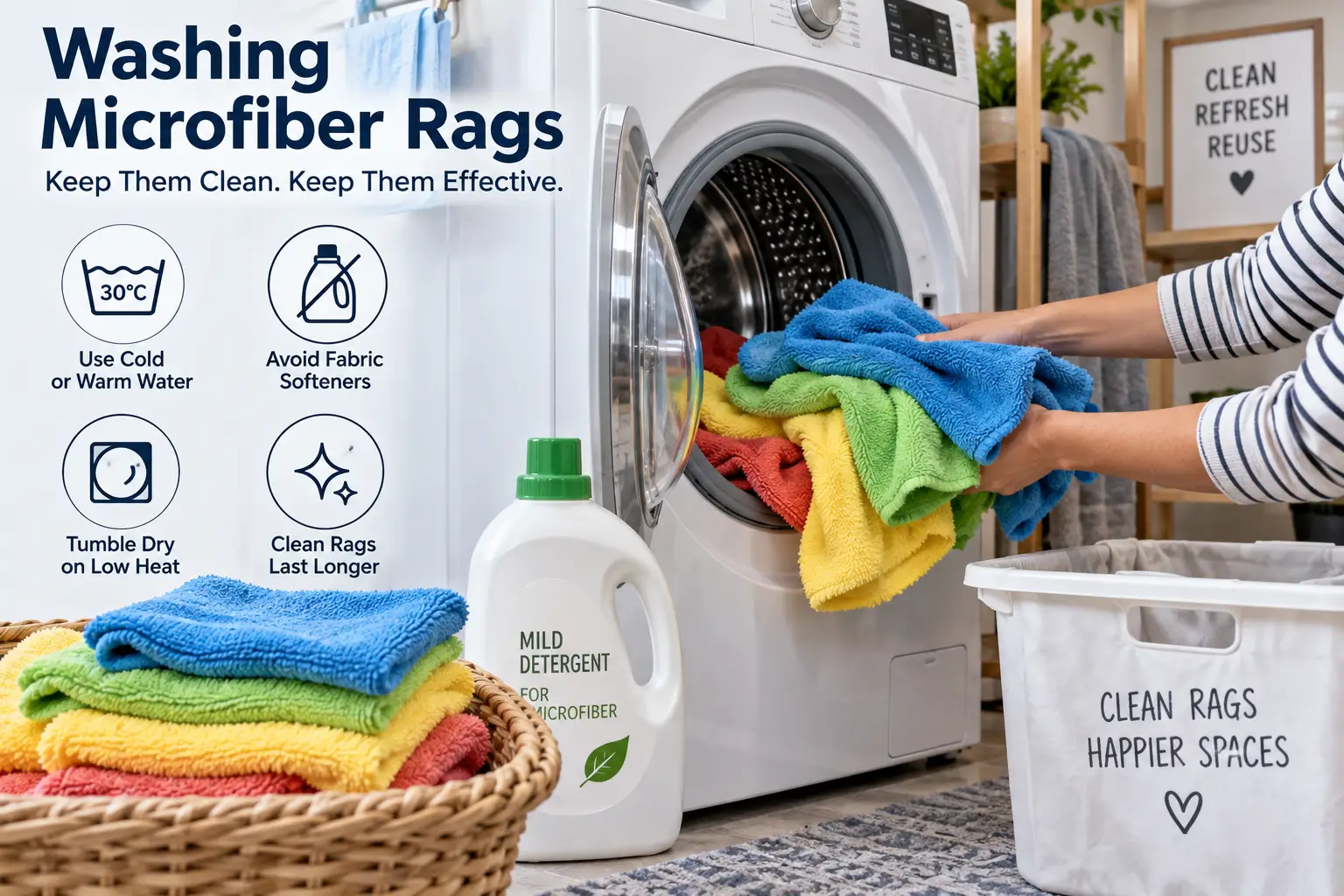
Getting washing microfiber rags right is less about any single product and more about a consistent routine. First, sort by soil type — separate rags used with grease, wax, or oil from ones used only for dusting or glass, since cross-contamination transfers residue between cloths. Second, shake out loose debris and lint before loading, since trapped particles can grind against the fibers during agitation. Third, load rags into a mesh wash bag if you have one, and never mix them with cotton towels or lint-heavy fabrics, which shed fibers that microfiber grabs onto instantly. Fourth, measure detergent carefully — concentrated microfiber detergents typically need only one to two ounces per load, and overdosing is a leading cause of the stiff, residue-coated feel people mistake for “worn out” fabric. Fifth, run a warm or cold cycle, skip the fabric softener dispenser entirely, and consider an extra rinse cycle if your machine offers one, since it flushes out any remaining detergent that would otherwise clog fibers on the next use. Finally, dry on low heat or air dry — high heat can melt the fine synthetic fibers, permanently reducing their ability to trap dirt and dust.
Real-World Scenarios: Matching Your Routine to How You Use Your Rags
Not every household needs the same wash routine, so it helps to think in terms of actual use cases rather than generic advice. Consider a home cook who uses two or three microfiber rags a week for countertops and spills: a single bottle of Tide Free & Gentle HE Liquid Laundry Detergent, a weekly wash on cold with air drying, and an occasional OxiClean Versatile Stain Remover pre-soak for tomato sauce stains covers this use case completely, with no need for boutique products. Now consider a weekend car detailer with a rotation of a dozen rags handling wax, polish, and glass: this is where P&S Rags to Riches Premium Microfiber Detergent and a Polecasa Mesh Laundry Bag earn their keep, since cross-contamination between a wax rag and a glass rag ruins streak-free performance almost immediately. Finally, picture a professional house cleaner running through 30+ rags a week across multiple client homes: high-volume washing with Chemical Guys Microfiber Wash Detergent in bulk, paired with a rotating stock from The Rag Company All-Purpose Microfiber Towels, keeps quality consistent without daily improvisation. Matching the product to the actual frequency and soil level of use — rather than buying the most expensive option by default — is the single biggest lever for getting value out of any of these picks.
Common Microfiber Rag Problems—and How to Fix Them
Even careful households run into a handful of recurring issues when washing microfiber rags, and most have a straightforward fix. If rags come out of the wash feeling stiff or greasy, the culprit is almost always detergent buildup or accidental fabric softener use; the fix is a detergent-free wash with a half cup of white vinegar in the rinse cycle to strip residue, followed by a proper wash with a dedicated microfiber detergent like Wolfgang Concours Series Microfiber Cleaner & Rejuvenator. If rags have lost their absorbency and seem to just push water around instead of soaking it up, that’s typically softener residue coating the fibers, and the same vinegar strip cycle usually restores at least partial performance. If rags smell musty even after washing, they were likely left damp in a hamper or washer too long before drying, encouraging bacterial growth; the fix is prompt drying and, for a deep reset, an oxygen-based soak with OxiClean Versatile Stain Remover before the next wash. If rags are shedding lint onto surfaces instead of cleaning them, they were probably washed with cotton towels or other lint-producing fabrics; separating loads going forward, ideally with a Polecasa Mesh Laundry Bag, solves this permanently. And if a rag simply won’t recover no matter what you try, it’s likely reached genuine end-of-life, which is where replacing with fresh stock like The Rag Company All-Purpose Microfiber Towels makes more sense than continuing to chase a lost cause.
How to Choose a Detergent for Washing Microfiber Rags
Picking the right detergent comes down to a handful of concrete criteria rather than brand loyalty. First, check the ingredient list for dyes and perfumes — both are unnecessary additives that can leave residue in the fibers without improving cleaning power. Second, confirm it’s fabric-softener-free, since softening agents are the single most common cause of ruined microfiber, coating fibers in a waxy layer that blocks their static charge. Third, favor liquid over powder, since powder doesn’t always fully dissolve and can leave granules trapped in the weave. Fourth, consider concentration — a highly concentrated detergent means you use less per load, which reduces the odds of overdosing and leaving residue behind. Fifth, match the detergent to your machine type; HE-specific formulas rinse more completely in low-water cycles than detergents designed for standard top-loaders. Sixth, factor in soil level — heavily soiled shop or detailing rags benefit from a professional-grade formula, while lightly soiled kitchen rags do fine with a mainstream dye-free option. Consumer Reports’ own lab testing of “free and clear” detergents has screened several for potentially harmful chemicals, and that kind of independent verification is a more reliable signal than marketing language on a bottle.
Common Mistakes to Avoid When Washing Microfiber Rags
The single most common mistake is using fabric softener, whether liquid in the dispenser or a dryer sheet — both coat the fibers in a film that blocks the static charge microfiber relies on to attract and hold dirt. A close second is washing microfiber alongside cotton towels, socks, or other lint-shedding fabrics; microfiber’s electrostatic pull grabs onto stray lint instantly, and once it’s embedded, it’s difficult to remove. Overloading the washer is another frequent misstep, since rags need room to move freely in the water for the detergent to actually reach and release trapped grime. High heat in the dryer is a fourth mistake worth flagging specifically, since synthetic fibers can soften or partially melt at high temperatures, permanently dulling their texture and cleaning ability. Finally, many people use far more detergent than necessary, assuming more soap means a deeper clean, when in reality it just means more residue left behind after an incomplete rinse — concentrated microfiber detergents are dosed in ounces, not cups, for a reason.
Washing Microfiber Rags vs Washing Cotton Rags
The core difference comes down to fiber structure and what each fabric tolerates in the wash. Cotton fibers are relatively thick and absorb dirt into their structure through capillary action, which means they tolerate hotter water, more aggressive detergents, and even occasional chlorine bleach without much consequence. Microfiber, by contrast, works through adhesive attraction that lets its ultra-fine fibers grab and hold onto microscopic dirt and bacteria — a mechanism that’s far more sensitive to heat, softener, and detergent residue than cotton’s simple absorption. Practically, this means you can wash a load of cotton kitchen towels with a normal detergent, hot water, and even a dryer sheet with no real downside, while doing the same to microfiber rags degrades their performance within one or two cycles. The tradeoff runs the other direction for cleaning results: cotton generally leaves more lint and streaks behind, while microfiber has been shown in testing to remove significantly more bacteria from a surface using only water, no chemicals required. In short, cotton is more forgiving to wash but less effective to clean with; microfiber is the opposite, and choosing between them — or maintaining both correctly — depends on whether convenience or cleaning performance matters more for a given task.
What to Expect: Everyday Performance After Proper Washing
When washing microfiber rags is done correctly, the day-to-day difference is noticeable within the first few uses. A properly washed rag should glide across a countertop or glass surface without dragging or squeaking, pick up dust and light grime without needing a spray cleaner first, and dry within an hour or two of use rather than staying damp and musty. You should also notice the rag getting slightly softer with each proper wash rather than progressively stiffer — a genuine sign of well-maintained split fibers rather than accumulating residue. On the flip side, a rag that’s been washed with softener or dried on high heat tends to feel slick or waxy to the touch, leave faint streaks on glass, and take noticeably longer to dry, since the fibers’ ability to wick moisture has been compromised. Tracking these everyday signals is a more reliable gut check than trying to guess a rag’s condition from appearance alone, since microfiber can look fine visually while performing poorly functionally.
Long-Term Cost and Maintenance of Microfiber Rags
The economics of washing microfiber rags properly are straightforward: a rag that’s cared for correctly can realistically last hundreds of wash cycles, while one washed carelessly with softener and high heat may need replacing within a few months. Doing the math, a $25 twelve-pack of quality rags like The Rag Company All-Purpose Microfiber Towels, maintained with a dedicated detergent, works out to a fraction of a cent per use over its lifespan — cheaper over time than repeatedly buying disposable paper towels or replacing degraded cloths every few months. The ongoing maintenance cost is similarly modest: a bottle of concentrated detergent like Chemical Guys Microfiber Wash Detergent lasts dozens of loads at roughly one to two ounces each, and a reusable mesh bag like the Polecasa Mesh Laundry Bags is a one-time purchase that pays for itself many times over in reduced fiber damage. The real long-term cost isn’t the detergent or the rags themselves — it’s the replacement cycle triggered by improper washing, which is exactly the expense this guide is designed to help you avoid.
Microfiber, Microplastics, and Your Washing Machine: What the Research Says
There’s a sustainability dimension to washing microfiber rags that’s worth understanding, separate from how well they clean. Because microfiber is synthetic, every wash cycle sheds a small number of tiny plastic fibers into wastewater, and a peer-reviewed study measuring fiber shedding across consumer textiles found that mechanically-treated polyester samples released roughly six times more microfibers per wash than woven nylon samples. This has drawn regulatory attention at the federal level, where the EPA’s interagency report on microfiber pollution outlines the scale of the issue and the strategies under consideration, and some states have already moved on labeling and filtration requirements for washing machines. Practically, this doesn’t mean you should stop washing microfiber rags — it means a few small habits reduce your household’s contribution meaningfully: washing full loads rather than small ones (which reduces the friction that causes shedding), using a lower-agitation cycle when possible, and, if your budget allows, a washing-machine microfiber filter. None of the products in this guide address filtration directly, but pairing a mesh wash bag with a full-load habit is a reasonable middle ground between convenience and environmental awareness for most households.
✨ Ready to build a wash routine that actually protects your rags? 🧺 🔍 Pick a dedicated detergent from the list above and pair it with a mesh wash bag — small changes that add years to every cloth you own.
Frequently Asked Questions
❓ What's the best way to start washing microfiber rags?
❓ Can you wash microfiber rags with regular laundry detergent?
❓ How often should you be washing microfiber rags?
❓ Is it safe to use fabric softener when washing microfiber rags?
❓ What temperature is best for washing microfiber rags?
Conclusion
Washing microfiber rags correctly isn’t complicated once you know the handful of things that actually matter: skip the fabric softener, keep them separate from cotton, measure detergent carefully, and stay away from high heat. Whether you land on a dedicated formula like Chemical Guys Microfiber Wash Detergent or P&S Rags to Riches Premium Microfiber Detergent for heavier grime, a budget-friendly staple like Tide Free & Gentle HE Liquid Laundry Detergent, or round things out with a Polecasa Mesh Laundry Bag and a fresh set of The Rag Company All-Purpose Microfiber Towels, the underlying routine matters more than any single product. Get that routine right, and a handful of rags can realistically outlast years of careless washing — and everything else that goes wrong is usually one of the fixable mistakes covered above. As an Amazon Associate, links in this guide support the site at no extra cost to you, and picking even one of these products is a solid step toward rags that actually stay useful.
Recommended for You
- Can You Wash Glasses Cloth? 7 Best Picks & Care Tips (2026)
- How to Clean Lens Cleaning Cloth: 7 Best Picks for 2026
- 7 Best Fabric Carbon Fiber Options for Strong and Lightweight Projects
Disclaimer: This post contains affiliate links. As an Amazon Associate, I earn from qualifying purchases made through these links, at no additional cost to you.
✨ Found this article helpful? Share it with someone who needs it! 💬🤗