In This Article
Why Car Cleaning Drying Towels Make or Break Your Wash
Here’s an uncomfortable truth about washing your car: the soap rarely causes the damage. The drying step does. You can use a pH-neutral shampoo, a two-bucket setup, and a plush wash mitt, then undo half that care in five minutes by dragging a stiff, low-absorbency towel across the hood. 🚗
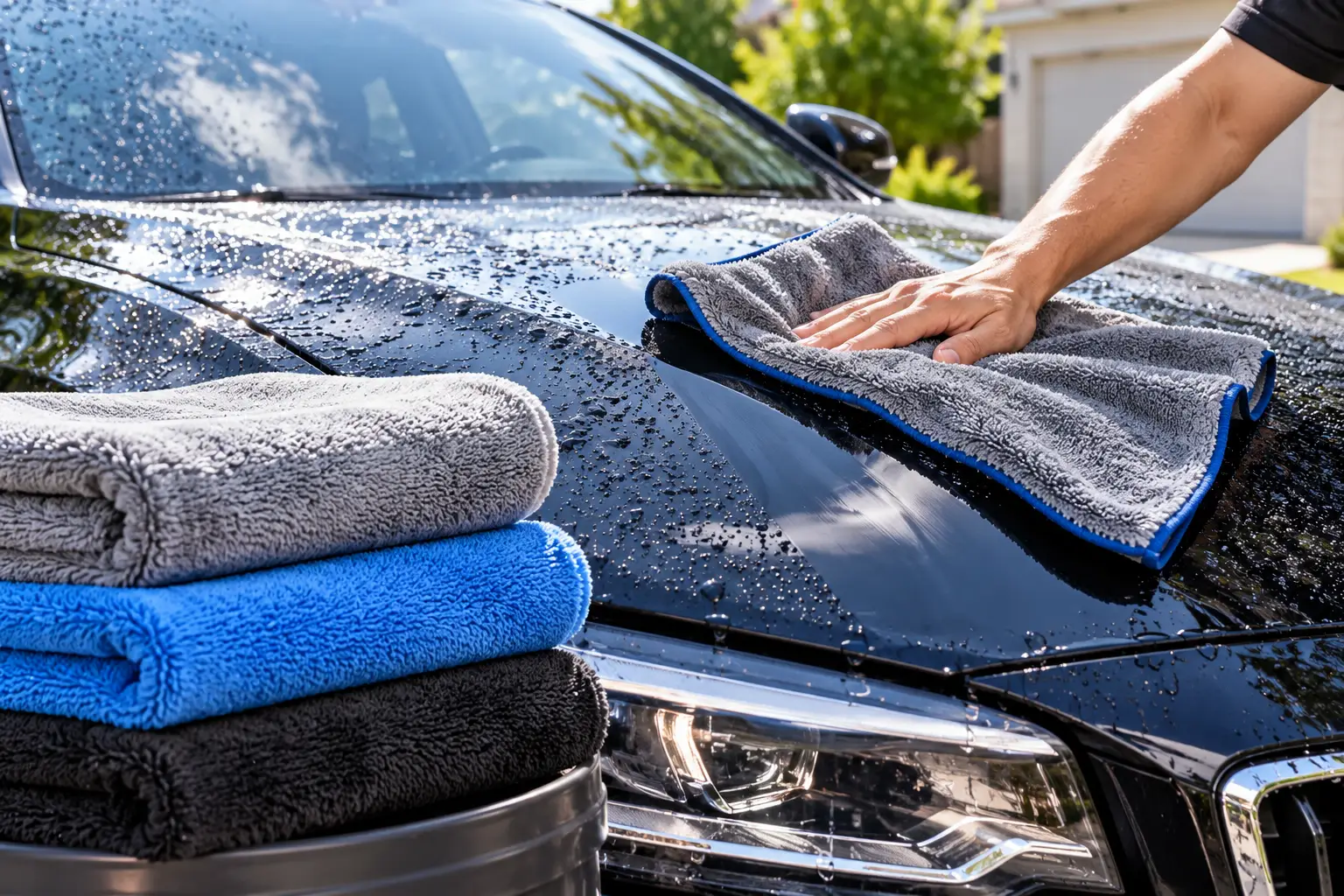
That’s why car cleaning drying towels deserve more attention than they usually get. The right towel lifts water off the paint before minerals can dry into spots, glides instead of grabs, and holds enough water that you’re not wringing it out every two panels. The wrong one smears, sheds lint, and — on dark paint especially — writes fine swirl marks into the clear coat that show up the first sunny afternoon.
In 2026, the category has matured. Twisted loop weaves have largely replaced the old chamois among enthusiasts, edgeless and suede-bordered designs now show up even in mid-priced towels, and most serious brands publish GSM (grams per square meter) figures that actually help you compare. At the same time, marketing has gotten louder: “absorbs a gallon,” “one towel, one car,” “zero drag.” Some of those claims hold up on paper; others need context.
This guide sorts it out. We compared seven real car cleaning drying towels sold to US shoppers — from a budget waffle weave under $20 to premium twisted loop towels around $40 — using published spec sheets, independent hands-on reviews, and aggregated owner feedback. You’ll get a quick comparison table, in-depth analysis of each towel, a swirl-free drying routine, fixes for common problems, and a clear framework for choosing the right size and weave for your vehicle. No invented test stories — just honest analysis of what the specs and reviews actually say.
What Are Car Cleaning Drying Towels?
Car cleaning drying towels are large, highly absorbent microfiber towels designed to remove rinse water from a vehicle’s paint, glass, and trim after washing. Built with twisted loop, plush, or waffle weaves and soft, tagless edges, they absorb water quickly while minimizing friction, helping prevent water spots, streaks, and swirl marks.
The magic is in the fiber itself. As Wikipedia’s overview of microfiber explains, microfiber is a synthetic fiber finer than one denier, most commonly polyester blended with polyamide (nylon). Those ultra-fine, split fibers create an enormous amount of surface area, which is why a good drying towel wicks water into itself rather than pushing it around the panel.
Most premium towels use a 70/30 or 80/20 polyester-to-polyamide blend. That ratio matters in practice: a higher polyamide share generally means a softer hand and better absorption, while more polyester tends to be tougher and cheaper to produce. Then there’s the weave:
- ⚡ Twisted loop: long, twisted fiber loops that act like thousands of tiny straws.
- ☁️ Plush: a deep, fluffy pile that cushions the paint.
- 🧇 Waffle weave: a flat grid of pockets that excels on glass but holds less water.
GSM tells you how dense the fabric is — useful, but as you’ll see below, it’s not the whole story.
Quick Comparison: 7 Car Cleaning Drying Towels at a Glance
| Towel | Weave | Size (Large) | Price Range* | Best For |
|---|---|---|---|---|
| Rag Company Gauntlet | Hybrid twist loop + plush stripes | 30″ x 36″ | ~$30–$45 | All-around drying, sedans to midsize SUVs |
| Rag Company Liquid8r | Double twist loop | 25″ x 36″ | ~$25–$40 | Maximum water capacity per dollar |
| Griot’s PFM Drying Towel | Long-loop terry weave | 25″ x 35″ | Around $40 | One-towel drying on unprotected paint |
| CarPro DHydrate | Twist loop + flat glass side | 28″ x 40″ | ~$25–$35 | Paint and glass with one towel |
| Gyeon SilkDryer EVO | Twisted synthetic fibers, single-sided | ~28″ x 35″ (70 x 90 cm) | ~$35–$50 | Ceramic-coated and soft paint |
| Chemical Guys Woolly Mammoth | Ultra-plush 1″ pile | 36″ x 25″ | Around $30 | Trucks, SUVs, big flat panels |
| Meguiar’s Water Magnet | Waffle weave | 22″ x 30″ | Under $20 | Budget buyers, glass, backup towel |
*Price ranges at the time of writing; prices may vary, so check the current price before buying.
Looking at the table, the Rag Company Gauntlet and CarPro DHydrate suit the widest range of drivers, because they balance absorbency with a manageable wet weight. If you drive a full-size truck, the Chemical Guys Woolly Mammoth‘s sheer pile makes sense, while the Meguiar’s Water Magnet earns its spot as the cheapest way to stop using bath towels — just expect more wring-outs.
💬 One click helps other shoppers make an informed choice too! 😊
Top 7 Car Cleaning Drying Towels: Expert Analysis for 2026
Each pick below covers what the specs mean on your driveway, who the towel suits, what real owners report, and where it falls short.
1. The Rag Company Gauntlet (30″ x 36″) — best all-around hybrid weave
The Rag Company Gauntlet earns the top slot because it solves the classic trade-off between thirst and glide. Its patented hybrid weave alternates stripes of twist loop and soft plush on a 900 GSM Korean 70/30 blend, finished with a black suede border and no tags. In practice, the twist loop stripes grab water fast while the plush stripes cushion the paint, so the towel behaves almost like a squeegee when you drag it — the technique The Rag Company says it’s designed for.
Who’s it for? Honestly, most people. At 900 GSM, it’s lighter than the 1,100+ GSM heavyweights, so it stays manageable when soaked, and the 30″ x 36″ size handles a hood in one pull. Compact-car owners can drop to the 20″ x 30″ size; the towel also comes in 12″ x 12″ and 15″ x 24″ for jambs and mirrors. The dual-tone design (charcoal on one side, ice gray on the other) makes it easy to track which face you’ve already used.
Customer reviews on the brand’s own store are overwhelmingly positive, and independent 2026 roundups consistently describe it as a pro-level hybrid performer. The main trade-off is price compared with generic twist loop towels.
Pros:
- ✅ Hybrid weave balances absorbency and glide
- ✅ Suede border and tagless build protect paint
- ✅ Four sizes cover every drying job
Cons:
- ❌ Costs more than generic twist loop towels
- ❌ Holds less total water than 1,100 GSM options
Expect roughly $30–$45 for the 30″ x 36″ size (check the current price) — strong value given the brand’s claim that it survives hundreds of washes.
2. The Rag Company Liquid8r (25″ x 36″) — thirstiest twist loop for the money
The Rag Company Liquid8r is the pick when raw water capacity is your priority. It steps up to a 1,100 GSM double twist loop weave, and the 25″ x 36″ size is big enough for most sedans and small SUVs without stopping to wring out.
What does 1,100 GSM mean on your driveway? More fiber mass per square inch, so every pass pulls more water — especially helpful on unprotected or older paint, where water sheets and clings instead of beading up. The trade-off is weight: denser towels get heavier once saturated, so they reward a slow drag rather than quick wipes. Smaller 16″ x 16″ and 20″ x 24″ versions are available for door jambs and mirrors.
Compared with the Rag Company Gauntlet, the Rag Company Liquid8r is the more brute-force tool, while the Gauntlet is the more refined all-rounder. If you rinse with hard water or your paint has no wax, sealant, or coating, the extra capacity will matter more to you than a slightly slicker glide.
In a hands-on review, automotive site FlatSixes found it easy to use and noted it didn’t get too heavy while drying an entire car — a useful counterpoint to the assumption that higher GSM always means a sluggish towel. Broader aggregated US review data was limited in our research, so treat that as one well-documented data point rather than a consensus.
Pros:
- ✅ 1,100 GSM holds a lot of water
- ✅ Large enough to dry most sedans
- ✅ Multiple sizes for detail work
Cons:
- ❌ Gets heavy once fully saturated
- ❌ Takes longer to air-dry between washes
At roughly $25–$40 for the large size, it’s one of the best capacity-per-dollar buys in this lineup.
3. Griot’s Garage PFM Terry Weave Drying Towel (25″ x 35″) — heavyweight one-towel-one-car drying
The Griot’s PFM Drying Towel (Griot’s item #55590) is built around a simple promise: one towel, one vehicle. It uses a double-lined, long-loop terry weave microfiber with rounded corners and bound-in satin edging, and Griot’s claims it holds as much as 5 pounds of water (some retailer listings say 6).
The long loops are the key detail. They add surface area without the grabby surface tension that very thick plush towels can create, so the towel glides when you lay it flat and pull — the technique Griot’s recommends. Rounded corners are a quiet win, too: square corners are where stiff stitching tends to snag trim, emblems, and mirror housings.
This is a premium towel for owners who want to skip the second towel on a midsize car. Detailed Image’s Ask-a-Pro review reported that it replaced all their other drying towels — notable coming from a retailer that stocks dozens of competitors. One spec caveat: published GSM figures vary by source (that review lists 860 GSM and an 80/20 blend, while some newer listings cite 1,120 GSM), so don’t buy it on GSM numbers alone.
The most common reservation, even among fans, is size and heft: fully loaded, 25″ x 35″ is a lot of wet towel to handle, which is why Griot’s also sells 16″ x 16″ PFM towels.
Pros:
- ✅ Long loops glide with little drag
- ✅ Rounded satin edges avoid snagging trim
- ✅ Dries a midsize car in one towel
Cons:
- ❌ Heavy and bulky when saturated
- ❌ GSM specs vary between listings
At around $40 (check the current price), it’s premium-priced, but the one-towel convenience justifies it for frequent washers.
4. CarPro DHydrate (28″ x 40″) — two sides for paint and glass
The CarPro DHydrate is the multitasker of the group: one side is plush twist loop microfiber for paint, and the other is a flat, woven nap designed to leave glass streak-free. It’s made in Korea from an 80/20 blend, with a tagless design and a soft microfiber edge.
That dual-sided design has a real practical payoff. Plush towels can leave a faint haze on windows because their long fibers hold a thin film of moisture; flipping to the flat side for glass removes a step (and a towel) from your routine. CarPro also designs it to be laid flat and pulled by the edges rather than patted, which keeps hand pressure off the paint.
At 28″ x 40″, the large size covers more area than any other towel here, yet the standard version’s listed 540 GSM keeps it lighter than 1,000+ GSM towels. Need more capacity? CarPro’s DHydrate BOLD variant lengthens the double twisted loops and roughly doubles the GSM to 1,000 in a 27″ x 35″ format.
Owner reviews on detailing retailer pages praise how much water it takes up and how soft the edges feel. One forum reviewer noted it doesn’t get as heavy as the Griot’s PFM Drying Towel while drying comparably, though larger vehicles may need a second towel — and some owners find the big size harder to wring out.
Pros:
- ✅ Dedicated flat side for streak-free glass
- ✅ Largest coverage area in this lineup
- ✅ Stays relatively light when wet
Cons:
- ❌ Big trucks may need a second towel
- ❌ Large size is awkward to wring out
At roughly $25–$35 for the 28″ x 40″ size, it’s arguably the best value for anyone who wants one towel for everything.
5. Gyeon Q²M SilkDryer EVO (70 x 90 cm) — smoothest glide for coated paint
The Gyeon SilkDryer EVO takes a different philosophy: lighter fabric, maximum glide. It uses twisted synthetic fibers at a listed 530 GSM in an 80/20 blend, and Gyeon says the EVO version absorbs up to 50% more than the 2015 original while cutting its edges down to an absolute minimum.
Why choose a lower-GSM towel? Because on ceramic-coated paint, water beads and rolls off rather than sheeting, so you rarely need gallon-class capacity — you need a towel that won’t drag. The near-edgeless, laser-cut perimeter also matters on complex body lines, mirrors, and badges where a stitched edge could catch. The large size works out to roughly 28″ x 35″, with a smaller 50 x 55 cm option for jambs and lower panels.
This is the towel for owners of coated cars, soft paints, or dark colors that show every micro-mar. It’s less ideal if you’re drying an unprotected full-size SUV where water sheets across the roof.
Aggregated reviews on a major European detailing retailer (115+ reviews) describe it as soft, smooth-gliding, and fast, with many owners drying a whole car with one towel. The recurring caveats: some color shedding in early washes, saturation on very large vehicles, and a single usable side. US-specific review volume was harder to verify.
Pros:
- ✅ Exceptionally smooth glide on coatings
- ✅ Minimal edges for complex body lines
- ✅ Light and easy to handle
Cons:
- ❌ Only one side is usable
- ❌ Can saturate on large vehicles
At about $35–$50 depending on the seller, you’re paying for finesse rather than capacity — worth it for coated or delicate paint.
6. Chemical Guys Woolly Mammoth (36″ x 25″) — deepest pile for trucks and SUVs
The Chemical Guys Woolly Mammoth (model MIC1995) is sized and built for big vehicles. It’s a 36″ x 25″ slab of 70/30 microfiber with a pile Chemical Guys lists at a full inch thick, silk-banded edges on all four sides, and a claimed capacity of close to a gallon of water.
That one-inch pile does two jobs. It holds a lot of water, and it gives any grit you missed during the wash room to sink away from the paint instead of being dragged across it. The light gray color is a smart touch, too — dirt shows up clearly, telling you when to switch to a fresh side. On a pickup hood or an SUV roof, the large footprint means fewer passes, and fewer passes mean less total friction.
The flip side of a gallon-class towel is weight: water weighs about 8.3 pounds per gallon, so a saturated Chemical Guys Woolly Mammoth gets genuinely heavy, and deep plush takes longer to dry between uses. Chemical Guys recommends washing it separately with a microfiber detergent, drying on low heat, and skipping fabric softener entirely.
We couldn’t verify a large, consistent body of independent aggregated reviews for this specific model beyond retailer listings, so this analysis leans on published specs. Based on those specs, it’s best viewed as a truck-and-SUV specialist rather than a compact-car towel.
Pros:
- ✅ One-inch pile cushions the paint
- ✅ Huge footprint suits trucks and SUVs
- ✅ Light color reveals trapped dirt
Cons:
- ❌ Very heavy when fully saturated
- ❌ Deep pile dries slowly after washing
At around $30 (check the current price), it’s solid value if you drive something big.
7. Meguiar’s Water Magnet X2000 (22″ x 30″) — best budget waffle weave
The Meguiar’s Water Magnet is the easiest upgrade from bath towels or an old chamois. It’s a 22″ x 30″ waffle weave microfiber towel that Meguiar’s says absorbs up to twice as much water as traditional terry towels, and it’s machine washable.
Waffle weave works differently from twist loop. The grid of small pockets traps water, while the flatter surface contacts the paint more directly. That makes it excellent on glass, where plush fibers can streak, and it wrings out easily. The trade-off is lower total capacity and less cushion, so it’s less forgiving if you left grit behind during the wash.
This is the right pick for budget-conscious drivers, anyone who wants a dedicated glass or door-jamb towel, or as a backup to a premium twist loop towel. It has been listed on Amazon since 2005, which says something about its staying power in a crowded category.
Aggregated owner feedback is broadly positive about softness and spot-free results, with one consistent caveat: on larger vehicles, owners report wringing it out more often than they’d like once it’s saturated.
Pros:
- ✅ Very affordable entry into microfiber
- ✅ Waffle texture excels on glass
- ✅ Wrings out quickly and easily
Cons:
- ❌ Lower capacity than twist loop towels
- ❌ Less cushion if grit remains
Typically under $20, it’s excellent value — especially as a second towel alongside a premium dryer.
Head-to-Head Spec Comparison
| Towel | Listed GSM | Blend (Poly/Polyamide) | Edge | Best For |
|---|---|---|---|---|
| Rag Company Gauntlet | 900 | 70/30 | Suede border, tagless | Everyday all-rounder |
| Rag Company Liquid8r | 1,100 | 70/30 | Hidden edge (per listings) | Maximum capacity |
| Griot’s PFM Drying Towel | 860–1,120 (varies by source) | 80/20 (per review) | Rounded, satin-bound | Unprotected paint |
| CarPro DHydrate | 540 (BOLD: 1,000) | 80/20 | Microfiber edge, tagless | Paint + glass |
| Gyeon SilkDryer EVO | 530 | 80/20 | Minimal, laser-cut | Coated paint |
| Chemical Guys Woolly Mammoth | Not published (1″ pile) | 70/30 | Silk-banded | Trucks & SUVs |
| Meguiar’s Water Magnet | Not published | Not published | Not specified | Budget & glass |
The data makes one pattern obvious: higher GSM isn’t automatically better. The Gyeon SilkDryer EVO and CarPro DHydrate sit near 530–540 GSM yet are engineered for glide and versatility, while the Rag Company Liquid8r targets sheer capacity. Match GSM to your paint protection — coated cars favor lighter, slicker towels, while unprotected paint that sheets water benefits from 900+ GSM.
✨ Don’t let your drying towel undo your wash! 🔍 Match the towel to your vehicle size and paint protection, then click a highlighted name to check current pricing and availability. These picks will help you get a spotless, swirl-free finish you’ll actually enjoy looking at!
How to Dry Your Car Without Swirls: A Step-by-Step Routine
Even the best car cleaning drying towels can’t save a sloppy technique. Here’s a routine that works with any towel in this guide:
- Do a sheeting rinse. Remove the spray nozzle and let water flow gently over each panel from the top down. On protected paint, most water slides off in sheets, leaving far less for your towel.
- Work in the shade. Hot panels evaporate water fast, leaving mineral spots before you reach them.
- Go top-down. Roof, glass, hood, trunk, then upper sides. Lower panels carry the most grit, so dry them last.
- Lay flat and drag. Spread the towel across the panel and pull it slowly toward you with little or no pressure. Skip circular scrubbing — it’s the classic swirl-mark generator.
- Add lubrication. A light mist of drying aid or spray detailer reduces friction and adds gloss. Chemical Guys, for instance, recommends pairing the Chemical Guys Woolly Mammoth with its own drying aid.
- Split your towels. Use one large towel for paint, a small one for glass and jambs, and a separate, cheaper towel for wheels.
- Chase the drips. Mirrors, emblems, and fuel doors release water minutes later. Do a final walk-around with a small dry towel.
Common mistakes in the first 30 days: skipping a pre-wash of new towels (several brands, including Gyeon, can shed color at first), washing them with cotton laundry that deposits lint, and adding fabric softener, which coats the fibers and kills absorbency. Wash new towels once, on their own, before they ever touch paint.
Which Towel Fits Your Garage? Three Real-World Buyer Profiles
🚙 Profile 1: The weekend commuter with a compact sedan
You wash every two weeks, park outside, and want to spend about $40 total. A 20″ x 30″ Rag Company Gauntlet covers a compact car comfortably, and a Meguiar’s Water Magnet handles glass and jambs. Why this pairing? The Gauntlet’s hybrid weave forgives imperfect technique, while the waffle weave gives you streak-free windows — two jobs, two specialized tools, all within budget.
🛻 Profile 2: The family with a full-size SUV and hard water
You wash weekly, often in the Southwest or Midwest, where tap water leaves stubborn spots. Speed matters more than finesse here: the Chemical Guys Woolly Mammoth or Rag Company Liquid8r pulls the most water per pass, reducing the time minerals sit on the paint. Add a drying aid and a second smaller towel for the tailgate and lower doors. At roughly $50–$70 for the pair, you’re buying time — the enemy of hard water is delay.
🏁 Profile 3: The enthusiast with a ceramic-coated black car
You wash carefully and notice every micro-mar under garage lights. The Gyeon SilkDryer EVO is built for exactly this: slick glide, minimal edges, and just enough capacity for beading water on a coated surface. Pair it with the CarPro DHydrate for its flat glass side. The combined cost sits around $60–$85, but on dark coated paint, the cost of polishing out swirls is far higher.
Problem → Solution: Fixing Streaks, Lint, and Water Spots
Problem 1: White water spots appear minutes after drying
This is almost always mineral content. According to the U.S. Geological Survey, water above 180 mg/L of calcium carbonate is classified as very hard — and when it evaporates, those minerals stay behind on your paint. Solution: dry faster with a high-capacity towel like the Rag Company Liquid8r, work in the shade, dry one section at a time on hot days, and consider a filtered final rinse if you live in a hard-water area.
Problem 2: The towel leaves lint behind
New towels often shed loose fibers, and towels washed with cotton pick up lint that transfers back to the paint. Solution: wash new towels alone before first use, keep microfiber loads separate, and avoid dryer sheets entirely.
Problem 3: Streaks on glass
Plush and twist loop fibers can leave a thin film of moisture on windows. Solution: switch to a flat or waffle surface — the flat side of the CarPro DHydrate or a Meguiar’s Water Magnet — for glass.
Problem 4: The towel drags or “grabs” the paint
This usually happens with a saturated or dirty towel, or on bare, unprotected paint. Solution: wring the towel out, mist a drying aid for lubrication, and pull lightly rather than pressing.
Problem 5: Absorbency drops after a few months
Fabric softener, high dryer heat, and detergent residue clog fibers. Solution: use a microfiber-specific detergent, dry on low or no heat, and run an occasional extra rinse cycle.
How to Choose Car Cleaning Drying Towels: 6 Steps
- Match size to your vehicle. Compacts do fine with 20″ x 30″; midsize cars and SUVs benefit from 25″ x 35″ or larger; full-size trucks justify 28″ x 40″ or 36″ x 25″ footprints.
- Choose the weave for your paint. Twisted loop suits most cars, plush suits big vehicles and soft paint, and waffle weave belongs on glass or in a budget kit.
- Read GSM in context. Around 500–600 GSM favors glide and light handling; 900–1,100+ GSM favors capacity. Neither is universally “better.”
- Check the edges. Suede, silk-banded, satin, or laser-cut edges with no tags reduce the risk of fine scratches from stiff stitching.
- Look at the blend. A 70/30 blend is typically softer and more absorbent; 80/20 is common, durable, and still paint-safe when well made.
- Plan a two-towel system. One large towel for paint plus a small towel for glass and jambs beats one oversized towel doing everything.
Why does this order matter? Because most drying problems come from mismatches — a small towel on a big truck, a thick plush on glass, a heavy towel on coated paint that only needed a quick glide. Get size and weave right first, and GSM and edges become fine-tuning rather than guesswork.
Twisted Loop Drying Towel vs Waffle Weave vs Chamois
| Drying Tool | Water Handling | Paint Safety | Glass Results | Best For |
|---|---|---|---|---|
| Twisted loop microfiber | Very high; wicks into loops | High; cushioned glide | Good; can haze | Most paint, e.g., Rag Company Liquid8r |
| Plush microfiber | High | Very high; deep pile | Fair | Trucks and SUVs, e.g., Chemical Guys Woolly Mammoth |
| Waffle weave microfiber | Moderate | Good; less cushion | Excellent | Glass and budgets, e.g., Meguiar’s Water Magnet |
| Chamois (natural or PVA) | Good; needs frequent wringing | Lower; flat surface can drag grit | Good | Quick wipe-downs, not finishing |
| Cotton bath towel | Low to moderate | Low; lint and coarse loops | Poor | Nothing paint-related |
The table explains why the twisted loop drying towel has become the enthusiast default: it combines high capacity with a cushioned surface, while a chamois offers no pile at all to keep missed grit away from the clear coat. Waffle weave still earns a place, though — not as your main paint towel, but as your glass specialist.
In practice, a chamois works by pressing a flat surface against the paint and absorbing water through contact. If a speck of sand sits between that surface and the clear coat, there’s nowhere for it to go, so it gets dragged along. A twisted loop drying towel, by contrast, lets that particle nestle into its loops. Cotton bath towels fail on both counts — coarse loops and constant lint — which is why detailers treat them strictly as garage rags.
Features That Actually Matter (and Ones That Don’t)
Matter: ✅ Edge construction, because a stiff stitched hem touching dark paint is a common source of fine marring. ✅ Size relative to your vehicle, because every extra wring-out means more handling and more chances to drop the towel. ✅ Weave type, because it decides whether a towel suits paint, glass, or both. ✅ Wash durability, because a towel that loses softness after 20 cycles isn’t cheap at all.
Matter less than marketing suggests: ❌ Headline “absorbs a gallon” claims — capacity is only useful if you can still lift and control the towel. A saturated gallon-class towel weighs over eight pounds. ❌ The biggest possible GSM number, since a 1,300 GSM towel on a ceramic-coated car mostly adds weight you don’t need. ❌ “Scratch-free” labels on their own; technique and cleanliness decide that far more than packaging.
Genuinely nice extras: dual-sided designs like the CarPro DHydrate, contrasting colors that show which side you’ve used (the Rag Company Gauntlet), and light colors that reveal trapped dirt (the Chemical Guys Woolly Mammoth). These don’t change absorbency, but they reduce mistakes — which is what protects your paint in the long run.
Common Mistakes to Avoid When Buying a Microfiber Drying Towel for Cars
1. Buying on GSM alone. It’s the number on every listing, so it’s tempting to treat it as a score. Yet the Gyeon SilkDryer EVO at 530 GSM is purpose-built for coated paint, while a 1,300 GSM towel could be overkill there. Buy a microfiber drying towel for cars based on your paint and vehicle size first.
2. Ignoring the edges. Cheap multipacks often use hard stitched hems and large care tags. On dark paint, that edge can leave fine marks. Look for suede, silk, satin, or laser-cut borders.
3. Going too big for your car. A 36″ x 25″ towel on a Mazda Miata is mostly dead weight that drags on the ground. Size to the vehicle, then add a small detail towel.
4. Assuming one towel does everything. Plush on glass streaks; waffle on paint offers less cushion. A two-towel setup is cheap insurance.
5. Buying a single towel for a multi-car household. Drying towels need a fresh, clean surface. If you wash two cars in one session, plan on two main towels — or you’ll finish the second car with a soggy, dirty one.
6. Forgetting care costs. Every microfiber drying towel for cars needs microfiber-safe detergent and careful drying. Budget for it upfront so your towel lasts.
Long-Term Cost and Maintenance of Car Detailing Towels
| Towel | Price Range* | Coverage (sq in) | Best For (Value Angle) |
|---|---|---|---|
| Meguiar’s Water Magnet | Under $20 | 660 | Lowest entry cost; more wring-outs |
| Rag Company Liquid8r | ~$25–$40 | 900 | Most capacity per dollar |
| CarPro DHydrate | ~$25–$35 | 1,120 | Most coverage per dollar; doubles as glass towel |
| Chemical Guys Woolly Mammoth | Around $30 | 900 | Budget-friendly for big vehicles |
| Rag Company Gauntlet | ~$30–$45 | 1,080 | Premium, long-lasting all-rounder |
| Gyeon SilkDryer EVO | ~$35–$50 | ~980 | Paying for glide, not capacity |
| Griot’s PFM Drying Towel | Around $40 | 875 | One-towel convenience |
*At the time of writing; check the current price.
On a cost-per-square-inch basis, the CarPro DHydrate stands out, and it can also replace a separate glass towel. The Rag Company Gauntlet and Griot’s PFM Drying Towel cost more upfront, but if they deliver the hundreds of washes their makers describe, the cost per wash drops to pennies.
The real long-term cost of car detailing towels, though, is care. Here’s a simple maintenance schedule:
- 🧺 After every use: machine wash separately with a microfiber-specific detergent in warm (not hot) water.
- 🔥 Drying: air-dry or tumble on low. High heat can melt fiber tips and reduce softness.
- 🚫 Never: fabric softener, dryer sheets, bleach, or cotton laundry in the same load.
- 🔁 Monthly: run an extra rinse cycle to flush detergent residue.
- 🗑️ Retire or demote: when a towel feels stiff or stops absorbing, move it to wheels or engine-bay duty instead of paint.
Treat your car detailing towels like tools, not rags, and a quality drying towel should last years rather than months.
The Best Car Drying Towel for Ceramic-Coated and Dark Paint
If you’ve invested in a ceramic coating or own a black, dark blue, or deep red car, drying becomes a precision job. Dark paint shows every micro-mar, and coatings change how water behaves.
On a coated surface, water beads tightly and slides off with a sheeting rinse, so the best car drying towel here isn’t the thirstiest — it’s the slickest. The Gyeon SilkDryer EVO fits that brief with its low-drag fibers and near-edgeless design. The CarPro DHydrate is a strong alternative, and its flat side keeps coated glass streak-free.
For dark but unprotected paint, priorities shift. Water clings and sheets, so capacity matters more. The Rag Company Gauntlet offers a good balance, since its plush stripes provide cushion while its twist loop stripes handle volume.
A few habits matter more than the towel on dark paint:
- Use a drying aid on every panel to add lubrication.
- Flip or refold often, so a clean section always touches the paint.
- Keep a spare towel handy; if one touches the ground, it’s done for the day.
- Inspect under a flashlight monthly to catch early marring before it spreads.
The best car drying towel for dark paint is ultimately the one you use gently, keep scrupulously clean, and replace before it wears out.
FAQ: Car Cleaning Drying Towels
❓ How many car cleaning drying towels do I need per wash?
❓ What size drying towel is best for a full-size truck or SUV?
❓ Can I use a car drying towel on my wheels and tires?
❓ How long do microfiber car drying towels last?
❓ Is a car blower better than car cleaning drying towels?
Conclusion: Pick the Towel That Fits Your Car, Not the Hype
Drying is the moment your paint is most vulnerable, and car cleaning drying towels are the tool that decides whether your wash ends with a mirror finish or a fresh set of swirls. The good news? You don’t need the most expensive towel — you need the right one for your vehicle and paint.
For most drivers, the Rag Company Gauntlet is the safest all-around choice. If capacity is your top concern, the Rag Company Liquid8r delivers the most water-holding power per dollar, while the Griot’s PFM Drying Towel remains a premium one-towel solution. The CarPro DHydrate is the smartest pick for anyone who wants paint and glass handled by one towel, and the Gyeon SilkDryer EVO is the specialist for coated or dark paint. Truck and SUV owners will appreciate the Chemical Guys Woolly Mammoth, and budget-minded drivers can start with the Meguiar’s Water Magnet today.
Whichever you choose, pair it with a sheeting rinse, a light drying aid, and a strict wash routine for the towel itself. And if you wash at home, consider where your runoff goes — local guidance like Chandler, Arizona’s residential car wash tips recommends washing on grass or gravel, using biodegradable products, and keeping soapy water out of storm drains. A cleaner car shouldn’t come at the expense of cleaner water. 🌎
🚀 Upgrade your drying game today! ✨ Choose the towel that matches your ride, click its highlighted name to check current pricing and availability, and enjoy a spotless, swirl-free finish after every wash — no more bath towels, no more water spots!
Recommended for You
- Auto Drying Cloth: 7 Best Picks That Won’t Scratch Paint (2026)
- Eco Friendly Cleaning Cloths: 7 Best Picks That Actually Work (2026)
- Vegan Cleaning Products: 7 Best Picks That Actually Work (2026)
Disclaimer: This post contains affiliate links. As an Amazon Associate, I earn from qualifying purchases made through these links, at no additional cost to you.
✨ Found this article helpful? Share it with someone who needs it! 💬🤗