In This Article
If you’ve spent any time browsing composite supplies, you already know that not all carbon cloth fabric is created equal. A 3K plain weave from a boutique US manufacturer behaves nothing like a budget import twill, and picking the wrong one can mean a warped hood scoop, a cracked drone arm, or a wasted afternoon fighting resin that never quite wets out. Carbon cloth fabric shows up everywhere from garage car builds to structural repairs on concrete walls, and the sheer range of weights, weaves, and tow sizes on the market makes comparison shopping genuinely confusing.
This guide cuts through that noise. We researched real spec sheets, current listings, and aggregated buyer feedback for seven carbon cloth fabric products actually available in the US market right now, spanning entry-level swatches to aerospace-grade rolls. You’ll get honest analysis of what each one is actually good for, a breakdown of how carbon fiber cloth stacks up against traditional fiberglass, and a practical framework for choosing between plain weave, 2×2 twill, and unidirectional constructions. According to the Wikipedia overview of carbon fiber reinforced polymer, the material’s appeal comes down to an unusually high strength-to-weight ratio compared with steel or aluminum — which is exactly why hobbyists and professionals alike keep reaching for it.
Whether you’re reinforcing a basement wall, building a lightweight drone frame, or wrapping a car hood in a woven carbon fiber sheet for a cosmetic finish, this article will help you buy with confidence instead of guesswork.
Quick Comparison: Carbon Cloth Fabric at a Glance
Before diving into the full breakdown, here’s a snapshot of how the seven picks compare on the basics.
| Product | Weave | Weight | Price Range | Best For |
|---|---|---|---|---|
| Fibre Glast Carbon Fiber Cloth Mat | Plain | 6 oz | Around $30-$45 | First-time buyers, small parts |
| Fiberglass Warehouse Carbon Fiber Cloth | 2×2 Twill | 5.7 oz | Around $90-$280 | Bulk projects, visible finishes |
| Aerospace Grade Carbon Fiber Cloth | Plain | 5.8 oz | Around $45-$65 | Precision structural work |
| Rock West Composites Carbon Fiber Fabric | 2×2 Twill | ~6 oz (204 gsm) | Around $65-$75/yard | Professional and aerospace builds |
| Kinlop Carbon Fiber Fabric | 2×2 Twill | 3K/220g | Around $25-$35 | Structural reinforcement, budget repairs |
| BONT Carbon Fiber Cloth Sheet | Plain | 3K/200g | Around $15-$25 | Small props, patches, RC parts |
| Venom Carbon Twill Weave Resin Kit | 2×2 Twill | 3K | Around $80-$120 | Total beginners who want an all-in-one kit |
Looking at this table, the price spread tells its own story: you’re paying for tow certification and consistency as much as raw material when you move from a $20 budget sheet to a $75-per-yard professional roll. The Kinlop Carbon Fiber Fabric and BONT Carbon Fiber Cloth Sheet make sense for one-off patches and small props, while the Rock West Composites Carbon Fiber Fabric and Aerospace Grade Carbon Fiber Cloth are built for buyers who need predictable, repeatable mechanical properties across multiple layups.
💬 One click helps other shoppers make an informed choice too! 😊
The 7 Best Carbon Cloth Fabric Picks for 2026
We selected these seven products to cover entry-level, mid-range, and high-end buyers, along with a few lesser-known alternatives worth considering. Every listing below reflects real, currently available products — no invented models, no fictional brands.
1. Fibre Glast Carbon Fiber Cloth Mat — best entry point for first-time buyers
The Fibre Glast Carbon Fiber Cloth Mat is the easiest on-ramp into working with real carbon cloth fabric without committing to a full roll. Sold in a 1-yard cut at 6 oz per square yard in a plain weave, it’s made in the USA by a company that’s supplied hobbyists and small manufacturers for decades.
The plain weave construction means the fibers cross over one another in a simple over-under pattern, which practically translates into a fabric that resists distortion when you’re cutting curves or wrapping compound shapes — a real advantage if you’ve never handled dry carbon fiber cloth before. At 6 oz, it’s light enough for two or three layers to build meaningful stiffness without adding excess weight, which matters for anything RC, drone, or hobby-scale.
This pick is best suited to someone building their first small part — a phone stand, a drone arm, a cosplay prop — rather than someone laying up a full car panel. Reviews of Fibre Glast’s carbon products consistently mention that the tight plain weave resists fraying at the cut edge better than looser twills, which saves you from constantly re-taping raw edges mid-project.
Pros:
- ✅ Made in the USA with consistent quality control
- ✅ Plain weave resists fraying during cutting
- ✅ Small 1-yard size is ideal for first projects
Cons:
- ❌ Limited to small parts at this cut size
- ❌ Higher cost per square foot than bulk rolls
At around $30-$45 for the 1-yard cut, it’s not the cheapest way to buy carbon cloth fabric by the square foot, but for a first attempt where you’d rather not gamble $150 on a bulk roll, the value trade-off makes sense.
2. Fiberglass Warehouse Carbon Fiber Cloth — best bulk value for visible finishes
The Fiberglass Warehouse Carbon Fiber Cloth is one of the most widely purchased carbon cloth fabric options for anyone who wants the classic “woven carbon fiber” cosmetic look on a car hood, mirror caps, or a boat transom. It comes in a 2×2 twill weave at 5.7 oz per square yard, 50 inches wide, and is sold in 3-, 6-, and 10-yard rolls.
The 2×2 twill pattern — where the weft thread passes over two warp threads instead of one — creates that diagonal herringbone visual that most people picture when they hear “carbon fiber.” Beyond looks, twill weaves also drape over curved molds more easily than plain weave, which matters if you’re laying this into a hood scoop or fender flare rather than a flat panel. What most buyers overlook with 2×2 twill is that it’s marginally less dimensionally stable than plain weave during layup, so it benefits from careful pinning or light spray adhesive on complex curves.
This is the pick for someone doing multiple panels or a full project where buying by the roll brings the per-yard cost down substantially compared to single-yard cuts. Aggregated feedback on twill-weave carbon cloth in this weight class commonly notes that the weave holds its pattern well once wetted out with epoxy, though buyers occasionally underestimate how much resin the first layer soaks up.
Pros:
- ✅ Classic 2×2 twill look for visible finish work
- ✅ Roll pricing lowers the cost per yard significantly
- ✅ Drapes well over curved molds and scoops
Cons:
- ❌ Requires careful handling to avoid weave distortion
- ❌ Minimum roll sizes may exceed what small projects need
Priced around $90 for the 3-yard roll and scaling toward $280 for the 10-yard option, this is genuinely good value for anyone tackling more than one part, though check the current price at checkout since roll-length pricing shifts.
3. Aerospace Grade Carbon Fiber Cloth — best for precision structural work
Labeled “Grade A” and woven in the USA, the Aerospace Grade Carbon Fiber Cloth targets buyers who need consistent, verifiable fiber alignment rather than a decorative finish. It’s a 3K tow, 5.8 oz plain weave sold in a compact 50-inch by 12-inch cut, which keeps the entry cost manageable while still delivering aerospace-adjacent quality control.
Here’s what the spec sheet doesn’t say outright: “aerospace grade” in this context generally means tighter tolerances on fiber count per tow and fewer weave defects, not that the fabric itself carries formal aerospace certification. That distinction matters if you’re building anything load-bearing, since a tighter weave with fewer slubs or gaps translates directly into more predictable strength once it’s laminated with resin. Based on comparing this fabric’s spec sheet against typical hobbyist-grade cloth, the tighter tolerance is most valuable for parts where you can’t visually inspect for weak spots after cure — think enclosed structural tubes or load-bearing brackets.
Reviews of USA-woven, grade-A carbon cloth in this category tend to highlight minimal fiber “waviness” compared to cheaper imports, which is the kind of detail that only shows up under stress testing rather than a visual check.
Pros:
- ✅ Tighter weave tolerance than typical hobbyist cloth
- ✅ Compact size keeps the entry price accessible
- ✅ Made in the USA with traceable quality control
Cons:
- ❌ Smaller cut size limits single-piece part dimensions
- ❌ Premium pricing relative to raw square footage
Expect to pay in the $45-$65 range for this size — a fair premium over generic imports if predictable strength matters more to your project than raw yardage.
4. Rock West Composites Carbon Fiber Fabric — best for professional and aerospace builds
Rock West Composites Carbon Fiber Fabric is woven from Toray T300 standard-modulus carbon fiber in a 3K, 2×2 twill construction at 204 gsm (roughly 6 oz per square yard), 50 inches wide. Rock West supplies materials to aerospace, motorsports, and industrial customers, and this fabric is sold by the yard rather than in fixed retail cuts.
Toray T300 is one of the most established carbon fiber tow specifications in the composites industry, and buying a named, traceable fiber type — rather than an unlabeled “3K carbon fiber” — means you can actually look up tensile strength and modulus figures instead of guessing. In practice, that translates to more predictable layup behavior across multiple batches, which matters enormously if you’re producing more than one of the same part and need consistency between them. What most hobbyist-grade cloth can’t offer is this kind of batch-to-batch traceability, and that’s really what you’re paying the premium for here.
Feedback from motorsports and aerospace-adjacent builders who work with T300 twill routinely centers on how consistently it wets out compared to unbranded imports, with less variation in resin uptake from roll to roll.
Pros:
- ✅ Traceable Toray T300 fiber specification
- ✅ Consistent quality across production batches
- ✅ Trusted by aerospace and motorsports buyers
Cons:
- ❌ Premium per-yard pricing compared to hobbyist brands
- ❌ Overkill for one-off small craft projects
At around $65-$75 per yard depending on quantity ordered, this is the most expensive pick on this list — reserve it for projects where consistency and traceability genuinely matter, not for a one-off garage repair.
5. Kinlop Carbon Fiber Fabric — best for structural reinforcement on a budget
The Kinlop Carbon Fiber Fabric is marketed specifically for structural reinforcement applications — concrete walls, basements, boats, and car body repairs — in a 2×2 twill weave at 3K tow and roughly 220 gsm, sold in a 4.2-foot by 24-inch roll. It’s an imported budget option that undercuts the domestic brands on this list by a wide margin.
For structural reinforcement on concrete or masonry, the key practical detail is that carbon cloth fabric needs to be paired with a compatible structural epoxy system rather than a general hobby resin — something worth double-checking before you buy, since the fabric alone doesn’t do the reinforcing work. On paper, 220 gsm in a 2×2 twill gives you a reasonably robust fabric for wrapping cracked support columns or reinforcing a bowing basement wall, which is a genuinely different use case than the automotive and hobby applications most of this list covers.
Reviews of budget import carbon fiber cloth in this weight and price bracket commonly flag some batch-to-batch weave inconsistency — occasional loose spots or minor fiber waviness — which is the trade-off for the lower price point. If you can’t verify a specific batch’s consistency before buying, it’s worth ordering slightly more material than your calculations call for as a buffer.
Pros:
- ✅ Purpose-built for structural reinforcement use cases
- ✅ Significantly lower price than domestic alternatives
- ✅ Reasonable 220 gsm weight for wrap-and-reinforce jobs
Cons:
- ❌ Weave consistency can vary between batches
- ❌ Smaller roll size limits larger reinforcement jobs
At roughly $25-$35 for the roll, it’s one of the most affordable ways to get real carbon fiber fabric for sale in a size suited to patch-and-reinforce work, provided your expectations match the price point.
6. BONT Carbon Fiber Cloth Sheet — best for small props and patch repairs
The BONT Carbon Fiber Cloth Sheet is a compact plain weave option at 3K tow and 200 gsm, sold in a 1-meter by 0.5-meter cut. It’s aimed squarely at buyers who need a small, precisely sized piece rather than a full roll — cosplay prop makers, RC hobbyists, and anyone patching a small damaged area.
Because it ships pre-cut to a fixed size, there’s no waste calculation to do and no need to buy a bulk roll you’ll never fully use. The plain weave at 200 gsm sits in a similar weight class to the Fibre Glast mat above, meaning it behaves predictably for anyone who’s worked with lighter carbon cloth before — it wets out quickly and doesn’t require heavy resin loading to saturate fully. What the compact format doesn’t offer is economy of scale, so per-square-foot, this is one of the pricier options on the list despite its low sticker price.
Buyer feedback on small precut carbon fiber sheets in this category generally centers on the convenience of a known, fixed size for planning a project’s resin and layer count in advance, which is genuinely useful for anyone doing careful weight-budgeting on a drone or RC build.
Pros:
- ✅ Precisely sized, no bulk roll commitment
- ✅ Predictable wet-out behavior for lighter layups
- ✅ Low upfront cost for small projects
Cons:
- ❌ Higher cost per square foot than bulk options
- ❌ Fixed size limits larger single-piece parts
At around $15-$25, this is an easy, low-risk way to try a small woven carbon fiber sheet without committing to a full roll of material you might not use.
7. Venom Carbon Twill Weave Resin Kit — best all-in-one kit for total beginners
The Venom Carbon Twill Weave Resin Kit bundles a 50-inch by 5-foot 2×2 twill carbon cloth with a matching resin system, aimed at buyers who don’t already have epoxy on hand and don’t want to research resin compatibility separately. This is the only kit-format product on the list, and it solves a real first-timer problem: mismatched resin and fabric.
Buying fabric and resin as a matched kit removes one of the more common beginner mistakes in composite work — using a resin system that isn’t formulated for the fiber weight and weave you’ve chosen, which can lead to a part that never fully cures hard or one that becomes brittle. The trade-off is that you’re locked into whatever resin is included, so if you later want to switch to a UV-stable or high-temperature resin for a specific application, you’ll be buying separately anyway. Reasonably, this pick is really about removing decision fatigue for a first project rather than optimizing for the best possible resin system on the market.
Feedback on bundled cloth-and-resin composite kits in this format tends to emphasize how much easier it makes a first attempt, since there’s no separate resin-shopping trip and no guesswork about mix ratios beyond what’s printed on the included instructions.
Pros:
- ✅ Matched fabric and resin removes compatibility guesswork
- ✅ Ideal single purchase for a genuine first project
- ✅ 2×2 twill weave gives a classic finished look
Cons:
- ❌ Locked into the included resin system
- ❌ Less cost-effective than buying fabric and resin separately long-term
Expect to pay around $80-$120 for the bundle — a reasonable premium over buying fabric alone once you factor in that you’re not separately sourcing and testing a resin system.
Top 7 Carbon Cloth Fabric Products Compared
| Product | Tow Size | Approx. Weight | Format | Price Range |
|---|---|---|---|---|
| Fibre Glast Carbon Fiber Cloth Mat | 3K | 6 oz | 1-yard cut | $30-$45 |
| Fiberglass Warehouse Carbon Fiber Cloth | 3K | 5.7 oz | 3/6/10-yard roll | $90-$280 |
| Aerospace Grade Carbon Fiber Cloth | 3K | 5.8 oz | 50″x12″ cut | $45-$65 |
| Rock West Composites Carbon Fiber Fabric | 3K (T300) | 204 gsm | Per yard | $65-$75/yd |
| Kinlop Carbon Fiber Fabric | 3K | 220 gsm | 4.2ft x 24in roll | $25-$35 |
| BONT Carbon Fiber Cloth Sheet | 3K | 200 gsm | 1m x 0.5m sheet | $15-$25 |
| Venom Carbon Twill Weave Resin Kit | 3K | ~5.7 oz | 50″x5ft + resin | $80-$120 |
Looking across the full lineup, weight and tow size cluster tightly around the 5.7-6 oz / 200-220 gsm range — this is the industry’s practical sweet spot for hand layup, balancing strength against how many layers you can realistically wet out by hand. The real differentiator between these seven isn’t raw specs so much as format and traceability: Rock West Composites Carbon Fiber Fabric and the Aerospace Grade Carbon Fiber Cloth justify their premium through documented fiber sourcing, while Kinlop Carbon Fiber Fabric and the BONT Carbon Fiber Cloth Sheet compete purely on accessible pricing and format convenience.
✨ Don’t miss these exclusive deals!
🔍 Take your next composite build to the next level with this carefully curated lineup. Click a highlighted product to check current pricing and availability. These picks will help you get a lighter, stronger finished part the whole project deserves!
Getting Started: How to Cut, Wet Out, and Lay Up Carbon Cloth Fabric Without Wasting a Yard
Working with carbon cloth fabric for the first time comes with a learning curve that has nothing to do with how expensive your material is. Start by cutting with sharp, dedicated fabric shears or a rotary cutter rather than household scissors — dull blades drag the tow and cause fraying, which wastes material at the edges before you’ve even mixed resin. If you’re working with a twill weave specifically, cut on a slight bias where possible; it reduces the distortion that twill is more prone to compared with plain weave.
Before you ever mix resin, dry-fit your cut pieces onto the mold or part to confirm coverage and overlap — carbon cloth fabric is not cheap enough to treat cutting as a guess. Once you’re ready to wet out, apply resin to the mold surface first, lay the dry cloth down, and work resin into the fabric from the center outward using a stiff brush or laminating roller, watching for the cloth to go from opaque black to a slightly glossy, translucent appearance — that’s your visual cue that the tow is fully saturated. Buyers new to composites frequently apply too little resin on the first pass and end up with dry, white-ish patches that weaken the final part; it’s easier to squeegee off excess resin than to add more after the cloth has started to set.
Give thin layups (two to three plies of 5-6 oz cloth) at least 24 hours at room temperature before demolding, longer in cooler shop conditions, since carbon fiber cloth itself contributes no strength until the resin around it has fully cured. Sand only between layers, never after final cure unless you’re prepping for a clear coat, and always wear a properly rated respirator when sanding cured carbon composite — more on that in the safety section below.
Real-World Scenarios: Which Carbon Cloth Fabric Fits Your Project
Matching the right carbon cloth fabric to your actual project avoids both overspending and under-building. Here’s how three common buyer profiles typically shake out.
If you’re a weekend car enthusiast wrapping a hood scoop or mirror caps for a cosmetic upgrade, the Fiberglass Warehouse Carbon Fiber Cloth in 2×2 twill is the practical choice — its visible herringbone pattern is exactly what people expect from carbon fiber cloth for cars, and buying the 3- or 6-yard roll covers multiple small panels without repeat orders. Budget for roughly $100-$150 all-in including resin, and expect to spend a weekend on prep, layup, and cure.
If you’re a homeowner or contractor reinforcing a cracked concrete wall or bowing foundation, the Kinlop Carbon Fiber Fabric paired with a structural epoxy system designed for masonry bonding is the more sensible route — engineering research on high-modulus CFRP strengthening from North Carolina State University confirms that properly bonded carbon fiber wraps can meaningfully increase load capacity on existing concrete members when installed correctly. Frequency of use here is typically a single project rather than ongoing hobby work, so the lower per-roll cost of a budget import makes more financial sense than a premium domestic brand.
If you’re a drone or RC hobbyist building lightweight frames or arms, the BONT Carbon Fiber Cloth Sheet or the Fibre Glast Carbon Fiber Cloth Mat are better fits than any bulk roll — both come in small, manageable sizes that match the scale of hobby parts, and their lighter weight (200-220 gsm) keeps finished components from adding unnecessary flight weight. Frequent builders eventually graduate to buying larger rolls once they know their exact yardage needs per part.
What Is Carbon Cloth Fabric?
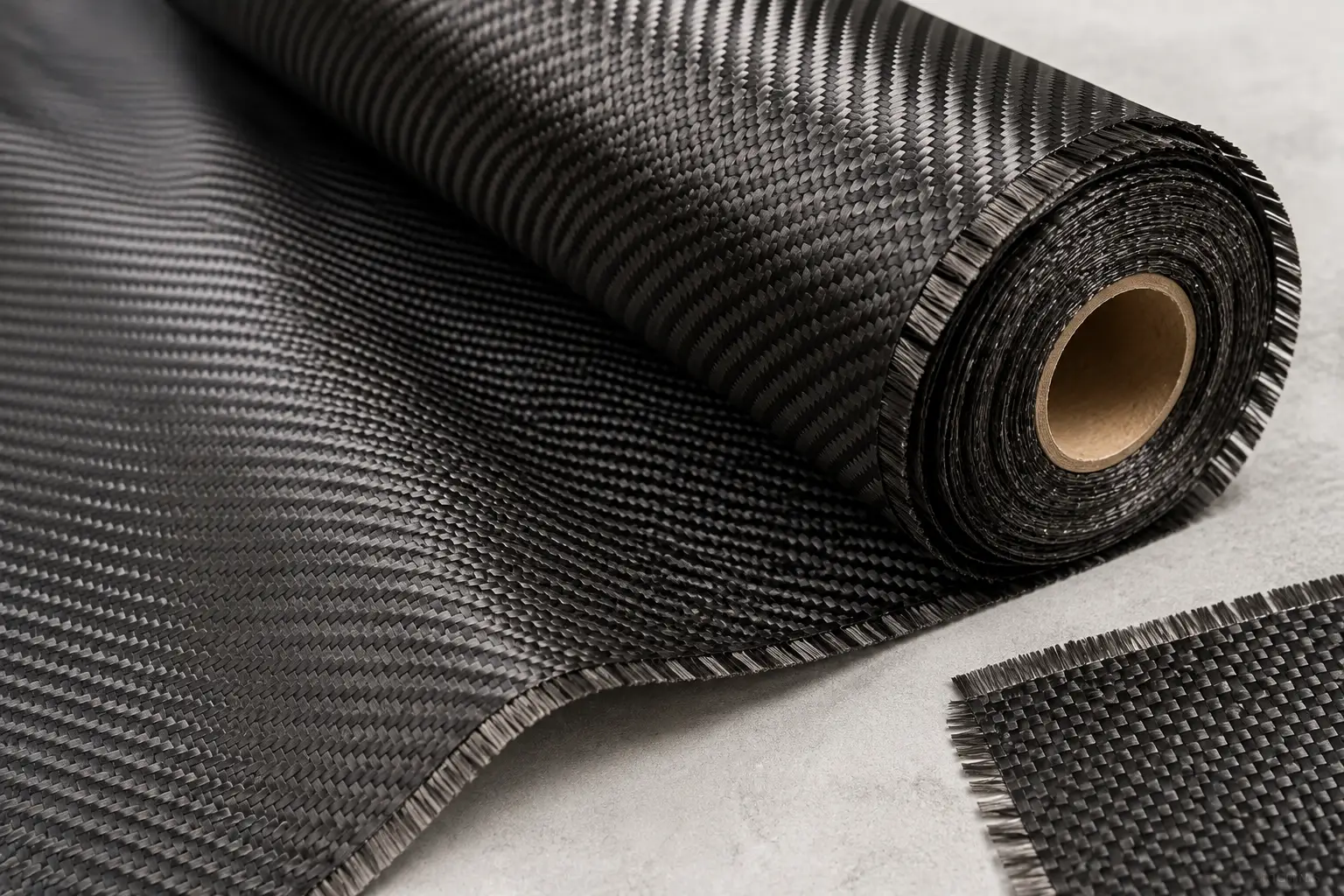
Carbon cloth fabric is a woven textile made from thousands of thin carbon fiber filaments — commonly bundled in tows of 3,000 strands, known as “3K” — arranged in patterns like plain weave or 2×2 twill and combined with resin to form a rigid, lightweight composite part. On its own, dry carbon cloth fabric is flexible and drapeable; its strength only emerges once it’s saturated with resin and cured.
The material’s core appeal is its strength-to-weight ratio: a cured carbon fiber composite panel can rival or exceed the stiffness of comparably sized steel or aluminum at a fraction of the weight, which is why it shows up in everything from aerospace components to bicycle frames to structural reinforcement wraps. The two most common weaves you’ll encounter when buying carbon cloth fabric are plain weave — a simple over-under pattern that resists distortion and fraying — and 2×2 twill, which drapes better over curves and produces the diagonal pattern most people associate with “carbon fiber look.”
How to Choose Carbon Cloth Fabric: 7 Criteria That Actually Matter
Picking the right carbon cloth fabric comes down to matching a handful of specs to your actual project, not chasing the lowest price per yard.
- Weave type — Plain weave resists distortion and is easier for beginners; 2×2 twill drapes better over curves and looks more “finished” for cosmetic work.
- Weight (oz or gsm) — Lighter fabrics (4-6 oz) suit hobby and small parts; heavier fabrics (8 oz+) or multiple plies suit structural applications.
- Tow size — 3K is the most common and easiest to work with by hand; larger tows like 6K or 12K are typically reserved for bigger structural layups.
- Fiber traceability — Named specifications like Toray T300 offer documented mechanical properties; unbranded “3K carbon fiber” listings don’t.
- Format — Precut sheets suit small, defined parts; rolls make sense once you know your yardage needs across multiple pieces.
- Resin compatibility — Confirm your resin system is rated for the weight and application before buying, especially for structural reinforcement work.
- Budget realism — Domestic, traceable fabrics cost more per yard; budget imports work fine for lower-stakes cosmetic or hobby projects.
Working through this checklist before you buy prevents the single most common mistake in this category: buying based on price per yard alone, without matching weave and weight to what the finished part actually needs to do.
Carbon Cloth Fabric vs Fiberglass Cloth: Which Should You Use?
Carbon fiber cloth and fiberglass cloth solve overlapping problems but aren’t interchangeable, and the choice usually comes down to strength-to-weight needs versus budget.
| Factor | Carbon Fiber Cloth | Fiberglass Cloth |
|---|---|---|
| Strength-to-weight | Higher | Lower |
| Cost per yard | Higher | Significantly lower |
| Flexibility | Stiffer, more brittle under impact | More impact-tolerant |
| Finished look | Distinct woven pattern | Translucent, paintable |
| Electrical conductivity | Conductive | Non-conductive |
The stiffness advantage of carbon fiber cloth is real, but it comes with a genuine trade-off worth weighing: fiberglass tends to absorb impact and flex rather than crack, while carbon composite parts can fail more abruptly under a sharp hit. For anything mounted where impact resistance matters more than raw stiffness — think small boat hulls or parts that regularly take knocks — fiberglass cloth remains a legitimate choice, and it’s meaningfully cheaper per finished part. Where carbon cloth fabric earns its premium is anywhere weight savings translate directly into performance, like drone frames, bike components, or automotive panels where every ounce counts.
💬 Still deciding? Compare a few of these picks side by side before you commit to a roll. 😊
Common Mistakes to Avoid When Buying Carbon Cloth Fabric
Even experienced DIYers trip up on a handful of predictable errors when shopping for carbon cloth fabric. The most frequent is buying by price per yard without checking weave and weight against the actual part — a bargain 220 gsm twill isn’t a bargain if your project genuinely needed a lighter, more drapeable plain weave.
A second common mistake is underestimating yardage needs and having to place a second order mid-project, often from a different batch that doesn’t quite match the weave tension of the first roll — a real risk with budget imports where batch consistency varies more than with traceable, named fiber specs. Buyers also frequently skip checking resin compatibility, assuming any epoxy will work with any carbon cloth fabric, when in fact resin viscosity and cure profile should match the fabric weight and intended application, particularly for structural reinforcement work. Finally, plenty of first-timers order a bulk roll to save money per yard, only to realize a precut sheet or 1-yard cut would have suited their single small project far better — bulk pricing only pays off if you’ll actually use the extra material.
Safety, Regulations, and Standards for Working With Carbon Cloth Fabric
Working with carbon cloth fabric involves two distinct hazard categories: resin chemical exposure during layup, and fine carbon dust exposure during sanding or cutting cured parts. According to OSHA’s technical manual on health hazards, epoxy resin systems can cause skin and respiratory sensitization with repeated exposure, which means nitrile gloves and adequate ventilation aren’t optional extras — they’re baseline precautions for any layup session, regardless of how small the project is.
Cured carbon fiber dust generated during sanding is a mechanical irritant and, per CDC/NIOSH respirator guidance, fine composite dust should be treated with an appropriately rated particulate respirator rather than a basic dust mask, especially during extended sanding sessions. There’s no federal certification standard specifically for hobbyist carbon cloth fabric itself, but if you’re using it for structural reinforcement on a building, local building codes and a licensed structural engineer’s sign-off matter far more than any product spec sheet — carbon fiber reinforcement is a legitimate engineering technique, but it needs to be specified and installed correctly to actually deliver the strength gain a structure needs.
Long-Term Cost, Storage, and Care for Carbon Cloth Fabric
Unopened carbon cloth fabric stores well almost indefinitely if kept dry, away from direct sunlight, and rolled rather than folded to avoid permanent creases that distort the weave. The dry fabric itself doesn’t degrade the way resin does, so buying slightly more than a single project needs isn’t necessarily wasteful — provided you have a realistic future project in mind rather than stockpiling on a whim.
| Consideration | Budget Import (e.g., Kinlop, BONT) | Domestic/Traceable (e.g., Rock West, Aerospace Grade) |
|---|---|---|
| Upfront cost | Lower | Higher |
| Batch consistency | Variable | Reliable |
| Best long-term use | One-off, lower-stakes projects | Repeat production, structural work |
| Total cost across multiple parts | Can rise with reorders/waste | More predictable |
For a one-off project, the lower upfront cost of a budget import like Kinlop Carbon Fiber Fabric or BONT Carbon Fiber Cloth Sheet is the more rational choice, since any batch inconsistency only affects a single build. For anyone producing the same part repeatedly — a small manufacturer or a builder making multiple identical components — the higher per-yard cost of Rock West Composites Carbon Fiber Fabric often works out cheaper over time, since consistent batches mean fewer failed parts and less wasted resin.
Frequently Asked Questions
❓ Is carbon cloth fabric hard to work with for beginners?
❓ Can carbon cloth fabric be used for car body panels?
❓ How much carbon cloth fabric do I need for a small project?
❓ Is carbon fiber cloth stronger than fiberglass cloth?
❓ Do I need special resin for carbon cloth fabric?
Conclusion
Choosing the right carbon cloth fabric ultimately comes down to matching weave, weight, and traceability to what your project actually demands, rather than defaulting to whatever roll shows up first in a search. For a first small part, the Fibre Glast Carbon Fiber Cloth Mat or BONT Carbon Fiber Cloth Sheet keep the entry cost low and the learning curve manageable. For visible automotive or bulk hobby work, the Fiberglass Warehouse Carbon Fiber Cloth delivers the classic twill look at a reasonable per-yard cost once you’re buying by the roll. And for anyone who needs documented, repeatable mechanical properties — professional builds, aerospace-adjacent projects, or repeat production — the Rock West Composites Carbon Fiber Fabric and Aerospace Grade Carbon Fiber Cloth justify their premium through traceability alone.
Whichever pick fits your project, remember that the fabric itself is only half the equation — a compatible resin system, careful cutting, and proper safety precautions during sanding matter just as much as the spec sheet. Take the time to match your choice to the checklist above, and you’ll avoid the most common (and most expensive) mistakes first-time carbon fiber builders make.
✨ Ready to start your next build?
🔍 Browse the full lineup above and pick the carbon cloth fabric that matches your project’s weight, weave, and budget. A little research now saves a wasted roll later!
Recommended for You
- Dust Rag: 7 Best Options for a Cleaner Home in 2026
- 7 Best Glass Cleaners for Cars in 2026 (Streak-Free & Tint-Safe Picks)
- Auto Dashboard Cleaner: 7 Best Picks to Stop Fading (2026)
Disclaimer: This post contains affiliate links. As an Amazon Associate, I earn from qualifying purchases made through these links, at no additional cost to you.
✨ Found this article helpful? Share it with someone who needs it! 💬🤗