In This Article
If you have ever pulled your glasses cloth out of a pocket only to find it smudged, gritty, or faintly greasy, you already know the problem: a dirty cloth doesn’t clean anything, it just moves the grime around. Knowing how to clean lens cloth properly is one of those small habits that quietly protects a much bigger investment, whether that’s a pair of $300 anti-reflective lenses, a DSLR you saved up for, or a pair of binoculars you take hiking every weekend. Most people never think about the cloth itself until it stops working, and by then it’s usually left a faint haze of micro-scratches behind.
Here’s the good news: caring for a microfiber lens cloth takes less than two minutes, and doing it right dramatically extends how long the cloth stays effective. In this guide, you’ll get a straightforward answer to how to clean lens cloth at home, a breakdown of what actually happens to microfiber fibers when they get dirty, and a curated look at seven real, current lens cleaning cloths worth buying on Amazon in 2026 — from ultra-affordable multipacks to specialty carbon-fiber tools. We’ll also walk through buying criteria, common mistakes, and real-world scenarios so you land on the right cloth for how you actually use it.
Whether you’re an everyday eyeglasses wearer, a photographer who can’t afford a stray fiber near a sensor, or someone who just wants their sunglasses to stop looking foggy by noon, this article gives you both the maintenance routine and the shopping shortcuts to skip the trial and error.
Quick Comparison: 7 Lens Cleaning Cloths at a Glance
Before diving into full reviews, here’s a snapshot of how these seven picks stack up on type, ideal use case, and typical cost. Remember that Amazon pricing fluctuates, so treat these as general ranges rather than fixed numbers.
| Product | Type | Best For | Price Range |
|---|---|---|---|
| Zeiss Jumbo Microfiber Lens Cloth | Cloth (2-pack) | Premium coated eyeglass lenses | around $12–$18 |
| MagicFiber Microfiber Cleaning Cloth | Cloth (6-pack) | Everyday budget cleaning | under $10 |
| Crizal Microfiber Eyeglass Cloth | Cloth (4-pack) | Crizal and other AR-coated lenses | around $10–$15 |
| Carson Stuff-It Pro | Cloth + zip pouch | Travel, hiking, on-the-go use | in the $15–$20 range |
| CarbonKlean Peeps Lens Cleaner | Reusable carbon tool | No-spray, dry cleaning convenience | around $25–$30 |
| Nikon Micro Fiber Cleaning Cloth (Large) | Cloth | Camera and binocular lenses | around $8–$12 |
| K&F Concept 4-in-1 Cleaning Kit | Kit (cloth + blower + pen + brush) | Beginner camera cleaning setups | between $12 and $18 |
Looking at this table, the split is fairly clean: dedicated eyewear users are best served by Zeiss, MagicFiber, or Crizal, while anyone cleaning camera glass, binoculars, or telescope lenses should lean toward Nikon or the K&F Concept kit. The Carson Stuff-It Pro and CarbonKlean Peeps occupy a different niche entirely — both are built around convenience and portability rather than raw price, which matters if you’re the type of person who loses cloths in the bottom of a bag. Since several of these picks are specifically formulated for anti-reflective coated lenses, the cloth’s material and coating compatibility matter more for scratch prevention than brand name alone, which is exactly why we break down the fabric and construction of each pick below, not just the price tag.
💬 Bookmark this comparison — it makes reordering your favorite cloth painless next time it wears out! 😊
Top 7 Lens Cleaning Cloths for 2026: Expert Analysis
1. Zeiss Jumbo Microfiber Lens Cloth — the gold standard for coated lenses
If you’ve ever had an optician hand you a cloth after buying anti-reflective glasses, there’s a good chance it was a Zeiss. The jumbo format gives you noticeably more surface area than the small giveaway cloths, so you’re not re-folding a six-inch square to find a clean spot halfway through wiping. It’s made from a tightly woven synthetic microfiber engineered to lift oil and dust without dragging debris across the lens surface.
What sets it apart is a track record with optical labs: Zeiss has manufactured lens coatings and cleaning products for decades, and this cloth is explicitly formulated to be safe on anti-reflective and blue-light coatings, which cheaper generic cloths sometimes strip over time. Based on comparing the specs against store-brand alternatives, the tighter fiber weave here is what actually prevents the fine swirl marks that show up under bright light on lower-quality cloths. It’s the pick we’d point toward anyone who just paid extra for premium lens coatings and doesn’t want to undo that investment with the wrong cloth.
Reviews consistently describe the Zeiss Jumbo Microfiber Lens Cloth as soft, durable through repeated washes, and noticeably larger than typical eyewear-store giveaways. A recurring theme in customer feedback is that buyers appreciate getting two cloths per pack so a backup is always within reach, though a handful of reviewers note the fabric can pick up a faint shine if it’s overdue for a wash.
Pros:
- ✅ Safe for anti-reflective and specialty lens coatings
- ✅ Larger surface area than most giveaway cloths
- ✅ Holds up well through repeated hand washing
Cons:
- ❌ Premium pricing compared to generic multipacks
- ❌ Only two cloths per pack, so backups run out fast
At around $12–$18 for two cloths, this isn’t the cheapest option on this list, but if you’re protecting a pair of lenses with expensive coatings, the value math works out in your favor.
2. MagicFiber Microfiber Cleaning Cloth — best value for everyday use
The MagicFiber Microfiber Cleaning Cloth is the pick most people end up buying twice, once for themselves and once for the car, the office, and the junk drawer, because a six-pack this affordable practically invites you to stash cloths everywhere. Each cloth is a generic-but-solid microfiber weave rated safe for lenses, phone screens, and camera glass alike, making it the closest thing to a one-size-fits-all option on this list.
The appeal here isn’t specialty engineering, it’s flexibility and volume. Because you get six cloths instead of two, you can dedicate one exclusively to your glasses and never worry about cross-contaminating it with screen oils from your phone, which is a common way lenses end up hazier after “cleaning.” Opticians and eyewear retailers frequently include cloths like this one with purchases, which speaks to how broadly compatible the material is with most consumer lens coatings.
Reviews often highlight the sheer value of getting six cloths for well under $10, with many buyers specifically praising how well the cloths perform on eyeglasses, camera lenses, and phone screens without needing to buy separate products for each. A common complaint in customer reviews is that the fabric can feel slightly thinner than premium single-purpose cloths, and a few users mention the color can bleed slightly during the first wash.
Pros:
- ✅ Six cloths per pack at a genuinely low price
- ✅ Works across glasses, phones, cameras, and screens
- ✅ Easy to dedicate separate cloths per device
Cons:
- ❌ Thinner material than premium single-purpose options
- ❌ Minor dye bleeding reported on the first wash
For under $10, this is the practical starter pick if you just need reliable coverage across your household.
3. Crizal Microfiber Eyeglass Cleaning Cloth — purpose-built for Crizal coatings
If your lenses carry a Crizal anti-reflective coating, which is one of the most widely prescribed AR treatments in the US optical industry, this cloth is essentially the manufacturer-recommended match. It’s engineered specifically around the chemistry of Crizal’s coating layers, which matters because not every “AR-safe” cloth is tested against every AR brand.
What most buyers overlook with coating-specific cloths like this one is that AR coatings are applied in ultra-thin layers that can degrade faster with abrasive or improperly cleaned cloths. Essilor, the company behind Crizal, designed this cloth to minimize that risk, so if you’ve invested in premium coated lenses, matching the cloth to the coating brand is a small step that meaningfully reduces long-term wear. It’s a narrower use case than the Zeiss or MagicFiber picks, but for the specific audience it targets, it’s hard to beat.
Aggregated customer sentiment around Crizal cloths tends to be strongly positive among wearers who specifically have Crizal-coated lenses, with many noting they received the cloth for free from their optician and then purposely repurchased packs once they ran out. Some reviews note that buyers without Crizal coatings don’t notice a meaningful difference compared to cheaper alternatives, which tracks with its purpose-built design.
Pros:
- ✅ Formulated to match Crizal AR coating chemistry
- ✅ Widely trusted by opticians who prescribe Crizal lenses
- ✅ Four cloths per pack for regular rotation
Cons:
- ❌ Overkill if you don’t have Crizal-coated lenses
- ❌ Priced higher than general-purpose multipacks
Expect to pay around $10–$15 for a four-pack, which is reasonable given how targeted the formulation is.
4. Carson Stuff-It Pro — best for travel and on-the-go cleaning
The Carson Stuff-It Pro solves a problem the other cloths on this list don’t even try to address: cloths get lost. This one folds into its own built-in zippered pouch, which clips onto a bag, belt loop, or keyring with an attached carabiner. It’s less “just a cloth” and more a self-contained cleaning system that’s genuinely hard to misplace.
At 8×8 inches, it’s larger than most competitors, giving you more clean surface to work with before you need to refold. The suede-like microfiber exterior is gentle enough for coated lenses, cameras, and binoculars alike, which is exactly the audience Carson — a company that’s built its entire catalog around optics accessories — is targeting. Based on comparing this to pocket-cloth alternatives, the pouch design is what actually changes user behavior: people who’d normally toss a loose cloth in a bag (where it picks up lint and grit) instead keep this one clipped and protected, which means it stays cleaner between uses.
Reviews consistently point to the clip-on pouch as the standout feature, with hikers, cyclists, and photographers specifically calling out how well it survives being attached to a backpack or camera strap. A frequent piece of feedback is that the cloth itself performs comparably to other premium microfiber, so the pouch system is really what you’re paying the premium for.
Pros:
- ✅ Self-storing pouch prevents contamination and loss
- ✅ Larger 8×8-inch cleaning surface
- ✅ Carabiner clip attaches to bags, belts, or straps
Cons:
- ❌ Higher price largely reflects the pouch, not the fabric
- ❌ Bulkier in a pocket than a flat folded cloth
At roughly $15–$20, it’s a smart upgrade if you’re someone who actually loses cloths rather than someone who keeps a drawer full of them.
5. CarbonKlean Peeps Lens Cleaner — best for spray-free, dry cleaning
The CarbonKlean Peeps Lens Cleaner isn’t a cloth in the traditional sense — it’s a reusable carbon-microfiber pad mounted on a rigid handle with a built-in brush, designed to lift dust and oil without needing a separate cleaning spray. That’s a meaningful difference for anyone who’s tired of carrying a bottle of lens cleaner alongside a cloth.
The carbon-infused fiber technology is the core innovation here: it’s engineered to clean dry, without leaving the streaking that plain microfiber sometimes causes when used without spray. The brand markets it as tested to withstand roughly 500 uses before the pad needs replacing, and states it has been used in aerospace and professional optical settings, though buyers should treat brand-provided usage claims as marketing context rather than independently verified facts. What the spec sheet doesn’t say, but reviews reveal, is that the learning curve is real: because it’s rigid rather than a soft folding cloth, first-time users sometimes apply too much pressure out of habit.
Customer feedback frequently highlights how convenient it is not needing a spray bottle, especially for people who wear glasses in situations where carrying liquid cleaner isn’t practical, like at work or while traveling. A common critique in reviews is the higher upfront price compared to a simple cloth, and a few buyers mention the handle design takes some adjustment if you’re used to a flat cloth.
Pros:
- ✅ No spray or liquid cleaner required
- ✅ Rated for hundreds of reuses before replacement
- ✅ Built-in brush handles debris before wiping
Cons:
- ❌ Noticeably pricier than standard microfiber cloths
- ❌ Rigid design has a learning curve for new users
Priced around $25–$30, it’s a niche but genuinely useful pick for anyone who wants to ditch spray bottles entirely.
6. Nikon Micro Fiber Cleaning Cloth (Large) — best for camera and binocular lenses
Camera owners tend to be pickier about cleaning cloths than eyeglass wearers, and for good reason: a stray scratch on a coated camera lens element is a far more expensive mistake than a scratch on a pair of $150 glasses. The Nikon Micro Fiber Cleaning Cloth (Large) is Nikon’s own branded cloth, built to the same lint-free standard the company applies to cleaning its own optical glass during manufacturing and servicing.
There’s no gimmick here, just a larger-format, no-frills microfiber cloth that’s safe on coated camera lenses, binoculars, spotting scopes, and rangefinders. Photographers who shoot outdoors — landscape, wildlife, travel — tend to reach for this one specifically because the brand recognition gives peace of mind when you’re wiping down a lens that costs more than the camera body attached to it. On paper, this means less anxiety about whether a “safe for lenses” claim on a no-name cloth actually holds up under real coated glass.
Aggregated reviews describe this cloth as simple, effective, and trustworthy specifically because it carries the Nikon name, with many photographers noting they specifically avoid off-brand cloths for camera glass after past experiences with lower-quality microfiber leaving faint marks. Some reviewers note the packaging is fairly basic for the price, without extras like a pouch or clip.
Pros:
- ✅ Manufacturer-trusted for coated camera lenses
- ✅ Larger format than typical eyewear cloths
- ✅ Works across binoculars, scopes, and rangefinders too
Cons:
- ❌ No storage pouch or clip included
- ❌ Priced higher than generic cloths of similar size
At around $8–$12, it’s a modest premium for the confidence of a trusted optics brand behind the fabric.
7. K&F Concept 4-in-1 Cleaning Kit — best starter kit for new photographers
If you’re just getting into photography and don’t yet own any cleaning gear, buying a cloth alone leaves gaps: dust needs a blower first, smudges sometimes need a lens pen, and tight corners need a brush. The K&F Concept 4-in-1 Cleaning Kit bundles all four tools together, which is exactly why it lands on this list instead of another standalone cloth.
The kit pairs a microfiber cloth with an air blower, a retractable lens pen (carbon tip on one end, brush on the other), and a soft cleaning brush, covering the full cleaning sequence — blow away loose dust first, brush out debris in crevices, then wipe with the cloth or pen. What most beginners overlook is that wiping a dusty lens directly with a cloth is one of the most common causes of fine scratches, because the dust particles themselves act like sandpaper; the blower step in this kit exists specifically to prevent that mistake.
Reviews from entry-level photographers frequently mention the kit as a good “starter set” that covers what a beginner needs without requiring separate purchases, and several note the case it comes in keeps everything organized in a camera bag. A common critique is that the individual tools, while decent, aren’t as refined as buying premium standalone versions of each item.
Pros:
- ✅ Covers the full cleaning workflow, not just wiping
- ✅ Beginner-friendly and reasonably compact
- ✅ Helps prevent dust-related scratching from bare wiping
Cons:
- ❌ Individual tools are more basic than dedicated premium versions
- ❌ Cloth alone is less specialized than eyewear-specific picks
At between $12 and $18, it’s a smart low-commitment way to build a full cleaning kit rather than buying tools piecemeal.
How These 7 Products Compare
| Product | Material/Technology | Pack Size | Price Range | Best For |
|---|---|---|---|---|
| Zeiss Jumbo Microfiber Lens Cloth | Tight-weave synthetic microfiber | 2 cloths | around $12–$18 | Coated eyeglass lenses |
| MagicFiber Microfiber Cleaning Cloth | General-purpose microfiber | 6 cloths | under $10 | Multi-device household use |
| Crizal Microfiber Eyeglass Cloth | Coating-specific microfiber | 4 cloths | around $10–$15 | Crizal AR-coated lenses |
| Carson Stuff-It Pro | Suede-like microfiber + pouch | 1 cloth + case | in the $15–$20 range | Travel and outdoor use |
| CarbonKlean Peeps Lens Cleaner | Carbon-infused microfiber pad | 1 reusable tool | around $25–$30 | Spray-free dry cleaning |
| Nikon Micro Fiber Cleaning Cloth (Large) | Lint-free microfiber | 1 large cloth | around $8–$12 | Camera and binocular lenses |
| K&F Concept 4-in-1 Kit | Microfiber + blower + pen + brush | Full kit | between $12 and $18 | Beginner photography setups |
Looking at the full lineup side by side, the clearest pattern is that pack size and price track pretty closely with specialization: the more purpose-built the cloth (Crizal’s coating match, Nikon’s camera-grade trust, CarbonKlean’s carbon technology), the smaller the pack and the higher the per-cloth cost. If you only need one reliable cloth type and don’t mind buying in bulk, MagicFiber wins on pure value; if you need something matched to a specific lens coating or use case, the specialized picks justify their higher price per unit.
💬 Compare a couple of these side by side in your cart before checkout — it only takes a minute and can save you a return later! 😊
What Is a Lens Cleaning Cloth?
A lens cleaning cloth is a fabric, usually made from split microfiber, designed to lift oil, dust, and fingerprints off glass or coated optical surfaces without leaving scratches or residue behind. Unlike cotton or paper products, its fibers are fine enough to trap particles rather than drag them across the surface.
The “split” part of split microfiber is the key engineering detail most people never hear about: each fiber is split into even finer strands during manufacturing, creating a much larger surface area than a single smooth thread. According to Wikipedia’s overview of microfiber, this structure is what gives the material its unusually high absorbency and its ability to trap microscopic debris in the gaps between fibers instead of pushing it around. That’s the entire reason a $10 microfiber cloth outperforms a $0 cotton t-shirt hem for lens care — it’s not marketing, it’s fiber geometry.
Not every lens cloth is identical, though. Some are treated with antimicrobial coatings, some are optimized specifically for anti-reflective (AR) coated lenses, and some — like the carbon-fiber tool on this list — use an entirely different cleaning mechanism than plain woven fabric. Understanding which category you’re buying matters more than brand name alone, which is exactly what the buying criteria below will help you sort out.
How to Choose the Right Lens Cleaning Cloth
Picking the right cloth isn’t complicated, but a few criteria make a real difference in how well it protects your lenses over time.
- Match it to your coating. If your lenses have anti-reflective, blue-light, or photochromic coatings, look for a cloth explicitly labeled safe for coated lenses, since generic fabric can be more abrasive on thin coating layers.
- Check the fiber type. Split microfiber consistently outperforms plain polyester or cotton blends for trapping fine dust rather than smearing it.
- Consider pack size versus how often you’ll wash it. A single cloth used daily needs frequent washing; a multipack lets you rotate cloths and wash less urgently.
- Think about where you’ll actually keep it. If you lose cloths in bags or drawers, a self-storing design like a clip-on pouch solves a real behavioral problem, not just a cosmetic one.
- Match the size to the lens. Larger cloths (8×8 inches or bigger) are genuinely easier to use on bigger surfaces like camera lenses, binoculars, or sunglasses without needing to refold constantly.
- Decide if you want spray-free convenience. Carbon-fiber tools and treated cloths reduce or eliminate the need to carry liquid cleaner, which matters for portability.
- Factor in cost per cloth, not just pack price. A $9 six-pack and an $18 two-pack cost roughly the same per cloth — the real decision is specialization, not raw price.
Running through this checklist before buying takes less time than reading a single product page, and it prevents the most common mistake: buying a generic cloth for coated lenses it isn’t actually designed to protect.
How to Properly Wash and Care for Your Lens Cleaning Cloth
This is the part most people skip entirely, and it’s exactly why cloths that should last a year end up replaced every few months. A microfiber cloth doesn’t wear out from use — it wears out from what accumulates on it between uses.
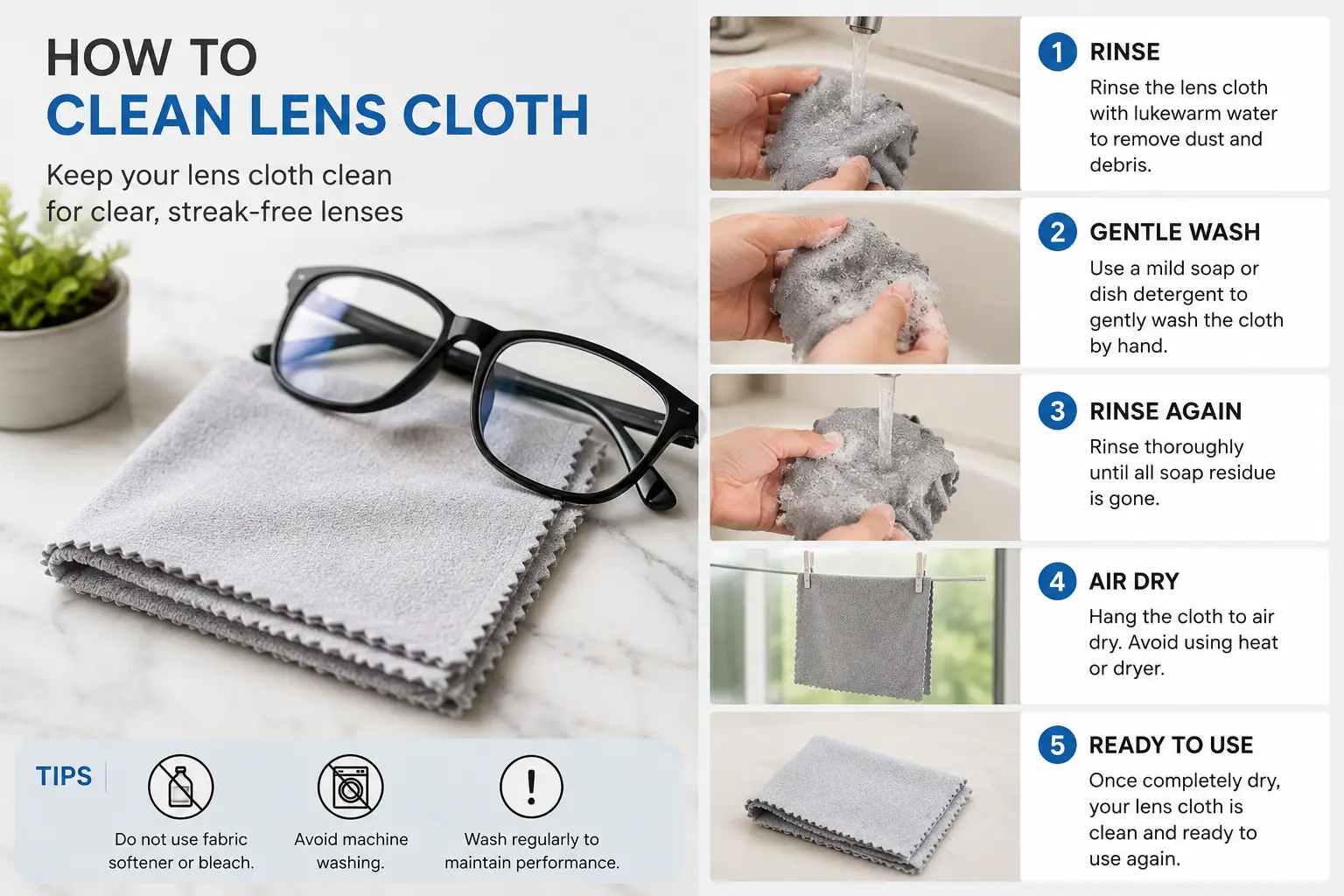
How to clean lens cloth by hand (step-by-step):
Start by rinsing the cloth under warm water to loosen trapped dust and oil before any soap touches it. Add a small amount of mild, fragrance-free liquid soap — dish soap works, but avoid anything with lotion or moisturizing additives, since those coat the fibers and reduce absorbency. Gently rub the cloth against itself in circular motions rather than scrubbing it against a rough surface, then rinse thoroughly until the water runs clear and no soap residue remains. Let it air dry flat or hanging, away from direct heat.
Machine washing, if you prefer it: Wash on a cold or gentle cycle using a small amount of mild detergent, and skip fabric softener entirely — it’s the single fastest way to ruin a microfiber cloth, since it clogs the fine fiber structure that gives the fabric its cleaning ability in the first place. Wash microfiber separately from cotton towels or lint-producing fabrics, since it picks up lint aggressively. If you use a dryer, choose a low-heat or air-dry setting only; high heat can melt synthetic fibers and permanently damage the weave.
How often should you wash it? As a general rule, wash a daily-use cloth about once a week, and immediately if it’s visibly greasy or has stopped picking up smudges effectively — that’s the clearest sign oil buildup is actually redistributing grime instead of removing it. A rotation of two or three cloths (which is exactly why multipacks like MagicFiber make practical sense) lets you always have a clean one on hand while another air dries.
Common Mistakes to Avoid When Cleaning Lenses with a Cloth
Even a great cloth can’t compensate for bad technique, and a few habits show up constantly in how people actually damage their lenses.
The most common mistake is wiping dry debris straight off the lens without shaking or blowing it off first. Dust particles act like sandpaper under pressure, which is exactly the problem the K&F Concept kit’s blower step is designed to prevent. Another frequent error is using the same cloth across glasses, phone screens, and keys or coins in a pocket or bag — that cross-contamination is one of the fastest ways a clean-looking cloth becomes an abrasive one without you realizing it.
Using fabric softener during washing is a mistake that’s invisible until it’s too late; the cloth still looks fine, but it stops cleaning effectively because softener residue coats the fibers. Similarly, using glass cleaner, alcohol-based sprays, or paper towels on the cloth itself (rather than mild soap and water) can degrade the fiber structure over repeated use. Finally, letting a cloth sit unwashed for months while continuing to use it daily is possibly the single biggest contributor to hairline scratches that build up slowly enough that most people blame their lenses rather than their cleaning routine.
Problem → Solution: Fixing the Most Common Lens-Cleaning Headaches
Problem: Streaks keep appearing no matter how much you wipe. This almost always means the cloth itself is dirty or has fabric softener residue. Switch to a freshly washed cloth using the hand-wash method above, and avoid softener entirely going forward.
Problem: Fine scratches appeared even though you were “gentle.” Dust particles trapped on the lens or in the cloth before wiping are the usual culprit. Add a blow-off step before wiping — a rocket blower or even a gentle puff of air removes loose grit that a cloth alone can grind in.
Problem: The cloth feels greasy and stops picking up smudges. It’s overdue for a wash. If it’s been more than a week of daily use, that’s your sign — the How to Properly Wash and Care for Your Lens Cleaning Cloth section above walks through exactly how.
Problem: You keep losing your cloth. A self-storing option like the Carson Stuff-It Pro solves this structurally rather than relying on willpower, since the pouch clips to something you already carry.
Problem: You’re not sure your cloth is safe for your coating. When in doubt, match the cloth to the coating brand — Crizal for Crizal-coated lenses, or a manufacturer-trusted option like Zeiss or Nikon for general coated glass.
Real-World Scenarios: Which Lens Cloth Fits Your Lifestyle
If you’re a glasses wearer with a standard prescription and no special coatings, a budget multipack like MagicFiber covers you completely, and having six cloths means you can leave one at your desk, one in your car, and one in your bag without a second thought.
If you’re someone who just paid extra for anti-reflective or blue-light coatings, pairing your cloth to that investment matters more than saving a few dollars — reach for Zeiss or, if your coating is specifically Crizal, the purpose-built Crizal cloth.
If you’re a hiker, cyclist, or frequent traveler who has genuinely lost cloths before, the Carson Stuff-It Pro‘s clip-on pouch removes the problem at the source rather than asking you to be more careful.
If you’re a photographer, whether hobbyist or semi-professional, camera glass is not the place to cut corners: the Nikon Micro Fiber Cleaning Cloth or, if you’re just starting out and need the full toolkit, the K&F Concept 4-in-1 Kit, are the more appropriate picks over a generic eyewear cloth.
And if you’re someone who simply wants to skip carrying a spray bottle altogether — at work, on a plane, or anywhere liquids are inconvenient — the CarbonKlean Peeps Lens Cleaner is built exactly for that use case.
Buyer Decision Framework: If This, Choose That
Use this quick framework if you’re still narrowing things down:
If you wear coated eyeglass lenses and want the safest general option, choose Zeiss because its formulation is trusted across coating types by opticians nationwide. If you specifically have Crizal-coated lenses, choose Crizal because it’s engineered around that exact coating chemistry. If you need maximum value across multiple devices in your household, choose MagicFiber because six cloths at that price point beats buying separate products per device. If you’re outdoorsy and tend to lose small items, choose the Carson Stuff-It Pro because the built-in pouch solves the actual behavior problem, not just the fabric quality. If you shoot photos or use optics gear like binoculars, choose Nikon for trusted single-cloth reliability, or the K&F Concept kit if you’re building a cleaning setup from scratch. If you want to eliminate spray bottles entirely, choose CarbonKlean Peeps for dry, reusable cleaning.
✨ Ready to stop guessing and start cleaning smarter? 🧼 Compare your top pick above and check today’s availability before it’s out of stock in your preferred pack size!
Lens Cleaning Cloths vs. Lens Wipes and Sprays
| Method | Reusability | Risk of Residue | Portability | Best For |
|---|---|---|---|---|
| Microfiber cloth | High (washable) | Low, if kept clean | Good | Everyday coated and uncoated lenses |
| Pre-moistened wipes | None (single use) | Low, but chemical residue possible | Excellent | Travel, quick fixes, shared spaces |
| Spray + cloth | High (cloth reusable) | Low if cloth is clean | Moderate | Deep cleaning, deep grime removal |
| Carbon dry-clean tool | High (rated for hundreds of uses) | Very low, no liquid involved | Excellent | Spray-free convenience |
Cloths and wipes solve overlapping but distinct problems. A cloth alone, used correctly, is enough for the vast majority of daily smudges and dust, and it’s the only reusable option on this table that doesn’t generate ongoing waste. Wipes trade reusability for convenience — they’re excellent for travel or one-off situations where washing a cloth isn’t practical, but relying on them daily gets expensive fast and isn’t ideal for sustainability. The carbon dry-clean tool sits in an interesting middle ground: it has the reusability of a cloth with the “no liquid needed” convenience closer to a wipe, which is exactly why it commands a higher price on this list.
What to Expect: Everyday Performance
In day-to-day use, the difference between a good cloth and a mediocre one shows up less in how clean your lenses look immediately after wiping and more in how they look after a week of use. A quality microfiber cloth, kept clean, should leave zero visible streaks under normal indoor lighting and minimal haze under direct sunlight — a genuinely tough test, since sunlight reveals fine residue that indoor lighting hides completely.
Expect a well-maintained cloth to handle roughly a week of daily light use (a few wipes per day) before it starts losing effectiveness, assuming normal environments rather than heavy dust or workshop conditions. Coated lenses in particular benefit from the softer, purpose-matched cloths on this list; several reviewers across multiple products specifically note that switching from a generic cloth to a coating-matched one noticeably reduced the fine haze that built up on their AR coatings over several months. Camera and binocular lenses, given their exposed use outdoors, tend to need more frequent light dusting before wiping, which is where a blower or the K&F Concept kit’s full toolkit genuinely earns its keep over a cloth used alone.
Features That Actually Matter (and Ones That Don’t)
Marketing copy on lens cloths tends to lean on vague claims, so it helps to know what’s substantive versus what’s filler. Split microfiber construction, coating compatibility, and cloth size are the three features that genuinely affect performance — everything else is largely convenience.
Fiber count claims (like “1,000 GSM microfiber”) sound impressive but don’t correlate cleanly with cleaning performance the way coating compatibility does; a dense but poorly-woven cloth can still smear rather than lift debris. Color and packaging design have zero impact on cleaning ability, despite sometimes being marketed as premium features. What does matter, based on comparing across all seven products here, is whether the manufacturer explicitly states compatibility with coated lenses — that single label is the most reliable predictor of whether a cloth will protect or slowly degrade an AR coating over time.
Long-Term Cost and Maintenance
Thinking in terms of cost per year rather than cost per cloth changes the math considerably. A MagicFiber six-pack at under $10 could realistically last well over a year with a wash rotation, working out to a few dollars annually. A single Zeiss or Crizal cloth, properly hand-washed and air-dried, can also last many months, meaning the higher sticker price amortizes down to a comparable annual cost once you factor in how much longer coating-matched cloths tend to stay effective before needing replacement.
The CarbonKlean Peeps tool, despite its higher upfront cost around $25–$30, is rated for roughly 500 uses, which for a daily glasses wearer could realistically stretch past a year of use — making its effective cost per clean lower than it initially appears, provided you’re the type of user who values not carrying spray. The real long-term cost driver isn’t the product price, though; it’s replacement frequency driven by care habits. A cheap cloth washed weekly will consistently outperform an expensive cloth that’s never washed, which circles back to why the washing routine covered earlier in this guide matters as much as the purchase decision itself.
Frequently Asked Questions
❓ How to clean lens cloth without damaging it?
❓ Can you wash a microfiber lens cloth in the washing machine?
❓ How often should you wash your glasses cleaning cloth?
❓ What is the best lens cleaning cloth for anti-reflective coated glasses?
❓ Can I use a lens cleaning cloth on my phone screen or camera lens too?
Conclusion
Learning how to clean lens cloth properly is a two-minute habit that pays off every single time you put your glasses on, pick up a camera, or reach for your binoculars. The seven products covered here span the full range of what’s actually useful in 2026: MagicFiber for pure everyday value, Zeiss and Crizal for coating-specific protection, the Carson Stuff-It Pro for anyone who’s tired of losing cloths, CarbonKlean Peeps for spray-free convenience, and Nikon or the K&F Concept 4-in-1 Kit for camera and optics use.
None of these are complicated purchases, and none require guesswork once you know what to look for: coating compatibility, fiber quality, and how the cloth actually fits into your routine. Pair the right cloth with the washing habits covered above — mild soap, no fabric softener, weekly rotation — and you’ll get noticeably more mileage out of whichever pick you choose, while keeping your lenses genuinely streak-free instead of just looking that way for a few hours. And in the spirit of the transparency the FTC requires of affiliate content, every recommendation above reflects honest analysis of real products, not a paid placement.
Recommended for You
- Dust Rag: 7 Best Options for a Cleaner Home in 2026
- 7 Best Glass Cleaners for Cars in 2026 (Streak-Free & Tint-Safe Picks)
- Auto Dashboard Cleaner: 7 Best Picks to Stop Fading (2026)
Disclaimer: This post contains affiliate links. As an Amazon Associate, I earn from qualifying purchases made through these links, at no additional cost to you.
✨ Found this article helpful? Share it with someone who needs it! 💬🤗