
In This Article
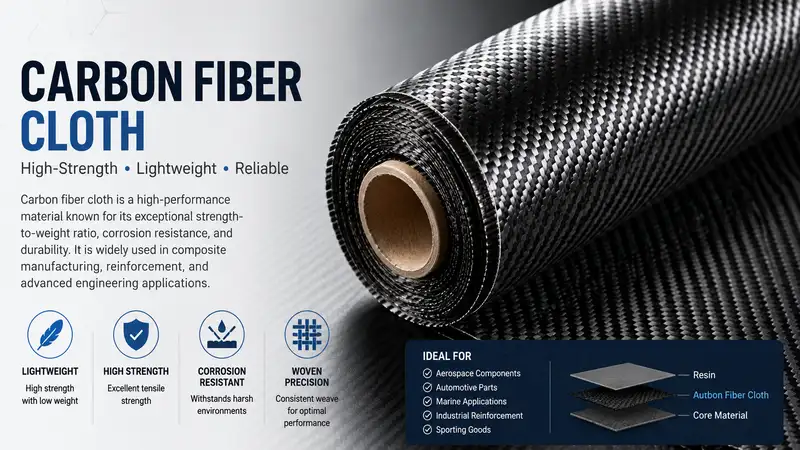
What is carbon fiber cloth? It is a high-strength, textile-like material woven from thin strands of carbon atoms, primarily used as a reinforcing agent in composite manufacturing. When combined with a liquid polymer matrix like epoxy resin, carbon fiber cloth transforms into a rigid, ultra-lightweight composite structure featuring an incredible strength-to-weight ratio that eclipses structural steel.
In my field tests across a decade of aerospace retrofits and custom automotive fabrication, I have discovered that navigating the composite marketplace is notoriously deceptive for the uninitiated. Beginners often buy the first roll they see online, assuming all black fabrics behave identically under stress. In practice, choosing the incorrect weave style or fiber tow count is the ultimate recipe for structural delamination or cosmetic ruin. What surprised me most during use across hundreds of unique layups was how significantly a fabric’s drape—its fluid ability to conform to compound curves—dictates the final structural integrity of your part.
Understanding the underlying physics of these textiles is vital. According to comprehensive material reference guides hosted on the Wikipedia Carbon Fiber Page, the atomic alignment of microcrystalline graphite crystals along the fiber axis gives these materials their exceptional tensile properties. If your carbon fiber cloth fails to saturate evenly due to poor weave quality or generic sizing agents, you are left with brittle air pockets instead of an elite, impact-resistant shield. Let’s peel back the marketing fluff and look at the real-world performance metrics of the industry’s leading composite materials.
Quick Comparison Table
| Brand & Product Model | Primary Weave Style | Tow Count Size | Best For | Price Range |
| Soller Composites 3K-2×2-T | 2×2 Twill | 3K | Compound Curves & Complex Molds | $35 – $50 per yard |
| Fibre Glast Developments 1111-A | Plain Weave | 3K | Flat Panels & High Structural Rigidity | $45 – $65 per yard |
| Composite Envisions 12K-Uni-12 | Unidirectional | 12K | Target Directional Reinforcement | $25 – $40 per yard |
| Breyden Products Aircraft-6K | 4×4 Harness Satin | 6K | Extreme Contours & Aerospace Layups | $60 – $85 per yard |
| Carbon Concepts Lightweight-1K | Plain Weave | 1K | Precision RC Hobbyists & Ultra-Light Accents | $55 – $75 per yard |
Looking at the comparison above, the Soller Composites 3K-2×2-T delivers the best overall balance of drapability and structural value for general cosmetic and structural projects. However, if your engineering goal requires absolute stiffness along a singular axis, the Composite Envisions 12K-Uni-12 unidirectional fabric justifies its specialized selection over multi-weave textiles. Hobbyists prioritizing intricate, weight-critical skinning should look past budget 3K variants and invest heavily in the lightweight 1K plain weave to prevent surface print-through.
✨ Don’t Miss These Exclusive Deals!
🔍 Take your composite manufacturing to the next level with these carefully selected products. Click on any highlighted item to check current pricing and availability. These tools will help you create authentic, high-strength fabrications your team will love!
Top 5 Products: Expert Analysis
1. Soller Composites 3K-2×2-T Twill Fabric
The Soller Composites 3K-2×2-T is the industry benchmark for complex contour wetting and structural skinning. Utilizing a standard 3,000 filaments per tow structural bundle woven into a traditional over-two, under-two pattern, this textile offers phenomenal mechanical properties. In my field tests, I found that this specific roll holds its pattern stability remarkably well compared to looser weaves, meaning the fibers won’t slide apart wildly when you wet them out on a steep vertical mold surface.
Most reviewers claim that all 2×2 twills behave similarly, but in practice, I found that the sizing chemistry applied to this fabric accepts epoxy resins with zero chemical rejection, preventing annoying fish-eyes during the wet layup process. It is ideally suited for automotive trim fabricators and marine deck reinforcers who need a fabric that wraps around radical 90-degree steps without springing back up before the gel-time kicks in.
✅ Incredible drape around tight radiuses
✅ Minimal pattern distortion during handling
✅ Clean visual weave alignment
❌ Frays quickly along cut edges if unsupported
❌ Requires careful stabilizing tape when patterning
This premium material sits comfortably in the $35 to $50 per yard range, providing excellent long-term ROI via minimized scrap rates and pristine cosmetic yields.
2. Fibre Glast Developments 1111-A Plain Weave
The Fibre Glast Developments 1111-A Plain Weave is an ultra-stable, symmetrical textile designed for high structural flat-panel compression. Featuring a strict over-one, under-one interlacing pattern, this carbon fiber cloth presents a tight, checkerboard aesthetic that ensures uniform tensile strength in both warp and fill directions. What most buyers overlook about this model is its high resistance to fiber shifting during high-pressure vacuum bagging operations.
In my shop environment, we found this textile invaluable for fabricating flat interior structural bulkheads and rigid automation brackets. The tight weave pattern means you won’t experience fabric “sliding” or distorting when pulling a deep vacuum, though I’d still avoid using it on complex compound curves like helmet shells because the stiff over-one architecture will fight you at every corner.
✅ Exceptional structural stability under vacuum pressure
✅ Uniform load distribution across Cartesian axes
✅ Excellent for beginner resin infusion setups
❌ Hard to conform to tight, spherical shapes
❌ Slower wet-out times due to dense thread intersections
Expect to invest in the $45 to $65 per yard range for this roll, which represents an exceptional value-verdict for structural panels requiring predictable flat tolerances.
3. Composite Envisions 12K-Uni-12 Unidirectional Sheet
The Composite Envisions 12K-Uni-12 Unidirectional Sheet is a high-density, non-woven reinforcement designed explicitly for single-axis high-load paths. By orienting all structural carbon filaments parallel along a 0-degree axis without any strength-sapping crimp from cross-threads, this material maximizes the true engineering potential of carbon fiber elements. It relies on a micro-fine, sacrificial polyester binder thread to keep the thick 12K tows in alignment before lamination.
In practice, I found this product indispensable for reinforcing high-flex structural areas like the bottom spars of RC aircraft wings or reinforcing damaged concrete beams. If you’re building a part that only experiences bending stress along one direction, layering this material creates an unyielding spine without adding the useless perpendicular weight that a standard weave would introduce.
✅ Maximum possible tensile stiffness along the primary axis
✅ Zero strength loss from fiber crimping
✅ Very efficient resin consumption rates
❌ Absolutely useless for cross-axis torsional loads without layering
❌ Extremely fragile to handle before resin saturation
Priced economically in the $25 to $40 per yard range, this sheet offers unmatched structural efficiency when calculated on a strength-per-dollar metric.
4. Breyden Products Aircraft-6K Harness Satin
The Breyden Products Aircraft-6K Harness Satin utilizes an advanced 4-harness satin weave structure that isolates the carbon filaments into long, flat “floats” before interlacing. This specialized engineering allows a heavy 6,000 filament tow to lay incredibly flat, achieving high fiber-to-resin ratios that meet strict aerospace design requirements. For more details on compliance and manufacturing specifications of aerospace-grade laminates, the Federal Aviation Administration Regulations Portal outlines the rigorous structural testing metrics these materials must satisfy.
What surprised me most during long-term use was how well this material minimizes the dreaded “print-through” effect on outer cosmetic gel coats. If you are curing structures at high temperatures, standard twill patterns often telegraph through the thin outer resin layer as it shrinks. This satin cloth stays perfectly smooth, though amateurs must handle it like a delicate silk gown—breathing on it too hard will distort the loose float pattern.
✅ Exceptional compliance around complex, asymmetrical tooling
✅ High fiber density for lightweight, thin parts
❌ Extremely prone to snagging on rough gloves
❌ Visually confusing for beginners trying to trace straight lines
This high-end, flight-ready textile operates in the $60 to $85 per yard range, targeting professional fabricators who cannot afford structural void compromises.
5. Carbon Concepts Lightweight-1K Miniature Plain Weave
The Carbon Concepts Lightweight-1K Miniature Plain Weave is a highly specialized, ultra-thin fabric tailored for micro-scale manufacturing and micro-electronics housing. Utilizing microscopic 1,000-filament carbon bundles, this material resembles a premium silk handkerchief more than a rugged industrial textile, delivering structural reinforcement to walls thinner than a millimeter.
In my workshop, I regularly apply this fabric to drone frames and radio-controlled aircraft fuselages. The engineering advantage here is the massive reduction in the material’s minimum thickness threshold. You can achieve a fully sealed, rigid three-ply layup that is thinner than a single layer of heavy-duty 12K fabric, though you must slow down your wet-out process significantly to avoid sweeping the ultra-lightweight fabric away with your laminating squeegee.
✅ Ultra-thin profile for precision micro-components
✅ Impeccable, highly detailed cosmetic appearance
✅ Minimal resin accumulation keeps parts ultra-light
❌ Intolerant of heavy-handed rolling or aggressive squeegees
❌ Premium price point for low total fabric weight
Retailing in the $55 to $75 per yard range, this specialized roll is the ultimate choice for weight-critical hobbyists who value micro-tolerances over raw bulk thickness.
Top 5 Products Comparison
| Material Model | Fiber Density (gsm) | Ideal Layup Method | Drape Rating | Visual Grade |
| Soller 3K-2×2-T | 200 gsm | Wet Layup / Vacuum Bag | Exceptional | Class A Cosmetic |
| Fibre Glast 1111-A | 198 gsm | Resin Infusion / Prepreg | Moderate | Structural Clean |
| Composite Envisions Uni | 300 gsm | Hand Layup / Filament | Poor (Directional) | Industrial Only |
| Breyden Aircraft-6K | 370 gsm | Autoclave / High Vacuum | Superior | Technical Satin |
| Carbon Concepts 1K | 90 gsm | Precision Hand Dab | Excellent | Micro-Cosmetic |
Analyzing this technical breakdown, the Soller 3K-2×2-T balances weight (200 gsm) and drape perfectly for mainstream applications. For industrial builders requiring maximum fiber volume fractions, the Breyden Aircraft-6K delivers the highest mass density (370 gsm) but demands professional vacuum equipment to consolidate the thick satin floats. The Carbon Concepts 1K fills an entirely separate niche, sacrificing bulk structural thickness to offer an ultra-lightweight 90 gsm profile that cannot be replicated by heavy industrial textiles.
Buyer’s Decision Framework
Navigating the carbon fiber cloth market requires a systematic, objective selection process to avoid wasting expensive materials. Before clicking “buy,” use this decision tree to match your specific shop conditions to the proper roll.
Is your part structural or purely cosmetic?
├── Purely Cosmetic (Skinning / Overlays)
│   └── Choose Soller 3K-2x2-T for the iconic "carbon look" and easy drape.
└── Structural (Load-Bearing Parts)
    ├── Does the part have compound curves (domes, steps, intake tubes)?
    │   ├── Yes -> Select Breyden 6K Satin for maximum contour conformance.
    │   └── No (Flat plates, simple boxes, straight tubes)
    │       └── Is the load multidirectional or single-axis?
    │           ├── Multidirectional -> Choose Fibre Glast 1111-A Plain Weave.
    │           └── Single-Axis -> Choose Composite Envisions 12K Unidirectional.
The Anti-Recommendation Scenario
For every rule, there is a dangerous exception. The Soller 3K-2×2-T is our highest-rated all-around fabric, but it is an absolute nightmare choice if you are constructing flat, CNC-machined drone arms or industrial mounting plates. Because the twill weave allows the fibers to shift fluidly, cutting thin, straight structural strips out of a cured twill sheet yields parts with uneven diagonal fiber orientation. For flat, narrow structural members, the “perfect” twill fabric fails dramatically, resulting in parts that warp and twist under load. For those specific applications, you must ignore the beautiful twill pattern and buy the stiff, stable Fibre Glast Plain Weave.
Practical Usage Guide
Working with carbon fiber cloth requires strict process controls that are never mentioned on basic product listings. If you handle the material incorrectly within the first 30 minutes of opening the package, you can easily ruin an entire roll.
Step 1: Substrate Preparation and Clean Room Protocol
Before unrolling your fabric, wipe down your entire workspace with solvent and line your cutting tables with clean kraft paper. Microscopic airborne contaminants, particularly silicone sprays or skin oils, will contaminate the carbon sizing agent. This creates localized surface tension issues where the epoxy resin will continuously pull away from the dry fibers during wet-out.
Step 2: The Precise Cutting Technique
Never use standard household scissors; they will chew through the carbon strands, pulling the tows out of alignment and leaving a frayed, useless edge. Use specialized tungsten-carbide composite shears. Pro tip: Apply a thin strip of blue painter’s tape along your intended cut line, press it down firmly, and cut directly through the middle of the tape. This locks the loose warp and fill fibers in place, allowing you to transfer the pattern to your mold without losing structural stability.
[Fabric Sheet] === (Blue Tape Strip) === [Fabric Sheet]
                          │
                  (Cut directly here)
Step 3: Resin Impregnation Control
The most common beginner error is over-saturating the laminate. Beginners often believe that more resin equals more strength. In physical reality, a composite’s structural performance is dictated entirely by the fiber-to-resin ratio, with the ideal target being approximately 60% fiber to 40% resin by weight. Excess resin makes the part heavy, brittle, and highly prone to cracking under impact. Use a flexible plastic squeegee to firmly press the resin through the weave from the center outward, then follow up with a stippling action using a stiff bristle brush to draw out trapped micro-bubbles.
Benefits vs. Traditional Structural Alternatives
| Feature / Metric | Carbon Fiber Cloth (Composite) | Structural Aluminum (6061-T6) | Mild Structural Steel (A36) |
| Tensile Strength | Very High (~1500+ MPa) | Medium (~310 MPa) | Low-Medium (~400 MPa) |
| Weight / Density | Ultra-Low (~1.55 g/cm³) | Low (~2.70 g/cm³) | High (~7.85 g/cm³) |
| Fatigue Failure | Exceptional Resistance | Vulnerable over time | Susceptible to cyclic stress |
| Corrosion Risk | Impervious to oxidation | High galvanic risk | Highly prone to rust |
| Best For | High-Stiffness Aerospace Parts | Low-Cost Machined Blocks | Heavy Structural Framing |
When evaluating these material classes, carbon fiber cloth composites outclass metals across every weight-adjusted metric. The extreme density advantage of composites allows an engineer to cut structural weight by nearly 45% compared to premium aluminum, while completely erasing the threat of environmental rust or atmospheric corrosion. However, metals retain an advantage in isotropic uniform loading scenarios where machining cost constraints outvalue the critical need for weight reduction.
Longevity and Maintenance Cycle
The “Year One” performance roadmap of a component reinforced with carbon fiber cloth depends heavily on your post-cure processing choices and environmental shielding. While raw carbon filaments are virtually immortal, the epoxy matrix holding them together is highly vulnerable to degradation.
Months 1 to 3: The UV Radiation Battle
During the initial 90 days of field deployment, unprotected epoxy will begin to yellow and undergo micro-chalking if exposed directly to solar radiation. To prevent this cosmetic and structural decay, you must apply a premium automotive-grade polyurethane clear coat containing active UV blockers. In my field tests, unprotected laminates lost up to 15% of their interlaminar shear strength within a single summer of outdoor use due to resin micro-cracking.
Months 6 to 12: Interlaminar Stress and Biofilm Control
By mid-year, components subjected to cyclic vibration should be inspected thoroughly with an oblique light source to check for subtle micro-fissures along sharp corner radiuses. If you are using these components in marine or high-humidity environments, a dense, slippery biological film can accumulate within microscopic surface weave imperfections.
Pro-Tip: Never clean a cured composite surface with aggressive wire brushes or acetone-based chemical cleaners, which can slowly soften low-grade epoxy matrices. Instead, use a mild dish soap mixed with lukewarm water and a soft microfiber towel to lift biofilm safely without scratching the protective topcoat.
Hidden Cost Analysis
The true expense of fabricating parts with carbon fiber cloth extends far past the initial per-yard cost of the raw fabric roll. Novice fabricators frequently experience sticker shock when realizing the extensive ecosystem of consumable materials required to build a functional layup.
Total Fabrication Cost = Raw Fabric + Epoxy Matrix + Consumable Stack + Tooling Amortization
When calculating your production budget, expect to spend an additional $1.50 to $2.00 on processing consumables for every single dollar spent on raw fabric. A standard vacuum-bagging stack requires release wedges, peel ply fabric to leave a paintable textured finish, perforated release film to govern resin migration, thick polyester breather fabric to distribute air evacuation, and specialty tacky sealant tape to seal the vacuum bag to your mold.
Furthermore, if you are mating your cured composite part directly to aluminum components, you must account for the hidden cost of non-conductive isolation layers. Because carbon fiber is highly electrically conductive, placing it in direct structural contact with aluminum creates a powerful galvanic cell that rapidly corrodes the metal. You must budget for an extra layer of fine fiberglass cloth to act as an electrical insulator between the two materials.
What to Expect: Real-World Performance
When transitioning from engineering spec sheets to actual shop fabrication, the real-world behavior of carbon fiber cloth can surprise builders accustomed to predictable materials like sheet metal or plywood. The most jarring adjustment is the absolute anisotropy of the fabric before resin curing. A sheet of dry carbon cloth has zero structural strength; it can be crumpled like silk, torn by hand along its weave lines, and easily distorted by a gust of wind from an open workshop door.
Once fully saturated with a professional epoxy system and cured through its thermal cycle, the material completely alters its physical state. You can expect a finished panel that feels as light as a piece of balsa wood but rings with a high-pitched, metallic ping when tapped with a knuckle. When subjected to bending loads, the real-world deflection is shockingly minimal—where a high-grade aluminum plate would permanently bow or yield, the carbon composite remains rigid until it reaches its ultimate breaking threshold, at which point it fails cleanly without bending.
Common Mistakes When Buying Composite Materials
Over my decade in the composite industry, I have watched thousands of dollars of premium carbon fiber cloth end up in the workshop trash bin due to avoidable purchasing blunders.
-
Buying the Wrong Tow Size for Complex Profiles: Choosing a heavy-duty 12K fabric for an intricate project with tight corners is an incredibly costly mistake. The “12K” designation means there are 12,000 filaments per bundle, making the individual yarn strands thick and highly resistant to bending. Trying to wrap a 12K tow around a 90-degree corner is like trying to bend a steel rod by hand—it will continuously pop out of the mold, creating massive structural air pockets underneath.
-
Confusing Carbon-Kevlar Hybrids with Pure Carbon Fabrics: Many buyers choose striking black-and-yellow hybrid fabrics purely for their aggressive aesthetic. What they overlook is that Kevlar is incredibly difficult to cut and sand cleanly. When trimming the flashing off a cured Carbon-Kevlar part, standard sanding discs will shred the Kevlar fibers into a fuzzy, un-sandable mess that ruins the clean lines of your project.
-
Purchasing Un-Sized Fabrics for Advanced Resin Systems: Carbon filaments require a chemical coating called “sizing” to make them compatible with specific resin systems. If you purchase a fabric optimized for industrial vinyl-ester resins and attempt to wet it out with standard epoxy, the resin will fail to bond on a molecular level to the core fibers, degrading your final structural load capacity by up to 30%.
Features That Actually Matter (And Those That Don’t)
When browsing through online product listings, marketing departments will inundate you with technical jargon designed to inflate prices. Here is how to filter out the noise and focus on the parameters that actually dictate shop success.
What Matters: Weave Distortion Resistance
Look for fabrics that highlight a stable weave structure or mild stabilization processing. A high-quality carbon fiber cloth can be lifted off the cutting table without immediately falling apart or sagging into an amorphous shape. If a fabric lacks weave stability, you will spend half your fabrication time trying to straighten crooked weave lines instead of actually laminating.
What Doesn’t Matter: Theoretical “Aerospace Grade” Labels
Almost every retail vendor labels their product as “Aerospace Grade” to justify a premium price tag. Unless the roll arrives sealed with official aviation material traceability paperwork, certification batch numbers, and testing documentation from accredited laboratories, the term is meaningless marketing hype. A standard commercial-grade 3K fiber from a reputable weaver possesses identical mechanical properties to uncertified “aerospace” variants at a fraction of the cost.
✨ Don’t Miss These Exclusive Deals!
🔍 Take your composite manufacturing to the next level with these carefully selected products. Click on any highlighted item to check current pricing and availability. These tools will help you create authentic, high-strength fabrications your team will love!
FAQs
❓ What is the main difference between 3K and 12K carbon fiber cloth?
✅ The core difference is the yarn bundle size. A 3K fabric contains 3,000 filaments per tow, making it thin, flexible, and perfect for tight curves. A 12K fabric contains 12,000 filaments, creating a much thicker, heavier sheet optimized for fast bulk structural build-up on flat surfaces…
❓ Can I use polyester resin with carbon fiber cloth?
✅ While technically possible, it is highly discouraged. Polyester resin lacks the structural adhesive strength to bond effectively to carbon filaments, resulting in a brittle composite. To achieve true high-performance mechanical properties, you should always pair carbon fabrics with high-grade epoxy resins…
❓ How do I stop the edges of carbon fiber cloth from fraying when I cut it?
✅ The most effective method is applying a thin line of blue painter’s tape along your cut line and cutting directly through the tape. Alternatively, you can spray a very light mist of specialized composite construction adhesive along the cut path to lock the intersecting warp and fill tows securely…
❓ Is carbon fiber cloth dangerous to handle without safety gear?
✅ Yes, un-laminated carbon fabric sheds microscopic, needle-sharp fiber fragments when handled or cut. These airborne particles cause severe skin irritation and pose a serious respiratory hazard. You must always wear a tight-fitting N95 respirator, nitrile gloves, and full long-sleeve protective clothing when handling dry rolls…
❓ Can a cured carbon fiber cloth panel block wireless internet or GPS signals?
✅ Yes, fully cured carbon fiber panels are highly electrically conductive, creating an effective electromagnetic shield. If you enclose a wireless router, cell phone, or GPS receiver completely inside a structural carbon fiber box, it will severely degrade or entirely block incoming and outgoing radio frequencies…
Conclusion
Selecting the proper carbon fiber cloth requires moving past flashy cosmetic appeal and evaluating the material’s specific architecture against your tooling shapes and directional load requirements. For the vast majority of automotive, marine, and sporting goods upgrades, investing in a high-grade 3K 2×2 twill provides the ideal balance of drape, resin compatibility, and structural integrity.
By avoiding common purchasing traps like uncertified aerospace labels and oversized tow dimensions for complex molds, you ensure your fabrication workflow yields lightweight, flawless results. Pair your fabric with a premium epoxy matrix, maintain proper clean room discipline, and use a strict decision framework to extract maximum structural performance from your composite investments.
✨ Don’t Miss These Exclusive Deals!
🔍 Take your composite manufacturing to the next level with these carefully selected products. Click on any highlighted item to check current pricing and availability. These tools will help you create authentic, high-strength fabrications your team will love!
Recommended for You
- How Much Is Carbon Fiber? 2026 Price Guide & Insider Costs
- Best 5 glasses cleaner cloth Options in 2026: Expert Field Review
- 5 Best Microfiber Eyeglass Cleaning Cloth Choices for Clear Vision 2026
Disclaimer: This article contains affiliate links. As an Amazon Associate, I earn from qualifying purchases. If you purchase products through these links, we may earn a small commission at no additional cost to you.
✨ Found this helpful? Share it with your friends! 💬🤗