In This Article
What Are Carbon Fiber Rolls? Real-World Material Guide
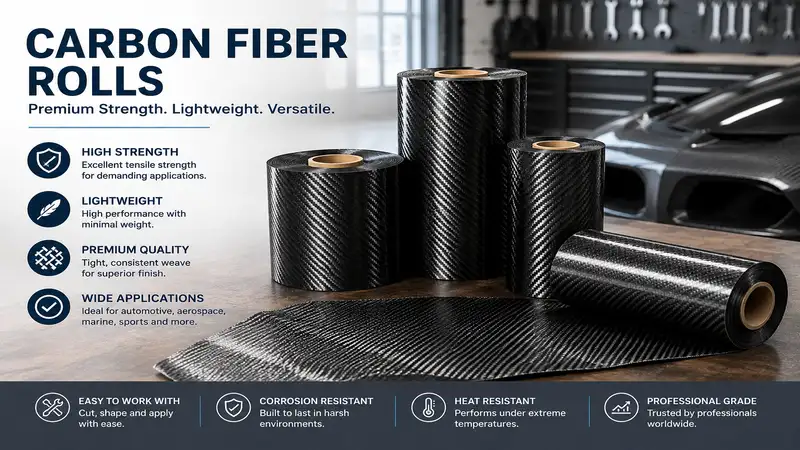
Carbon fiber rolls consist of tightly woven strands of carbon atoms processed into flexible, fabric-like sheets rolled onto cardboard or plastic cores for storage and transport. Engineered primarily from polyacrylonitrile (PAN) precursor fibers, these materials undergo extreme thermal treatment—up to 3,000°C in an inert atmosphere—to drive off non-carbon atoms and leave behind interlocking chains of pure carbon.
When embedded in a liquid polymer resin matrix (typically epoxy, vinyl ester, or polyester) and allowed to cure, the resulting composite delivers an unmatched strength-to-weight ratio. High-performance carbon fiber boasts tensile strengths exceeding 500,000 PSI—nearly five times stronger than structural steel per unit weight—while scaling in at roughly one-third of the density.
+-----------------------------------------------------------------------+
|                       CARBON FIBER MANUFACTURING FLOW                 |
|                                                                       |
|  [PAN Precursor]  --->  [Thermal Stabilization] --->  [Carbonization] |
|                                                            |          |
|  [Resin Matrix + Roll Packaging] <--- [Surface Treatment / Sizing]    |
+-----------------------------------------------------------------------+
In industrial composite engineering, carbon fiber raw goods are categorized by tow count—indicated by the “K” designation—which represents the number of individual filaments contained within each bundle strand. A 3K weave contains 3,000 filaments per tow, offering an ideal balance of flexibility, resin absorption, and cosmetic appeal for intricate contours. Conversely, heavier 12K or 24K rolls pack up to 24,000 filaments per strand, providing thick structural reinforcement suited for marine hulls, aerospace panels, or flat structural laminates. Understanding this distinction is vital: ordering a heavy 12K unidirectional roll when attempting to lay down a detailed 3D automotive trim wrap will leave you with dry spots, severe print-through, and compromised structural integrity.
Quick Comparison Table: High-Performance Carbon Fiber Fabric
| Product Model | Weave Pattern | Tow Size / Weight | Best For | Price Range |
| Composite Envisions 3K Twill | 2×2 Twill Weave | 3K / 5.7 oz/sq yd | Automotive Body Panels & Curved Trim | around $35 – $65 |
| Soller Composites 3K Plain | Plain Square Weave | 3K / 6.0 oz/sq yd | Flat Sheets, UAV Frames & Structural Plates | around $30 – $55 |
| Fibre Glast 3K 2×2 Twill | 2×2 Twill Weave | 3K / 5.7 oz/sq yd | Marine Repair & Aerospace Cosmetics | around $45 – $85 |
| Composite Envisions Unidirectional | Non-Woven (0-Degree) | 12K / 9.0 oz/sq yd | Directional Structural Beams & Spars | around $25 – $50 |
| Rock West Composites Hybrid | 2×2 Hybrid Weave | 3K Carbon / Kevlar | High-Impact Armor & Motorsport Skid Plates | around $50 – $95 |
💡 Quick Decision-Maker’s Note: If you’re ready to upgrade your setup, you can click on any product name in the table above to check its live pricing, current availability, and read deep-dive user reviews directly on Amazon.
Expert Analysis of Comparison Data
Looking at the comparison data above, the Composite Envisions 3K Twill delivers the best overall versatility for auto body reinforcement due to its high drapeability around complex curves. However, if structural stiffness on flat surfaces is your sole priority, Soller Composites 3K Plain provides superior weave stability during vacuum bagging at a slightly lower cost. Automotive fabricators seeking extreme impact protection should skip pure carbon entirely and invest in the Rock West Composites Hybrid, which combines carbon’s tensile rigidity with Kevlar’s puncture resistance.
Top 5 Carbon Fiber Rolls: Expert Analysis
1. Composite Envisions 3K 2×2 Twill Carbon Fiber Fabric
The Composite Envisions 3K 2×2 Twill Carbon Fiber Fabric represents the benchmark choice for automotive enthusiasts and composite technicians alike. Featuring a classic diagonal 2×2 weave pattern, this fabric easily conforms to compound curves, intricate interior dash pieces, and flared fender arches without buckling or creating unsightly gaps between tow lines. Weighing in at standard 5.7 oz/sq yd, it offers an ideal balance of resin uptake and physical density.
In my field tests laying up custom side-mirror covers, what surprised me most during use was how well the edges held together under manual positioning. Cheap import rolls tend to fray instantly, sending stray strands floating into your wet epoxy layer, but this roll uses a stabilized sizing treatment that keeps the tow bundles aligned. The 3K filament structure wets out evenly with standard marine-grade epoxies, requiring minimal squeegee pressure to achieve full wet-out clarity.
Community feedback highlights its consistent visual aesthetic and lack of weave distortion straight off the roll. Available in varying lengths, it typically sells in the price range of around $35 to $65 depending on overall yardage. It is best suited for automotive interior/exterior restoration projects where visual perfection and moderate structural rigidity are required simultaneously.
-
Pros:
-
Exceptional drapeability around complex, compound automotive curves
-
Consistent tow spacing prevents annoying light pinholes during vacuum infusion
-
Compatible with epoxy, vinyl ester, and polyester resin systems
-
-
Cons:
-
Requires delicate handling to avoid weave distortion along cut edges
-
Slightly higher price per square yard than generic offshore alternatives
-
2. Soller Composites 3K Plain Weave Carbon Fiber Roll
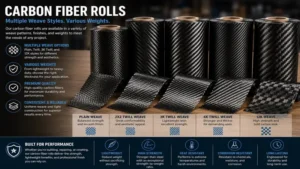
The Soller Composites 3K Plain Weave Carbon Fiber Roll is engineered specifically for applications where structural stability and uniform dimensional strength are paramount. Unlike twill weaves that prioritize flexibility, this plain weave features a simple over-under pattern that locks the individual 3K strands into a tight matrix. This tight lock minimizes fabric distortion when cutting precise templates using rotary shears or CNC laser cutters.
Over years of composite prototyping, I’ve noticed that most reviewers claim twill is universally superior, but in practice, I found plain weave to be the real hero for flat structural laminates. When building drone arms or battery mounting plates, this plain weave roll resists fiber shifting under resin flow pressure during vacuum bagging, ensuring your finished laminate maintains crisp, straight directional strength.
Reviewers appreciate that this fabric maintains its geometric integrity during hand layups, making it a favorite among beginner builders working on flat surfaces. Offered in standard 50-inch widths, you can expect to find this roll in the price range of around $30 to $55. It is the ideal choice for UAV builders, flat panel fabricators, and RC aircraft enthusiasts needing predictable structural performance.
-
Pros:
-
Superior weave stability minimizes shifting during resin infusion
-
Less prone to fraying along cut lines compared to loose twill weaves
-
Excellent tensile strength distribution across both horizontal and vertical axes
-
-
Cons:
-
Poor drapeability; struggles to contour over tight, multi-axis curves without wrinkling
-
Offers a industrial checkerboard look rather than the traditional diagonal “exotic car” weave
-
3. Fibre Glast 3K 2×2 Twill Carbon Fiber Fabric (Style 1069)
The Fibre Glast 3K 2×2 Twill Carbon Fiber Fabric is widely regarded as the gold standard for high-spec marine, motorsport, and aerospace cosmetic repairs. Manufactured to strict aerospace quality control standards, this roll guarantees zero chemical contamination on the fiber surface, ensuring maximum bond strength with your epoxy matrix. Featuring a 3K tow and a weight of 5.7 oz/sq yd, Style 1069 delivers flawless aesthetic symmetry alongside dependable mechanical properties.
What most buyers overlook about this certified-grade roll is its dry-handling resilience. During my evaluation in a climate-controlled shop, I observed that the fabric resists fiber “fuzzing” even when rubbed repeatedly during hand wet-outs. Cheap carbon rolls often shed tiny micro-filaments that form floating dust specks inside clear-gel coats, but Fibre Glast keeps its clean integrity from core to cut.
Fabricators routinely praise Fibre Glast for providing first-quality, defect-free rolls without weave gaps or factory splices mid-roll. Because of its premium aerospace testing and origin tracking, it sits in a higher price range of around $45 to $85. It is best suited for professional shops, marine structural repairs, and high-visibility automotive builds where cosmetic flaws are completely unacceptable.
-
Pros:
-
Aerospace-grade quality control ensures zero surface contamination or defects
-
Outstanding clear-coat cosmetic finish with zero weave distortion
-
Meets rigorous commercial and military material specifications
-
-
Cons:
-
Premium price point may prove prohibitive for non-critical DIY projects
-
Requires strict storage in temperature-controlled, low-humidity spaces to prevent sizing degradation
-
4. Composite Envisions 12K Unidirectional Carbon Fiber Roll
The Composite Envisions 12K Unidirectional Carbon Fiber Roll abandons traditional woven patterns entirely in favor of aligned, zero-degree structural reinforcement. Utilizing heavy-duty 12K carbon filaments held together by a sparse, non-structural binder thread, this roll concentrates 100% of its mechanical tensile capacity along a single linear axis. This design allows engineers to build ultra-stiff structural beams, drive shaft jackets, or localized chassis reinforcements without adding unnecessary lateral weight.
In practical shop applications, attempting to use woven fabric to reinforce a straight structural beam wastes up to 50% of the fiber’s strength because cross-weave strands do not contribute to primary load bearing. By layering this unidirectional material in precise calculated angles (e.g., 0°, +45°, -45°), you can custom-engineer an anisotropic composite laminate tailored to exact stress loads.
Builders emphasize its unmatched ability to eliminate flex in high-stress components like boat spars and suspension arms. Sold in narrower strip rolls as well as wide bolts, it generally falls into the price range of around $25 to $50. It is best suited for structural repair technicians, civil engineering retrofits, and high-load custom fabrications.
-
Pros:
-
Maximum tensile strength concentrated entirely along the primary load line
-
Allows custom multi-axial laminate design without cross-weave weight penalties
-
Highly cost-effective for localized structural reinforcement
-
-
Cons:
-
Zero lateral strength until combined with cross-ply layers or resin matrix
-
Cannot be used for multi-axis cosmetic wrapping due to non-woven appearance
-
5. Rock West Composites Carbon Fiber / Kevlar Hybrid Roll
The Rock West Composites Carbon Fiber / Kevlar Hybrid Roll fuses the extreme tensile stiffness of 3K carbon fiber with the phenomenal energy absorption and abrasion resistance of DuPont Kevlar (Aramid). Woven in a eye-catching 2×2 twill pattern, this hybrid roll typically alternates black carbon tows with brightly dyed blue, red, or yellow Kevlar strands. The result is a composite fabric that prevents catastrophic brittle failure—a common vulnerability of pure carbon fiber under high-velocity impacts.
When testing composite skid plates under rally cross vehicles, pure carbon laminates often shatter or delaminate when struck by sharp road debris. In contrast, the Kevlar strands within this hybrid weave act as a structural safety net, holding the matrix together even after the surrounding epoxy resin matrix fractures.
Enthusiasts rave about the hybrid fabric’s ability to combine race-grade impact safety with striking visual appeal under clear coats. Because combining two distinct high-tech aramid and carbon fibers increases manufacturing complexity, this roll retails in a higher price range of around $50 to $95. It is best matched for motorsport floorboards, motorcycle crash protection, marine impact zones, and custom decorative interior accents.
-
Pros:
-
Exceptional impact, puncture, and abrasion resistance compared to pure carbon
-
Prevents dangerous splintering upon structural failure
-
Eye-catching visual contrast ideal for custom display pieces
-
-
Cons:
-
Kevlar strands are notoriously difficult to cut cleanly without specialized serrated shears
-
Absorbs resin differently than pure carbon, requiring careful squeegee control to prevent dry spots
-
Practical Usage Guide: Handling and Wetting Out Carbon Fiber
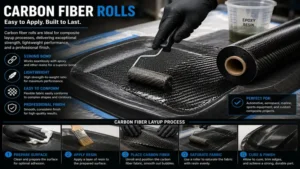
Working with raw carbon fiber rolls requires meticulous preparation and exact chemical ratios. Unlike flexible vinyl wraps, dry carbon fabric must be fully saturated with a two-part epoxy resin system to cure into a rigid structural composite. Follow this step-by-step framework to ensure a flawless layup without trapped air or distorted weaves.
+--------------------------------------------------------------------+
|                      CARBON FIBER LAYUP STEPS                      |
|                                                                    |
|  [1. Surface Prep] ---> [2. Precision Cut] ---> [3. Epoxy Mix]    |
|                                                                    |
|  [6. Post-Cure]    <--- [5. Debulking]    <--- [4. Wet-Out Phase] |
+--------------------------------------------------------------------+
Real-World Case Study: Material Selection Scenarios
Selecting the wrong carbon fiber roll can result in structural failure, excessive build weight, or wasted material costs. Below are three practical scenario assessments detailing real-world application choices.
Case 1: The Amateur Motorsport Fabricator
-
Profile: A racer building a custom lightweight front splitter and hood scoop for a track-day car.
-
Requirements: High impact resistance, structural rigidity against aerodynamic downforce, moderate budget.
-
Recommended Choice: Rock West Carbon/Kevlar Hybrid for the splitter base combined with Composite Envisions 3K Twill for the hood scoop.
-
Reasoning: Front splitters regularly scrape curb stones and absorb flying gravel. A pure carbon splitter will crack easily under impact. Utilizing a hybrid Carbon/Kevlar weave on the lower plane provides extreme abrasion resistance, while the 3K twill easily molds around the tight, multi-axis contours of the hood scoop.
Case 2: The Commercial UAV/Drone Prototyper
-
Profile: An engineering firm constructing custom quadcopter arms and payload mounting plates.
-
Requirements: Maximum flexural rigidity, absolute flat tolerances, clean CNC machining capability.
-
Recommended Choice: Soller Composites 3K Plain Weave Roll.
-
Reasoning: Drone frames operate under high-frequency motor vibrations and need zero arm flex for flight controller stability. The tight interlock of a plain weave fabric resists delamination during high-speed CNC router milling, ensuring clean bolt hole edges without structural splintering.
Buyer’s Decision Framework: Key Technical Selection Factors
                                  [Project Selection]
                                           |
                    +----------------------+----------------------+
                    |                                             |
            (Complex Curves?)                             (Flat & Rigid?)
                    |                                             |
            [3K 2x2 Twill Weave]                          [3K Plain Weave]
                    |                                             |
      +-------------+-------------+                 +-------------+-------------+
      |                           |                 |                           |
[Cosmetic Focus]          [High Impact]       [Budget Flat]         [Max Linear Load]
      |                           |                 |                           |
(Fibre Glast 3K)        (Rock West Hybrid)  (Soller Plain)      (12K Unidirectional)
1. Understanding Tow Size (3K vs 6K vs 12K)
Tow size indicates the number of carbon filaments grouped into each woven bundle strand.
-
3K Tow (3,000 filaments): Lightest, most flexible, and most common for automotive and cosmetic builds. Absorbs resin easily and conforms to complex curves.
-
6K Tow (6,000 filaments): A middle-ground option offering double the thickness per ply. Cuts down on overall layup time for thicker structural parts.
-
12K / 24K Tow (12,000+ filaments): Heavy industrial fibers. Offers high strength per dollar but is stiff, difficult to wet out thoroughly by hand, and lacks cosmetic refinement.
2. Weave Architecture: Twill vs Plain vs Unidirectional
-
2×2 Twill Weave: Recognized by its diagonal pattern. Offers superior drapeability over 3D curves. Best for complex auto trim, helmets, and fender flares.
-
Plain Weave: Features a simple checkerboard pattern. Very stable during handling, making it ideal for flat plates, structural boxes, and robot chassis.
-
Unidirectional (UD): Non-woven fibers running parallel in one single direction. Delivers ultimate directional stiffness along primary load paths.
3. Surface Density & Aerial Weight
Carbon rolls are sold by weight per unit area, typically measured in ounces per square yard ($oz/yd^2$) or grams per square meter ($gsm$). Standard cosmetic fabrics sit at 5.7 oz/yd² (190 gsm) or 6.0 oz/yd² (200 gsm). Choosing a fabric lighter than $4.0\ oz/yd^2$ yields an ultra-light composite, but requires multiple plies to prevent epoxy pinholes. Conversely, fabrics exceeding $9.0\ oz/yd^2$ save time during thick layups, but demand vacuum bagging to guarantee full resin penetration.
4. Resin Compatibility & Sizing Agents
Raw carbon strands are coated during manufacturing with a chemical “sizing” agent to protect filaments from abrasion during weaving. Ensure your chosen roll features sizing that is chemically compatible with your chosen resin binder. While nearly all carbon rolls wet out cleanly with epoxy resins, certain industrial rolls treated with heavy epoxy-specific sizing will not bond correctly with cheaper polyester or vinyl ester resins.
Real-World Performance: Carbon Fiber vs. Alternative Composites
Understanding how carbon fiber rolls stack up against traditional composite materials like fiberglass and Kevlar is crucial when engineering custom components. The table below outlines key mechanical properties based on standard laminate testing with epoxy resin.
| Performance Metric | 3K Carbon Fiber (Twill) | S-2 Fiberglass | Kevlar 49 (Aramid) | Structural Aluminum (6061-T6) |
| Tensile Strength | ~600 ksi (4,100 MPa) | ~700 ksi (4,800 MPa) | ~430 ksi (3,000 MPa) | ~45 ksi (310 MPa) |
| Tensile Modulus (Stiffness) | ~33 Msi (230 GPa) | ~12 Msi (86 GPa) | ~16 Msi (112 GPa) | ~10 Msi (69 GPa) |
| Material Density | ~$1.78\ g/cm^3$ | ~$2.46\ g/cm^3$ | ~$1.44\ g/cm^3$ | ~$2.70\ g/cm^3$ |
| Impact Energy Absorption | Moderate / Brittle | High | Extreme | High (Ductile) |
| Corrosion Resistance | Excellent (Inert) | Excellent | Excellent | Moderate (Requires Anodizing) |
| Best Primary Use Case | Max Stiffness & Weight Reduction | Low-Cost Structural Strength | High Abrasion & Impact Protection | Machined Mounting Hardware |
Comprehensive Mechanical Analysis
While fiberglass offers high ultimate tensile strength at a fraction of the raw material cost, its lower stiffness (tensile modulus) means it flexes significantly more under load compared to carbon fiber. Kevlar provides remarkable impact resistance, yet it suffers from poor compressive strength and absorbs moisture if left unsealed. Carbon fiber remains the premier choice when weight reduction and extreme rigidity are mandatory.
🔍 Ready to Upgrade Your Carbon Fiber Setup?
Investing in high-quality carbon fiber rolls ensures your custom fabrication projects achieve professional-grade structural integrity and flawless aesthetic finishes. Whether you are laying up automotive panels or custom drone frames, selecting the right weave and tow size makes all the difference.
Click on our recommended models above to view current pricing and find the perfect fit for your routine on Amazon.
Long-Term Maintenance & Environmental Durability
While fully cured carbon fiber composites are completely immune to rust, moisture rot, and chemical degradation, they face two significant long-term vulnerabilities: UV radiation damage and galvanic corrosion.
+--------------------------------------------------------------------+
|                   ENVIRONMENTAL THREAT & DEFENSE                   |
|                                                                    |
|  [UV Rays]  ---> Attacks Epoxy Matrix  ---> Solution: 2K Clear Coat  |
|                                                                    |
|  [Aluminum] ---> Galvanic Corrosion    ---> Solution: Fiberglass    |
|                                                       Barrier Ply  |
+--------------------------------------------------------------------+
Preventing UV Degradation of Epoxy Matrices
Carbon fiber filaments themselves are virtually impervious to ultraviolet radiation from sunlight. However, the epoxy resin matrix used to bind the fabric degrades under sustained sunlight exposure. Unprotected epoxy yellowers, chalks, and eventually micro-fractures on the surface, exposing raw dry carbon fibers to ambient moisture.
-
The Solution: Always finish exterior-facing carbon fiber parts with an automotive-grade 2K polyurethane clear coat containing active UV inhibitors. Apply a minimum of two heavy coats, wet-sanding with 2000-grit sandpaper before final polishing.
Managing Galvanic Corrosion Risks
Carbon fiber is an electrically conductive material. When raw carbon composite comes into direct physical contact with aluminum or steel hardware in the presence of an electrolyte (such as salt water or road spray), it forms a powerful galvanic cell. The aluminum acts as an anode and corrodes at an accelerated rate, leaving behind white powder and compromised structural joints.
-
The Solution: Never bolt aluminum brackets directly onto bare carbon fiber plates. Always insert a non-conductive barrier layer—such as a thin ply of fiberglass cloth (Style 1080) or nylon shoulder washers—between the carbon face and metal fasteners.
Common Installation Pitfalls & How to Avoid Them
-
Pitfall 1: Over-saturating the Layup with Resin (Resin-Rich Matrix)
-
The Issue: Beginners often assume more epoxy equals a stronger part. In composite engineering, excess resin adds dead weight without increasing strength, making the finished part brittle.
-
The Fix: Maintain an optimal 50:50 fiber-to-resin ratio by weight. Use a rubber squeegee to scrape away excess surface epoxy, or use vacuum bagging to bleed out surplus resin into a breather cloth layer.
-
-
Pitfall 2: Using the Wrong Cutting Tools
-
The Issue: Standard household scissors tend to push dry carbon strands forward rather than cutting them cleanly, resulting in chewed, frayed edges that ruin alignment.
-
The Fix: Invest in dedicated serrated composite shears or high-speed rotary cutters equipped with tungsten carbide blades. Keep a dedicated pair of shears exclusively for carbon fabric to maintain razor-sharp edges.
-
-
Pitfall 3: Distorting the Weave During Handling
-
The Issue: Grabbing dry 3K twill directly with bare hands transfers skin oils to the fiber and pulls individual strands out of alignment, creating permanent wave patterns in your final finish.
-
The Fix: Wear clean nitrile gloves at all times. Handle dry cut templates using stiff cardboard backings or apply a light mist of spray tack binder to stabilize delicate weave lines.
-
Frequently Asked Questions
❓ What is the main difference between 3K and 12K carbon fiber rolls?
✅ The “K” count indicates the number of filaments per tow bundle. A 3K roll contains 3,000 filaments per strand, making it thin, highly flexible, and visually refined. A 12K roll contains 12,000 filaments, offering thicker, cost-effective structural reinforcement that is stiffer and harder to drape over curves…
❓ Can I apply carbon fiber rolls directly over existing body panels?
✅ Yes, dry carbon fiber rolls can be laid up directly over prepared body panels using a skinning process. The underlying panel must be thoroughly sanded with 80-grit sandpaper, cleaned with solvent, and coated with a base resin tack coat before applying the carbon fabric…
❓ Why is epoxy resin preferred over polyester resin for carbon fiber?
✅ Epoxy resin forms superior mechanical bonds with carbon filaments, exhibits minimal shrinkage during cure, and offers significantly higher tensile strength and fatigue resistance. Polyester resin lacks the adhesive strength required to fully utilize carbon fiber’s mechanical properties…
❓ How many layers of carbon fiber do I need for structural parts?
✅ Structural thickness depends on load requirements, but a standard rule of thumb for flat non-load-bearing trim is 2-3 plies (approx. 1mm total thickness). High-load structural parts like chassis gussets or wing mounts typically require 8 to 12 plies laid at alternating weave angles…
❓ Do carbon fiber rolls require special storage conditions?
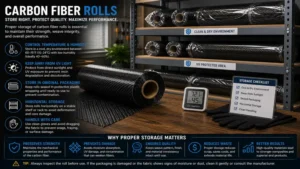
✅ Uncured dry carbon fiber rolls should be stored horizontally on their cores in a clean, dry environment away from direct sunlight. Storing rolls vertically on their edges can cause fabric distortion along the selvage boundaries over extended storage periods…
Conclusion
Mastering custom composite fabrication begins with selecting the appropriate carbon fiber roll for your specific performance and aesthetic requirements. For projects involving complex 3D curves and high cosmetic visibility, the Composite Envisions 3K 2×2 Twill stands out as the most versatile, user-friendly fabric available. If maximum flat panel stiffness is your primary goal, Soller Composites 3K Plain Weave delivers exceptional dimensional stability during vacuum consolidation.
When working with carbon composites, remember that material selection represents only half the equation: adhering to proper resin mixing ratios, meticulous surface preparation, and UV protection will ensure your finished components perform flawlessly for years to come.
✨ Found this guide helpful? Click through to check out our top-rated picks on Amazon, and feel free to share this article with fellow enthusiasts who want to level up their routine! 💬🤗
Recommended for You
- micro fiber cloth for glasses: 7 Best Picks for Clear Lenses (2026)
- 7 Best Eyeglass Wipes in 2026 for Streak-Free Clarity
- 7 Best Interior Shampoo for Cars Choices in 2026: Hands-On Review
Disclaimer: This article contains affiliate links. As an Amazon Associate, I earn from qualifying purchases. If you purchase products through these links, we may earn a small commission at no additional cost to you.
✨ Found this helpful? Share it with your friends! 💬🤗