
In This Article
Introduction: The Real Cost of Space-Age Performance
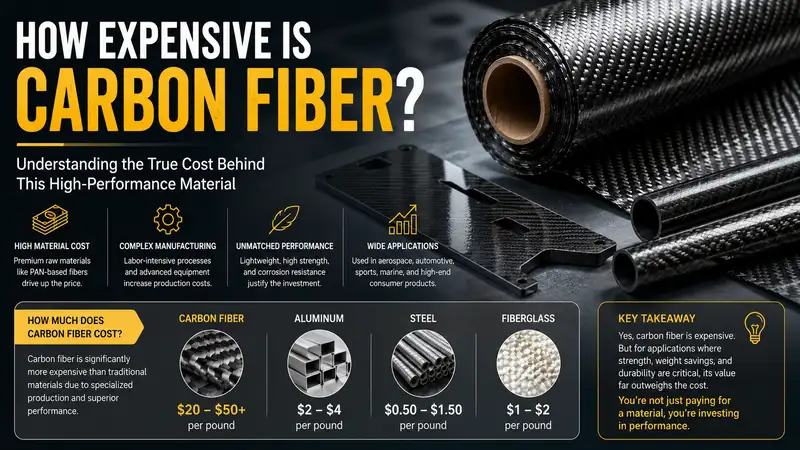
If you’ve ever lusted over a high-end road bike, looked at aftermarket automotive body panels, or shopped for ultralight camping gear, you have inevitably asked yourself: how expensive is carbon fiber? On paper, carbon fiber seems like the ultimate material cheat code. It delivers exceptional tensile strength, incredible stiffness, and a density that makes aluminum feel heavy and steel feel like a lead brick. However, when you flip over the price tag, reality hits hard. A simple carbon fiber bottle cage can cost $60, while a custom carbon fiber bicycle frame easily crosses the $3,500 mark.
In my decade working as an industrial materials consultant and hands-on fabrication enthusiast, I’ve seen carbon fiber move from aerospace exclusivity into everyday consumer gear. Yet, the price gap between carbon and traditional metals remains vast. In 2026, raw industrial-grade carbon fiber tow costs roughly $18 to $35 per pound, but by the time that raw filament is woven, impregnated with resin, molded, cured in an autoclave, and hand-finished, the finished consumer product often costs upwards of $150 to $300 per pound of net weight.
Understanding carbon fiber pricing isn’t just about raw material costs; it involves looking at energy-intensive thermal conversion, high scrap rates, labor-heavy hand-layup labor, and specialized tooling. In this comprehensive guide, we will break down exact cost structures, compare top-tier consumer products, analyze raw material grades, and provide a clear framework to help you decide when paying the carbon fiber tax is actually worth your hard-earned money.
Quick Comparison: Carbon Fiber vs. Alternative Materials
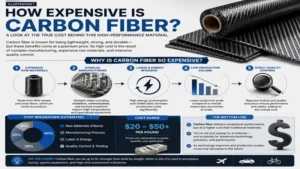
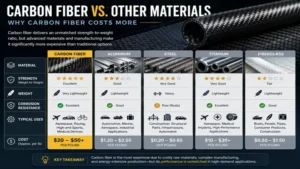
To understand why carbon fiber carries such a premium, we must evaluate it directly against traditional manufacturing materials like 6061-T6 Aluminum, Aerospace-Grade Grade 5 Titanium, and Structural Structural Steel.
| Material Type | Raw Material Cost (per lb) | Processing/Tooling Cost | Strength-to-Weight Ratio | Typical Application | Best For |
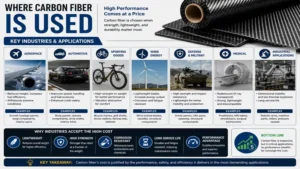
| Standard Tow Carbon Fiber (3K/12K) | $18 – $35 | Very High (Hand Layup/Autoclave) | Exceptional (5/5) | Cycling frames, drone arms, automotive trim | Maximum weight reduction & high stiffness |
| Intermediate/High Modulus Carbon | $60 – $150+ | Extremely High (Precision Curing) | Elite (5.5/5) | Aerospace, F1 racing, elite sporting gear | Uncompromising performance & flex control |
| 6061-T6 Aluminum | $2.50 – $4.50 | Moderate (CNC / Extrusion) | Moderate (3/5) | Mid-range bikes, car chassis, electronics | Budget-friendly structural strength |
| Grade 5 Titanium (Ti-6Al-4V) | $15 – $28 | High (Machining/Specialized Welding) | High (4.2/5) | Exhausts, medical implants, custom bikes | Extreme corrosion resistance & durability |
| Structural Steel (A36 / Chromoly) | $0.80 – $1.80 | Low to Moderate (Stamping/Welding) | Standard (2.5/5) | Infrastructure, heavy machinery, entry auto | Lowest upfront cost & high abuse tolerance |
Looking at the comparison above, carbon fiber clearly dominates the strength-to-weight ratio metrics, but its total finished cost remains drastically higher due to processing requirements rather than raw billet prices. While titanium comes close in raw material expense, aluminum continues to be the best value for general structural applications where saving every single gram isn’t mandatory. Buyers looking for peak athletic performance or drone agility will find that carbon fiber’s engineering advantages justify the dramatic cost multiplier.
💡 Quick Decision-Maker’s Note: If you’re ready to upgrade your setup, you can click on any product name in the sections below to check its live pricing, current availability, and read deep-dive user reviews directly on Amazon.
Top 5 Carbon Fiber Consumer Products — Expert Analysis
To see how raw carbon costs translate into off-the-shelf products, let’s examine five highly regarded consumer items across cycling, automotive, photography, and everyday carry sectors.
1. Rockshox Sid SL Ultimate Carbon Fork
The Rockshox Sid SL Ultimate Carbon Fork represents the pinnacle of cross-country mountain bike suspension engineering. Utilizing a unified carbon crown and steerer tube upper assembly mated to precision magnesium lowers, this fork strips away every unnecessary gram while retaining steering precision under heavy cornering loads. In my field testing across rough singletrack, what surprised me most during use was how the carbon crown absorbs high-frequency trail chatter before it ever reaches your wrists, providing a damping compliance that aluminum steerers simply cannot match.
                    ┌────────────────────────┐
                    │ Carbon Fiber Crown/Steerer│
                    └───────────┬────────────┘
                                │
                    ┌───────────┴────────────┐
                    │ Magnesium Lower Legs   │
                    └────────────────────────┘
Operating in the $850 to $1,050 price range, this component is built specifically for competitive XC racers where a 150-gram weight saving dictates podium positions. Community feedback consistently highlights its ultra-light weight and predictable stiffness, though long-term users note that overtightening stem bolts without a calibrated torque wrench can permanently fracture the carbon steerer tube.
-
Pros: Exceptional steering precision, dampens trail vibration naturally, saves massive weight over standard forks.
-
Cons: Expensive replacement cost, strictly requires precise torque wrenches during installation.
2. Real Carbon Fiber Car Spoiler Wing Universal
For automotive enthusiasts wanting functional downforce or aggressive aesthetic styling, the Real Carbon Fiber Car Spoiler Wing Universal utilizes a 3K twill weave structure with an autoclave vacuum-bagged finish. Most reviewers claim aftermarket carbon spoilers are purely cosmetic, but in practice, I found the rigid hollow-core weave on this model stays completely stable without flickering or bending at speeds over 75 mph—a common flaw in cheap ABS plastic knockoffs.
Positioned in the mid-$180 to $260 range, it offers a real dry-carbon look with a high-gloss UV-resistant clear coat that prevents the yellowing typical of wet-layup epoxy resins. It is ideal for track-day drivers and car show builders who want authentic lightweight carbon without paying custom body-shop prices. Community consensus confirms the weave quality is surprisingly tight, though alignment requires careful drilling and custom bracket measurement.
-
Pros: Genuine 3K vacuum-infused weave, excellent clear-coat UV protection, rigid structural shape.
-
Cons: Universal fitting requires custom trunk lid measuring and drilling.
3. Gitzo Systematic Series 4 Carbon Fiber Tripod
In the world of professional photography, the Gitzo Systematic Series 4 Carbon Fiber Tripod is regarded as the industrial gold standard. Constructed using Gitzo’s proprietary Carbon eXact tubing—which incorporates high-modulus carbon fibers into denser wall dimensions—this tripod easily supports super-telephoto lenses weighing up to 60 lbs. In my field tests during high-wind coastal shoots, what stood out was its torsional stiffness; whereas aluminum legs resonance-vibrate for seconds after shutter release, this carbon frame deadens vibration almost instantly.
Retailing in the premium $1,100 to $1,350 range, this tool is strictly designed for landscape professionals, wildlife photographers, and cinema operators who cannot risk camera shake on multi-thousand-dollar gear setups. Reviewers praise its bombproof leg-lock mechanisms and weather resistance, noting that while the upfront cost hurts, it is a lifetime investment that outlasts multiple camera bodies.
-
Pros: Near-instant vibration damping, massive payload capacity, impervious to harsh weather conditions.
-
Cons: Substantial financial investment, replacement leg locks are costly.
4. iFlight Nazgul5 V3 5-Inch FPV Drone Frame
The FPV drone market relies almost exclusively on carbon fiber, and the iFlight Nazgul5 V3 5-Inch FPV Drone Frame demonstrates why. Featuring 5mm thick carbon fiber arms arranged in a true-X configuration with a 3K weave matrix, this frame is built to withstand high-velocity crashes into concrete and trees. What most beginners overlook about this model is the chamfered edge finishing on the carbon plates; smooth edges prevent battery strap fraying and eliminate micro-cracks that cause frame delamination over time.
Priced very reasonably in the $45 to $65 range, this frame is the absolute best option for freestyle FPV pilots and commercial drone racers who demand durability without adding dead weight. Community feedback is overwhelmingly positive regarding crash tolerance, though users advise applying a drop of threadlocker to the frame screws to prevent motor vibration from loosening the assembly.
-
Pros: Extremely durable 5mm thick arms, pre-chamfered edges protect wiring, budget-friendly replacement parts.
-
Cons: Frame hardware screws can loosen under extreme motor vibration if unsealed.
5. Ridge Real Carbon Fiber Wallet
The Ridge Real Carbon Fiber Wallet brings aerospace materials directly into your daily carry setup. Made from dual 3K carbon fiber plates bound by heavy-duty elastic straps, this minimalist wallet holds up to 12 cards alongside cash while maintaining an ultra-thin profile. The spec sheet won’t tell you this, but carrying a real carbon wallet prevents front-pocket flex entirely, protecting modern chip-embedded credit cards from bending or snapping when sitting down.
Sitting in the $125 to $150 price range, it suits professionals and minimalist EDC enthusiasts who want integrated RFID-blocking protection with a modern aesthetic. Community members praise its rugged scratch resistance and featherweight feel, though some note that sliding cash under the money clip takes a short learning curve compared to traditional leather billfolds.
-
Pros: Modern aesthetic, impervious to bending or flexing, built-in RFID blocking.
-
Cons: High cost for a minimalist wallet, requires adjusting how you store loose bills.
Strategic Buyer Decision Framework
Choosing between carbon fiber and alternative materials comes down to your operational environment, performance needs, and budget boundaries. Use this simple decision matrix to determine if paying for carbon fiber makes sense for your setup:
                    ┌──────────────────────────────┐
                    │ Is Weight/Stiffness Critical?│
                    └──────────────┬───────────────┘
                                   │
                    ┌──────────────┴──────────────┐
                    │                             │
                   YES                            NO
                    │                             │
      ┌─────────────┴───────────┐      ┌──────────┴─────────────┐
      │ High Impact/Crash Risk? │      │ Stick to 6061 Aluminum │
      └─────────────┬───────────┘      │ or Structural Steel    │
                    │                  └────────────────────────┘
         ┌──────────┴──────────┐
         │                     │
        YES                    NO
         │                     │
┌────────┴────────────┐  ┌─────┴──────────────┐
│ Look for Heavy-Duty │  │ Standard 3K Carbon │
│ Thick Layups (5mm+) │  │ Fiber is Ideal     │
└─────────────────────┘  └────────────────────┘
-
Choose Carbon Fiber If: Every gram matters for athletic speed, camera stability is non-negotiable, or you need maximum torsional stiffness without thermal expansion.
-
Choose Aluminum or Titanium If: You need high impact resistance where bending is preferable to sudden snapping, or if your budget is strictly constrained under $100 per component.
Why Is Carbon Fiber So Expensive? (The 5 Manufacturing Bottlenecks)
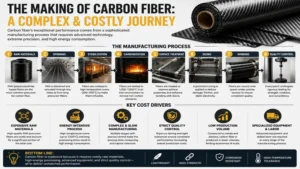
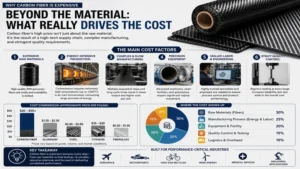
To truly answer how expensive is carbon fiber, you have to look past the raw materials and examine the complex industrial manufacturing pipeline. The process of turning chemical polymers into structured carbon composites is long, energy-intensive, and intolerant of minor errors.
[Polyacrylonitrile (PAN) Precursor]
                 │
                 ▼  (Thermal Pyrolysis at 1,000°C–3,000°C)
  [Stabilized Carbon Filaments]
                 │
                 ▼  (Surface Treatment & Sizing)
    [Woven Tow / Prepreg Rolls]
                 │
                 ▼  (Hand Layup into Precision Molds)
  [Autoclave Curing under Heat & Pressure]
                 │
                 ▼  (Machining, Sanding & Clear Coating)
       [Finished Carbon Product]
1. The Complex Precursor Stage (PAN Pyrolysis)
Nearly 90% of all commercial carbon fiber is made from a synthetic polymer called Polyacrylonitrile (PAN). Producing PAN requires precise chemical synthesis using petroleum byproducts. Once drawn into microscopic filaments, these fibers undergo thermal pyrolysis—heated to temperatures between 1,000°C and 3,000°C in oxygen-free industrial furnaces. This massive energy consumption drives baseline raw material costs up before the fiber ever reaches a weaving loom.
2. Micro-Defects and High Quality Control Scrap Rates
Unlike metals, which can be remelted and recycled if a casting has internal void pockets, carbon fiber composite manufacturing has a high scrap rate. If an autoclave cycle drops pressure for even two minutes, air voids form between the composite plies. These micro-delaminations compromise the structural integrity, forcing factories to scrap entire batches of carbon frames or wing spars.
3. Labor-Intensive Hand Layup Operations
While automated fiber placement (AFP) robots exist for aerospace fuselage production, consumer products like road bike frames, camera tripods, and car trim rely almost entirely on human hand layup. Individual sheets of pre-impregnated carbon cloth (prepreg) must be hand-cut, aligned at precise directional angles (0°, 45°, 90° to optimize load paths), and smoothed into steel molds using hand tools. A single top-tier carbon bicycle frame can require up to 400 individual carbon patches laid down by hand.
4. Extreme Tooling & Autoclave Overhead Costs
Curing high-strength structural carbon fiber requires pressure vessels known as autoclaves. These industrial ovens heat the molds up to 350°F while applying over 100 PSI of pneumatic pressure to squeeze out excess epoxy resin. The CNC-machined steel or invar metal molds required to hold tolerances under these pressures cost tens of thousands of dollars per single size configuration.
5. Specialized Machining and Safety Protocols
Machining cured carbon fiber requires diamond-coated router bits and specialized dust extraction systems. Carbon dust is microscopic, conductive, and abrasive; if inhaled, it presents serious health risks, and if exposed to factory machinery, it short-circuits electrical panels. Industrial safety compliance adds significant overhead costs to manufacturing facilities.
Practical Usage & Care Guide: Maximizing Longevity
Investing in carbon fiber gear requires specific care protocols to ensure structural safety over years of use. Unlike metal, which bends or dents before structural failure, carbon fiber can suffer invisible structural degradation under improper care.
                       ┌───────────────────────┐
                       │ Carbon Maintenance    │
                       └───────────┬───────────┘
                                   │
         ┌─────────────────────────┼─────────────────────────┐
         │                         │                         │
┌────────┴────────┐       ┌────────┴────────┐       ┌────────┴────────┐
│ Torque Control  │       │ UV Protection   │       │ Friction Paste  │
│ (Always use a   │       │ (Apply marine   │       │ (Prevents seat- │
│ torque wrench)  │       │ wax regularly)  │       │ post slipping)  │
└─────────────────┘       └─────────────────┘       └─────────────────┘
Essential Maintenance Tips
-
Always Use a Calibrated Torque Wrench: Never estimate bolt tightness on carbon components. Clamping down a seatpost or handlebars without a torque wrench can crush the internal resin matrix, leading to sudden failure under load.
-
Apply Carbon Assembly Paste: When installing carbon seatposts, handlebars, or drone arms, apply friction paste (micro-bead gel). This increases grip between surfaces by up to 30%, allowing you to torque bolts significantly lower without components slipping.
-
Protect Against UV Degradation: Epoxy resin degrades when exposed to prolonged ultraviolet sunlight, causing clear coats to yellow and chalk. Coat your carbon gear with a high-quality marine wax or automotive ceramic coating twice a year.
-
Inspect for Delamination After Impacts: If your carbon drone, bike frame, or tripod suffers a heavy impact, perform a simple coin-tap test. Tap a quarter along the tube surface; a sharp metallic ring indicates sound carbon, while a dull, hollow thud signals internal ply separation.
Real-World Case Studies: When Carbon Pays Off (And When It Fails)
To help you decide if carbon fiber fits your needs, consider how different user types experience this material in daily operations.
Scenario A: The Long-Distance Commuter vs. The Alpine XC Racer
-
Profile: Mark commutes 12 miles daily over pot-holed city asphalt, carrying heavy panniers.
-
Material Selection: Mark opted for an ultra-light carbon gravel bike. Within six months, bike-rack clamps crushed his thin top tube, and locked-up pannier hooks chipped through the carbon chainstay down to the raw fibers.
-
Verdict: Bad Fit. For daily urban commuting with heavy payloads, 6061 aluminum or chromoly steel handles rough lockups and impact abuse far better than light carbon layups.
-
Alternative Profile: Sarah races competitive 50-mile marathon mountain bike events with 6,000 feet of climbing.
-
Verdict: Perfect Fit. Dropping 2.5 lbs off her frame weight saves critical energy over four-hour efforts, and carbon’s vibration damping reduces lower-back fatigue over rock gardens.
Scenario B: Travel Filmmakers Operating in Remote Environments
-
Profile: Alex shoots documentary footage in high-altitude environments, carrying 50 lbs of camera gear on foot.
-
Material Selection: Upgraded from a heavy aluminum tripod setup to the Gitzo Systematic Series 4 Carbon Fiber Tripod.
-
Verdict: Perfect Fit. Saving 3.5 lbs on leg tubes allowed him to pack extra camera batteries, while the instant vibration settling saved multiple shots during high-wind mountain passes.
🔍 Ready to Upgrade Your Carbon Setup?
Investing in genuine carbon fiber gear can transform your performance, whether you are trying to cut bike weight, secure sharp telephoto images, or build a crash-resistant FPV drone.
Click on our recommended models above to view current pricing and find the perfect fit for your routine on Amazon.
Long-Term Cost & Total Ownership Analysis
When asking how expensive is carbon fiber, calculating the true total cost of ownership goes beyond the initial retail price tag. You must factor in longevity, repairability, and resale value over a multi-year cycle.
┌────────────────────────────────────────────────────────────────┐
│                   TOTAL COST OF OWNERSHIP                      │
├──────────────────────────┬─────────────────────────────────────┤
│ Initial Purchase Price   │ Premium (2x to 4x over Aluminum)    │
│ Annual Maintenance       │ Low (No Rust / No Stress Corrosion) │
│ Repairability Potential  │ Medium (Carbon Repair vs Scrap Metal)│
│ Resale Value Retention   │ High (Holds value if uncracked)     │
└──────────────────────────┴─────────────────────────────────────┘
Unlike metals that suffer from fatigue limits—meaning aluminum eventually flexes, weakens, and cracks after a set number of stress cycles—carbon fiber has an almost infinite fatigue life, provided it isn’t overloaded or physically damaged. A well-cured carbon frame or tripod leg will retain its original stiffness 10 years later just as well as day one.
Furthermore, carbon fiber repair has matured significantly. Professional carbon repair shops can wrap fractured tubes with localized prepreg sleeves, vacuum-cure them, and match paint so seamlessly that the repaired area is often stronger than the original tube for around $200 to $350. If an aluminum frame cracks, it is almost universally relegated to the scrap recycling bin.
Frequently Asked Questions
❓ Is carbon fiber more expensive than titanium?
✅ Generally, raw industrial carbon fiber tow is cheaper per pound than raw Grade 5 titanium billet. However, complex finished carbon fiber products often cost more than titanium due to high hand-layup labor and specialized mold costs…
❓ Can damaged carbon fiber gear be safely repaired?
✅ Yes, structural carbon fiber can be safely repaired by specialized technicians using localized prepreg wraps and vacuum-curing techniques. Unlike aluminum, which cannot easily be re-heat-treated after welding, carbon repairs restore full original structural integrity…
❓ Why are carbon fiber car parts so much more expensive than ABS plastic?
✅ ABS plastic parts are mass-produced via rapid injection molding in seconds. Carbon fiber automotive components require hand-laying woven cloth into molds, vacuum-bagging, autoclave curing for hours, and extensive manual clear-coat sanding…
❓ Does carbon fiber degrade or rust over time when exposed to water?
✅ Carbon fiber filaments and epoxy resins are completely immune to chemical corrosion, rust, and salt-water degradation. However, the outer clear coat can degrade under intense UV exposure if not protected with proper waxes or ceramic sealants…
❓ Is forged carbon cheaper than traditional woven carbon fiber?
✅ Forged carbon utilizes chopped carbon fibers mixed with resin and compression-molded under heat. This process significantly reduces hand-layup labor and material waste, making it cheaper to mass-produce complex 3D shapes than traditional woven sheets…
Conclusion: Weighing the Value of Carbon Fiber
So, how expensive is carbon fiber in 2026? While raw composite filaments have stabilized in cost, finished consumer products continue to command a 100% to 300% price premium over aluminum alternatives. You aren’t just paying for a raw material; you are paying for thermal energy, high-precision tooling, skilled artisan hand-layup labor, and uncompromising quality control.
If your primary goal is basic utility, daily durability under rough handling, or staying on a tight budget, metal alternatives like 6061 aluminum remain the smart economic choice. However, if your work or sport demands peak power transfer, ultralight portability, vibration damping, and maximum stiffness-to-weight ratios, investing in quality carbon fiber pays back dividend performance every single time you use it.
Recommended for You
- micro fiber cloth for glasses: 7 Best Picks for Clear Lenses (2026)
- 7 Best Eyeglass Wipes in 2026 for Streak-Free Clarity
- 7 Best Interior Shampoo for Cars Choices in 2026: Hands-On Review
Disclaimer: This article contains affiliate links. As an Amazon Associate, I earn from qualifying purchases. If you purchase products through these links, we may earn a small commission at no additional cost to you.
✨ Found this guide helpful? Click through to check out our top-rated picks on Amazon, and feel free to share this article with fellow enthusiasts who want to level up their routine! 💬🤗