
In This Article
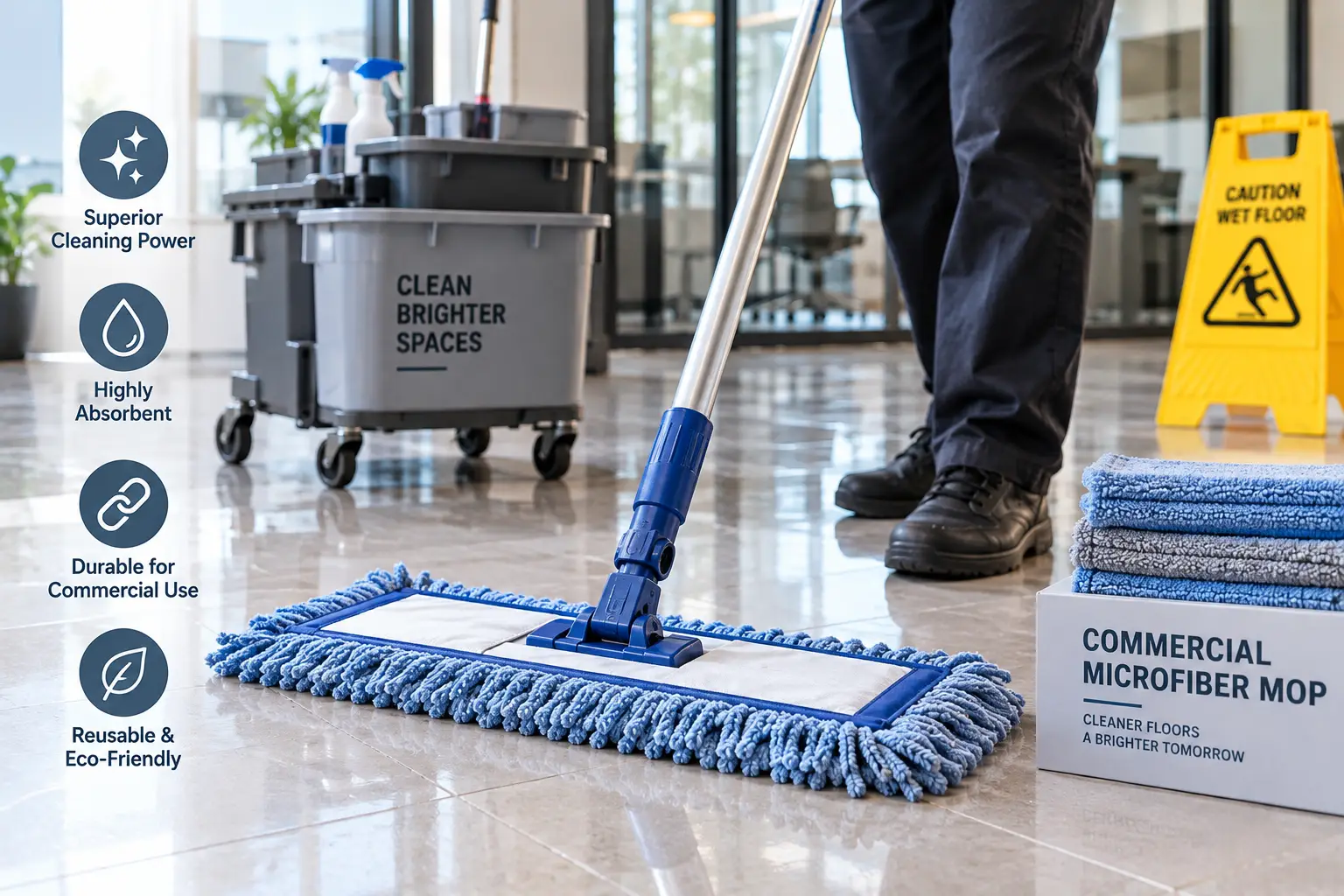
If you manage a restaurant kitchen, a medical office, a school hallway, or a fleet of short-term rental units, you already know a commercial microfiber mop is not the same tool as the one under your kitchen sink. A commercial microfiber mop is a flat- or loop-end mopping system built with denser, split microfiber, interchangeable washable pads, and a frame or handle rated for daily, high-traffic use rather than occasional weekend cleanup. That single definition matters because the janitorial market is flooded with lookalike “professional” mops that are really residential products with a bigger sticker.
This guide skips the marketing fluff. We researched real spec sheets, aggregated customer feedback, and manufacturer data from brands janitorial buyers actually trust — Rubbermaid Commercial, Unger, O-Cedar Commercial, and Libman Commercial among them — to help you pick a commercial microfiber mop that survives more than one cleaning season. You’ll get seven vetted options across entry-level, mid-range, and premium price tiers, plus the maintenance, cost, and safety context that most product listings leave out.
One quick note before we dive in: peer-reviewed infection-control research has repeatedly found that properly laundered microfiber cleans healthcare surfaces about as effectively as brand-new microfiber, which is exactly why so many hospitals, schools, and hotel chains standardized on microfiber flat-mop systems over old-school cotton string mops. That performance gap is the backbone of everything below.
This post contains affiliate links, and as an Amazon Associate, this site may earn from qualifying purchases at no extra cost to you.
Quick Comparison: Commercial Microfiber Mop at a Glance
Before the deep dive, here’s a fast reference if you just need a starting point.
| Product | Best For | Price Range | Pad/Head Width |
|---|---|---|---|
| Rubbermaid Commercial HYGEN PULSE | No-bucket spray mopping | $200–$260 | 18″ |
| Rubbermaid Commercial Executive Series HYGEN | Color-coded facilities | $130–$220 | 18″ |
| Unger SmartColor MicroMop System | Infection-control cleaning | $150–$300 | 16″ |
| O-Cedar Commercial MaxiPlus | Everyday mid-range workhorse | $40–$75 | 18″ |
| Libman Commercial 117 | Small business budgets | $25–$40 | 18″ |
| Renown Flat Mop System | Entry-level commercial use | $30–$50 | 18″ |
| Microfiber Wholesale 18″ Pro Kit | DIY-outfitted small crews | $35–$55 | 18″ |
Looking at this table, the Rubbermaid Commercial HYGEN PULSE clearly leads on convenience — you’re paying for a bucket-free reservoir system, not just a mop head. If your facility already owns a wringer bucket, though, the O-Cedar Commercial MaxiPlus delivers a similar cleaning chemistry for a third of the price. Facilities with cross-contamination concerns, like clinics or food service, should weigh the Unger SmartColor system’s color-coding above raw price, since a single wrong-zone mop pass can undo an entire cleaning protocol.
💬 One click helps other shoppers make an informed choice too! 😊
Top 7 Commercial Microfiber Mops for 2026
We picked these seven to cover every realistic commercial budget and use case: bucket-free spray systems, color-coded infection-control kits, and no-frills daily workhorses. Each one is a real, currently sold product line — no invented models.
1. Rubbermaid Commercial HYGEN PULSE Microfiber Spray Mop Kit — no bucket needed
The standout feature here is what’s missing: a bucket. This kit is built around an ergonomic handle with an onboard reservoir that you fill once and trigger-spray as you go, so there’s no wringer bucket to haul down a hallway. The manufacturer’s own spec sheet positions the pads as capable of removing 99.9% of tested microorganisms while standing up to roughly 500 launderings, or around 200 washes if you’re using bleach — a durability window that matters when you’re budgeting replacement pads for an entire year.
What most buyers overlook with this model is the reservoir math: the refillable reservoir holds about 21 ounces of cleaning solution and can cover roughly 850 square feet before it needs a refill, which is plenty for a single restaurant dining room or a mid-size retail floor between fills. Reviews consistently report that the trigger mechanism is intuitive but that the reservoir needs regular flushing with hot water to avoid clogging over time — a small maintenance habit that pays off in reliability.
This is the pick for facility managers who hate lugging wet buckets through narrow aisles, food-prep areas, or ADA-compliant hallways where a rolling bucket is a tripping hazard. It’s overkill if you’re mopping a 300-square-foot break room once a day; the mid-range options below will do that job for less.
Pros:
- ✅ No bucket to fill, carry, or spill
- ✅ Covers up to 850 sq ft per reservoir fill
- ✅ Pads remove 99.9% of tested microorganisms
Cons:
- ❌ Reservoir needs regular flushing to prevent clogs
- ❌ Highest upfront price on this list
Expect to pay in the $200–$260 range at the time of writing; prices may vary, so check the current price before ordering. For facilities that mop 5+ days a week, the labor time saved from skipping bucket setup often justifies the premium — this is a strong value pick despite the sticker price.
2. Rubbermaid Commercial Executive Series HYGEN Microfiber Mop — premium color-coded system
The Executive Series is Rubbermaid Commercial’s flagship configuration of the same HYGEN microfiber technology, built for facilities that need color-coded accountability across departments. It pairs a premium pad with a flat, trapezoidal Quick-Connect frame designed to slide under furniture and reach into corners that a bulkier mop head would miss.
The engineering detail that matters most in practice is the pad design. The pads use very fine, 3–5 micrometer split fibers that the manufacturer rates as outcleaning string mops by roughly 45% and standard microfiber mops by about 25%, thanks to a zig-zag stitching pattern that packs in noticeably more split microfiber surface area. Translated into real-world terms: this pad picks up dried-on soil in a restaurant kitchen that a cheaper flat pad would just smear around.
Based on comparing the specs against Rubbermaid’s standard HYGEN line, the Executive Series’ main draw is the black/gray color scheme that reads as more upscale for front-of-house use in hotels and corporate offices, while the color-coded ecosystem (yellow, red, blue, and green pad and frame options) helps larger custodial teams prevent cross-contamination between restrooms and dining areas — a consistency concern that infection-prevention guidance treats as central to reliable environmental cleaning.
Pros:
- ✅ Zig-zag pad design lifts noticeably more soil
- ✅ Trapezoidal frame reaches corners and tight spots
- ✅ Compatible with full HYGEN color-coded ecosystem
Cons:
- ❌ Frame, handle, and pads often sold separately
- ❌ Premium pricing versus the standard HYGEN line
Pricing typically lands between $130 and $220 depending on whether you buy the full kit or assemble frame, handle, and pads individually — always check the current price, since Rubbermaid Commercial bundles change often.
3. Unger SmartColor MicroMop System — best for infection-control cleaning
Unger built the SmartColor line specifically around zone-based color coding, and it shows in every spec sheet. The manufacturer positions the system as capable of reducing bacteria by up to 96% when paired with its color-coded holders — a figure that lines up with broader published research showing microfiber mopping with standard detergent removes a substantially higher share of surface microbes than a cotton string mop and the same detergent.
The SmartColor MicroMop comes in two duty levels worth knowing about: a 7mm pile version designed to minimize drag and reduce user fatigue on large, smooth-floor areas, and a heavier-duty 15mm pile built for stone and tile floors with grout lines. What the spec sheet doesn’t say outright, but the use-case split makes clear, is that facility managers overseeing mixed flooring (say, tiled restrooms next to vinyl hallways) often need to stock both pile depths rather than assuming one mop handles everything.
This is the mop for hospitals, schools, food service, and any operation where zone-based hygiene protocols are non-negotiable. It’s more system than a single household would ever need, and the color-coding only pays off once you have multiple staff members and multiple zones to track.
Pros:
- ✅ Documented up to 96% bacteria reduction
- ✅ Two pile depths for different flooring types
- ✅ Color-coded holders prevent cross-contamination
Cons:
- ❌ Full dual-bucket system adds cost and bulk
- ❌ Best value only realized with multi-zone protocols
A full Unger SmartColor kit — dual bucket, holder, and mop pads — generally runs $150 to $300, while individual mop pad cases (5-pack) sit closer to $100. Check the current price for both the standalone pads and the complete holder-and-bucket kit before buying, since they’re sold separately.
4. O-Cedar Commercial MaxiPlus 18″ Microfiber Mop System — best value workhorse
If the previous three options felt like overkill for a mid-size operation, the MaxiPlus line is O-Cedar Commercial’s answer to “give me pro-grade cleaning without the enterprise price tag.” Its split microfiber construction is rated to attract and remove significantly more dust and dirt than traditional cotton mops, and a color-coded head option offers the same use-segregation logic driving the pricier Unger and Rubbermaid systems above, just in a lighter-weight package.
Here’s what most listings skip: the fiber chemistry does double duty on cost. O-Cedar Commercial estimates its microfiber pads can cut chemical consumption by up to 90% compared with traditional mops, which matters for any facility tracking janitorial supply spend line by line. The loop-end design also releases more liquid on the down-stroke, so floors dry quicker and are ready for foot traffic sooner — a genuinely useful detail for restaurants and retail stores that can’t rope off aisles for long.
Reviews consistently describe the MaxiPlus line as the mop that “just works” for daily general-purpose cleaning — schools, restaurants, and small institutions cite it as their default choice specifically because it doesn’t require special training or a color-coded protocol to use correctly.
Pros:
- ✅ Removes significantly more dirt than cotton mops
- ✅ Cuts chemical usage by up to 90%
- ✅ Loop-end and pocket-style pads both available
Cons:
- ❌ Not rated for the highest infection-control tiers
- ❌ Handle sold separately from most mop heads
Individual mop heads run roughly $6 to $15 apiece, and a full system with a compatible pole typically lands in the $40–$75 range. This is the mop most small-to-midsize commercial buyers should start with before scaling up to a full color-coded system.
5. Libman Commercial 117 Microfiber Wet/Dry Floor Mop — best for small business budgets
Libman has manufactured cleaning tools since 1896, out of its own manufacturing plant in Arcola, Illinois, and the Commercial 117 is the company’s straightforward answer to “I need one solid mop, not a system.” It’s an 18-inch wet/dry microfiber flat mop with a steel handle — no reservoirs, no color-coding ecosystem, just a durable flat mop built for daily commercial wear.
The dual wet/dry functionality is the practical selling point here: the same mop head dust-mops a dry hallway in the morning and wet-mops up spills after lunch service, which matters for small operations that can’t justify buying separate tools for separate tasks. Based on comparing this spec sheet against pricier flat mops, the tradeoff is clear — you get Libman’s reputation for durable manufacturing and machine-washable, reusable pads, but you lose the reservoir convenience and color-coded infection-control features found in the Rubbermaid and Unger systems above.
Reviews consistently highlight the refill pads as a strong value point, since owners can keep reusing the steel handle for years and simply swap in fresh microfiber pads. What most buyers overlook is that the pads should be laundered without bleach unless specifically labeled bleach-safe — mixing this up shortens pad lifespan considerably.
Pros:
- ✅ Handles both wet and dry mopping tasks
- ✅ Steel handle built for repeated commercial use
- ✅ Long-standing US manufacturer reputation
Cons:
- ❌ No color-coding or infection-control ecosystem
- ❌ Refill pads sold separately from the handle kit
Expect a price in the $25–$40 range for the mop-and-handle combo, with refill packs typically under $20. This is the pragmatic pick for small offices, boutique shops, and independent cleaning contractors who need one reliable tool, not a system.
6. Renown 18″ Microfiber Flat Mop System — entry-level commercial pick
Renown’s flat mop pads are a straightforward, no-frills entry point into commercial microfiber, and they’re a common private-label choice among janitorial distributors. The 18-inch pads use a hook-and-loop connection and are marketed as effective with or without added chemicals or detergents, which is a meaningful cost lever for facilities trying to reduce chemical spend without sacrificing cleaning consistency.
What the spec sheet doesn’t say, but the hook-and-loop design implies, is faster pad changes between rooms — a genuine time-saver for contract cleaning crews billing by the hour. On paper, this means a Renown system trades some of the pile density and bacteria-reduction documentation you’d find in the Unger or Rubbermaid systems for a lower per-unit cost, which makes sense for lower-risk environments like general office space or retail floors rather than clinical settings.
Here’s what to weigh: Renown pads are widely available through janitorial supply channels and Amazon alike, and the 3-pack pricing structure makes it easy to stock spares without a big upfront commitment. If your facility doesn’t need documented infection-control performance, this is one of the most budget-friendly ways to get real commercial-grade microfiber.
Pros:
- ✅ Works with or without added cleaning chemicals
- ✅ Hook-and-loop pads swap quickly between rooms
- ✅ Lower per-unit cost than premium systems
Cons:
- ❌ Less documented bacteria-reduction data than rivals
- ❌ Frame and handle often need separate purchase
Pricing generally falls between $30 and $50 for a starter frame-and-pad combo, with 3-packs of replacement pads running around $13. Check the current price, as Renown’s janitorial-channel pricing can shift with distributor stock.
7. Microfiber Wholesale 18″ Pro Microfiber Mop Kit — best for DIY-outfitted small crews
Rounding out the list is a small-business-made option that’s become a go-to for independent cleaning crews who want a complete kit without navigating a big-brand catalog. The maker markets it as trusted by hospitals, schools, and professional cleaners for spotless floors without bleach or ammonia, and it ships as a complete bundle — a solid aluminum mop frame, an ergonomic handle, and reusable microfiber pads that attach with hook-and-loop fasteners and are rated machine-washable for hundreds of uses.
The practical advantage here is completeness: unlike several entries above where the handle and pads are sold separately, this kit bundles a dust pad and wet pads together out of the box. A lightweight aluminum frame with a 360-degree swivel head makes it easier to navigate around furniture and tight spaces — a detail that matters more than it sounds for hospitality crews cleaning around lobby furniture on a tight turnaround.
Reviews consistently describe this kit as an easy on-ramp for small cleaning businesses just getting their equipment standardized, since everything needed ships in one box rather than requiring separate frame, handle, and pad purchases. What most buyers overlook is that “small business” listings like this one can have less consistent stock than the major commercial brands, so ordering a spare pad set alongside your initial purchase is a smart hedge against supply gaps.
Pros:
- ✅ Complete kit — frame, handle, and pads included
- ✅ 360-degree swivel head for tight spaces
- ✅ No bleach or ammonia required for effective cleaning
Cons:
- ❌ Stock availability can be less consistent than major brands
- ❌ Aluminum frame less rugged than steel alternatives
This kit typically runs in the $35–$55 range, positioning it between the Libman Commercial and O-Cedar Commercial options above. It’s a smart starter kit for a new cleaning contractor outfitting a first crew on a limited budget.
Commercial Microfiber Mop Feature Comparison
| Product | Cleaning Chemistry | Bacteria Reduction | Best For |
|---|---|---|---|
| Rubbermaid Commercial HYGEN PULSE | Onboard reservoir spray | 99.9% microorganisms | No-bucket convenience |
| Rubbermaid Commercial Executive Series HYGEN | Zig-zag split microfiber | ~45% better than string mops | Color-coded facilities |
| Unger SmartColor MicroMop | 7mm/15mm pile options | Up to 96% | Infection control |
| O-Cedar Commercial MaxiPlus | Split microfiber loop-end | High contaminant removal | Everyday value |
| Libman Commercial 117 | Wet/dry flat pad | Not independently documented | Small business budgets |
| Renown Flat Mop | Hook-and-loop pad | Not independently documented | Entry-level commercial |
| Microfiber Wholesale Pro Kit | Aluminum frame + pads | Not independently documented | DIY small crews |
Looking at the table, the pattern is clear: the three highest-scoring systems on documented bacteria reduction — Rubbermaid Commercial HYGEN PULSE, Rubbermaid Commercial Executive Series HYGEN, and Unger SmartColor — are also the three most expensive, which tracks with the extra engineering behind their pad density and reservoir systems. Budget-conscious buyers shouldn’t read the “not independently documented” rows as a red flag, though; it simply means those manufacturers haven’t published third-party bacteria-reduction studies, not that the mops underperform on basic dirt removal.
How to Set Up and Maintain Your Commercial Microfiber Mop System
Getting a new commercial microfiber mop working at full capacity takes more than opening the box. Start by pre-washing every new pad once before first use — factory sizing agents can reduce absorbency until that first wash cycle strips them off. Next, match your pad’s pile depth to your flooring: a 7mm pile glides efficiently across large open vinyl or laminate areas, while a 15mm pile is worth the extra drag on tiled or grouted surfaces where soil hides in the lines.
For daily maintenance, launder pads according to the manufacturer’s cycle count rather than “until they look dirty” — most commercial pads are rated for 200 to 500 washes, and pushing past that range quietly degrades cleaning performance even when the pad still looks fine. Avoid fabric softener entirely; it coats the microfiber and blocks the electrostatic charge that lets these pads grab dust and bacteria in the first place. If your system is bleach-compatible, reserve bleach washing for high-risk zones like restrooms, since frequent bleaching shortens fiber life faster than standard detergent cycles.
A common first-30-days mistake is mixing pad colors across zones out of convenience during a busy shift. Once that habit starts, the entire cross-contamination benefit of a color-coded system unravels. Infection-prevention professionals routinely stress that microfiber systems only deliver their full benefit when they’re supported by real staff training and consistently followed protocols, not just the right equipment sitting in a supply closet.
✨ Ready to upgrade your cleaning crew’s toolkit? Check the current price on today’s top picks and stock your supply closet before the next shift! 🧹
Real-World Scenarios: Matching the Mop to Your Facility
The independent restaurant owner. Running a 1,500-square-foot dining room with tile and sealed concrete, mopping twice daily between lunch and dinner service, on a tight equipment budget: the O-Cedar Commercial MaxiPlus is the practical fit here. It cuts chemical costs, handles both dust and wet mopping, and doesn’t require staff training on a color-coded protocol that a small crew doesn’t have bandwidth to enforce.
The multi-location dental practice. Clinical floors across three locations, strict infection-control requirements, and a custodial contractor managing all sites: the Unger SmartColor MicroMop System earns its higher price tag. The documented up to 96% bacteria reduction and zone-based color coding directly support the sanitation standards a healthcare setting is held to, and the dual-pile options let staff match pad density to exam rooms versus hallways.
The boutique hotel general manager. A 40-room property where front-of-house polish matters as much as hygiene, with a lean housekeeping staff covering lobby, hallways, and guest bathrooms: the Rubbermaid Commercial Executive Series HYGEN fits the brief. Its more upscale color scheme reads better in a guest-facing environment than a bright industrial yellow bucket, while the zig-zag pad still delivers real cleaning performance in high-touch bathroom areas.
Common Commercial Mopping Problems—and How to Fix Them
Problem: Streaking on sealed floors. This is almost always an over-wet pad or a buildup of detergent residue. Wring pads more thoroughly, or switch to a lighter-chemistry pad like the Renown or O-Cedar Commercial MaxiPlus, which are designed to perform with minimal added chemical.
Problem: Pads losing absorbency fast. Fabric softener is the most common culprit, followed by overloading the washing machine so pads don’t get fully rinsed. Wash commercial microfiber pads separately, skip softener, and air-dry or tumble on low heat.
Problem: Cross-contamination complaints during health inspections. This points to a breakdown in color-coded protocol, not necessarily equipment failure. Systems like the Unger SmartColor or Rubbermaid Commercial Executive Series HYGEN solve this at the hardware level, but staff retraining on zone assignments is equally important.
Problem: Mop frames or handles breaking under daily use. Aluminum frames are lighter but less rugged than steel; if your crew is mopping 8+ hours a day across a large facility, the steel-handled Libman Commercial 117 or a full-steel Rubbermaid Commercial frame will outlast lightweight aluminum kits like the Microfiber Wholesale Pro Kit under heavy daily wear.
Problem: Budget overruns from constantly buying replacement pads. Track pad wash-cycle counts instead of guessing. A pad rated for 500 washes that’s replaced after 150 is money left on the table — set a simple laundry log to know when pads are actually due for replacement.
What Is a Commercial Microfiber Mop?
A commercial microfiber mop is a flat- or loop-end mopping tool built with split synthetic microfiber pads, designed for daily high-traffic cleaning in facilities like restaurants, schools, and healthcare settings. Unlike residential mops, commercial versions use denser fiber, washable/reusable pads rated for hundreds of laundry cycles, and often color-coded systems to prevent cross-contamination between cleaning zones.
The “micro” in microfiber refers to fiber diameter, not just marketing language. That split-fiber structure is what lets these pads mechanically capture particles a cotton loop tends to just push around, which is a big part of why the category outperforms traditional string mops in published cleaning-efficacy comparisons.
How to Choose a Commercial Microfiber Mop
- Match pile depth to your flooring. Smooth vinyl and sealed concrete do well with a 7mm pile for low drag; tiled or grouted floors need a 15mm heavy-duty pile to dig into grout lines.
- Decide if you need a bucket-free reservoir system. High-traffic areas with tripping hazards benefit from spray-mop kits like the Rubbermaid Commercial HYGEN PULSE; low-traffic back offices don’t need the extra cost.
- Weigh color-coding against your risk profile. Healthcare, food service, and multi-zone facilities should prioritize systems like Unger SmartColor; general office space usually doesn’t need it.
- Check wash-cycle ratings before comparing prices. A $15 pad rated for 500 washes often beats a $10 pad rated for 150 washes on cost per use.
- Confirm handle and frame material. Steel handles hold up better to heavier daily use; aluminum keeps costs and weight down for lighter-duty crews.
- Factor in chemical compatibility. If your facility relies on bleach-based disinfecting protocols, confirm the pad is explicitly bleach-safe before buying.
- Buy from brands with documented performance data. Rubbermaid Commercial and Unger both publish bacteria-reduction figures, which matters if you’ll need to show compliance during a health inspection.
Commercial Microfiber Mop vs. Traditional String Mop
The case for switching from cotton string mops to commercial microfiber isn’t just anecdotal anymore. Independent consumer product testing has consistently ranked microfiber spin and flat mops above traditional string designs for everyday cleaning power, and that performance edge scales up dramatically in commercial-grade systems.
| Factor | Microfiber Mop | Traditional String Mop |
|---|---|---|
| Microbe removal | Generally higher, especially with denser pile systems | Lower with standard detergent alone |
| Weight when wet | Lighter, less user fatigue | Heavier, more strain |
| Drying time | Faster, less slip risk | Slower, longer wet-floor window |
| Chemical use | Often significantly less required | Higher chemical dependency |
| Laundering | 200–500 cycles per pad | Frequent replacement needed |
This comparison isn’t close on performance, but string mops still have a place: they’re cheaper per unit for very large open industrial floors where reach and saturation matter more than precision. For most restaurants, offices, clinics, and retail spaces, though, a commercial microfiber mop wins on both hygiene and long-term cost. Faster drying time also directly supports basic workplace floor-safety requirements better than a heavily saturated string mop does, since standing water is exactly the kind of hazard that gets flagged during a safety walkthrough.
Features That Actually Matter (and Ones That Don’t)
Matters: pile depth matched to flooring, wash-cycle rating, and hook-and-loop pad security. These directly affect cleaning performance and total cost of ownership over a year of daily use.
Doesn’t matter much: handle color beyond its role in a color-coding protocol, and marketing claims like “hospital grade” unless the listing cites an actual test standard or study — a phrase alone isn’t a certification.
Matters more than most buyers expect: reservoir or bucket compatibility with your existing janitorial cart setup. Buying a spray-mop kit that doesn’t fit your existing supply cart workflow creates friction that erodes the time savings it was supposed to deliver.
Commercial Microfiber Mops for Different Facility Types
Restaurants and food service: Prioritize fast-drying pads and chemical-light cleaning like the O-Cedar Commercial MaxiPlus, since health codes require frequent mopping around prep areas without leaving standing water near cooking equipment.
Healthcare and clinics: Color-coded, high-bacteria-reduction systems like Unger SmartColor or the Rubbermaid Commercial Executive Series HYGEN are worth the premium, since infection-prevention guidance consistently favors microfiber for its stronger environmental cleaning and disinfection performance.
Hospitality (hotels, event venues): Balance polish and performance with the Rubbermaid Commercial Executive Series HYGEN, whose more upscale look fits guest-facing spaces without sacrificing cleaning power.
Small offices and boutique retail: The Libman Commercial 117 or Renown Flat Mop System deliver real commercial performance without the overhead of a full color-coded ecosystem a small space doesn’t need.
Independent cleaning contractors: The Microfiber Wholesale 18″ Pro Kit offers a complete, ready-to-use bundle that’s easier to standardize across a new crew than assembling frame, handle, and pads separately from a big-brand catalog.
Long-Term Cost and Maintenance
The sticker price on a commercial microfiber mop tells you almost nothing about its actual cost of ownership. A $250 Rubbermaid Commercial HYGEN PULSE kit rated for around 500 wash cycles per pad can end up cheaper per use than a $30 mop with pads rated for only 150 cycles, once you factor in replacement frequency and the labor time saved by not hauling a bucket.
| Cost Factor | Budget System | Premium System |
|---|---|---|
| Upfront cost | Lower | Higher |
| Pad replacement frequency | More frequent | Less frequent |
| Chemical usage | Moderate | Often lower |
| Labor time per mopping cycle | Similar to higher | Often lower (reservoir systems) |
Looking at the table, the real long-term savings from a premium system come from two places: fewer pad replacements over a year of daily use, and reduced labor time when a reservoir system eliminates bucket setup and teardown. Facilities mopping fewer than three times a week rarely recoup that premium quickly, which is exactly why the budget and mid-range picks on this list remain smart choices for lighter-use environments.
Safety, Regulations, and Standards
Floor cleaning isn’t just a hygiene issue — it’s a documented workplace safety requirement. Under OSHA’s walking-working surfaces standard, employers are required to keep floors clean and dry and keep aisles and passageways clear and in good repair. Faster-drying microfiber pads directly support that requirement better than heavily saturated string mops, since standing water in a hallway is exactly the kind of hazard that shows up in a safety inspection.
For facilities dealing with bloodborne pathogens or bodily fluid spills, OSHA’s bloodborne pathogens rules set specific spill clean-up requirements that go beyond routine mopping protocols — a reminder that microfiber mops handle general sanitation, not hazardous material response, which requires its own dedicated procedure and PPE. On the infection-control side, published guidance on laundering microfiber according to specific parameters is what allows reprocessed pads to perform at nearly the same level as brand-new ones, which is worth building into any facility’s standard operating procedures rather than leaving laundering to guesswork.
Frequently Asked Questions
❓ What's the difference between a commercial and residential microfiber mop?
❓ How often should commercial microfiber mop pads be replaced?
❓ Can commercial microfiber mops be washed with bleach?
❓ Do commercial microfiber mops really reduce bacteria better than string mops?
❓ What size commercial microfiber mop is best for most businesses?
Conclusion
A commercial microfiber mop isn’t a single product — it’s a category with real tiers, and picking the wrong one usually means either overpaying for infection-control features your facility doesn’t need, or underbuying and replacing a flimsy system within a year. If your facility handles clinical or food-service risk, the documented bacteria-reduction performance of the Unger SmartColor or Rubbermaid Commercial Executive Series HYGEN justifies the investment. If you’re running a small office, boutique shop, or independent cleaning business, the O-Cedar Commercial MaxiPlus, Libman Commercial 117, or Renown Flat Mop System deliver genuine commercial-grade performance without unnecessary overhead.
Whatever tier fits your budget, the underlying research is consistent: properly maintained microfiber outperforms cotton string mops on both hygiene and drying speed, which translates directly into safer, more compliant floors. Match the pile depth to your flooring, track wash-cycle counts instead of guessing, and your commercial microfiber mop will earn back its price many times over.
✨ Don’t miss these exclusive deals! 🔍 Take your facility’s floor care to the next level with this carefully curated lineup. Click a highlighted item to check current pricing and availability. These picks will help you get cleaner, safer floors your whole team — and every visitor — will notice!
Recommended for You
- Can You Wash Glasses Cloth? 7 Best Picks & Care Tips (2026)
- How to Clean Lens Cleaning Cloth: 7 Best Picks for 2026
- 7 Best Fabric Carbon Fiber Options for Strong and Lightweight Projects
Disclaimer: This post contains affiliate links. As an Amazon Associate, I earn from qualifying purchases made through these links, at no additional cost to you.
✨ Found this article helpful? Share it with someone who needs it! 💬🤗