In This Article
What Is a Microfiber Screen Cleaning Cloth?
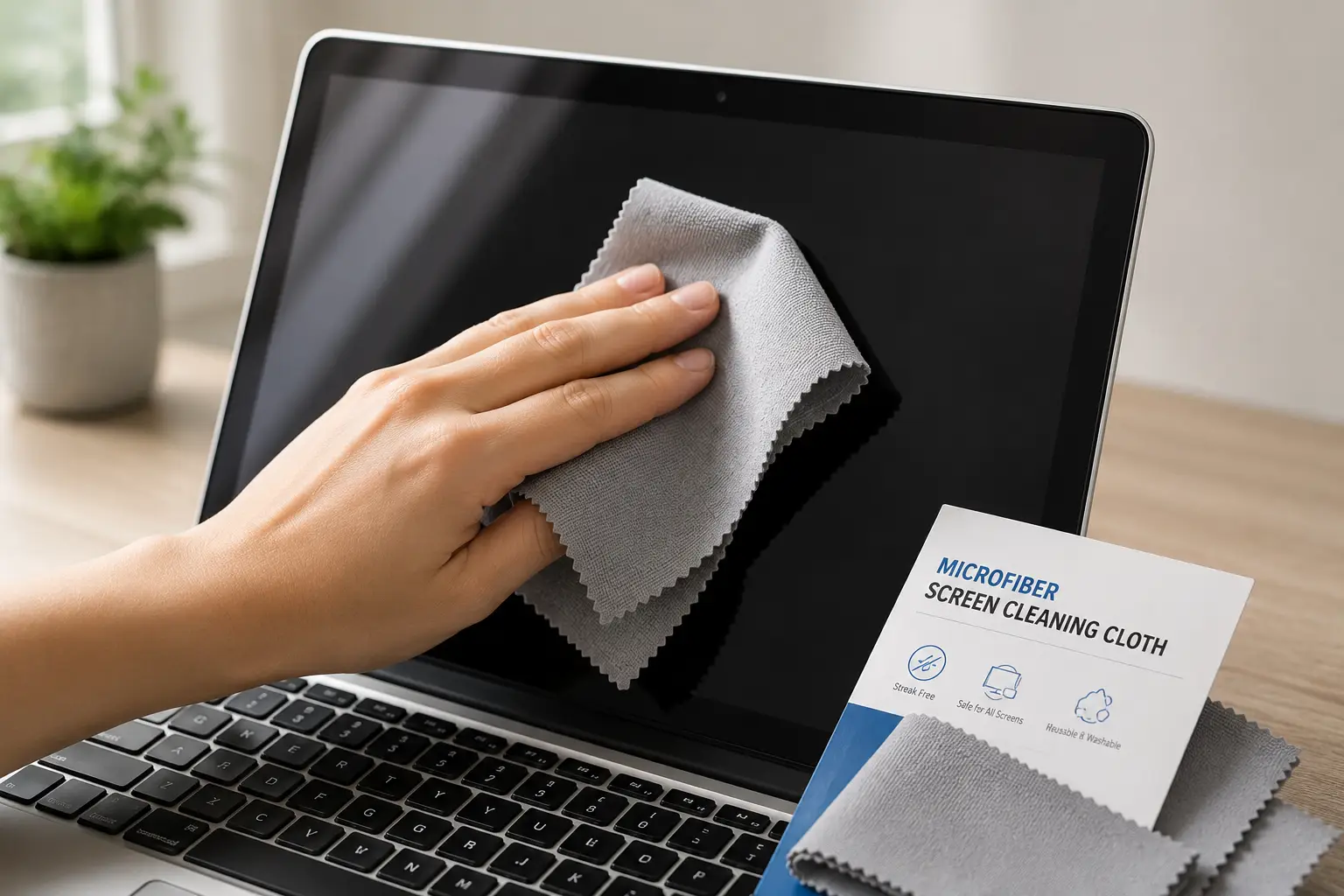
A microfiber screen cleaning cloth is a soft cleaning cloth made from extremely fine synthetic fibers, typically polyester and polyamide. The tightly woven fibers are designed to pick up dust, fingerprints, oils, and other light surface residue without the rough texture associated with ordinary paper towels or household rags.
Microfiber is especially useful for screens because modern displays can be sensitive to scratches, pressure, and inappropriate cleaning products. A good cloth should be soft, clean, lint-free, and free from abrasive particles before it touches a display.
Unlike disposable tissues, a reusable microfiber screen cleaning cloth can be washed and used repeatedly. This makes it practical for frequently cleaned devices such as smartphones, laptops, tablets, computer monitors, televisions, cameras, and glasses.
The important detail is that not every microfiber cloth is equally suitable for screens. Some cloths are designed for automotive surfaces, glass, kitchens, or general household cleaning and may be too thick, rough, contaminated, or treated with chemicals for delicate displays.
For screens, look for a fine, tightly woven microfiber with a smooth surface and minimal lint.
You should also avoid using fabric softener when washing screen-cleaning microfiber cloths. Residue can remain in the fibers and potentially transfer onto the display.
This guide compares seven practical microfiber screen cleaning cloth options and explains what actually matters: softness, lint, weave, size, edge construction, washability, streak resistance, and compatibility with different screens.
Quick Comparison: Top Microfiber Screen Cleaning Cloths at a Glance
| Product | Type | Main Feature | Best For |
|---|---|---|---|
| MagicFiber Microfiber Cleaning Cloths | Ultra-fine microfiber | Lint-free design | Screens & electronics |
| WHOOSH! Screen Shine Cloth | Premium microfiber | Designed for electronics | Phones & laptops |
| Koala Lens Cleaning Cloths | Fine microfiber | Soft, reusable material | Screens & glasses |
| Amazon Basics Microfiber Cleaning Cloths | General microfiber | Multipack value | Everyday cleaning |
| E-Cloth Window Cleaning Cloth | High-quality microfiber | Streak-free cleaning | Large displays |
| Moshi TeraGlove | Screen-cleaning system | Finger-friendly design | Phones & tablets |
| Care Touch Microfiber Cleaning Cloths | Fine microfiber | Multipack | Screens & optical surfaces |
A good microfiber screen cleaning cloth doesn’t need to be complicated.
For everyday phone and laptop cleaning, a soft fine-weave cloth is usually enough.
For larger televisions and monitors, a larger cloth can make cleaning faster because you can cover more surface area without repeatedly refolding the fabric.
If you also clean glasses or camera lenses, a smaller optical-grade microfiber cloth may be more convenient.
💬 Bookmark this comparison — it’s the fastest way to compare softness, lint, size, cleaning performance, and value before choosing your screen-cleaning cloth.
Top 7 Microfiber Screen Cleaning Cloth Options: Expert Analysis
1. MagicFiber Microfiber Cleaning Cloths — best overall
The MagicFiber Microfiber Cleaning Cloths are designed specifically for cleaning delicate surfaces such as screens, lenses, and electronics.
Their fine microfiber construction helps remove fingerprints, dust, and light oils without requiring aggressive scrubbing.
The multipack format is also useful because keeping separate clean cloths for different devices reduces the chance of transferring dust or residue from one surface to another.
A major advantage of microfiber is that it can generally be used dry for loose dust and fingerprints, with a small amount of appropriate screen-cleaning solution when necessary.
Pros:
- ✅ Soft microfiber construction
- ✅ Suitable for electronics and optical surfaces
- ✅ Reusable
- ✅ Multipack format
- Cons:
- ❌ Needs regular washing
- ❌ Can pick up dust when stored improperly
- ❌ Different colors may not indicate different cleaning functions
For a general-purpose microfiber screen cleaning cloth, MagicFiber is a practical starting point.
2. WHOOSH! Screen Shine Cloth — best for electronics
The WHOOSH! Screen Shine Cloth is designed as part of a screen-cleaning system for electronics.
Its main advantage is that it is intended specifically for delicate screens rather than general household cleaning.
That makes it a useful option for phones, tablets, laptops, monitors, and other glossy surfaces where streaks and fingerprints are particularly noticeable.
The cloth can be used with an appropriate screen-cleaning solution or on its own for light dust and fingerprints.
Pros:
- ✅ Designed for electronics
- ✅ Soft surface
- ✅ Good for fingerprints
- ✅ Reusable
- Cons:
- ❌ More expensive than generic microfiber
- ❌ Best results require proper washing
- ❌ Not necessary for basic dust removal
If you’re particularly concerned about streaks on expensive electronics, WHOOSH! Screen Shine Cloth is worth considering.
3. Koala Lens Cleaning Cloths — best multipurpose option
The Koala Lens Cleaning Cloths are made from fine microfiber and are designed for delicate optical surfaces.
Because screens and lenses both require gentle cleaning, this type of cloth can work well for people who want one product for phones, tablets, glasses, cameras, and monitors.
The small size is convenient for portable devices, although a larger cloth may be preferable for televisions and desktop monitors.
Pros:
- ✅ Fine microfiber
- ✅ Suitable for delicate surfaces
- ✅ Reusable
- ✅ Useful for screens and glasses
- Cons:
- ❌ Small size may be slow for large displays
- ❌ Requires frequent washing
- ❌ Can collect oils from hands
For people who want a versatile microfiber screen cleaning cloth that can also handle glasses and camera lenses, Koala is a useful choice.
4. Amazon Basics Microfiber Cleaning Cloths — best value
The Amazon Basics Microfiber Cleaning Cloths are a budget-friendly option for people who need multiple cloths around the house.
Having several cloths can actually be useful for electronics because you can dedicate a few specifically to screens instead of using the same cloth on countertops, appliances, or automotive surfaces.
The main advantage is value.
You can keep clean cloths in different rooms, at your desk, in a laptop bag, or near your television.
Pros:
- ✅ Affordable multipack
- ✅ Reusable
- ✅ Versatile
- ✅ Easy to keep dedicated cloths for electronics
- Cons:
- ❌ General-purpose rather than screen-specific
- ❌ Quality can vary by product version
- ❌ Should be separated from dirtier cleaning cloths
If you want an inexpensive supply of microfiber cloths, Amazon Basics can be a practical option.
5. E-Cloth Window Cleaning Cloth — best for large screens
The E-Cloth Window Cleaning Cloth is designed for glass and smooth surfaces, making the format particularly useful for large televisions, monitors, and other displays.
Its larger size allows you to clean more surface area without constantly refolding the cloth.
This is particularly useful for large TVs where a tiny optical cloth can make cleaning unnecessarily slow.
For screens, use gentle pressure and follow the manufacturer’s display-cleaning recommendations rather than aggressively scrubbing the surface.
Pros:
- ✅ Large cleaning surface
- ✅ Reusable
- ✅ Designed for glass and smooth surfaces
- ✅ Useful for large TVs and monitors
- Cons:
- ❌ Larger than needed for phones
- ❌ Can become contaminated if used on dirty windows
- ❌ Requires careful washing for screen use
For large displays, a clean microfiber screen cleaning cloth with a larger surface area can make the job considerably easier.
6. Moshi TeraGlove — best screen-cleaning system
The Moshi TeraGlove takes a slightly different approach to screen cleaning.
Instead of functioning like a conventional rectangular cloth, the design gives you a way to clean a device while keeping your hand separated from the cleaning surface.
This can be useful for smartphones and tablets because fingerprints are often the main problem you’re trying to remove.
The design also encourages using a dedicated cleaning surface rather than grabbing whatever cloth happens to be nearby.
Pros:
- ✅ Convenient for handheld electronics
- ✅ Reusable
- ✅ Helps reduce direct contact
- ✅ Designed for screen cleaning
- Cons:
- ❌ More specialized than a standard cloth
- ❌ Less useful for very large displays
- ❌ Higher cost than basic microfiber
If you frequently clean smartphones and tablets, this type of dedicated system can be convenient.
7. Care Touch Microfiber Cleaning Cloths — best multipack for delicate surfaces
The Care Touch Microfiber Cleaning Cloths are designed for cleaning delicate surfaces such as glasses, lenses, screens, and electronics.
Their multipack format makes it easy to keep clean cloths available without repeatedly washing the same cloth throughout the week.
This is particularly helpful for people with multiple devices.
A dedicated clean cloth should always be preferred over one that has already been used to wipe dust from furniture or other dirty surfaces.
Pros:
- ✅ Soft microfiber
- ✅ Multipack
- ✅ Suitable for optical surfaces
- ✅ Reusable
- Cons:
- ❌ Small cloths aren’t ideal for large TVs
- ❌ Require proper washing
- ❌ Can transfer residue if contaminated
For households with multiple screens and optical surfaces, Care Touch provides a practical multipack option.
How to Choose a Microfiber Screen Cleaning Cloth
Choosing the right microfiber screen cleaning cloth is easier when you focus on the actual characteristics of the fabric.
- Choose a fine weave. Finer fibers are generally better suited to delicate surfaces.
- Look for a lint-free or low-lint design. Loose fibers can leave debris behind.
- Check the size. Small cloths are convenient for phones; larger cloths work better for TVs and monitors.
- Avoid rough textures. Screen cleaning doesn’t require abrasive scrubbing.
- Keep screen cloths separate. Don’t use the same cloth for greasy kitchen surfaces.
- Check the edges. Soft or edgeless designs reduce the chance of hard seams contacting the display.
- Choose washable material. Reusable microfiber is more economical over time.
- Don’t use fabric softener. Residue can reduce cleaning performance.
- Keep multiple cloths available. A clean cloth is more useful than one already covered in dust.
- Match the cloth to the device. A phone and a 75-inch TV don’t necessarily need the same size.
The most important rule is simple: clean cloth + gentle pressure + appropriate screen-safe solution when needed.
Common Mistakes to Avoid When Buying a Microfiber Screen Cleaning Cloth
The biggest mistake is using any microfiber cloth interchangeably.
A cloth that has been used to clean a car, kitchen, or dusty surface may contain particles that can scratch or contaminate a delicate screen.
Another mistake is washing microfiber with fabric softener. The residue can coat the fibers and reduce their ability to pick up oils and dust.
People also tend to press too hard. A microfiber cloth is designed to collect surface debris without aggressive scrubbing.
Another common mistake is spraying liquid directly onto the screen. For electronics, it’s generally safer to apply an appropriate cleaning solution to the cloth according to the device manufacturer’s instructions rather than flooding the display.
Don’t forget to inspect the cloth before use. If you see grit, sand, dirt, or other particles trapped in the fabric, use a clean cloth instead.
Microfiber Screen Cleaning Cloth vs. Paper Towel
| Feature | Microfiber Cloth | Paper Towel |
|---|---|---|
| Reusable | Yes | No |
| Lint | Usually low | Can leave fibers |
| Softness | High | Varies |
| Fingerprint removal | Excellent | Moderate |
| Cost over time | Low | Higher |
| Environmental waste | Lower | Higher |
| Best for screens | Yes | Generally not ideal |
A microfiber screen cleaning cloth is generally the better choice for routine screen cleaning.
Paper towels can leave lint or tiny fibers behind and may have a rougher texture than a high-quality microfiber cloth.
Microfiber is also reusable, which means one good cloth can replace many disposable cleaning materials.
Microfiber Screen Cleaning Cloth vs. Cotton Cloth
| Feature | Microfiber | Cotton |
|---|---|---|
| Fiber fineness | Very fine | Generally thicker |
| Dust pickup | Excellent | Moderate |
| Lint | Usually low | Can vary |
| Dry cleaning | Excellent | Moderate |
| Screen use | Excellent | Depends on fabric |
| Reusability | Excellent | Excellent |
Cotton isn’t automatically unsafe, but ordinary cotton towels and fabrics aren’t necessarily designed for delicate screens.
Microfiber’s very fine fibers make it particularly useful for collecting dust, fingerprints, and oils from smooth surfaces.
If you’re choosing specifically for electronics, a dedicated microfiber cloth is usually the safer starting point.
Microfiber Screen Cleaning Cloth for Phones
Phones collect fingerprints constantly.
A small microfiber cloth is ideal because it can easily fit into a bag, desk drawer, or phone-accessory pouch.
For everyday cleaning, gently wipe the screen using a dry cloth.
If additional cleaning is necessary, follow your phone manufacturer’s recommendations for approved cleaning solutions.
Don’t press hard.
The goal is to remove oils and fingerprints, not scrub the display.
A small cloth can also be useful for cleaning the camera lenses on the back of the phone, provided the cloth is completely clean.
Microfiber Screen Cleaning Cloth for Laptops
Laptop displays can be more delicate than they appear.
Start by turning the laptop off and allowing the display to cool if necessary.
Use a clean, dry microfiber cloth to remove loose dust.
For fingerprints or oily marks, follow the laptop manufacturer’s cleaning instructions and use an appropriate solution sparingly.
Never saturate the cloth.
A larger microfiber cloth can be convenient for laptops because it allows you to wipe the entire display with a clean section of fabric.
Microfiber Screen Cleaning Cloth for TVs
Large televisions benefit from larger microfiber cloths.
A small optical cloth will work, but cleaning a 55-, 65-, or 75-inch display with one tiny cloth can take considerably longer.
Use a clean cloth and gentle pressure.
Avoid spraying liquid directly onto the screen unless the television manufacturer explicitly instructs you to do so.
For OLED and other delicate displays, always follow the manufacturer’s specific cleaning recommendations.
A dedicated large microfiber screen cleaning cloth can make routine TV maintenance much easier.
Microfiber Screen Cleaning Cloth for Monitors
Computer monitors accumulate fingerprints, dust, and particles throughout the day.
A microfiber cloth can remove light dust without leaving the paper fibers associated with tissues or towels.
For monitors, it is particularly useful to keep a dedicated cloth near the desk.
Don’t use the same cloth to clean the keyboard and then immediately wipe the display. Keyboard surfaces can contain dust, skin oils, and particles that you don’t want transferred onto the screen.
How to Clean a Microfiber Screen Cleaning Cloth
The cloth itself needs to be clean before it touches your screen.
Start by removing loose debris.
Wash microfiber separately from heavily soiled fabrics when possible.
Use the manufacturer’s recommended washing instructions.
Avoid fabric softener because it can leave residue in the fibers.
Avoid washing microfiber with materials that shed large amounts of lint.
After washing, dry the cloth according to the manufacturer’s instructions and store it somewhere clean and dry.
If the cloth develops a rough texture, becomes heavily contaminated, or contains embedded particles, replace it.
How Often Should You Replace a Microfiber Screen Cleaning Cloth?
There isn’t a universal replacement schedule.
A high-quality microfiber cloth can last for a long time when it is washed correctly and used only on relatively clean surfaces.
The important thing is condition rather than age.
Replace the cloth if:
- It becomes rough
- It develops holes
- It remains greasy after washing
- It contains embedded particles
- It begins shedding fibers
- It has been contaminated with harsh chemicals
- It no longer cleans effectively
Keeping several cloths in rotation can extend their useful life.
Features That Actually Matter
A lot of screen-cleaning products make impressive claims, but several basic features matter most.
Fiber fineness is important because delicate surfaces benefit from soft, fine fibers.
Lint performance matters because nobody wants a screen covered in tiny fibers after cleaning.
Size should match the device.
Washability determines how practical the cloth is over time.
Edge construction matters because rough seams can be less desirable for delicate surfaces.
Absorbency can be useful when using a small amount of cleaning solution.
And finally, dedicated use matters more than many specifications. Even an excellent microfiber cloth can become unsuitable for screens if it is repeatedly used on dirty surfaces.
Long-Term Cost and Maintenance
A microfiber screen cleaning cloth is inexpensive compared with most electronics accessories.
The real advantage is reusability.
Instead of repeatedly purchasing disposable wipes, you can wash the cloth and use it again.
A small set of microfiber cloths can cover your phone, laptop, monitor, TV, glasses, and camera equipment.
The main maintenance requirement is keeping the cloths clean.
Store screen-cleaning cloths in a drawer, pouch, or sealed container where they won’t collect dust.
Don’t leave a microfiber cloth on a dirty desk and then immediately use it on an OLED display.
A clean storage location is just as important as the cloth itself.
Safety and Screen-Cleaning Considerations
The cloth is only one part of safe screen cleaning.
Always follow the display manufacturer’s cleaning instructions.
Turn off and unplug equipment when appropriate.
Never soak the display.
Don’t apply excessive pressure.
Avoid abrasive household cleaners unless the manufacturer specifically says they’re safe.
Don’t use dirty microfiber cloths.
And don’t assume that a product marketed for glass is automatically suitable for every screen.
Modern displays can have coatings that are sensitive to certain chemicals, so the manufacturer’s instructions should take priority.
What to Expect: Everyday Performance
The best microfiber screen cleaning cloth should make screen maintenance almost effortless.
For light dust, you should be able to wipe the surface gently with a dry cloth.
For fingerprints, a clean microfiber surface can lift oils without leaving the paper fibers commonly associated with disposable towels.
For larger TVs and monitors, a larger cloth can make the cleaning process faster.
The biggest performance difference isn’t usually dramatic. It’s the combination of softness, cleanliness, low lint, and proper technique.
A cheap clean microfiber cloth can outperform an expensive cloth that has been contaminated with dust and oils.
Frequently Asked Questions
❓ What is the best microfiber screen cleaning cloth?
❓ Can I use a microfiber cloth to clean my TV screen?
❓ Are microfiber cloths safe for laptop screens?
❓ Can I wash a microfiber screen cleaning cloth?
❓ Should I use a wet or dry microfiber screen cleaning cloth?
Conclusion
A microfiber screen cleaning cloth is one of the simplest accessories you can keep around if you regularly use phones, laptops, monitors, televisions, cameras, or glasses.
For an overall option, MagicFiber Microfiber Cleaning Cloths offer a practical combination of fine microfiber construction and multipack convenience.
WHOOSH! Screen Shine Cloth is a good fit for users who specifically want a screen-focused cleaning system, while Koala Lens Cleaning Cloths are useful when you want one cloth for both electronics and optical surfaces.
For larger TVs and monitors, a larger cloth such as the E-Cloth Window Cleaning Cloth can make cleaning considerably faster.
The biggest lesson is simple: the cleanest cloth is often the safest cloth. Even a premium microfiber product can become unsuitable for delicate screens if it collects grit, dust, oils, or residue from other surfaces.
Choose a soft, low-lint microfiber cloth, keep it dedicated to electronics, wash it properly, and use gentle pressure.
With those simple habits, a microfiber screen cleaning cloth can keep your displays looking clean and fingerprint-free without turning routine screen maintenance into a complicated process.
✨ Don’t miss these exclusive deals! 🔍 Keep your screens looking crystal clear with this carefully curated lineup. Compare microfiber softness, lint performance, cloth size, washability, edge construction, and value before choosing the microfiber screen cleaning cloth that best fits your devices!
Recommended for You
- Can You Put Microfiber Towels in the Dryer? 7 Best Options to Try
- Washing Microfiber Towels for Car Wash: 7 Best Detergents (2026)
- Are Microfiber Cloths Lint Free? 7 Best Options to Know in 2026
Disclaimer: This post contains affiliate links. As an Amazon Associate, I earn from qualifying purchases made through these links, at no additional cost to you.
✨ Found this article helpful? Share it with someone who needs it! 💬🤗