In This Article
Are Microfiber Cloths Lint Free?
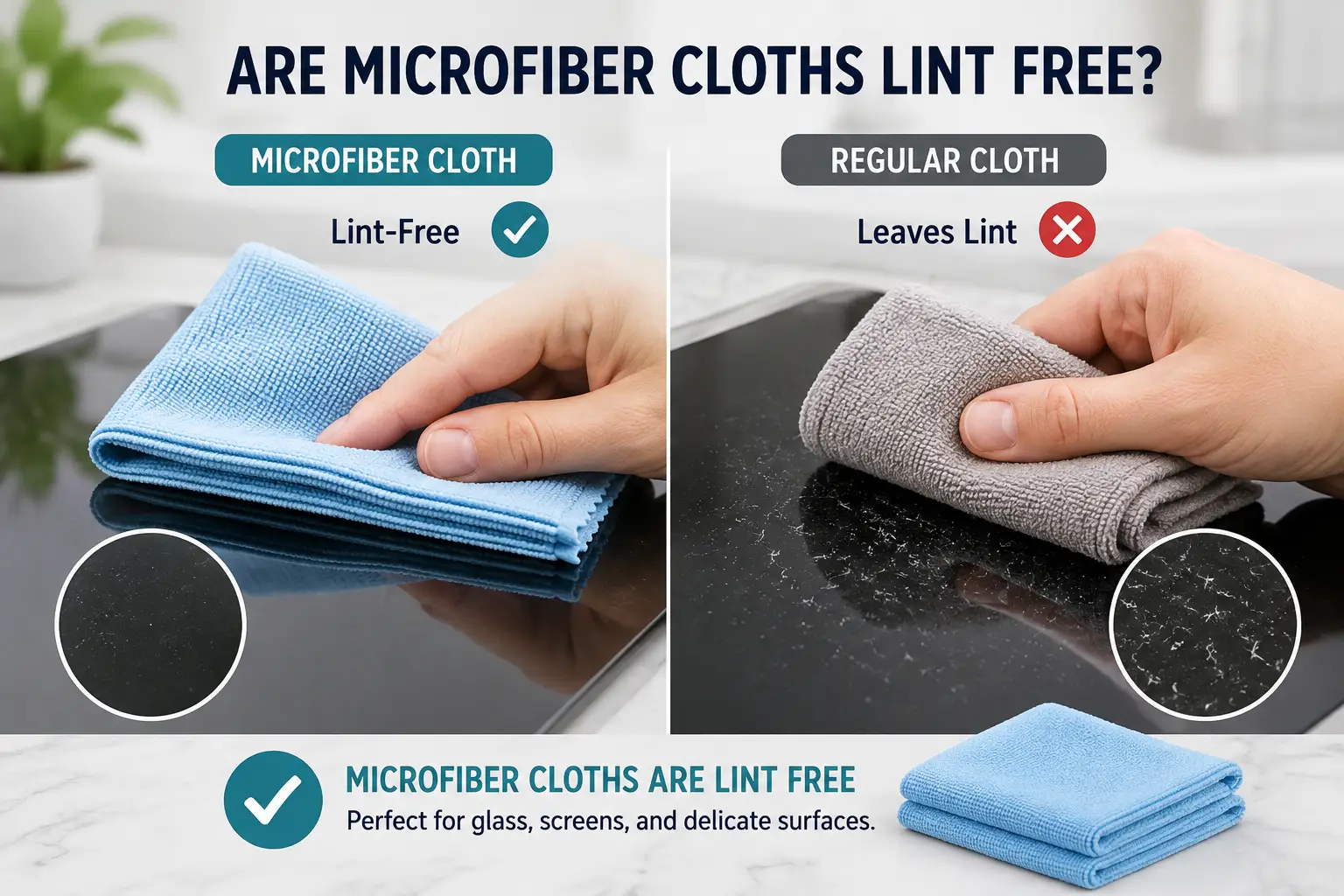
Are microfiber cloths lint free? Generally, yes — high-quality microfiber cloths are designed to produce very little lint compared with conventional cotton towels, paper towels, and many other cleaning fabrics. However, “lint free” does not always mean that every microfiber cloth will produce absolutely zero loose fibers.
Microfiber is made from extremely fine synthetic fibers, usually polyester, polyamide, or a blend of both. These fibers are much finer than ordinary textile fibers and are woven or knitted into a dense material designed to capture dust, dirt, oils, and moisture.
The fine fiber structure is one reason microfiber cloths are commonly used for cleaning glass, mirrors, electronics, eyeglasses, vehicles, stainless steel, and other surfaces where visible lint would be frustrating.
High-quality microfiber can leave considerably less residue than many traditional cleaning materials. However, the manufacturing process, fabric quality, washing method, age of the cloth, and the surface being cleaned can all affect whether you see lint or loose fibers.
If you’ve ever wiped a mirror only to discover tiny fibers left behind, you already understand why the question are microfiber cloths lint free matters. The answer depends partly on what type of microfiber cloth you’re using.
A general-purpose microfiber towel may be perfectly suitable for dusting and household cleaning but may not be the best choice for a camera lens, eyeglasses, or a high-gloss surface. For those applications, tightly woven, high-quality microfiber specifically marketed as low-lint or lint-free is usually a better option.
This guide breaks down exactly what to look for when asking are microfiber cloths lint free, compares seven microfiber cloth options worth considering in 2026, and explains the practical differences between weave types, fiber blends, thicknesses, and cleaning methods.
We’ll also cover why microfiber sometimes sheds, how washing affects lint, whether microfiber is safe for glass and electronics, and how to choose the right cloth for delicate surfaces.
Quick Comparison: Top Lint-Free Microfiber Cloth Options at a Glance
| Product | Material / Style | Main Use | Lint Performance | Best For |
|---|---|---|---|---|
| MagicFiber Premium Microfiber Cloths | Fine microfiber | Electronics & lenses | Very low | Best overall |
| E-Cloth Glass & Polishing Cloth | Microfiber | Glass & mirrors | Low | Streak-free glass |
| MR.SIGA Professional Microfiber Cloths | Microfiber | Household cleaning | Low | Everyday cleaning |
| The Rag Company Edgeless 365 | Premium microfiber | Automotive & detailing | Very low | Car detailing |
| Zwipes Microfiber Cleaning Cloths | Microfiber | General cleaning | Low | Budget users |
| Chemical Guys Professional Grade Microfiber | Premium microfiber | Automotive | Very low | Car interiors |
| Amazon Basics Microfiber Cleaning Cloths | Microfiber | General household use | Low to moderate | Affordable bulk cleaning |
Looking at the table above, the biggest difference is really about the type of surface you’re cleaning. A premium optical microfiber designed for glasses or camera lenses has a different construction and purpose from a thick general-purpose household towel.
MagicFiber is particularly useful for delicate surfaces because its cloths are designed for electronics, glasses, camera lenses, and other surfaces where residue and lint can be noticeable.
For glass and mirrors, E-Cloth Glass & Polishing Cloth is designed specifically around cleaning and polishing glass surfaces.
For automotive use, The Rag Company Edgeless 365 and Chemical Guys Professional Grade Microfiber provide denser microfiber constructions intended for detailing.
💬 Bookmark this comparison — it’s the fastest way to see which microfiber cloth matches your cleaning surface before you scroll through all seven full reviews below.
Top 7 Microfiber Cloth Options: Expert Analysis
1. MagicFiber Premium Microfiber Cloths — best overall lint-free microfiber cloth
If you’re asking are microfiber cloths lint free because you need something for glasses, screens, cameras, or other delicate surfaces, MagicFiber is one of the easiest options to consider.
MagicFiber cloths are made from very fine microfiber and are designed specifically for removing fingerprints, dust, oil, and smudges without leaving the type of residue commonly associated with paper towels or ordinary cotton fabrics.
The fine construction makes them particularly suitable for optical surfaces. A cloth that produces visible lint can be especially annoying when cleaning eyeglasses because the fibers become immediately noticeable against the lens.
Another advantage is their relatively thin profile. A thinner optical cloth is easy to fold and use around small surfaces without creating excessive bulk.
Pros:
- ✅ Very fine microfiber construction
- ✅ Designed for delicate surfaces
- ✅ Good for glasses and screens
- ✅ Low-lint performance
- ✅ Reusable
- ✅ Easy to carry
Cons:
- ❌ Not ideal for heavy-duty household messes
- ❌ Requires careful washing
- ❌ Thin cloth may not absorb large amounts of liquid
If your main concern is whether microfiber can clean a surface without leaving visible fibers, this is the type of cloth to look for.
2. E-Cloth Glass & Polishing Cloth — best for glass
For windows, mirrors, shower glass, and other smooth surfaces, a glass-specific microfiber cloth can make more sense than a general cleaning towel.
The E-Cloth Glass & Polishing Cloth is designed for polishing glass and removing fingerprints, smears, and residue.
The fabric’s fine structure is particularly useful because glass makes lint and streaks easy to see. A thick, fluffy microfiber towel may absorb a lot of water, but it isn’t necessarily the best choice for finishing a mirror.
A dedicated polishing cloth is generally thinner and smoother, helping it glide over the surface rather than leaving behind a fluffy texture.
Pros:
- ✅ Designed specifically for glass
- ✅ Low-lint finish
- ✅ Good for mirrors and windows
- ✅ Helps reduce visible streaks
- ✅ Reusable
- ✅ Suitable for regular household cleaning
Cons:
- ❌ Less absorbent than thick microfiber towels
- ❌ Not designed for heavy-duty cleaning
- ❌ Works best when washed correctly
If you’re asking are microfiber cloths lint free because you’re tired of seeing fibers on mirrors, a smooth glass-specific microfiber cloth is a particularly good place to start.
3. MR.SIGA Professional Microfiber Cloths — best for everyday cleaning
If you need one microfiber cloth for general household cleaning, MR.SIGA offers a more versatile option.
These microfiber cloths are designed for dusting, wiping countertops, cleaning appliances, and handling everyday household dirt.
The major advantage is versatility. Instead of using a delicate optical cloth for everything, you can reserve specialized cloths for screens and glasses while using general-purpose microfiber for kitchens, furniture, bathrooms, and other surfaces.
The cloths are also washable and reusable, which makes them practical for regular cleaning routines.
Pros:
- ✅ Versatile household use
- ✅ Reusable
- ✅ Absorbent
- ✅ Low-lint compared with many conventional cloths
- ✅ Suitable for multiple surfaces
- ✅ Available in multipacks
Cons:
- ❌ Not as specialized as optical microfiber
- ❌ Heavy washing can eventually affect fiber performance
- ❌ Not the best choice for delicate camera lenses
For everyday cleaning, you don’t necessarily need the most expensive microfiber. What matters more is using a good-quality cloth and washing it correctly.
4. The Rag Company Edgeless 365 — best for automotive detailing
For car detailing, lint performance becomes particularly important because fibers can become trapped around trim, glass, screens, and polished surfaces.
The Rag Company Edgeless 365 is a premium microfiber towel designed for detailing applications. Its edgeless construction reduces the risk of hard edges coming into contact with delicate surfaces.
The towel is particularly useful for polishing, removing product residue, and general detailing.
The dense microfiber construction also makes it useful for surfaces where you want good pickup without relying on aggressive rubbing.
Pros:
- ✅ Premium microfiber
- ✅ Edgeless construction
- ✅ Low-lint performance
- ✅ Excellent for detailing
- ✅ Useful for polished surfaces
- ✅ Reusable
Cons:
- ❌ More expensive than basic cleaning cloths
- ❌ May be unnecessary for simple household cleaning
- ❌ Requires careful washing to maintain performance
For automotive users, this is a strong answer to the practical side of are microfiber cloths lint free: quality, weave, and edge construction matter just as much as the word “microfiber” on the packaging.
5. Zwipes Microfiber Cleaning Cloths — best budget option
If you need a large number of microfiber cloths for everyday household cleaning, Zwipes is worth considering.
The primary advantage is quantity and versatility. These cloths can be used for dusting, wiping surfaces, cleaning appliances, and general household maintenance.
They are not necessarily the first choice for professional optical cleaning, but they can perform very well for ordinary surfaces.
Their low-lint characteristics also make them more convenient than many traditional cotton cleaning rags.
Pros:
- ✅ Affordable
- ✅ Multipack options
- ✅ Suitable for household cleaning
- ✅ Reusable
- ✅ Low-lint compared with many cotton towels
Cons:
- ❌ Not designed specifically for delicate optics
- ❌ Performance varies by cloth condition
- ❌ May shed more if washed incorrectly
For someone who needs dozens of cloths rather than a single premium towel, this is a practical budget category.
6. Chemical Guys Professional Grade Microfiber — best for car interiors
Chemical Guys offers microfiber products designed specifically for automotive detailing, including interior surfaces, dashboards, screens, trim, and polished finishes.
Automotive microfiber is particularly useful because cars contain many different materials in a small space. You may need to wipe leather, plastic, glass, piano-black trim, and screens without scratching or leaving fibers behind.
A high-quality microfiber cloth gives you the flexibility to use different cloths for different products and surfaces.
Pros:
- ✅ Designed for automotive use
- ✅ Low-lint performance
- ✅ Good for interiors and detailing
- ✅ Reusable
- ✅ Multiple sizes and styles available
Cons:
- ❌ Automotive-focused rather than optical
- ❌ Requires proper separation from greasy cleaning cloths
- ❌ Premium versions can cost more
If you’re cleaning a vehicle regularly, dedicated detailing microfiber is usually preferable to using the same cloth for every surface.
7. Amazon Basics Microfiber Cleaning Cloths — best affordable bulk option
If price is the main consideration, Amazon Basics microfiber cloths offer an inexpensive way to build a large cleaning supply.
They are designed for general household use and can handle dust, dirt, spills, and everyday wiping.
They are not the cloth we’d choose for expensive camera lenses or delicate coated optics, but they can be perfectly adequate for furniture, countertops, appliances, and other general surfaces.
Pros:
- ✅ Affordable
- ✅ Large multipack availability
- ✅ Good for general cleaning
- ✅ Reusable
- ✅ Easy to replace
Cons:
- ❌ Not specialized for delicate surfaces
- ❌ Some versions may be more lint-prone after heavy use
- ❌ Requires proper washing
If your goal is simply to have a stack of reusable cleaning cloths around the house, a budget microfiber multipack can be a sensible option.
How to Tell if Microfiber Cloths Are Lint Free, Step by Step
The question are microfiber cloths lint free doesn’t have a simple yes-or-no answer for every product. Use these steps to identify a genuinely low-lint cloth.
- Look at the fabric surface. High-quality microfiber generally has a dense, consistent texture.
- Check the product description. Look for terms such as low-lint, lint-free, optical-grade, or edgeless.
- Choose the correct weave. Smooth, tightly woven microfiber is generally better for glass and optical surfaces.
- Check the edges. Edgeless or silk-edged designs can be useful for delicate surfaces.
- Wash before first use. Manufacturing residue and loose fibers can be removed by an initial wash.
- Wash microfiber separately. Mixing microfiber with cotton towels can introduce lint into the microfiber.
- Avoid fabric softener. It can coat the fibers and reduce their cleaning performance.
- Avoid high heat. Excessive heat can damage or deform synthetic fibers.
- Inspect the cloth. Replace cloths that have become rough, damaged, or visibly shedding.
- Use different cloths for different jobs. Keep optical cloths separate from greasy kitchen or automotive towels.
✨ Ready to get a cleaner finish? Start with a smooth, high-quality microfiber cloth specifically designed for the surface you’re cleaning.
Common Mistakes to Avoid When Using Microfiber Cloths
Even people who use microfiber every day make a few predictable mistakes.
The biggest mistake is assuming that every microfiber cloth is automatically lint free. Microfiber describes the fiber size, not necessarily the quality, weave, edge construction, or manufacturing process.
Another common mistake is washing microfiber with cotton towels. Cotton produces loose fibers that can become trapped in microfiber, making the cloth appear linty even though the microfiber itself is not necessarily shedding.
Fabric softener is another problem. It can coat microfiber fibers and reduce their ability to attract and capture dust, oils, and moisture.
Using too much detergent can also leave residue in the cloth. For delicate cleaning applications, excessive detergent can be just as problematic as insufficient rinsing.
People also frequently use the same microfiber cloth for every surface. A cloth used to clean an oily kitchen surface shouldn’t immediately be used on eyeglasses or a laptop screen.
Finally, don’t keep using a microfiber cloth after it becomes visibly dirty or rough. A damaged or contaminated cloth can scratch delicate surfaces or simply move dirt around instead of removing it.
Are Microfiber Cloths Lint Free vs. Cotton Cloths?
The comparison most people actually care about is whether microfiber produces less lint than ordinary cotton.
| Factor | Microfiber Cloths | Cotton Cloths |
|---|---|---|
| Lint production | Very low when high quality | Often higher |
| Fiber size | Extremely fine | Larger |
| Dust pickup | Excellent | Good |
| Absorbency | Excellent | Excellent |
| Glass cleaning | Excellent | Moderate |
| Electronics | Excellent with suitable cloth | Less ideal |
| Reusability | Excellent | Excellent |
| Best for | Delicate and general surfaces | Heavy-duty cleaning |
The biggest advantage of microfiber is its fine fiber structure. The fibers can be split into extremely small strands that create a large surface area for collecting dust, oils, and moisture.
Cotton remains useful for many cleaning jobs, especially when absorbency and durability are more important than a completely clean finish.
But if you’re cleaning mirrors, glasses, screens, stainless steel, or polished surfaces, microfiber’s low-lint characteristics give it a major advantage.
The key is choosing the correct microfiber rather than assuming every microfiber towel performs identically.
Are Microfiber Cloths Lint Free for Glass and Mirrors?
Yes, high-quality microfiber is generally an excellent choice for glass and mirrors because it can produce a very low-lint finish.
Glass is one of the easiest surfaces on which to see lint. Even a few loose fibers can become immediately visible when light reflects across the surface.
For that reason, smooth polishing microfiber is generally preferable to thick, fluffy towels for the final cleaning pass.
Use one cloth to remove dirt or moisture and a second clean, dry cloth for polishing if necessary.
Avoid using a microfiber cloth that has previously been exposed to grease, wax, fabric softener, or heavy detergent residue.
For the best result, wash glass-cleaning microfiber separately and keep it away from cotton towels.
Are Microfiber Cloths Lint Free for Electronics?
Microfiber is one of the most popular choices for cleaning electronics because a clean, soft microfiber cloth can remove fingerprints and dust without the roughness of paper towels.
However, the cloth itself needs to be clean.
A microfiber cloth used to clean a kitchen counter may contain tiny particles that could potentially scratch a glossy screen. For phones, tablets, monitors, camera lenses, and glasses, keep a separate group of clean optical-quality microfiber cloths.
Use gentle pressure rather than aggressively scrubbing the screen.
Also, don’t soak electronics with cleaning liquid. If a cleaning solution is appropriate for the device, apply it according to the manufacturer’s instructions rather than saturating the cloth or device unnecessarily.
Are Microfiber Cloths Lint Free After Washing?
Microfiber can remain very low-lint after repeated washing, but incorrect washing can change its performance.
The most important rule is to wash microfiber separately from lint-producing fabrics.
Cotton towels, fleece, and other fabrics can release fibers during washing. Those fibers may become trapped in microfiber and appear as lint when the cloth is used later.
Avoid fabric softener because it can coat the fibers.
Use an appropriate amount of detergent and rinse thoroughly.
Dry microfiber according to the manufacturer’s instructions, generally avoiding excessive heat.
If the cloth becomes rough, damaged, or heavily contaminated, replace it rather than continuing to use it on delicate surfaces.
Are Microfiber Cloths Lint Free for Eyeglasses?
For eyeglasses, a clean optical microfiber cloth is generally one of the best choices.
The important word is clean. A microfiber cloth may be low-lint but still contain dust, grit, skin oils, or other particles from previous use.
For coated prescription lenses, use a cloth specifically intended for glasses or optical surfaces.
Keep these cloths separate from household cleaning towels.
Don’t use an old microfiber cloth that has been used to clean a car, kitchen, or dusty furniture on your eyeglasses.
A fresh, clean optical cloth reduces the chance of transferring particles onto the lens.
Long-Term Cost and Maintenance
Buying microfiber cloths is only part of the cost equation — maintaining them correctly determines how long they continue to perform well.
Microfiber cloths are reusable, which makes them considerably more economical over time than disposable paper towels for many cleaning jobs.
The most important maintenance habit is keeping cloths separated by purpose.
Create separate groups for:
- Glass and mirrors
- Eyeglasses and optics
- Electronics
- Kitchen cleaning
- Automotive detailing
- General dusting
This prevents grease, chemicals, and abrasive particles from moving from one cleaning task to another.
Wash microfiber separately and avoid fabric softener.
Store clean microfiber in a dry, enclosed area so it doesn’t collect dust before the next use.
With proper care, a high-quality microfiber cloth can be washed and reused many times.
Safety, Cleaning, and Surface Protection
Although microfiber is generally gentle, the cloth isn’t automatically safe for every surface.
The biggest factor is contamination. A dirty microfiber cloth can contain particles that scratch delicate finishes.
Always inspect the cloth before cleaning a sensitive surface.
For coated eyeglasses, camera lenses, and high-gloss displays, use microfiber specifically intended for optical or electronic applications.
Avoid using a cloth that has been exposed to abrasive cleaners.
If you’re cleaning a new or expensive surface, test the cloth on a small inconspicuous area first.
And never assume that because a product says “microfiber” it is automatically suitable for lenses, screens, or other delicate materials.
What to Expect: Everyday Performance
Specs only tell part of the story; here’s how microfiber cloths actually perform across everyday cleaning tasks.
For dusting furniture, almost any good-quality microfiber can work well.
For kitchen surfaces, thicker and more absorbent microfiber is generally preferable.
For glass and mirrors, smooth low-lint microfiber performs better because the goal is a clean, streak-free finish rather than maximum absorption.
For electronics and eyeglasses, a fine optical microfiber is the better choice.
For cars, premium detailing microfiber can provide better results because the cloths are available in different pile heights and constructions for different stages of cleaning.
The biggest takeaway is simple: are microfiber cloths lint free? High-quality microfiber is generally very low-lint, but the exact performance depends on the cloth’s construction, quality, condition, and care.
Frequently Asked Questions
❓ Are microfiber cloths lint free?
❓ Why does my microfiber cloth leave lint behind?
❓ Are microfiber cloths safe for glasses and screens?
❓ How should I wash microfiber cloths to keep them lint free?
❓ Do all microfiber cloths work the same way?
Conclusion
The answer to are microfiber cloths lint free is generally yes — high-quality microfiber is designed to produce very little lint and is one of the better choices for surfaces where loose fibers and residue are noticeable.
The right choice depends entirely on what you’re cleaning. MagicFiber is a strong option for glasses, electronics, and optical surfaces, while E-Cloth Glass & Polishing Cloth is better suited to mirrors and windows.
For everyday household cleaning, MR.SIGA, Zwipes, and Amazon Basics offer practical multipack options. For automotive detailing, premium products from The Rag Company and Chemical Guys provide specialized microfiber constructions for different surfaces.
Whichever option you choose, the fundamentals stay the same: use the right microfiber for the surface, wash it separately from cotton, avoid fabric softener, keep optical cloths away from greasy cleaning tasks, and replace cloths that become damaged or contaminated.
Microfiber isn’t magically lint free simply because the label says “microfiber.” The quality of the fabric, its weave, its condition, and how you wash it all affect the final result.
For the cleanest possible finish, choose a high-quality low-lint microfiber cloth and keep it dedicated to the surface you intend to clean.
✨ Don’t miss these exclusive deals! 🔍 Take your cleaning routine to the next level with this carefully curated lineup. Compare the microfiber types, sizes, textures, and intended uses before choosing the cloth that best fits your cleaning needs!
Recommended for You
- How to Clean Lens Cloth: 7 Best Picks & Easy Care Tips (2026)
- Carbon Cloth Fabric: 7 Best Picks for DIY Composites in 2026
- Dust Rag: 7 Best Options for a Cleaner Home in 2026
Disclaimer: This post contains affiliate links. As an Amazon Associate, I earn from qualifying purchases made through these links, at no additional cost to you.
✨ Found this article helpful? Share it with someone who needs it! 💬🤗