In This Article
What Are Auto Detailing Towels? An Expert Overview
Auto detailing towels are specialized, high-performance microfiber cloths engineered specifically for automotive care, ranging from delicate paint correction to heavy-duty interior cleaning. Unlike standard household rags, these towels are constructed from a synthetic blend of polyester and polyamide—typically in an 80/20 or 70/30 ratio. The polyester provides structural strength and scrubbing efficiency, while the polyamide imparts softness, density, and exceptional liquid absorption.
                                  AUTO DETAILING TOWELS
                                             │
      ┌──────────────────────────────────────┼──────────────────────────────────────┐
      │                                      │                                      │
   Drying                               Polishing                              Interior
  (1000+ GSM)                           (300-500 GSM)                          (200-300 GSM)
Twisted-Loop / Plush                Dual-Pile / Edgeless                   Tight Weave / Waffle
In my field tests over the past decade in professional detailing bays, the single biggest cause of clear coat micro-marring isn’t dirty wash mitts—it is using the wrong towel during the wipe-down process. Standard cotton towels possess rigid fibers that trap grit on their surface, dragging those abrasive particles directly across your paintwork. Professional microfiber, by contrast, features split fibers that are roughly 1/100th the diameter of a human hair. These microscopic split fibers create a capillary force that lifts, hooks, and encapsulates dirt, dust, and residual polish deep within the pile, safely isolating contaminants away from sensitive clear coats.
Understanding GSM (Grams per Square Meter) is crucial when selecting the proper towel for the job:
-
Low GSM (200–300): Tight weave, high friction. Ideal for glass cleaning, dirty door jambs, and interior vinyl where zero lint is required.
-
Medium GSM (300–500): Balanced pile and absorption. The gold standard for quick detailers, waterless washes, sealant removal, and interior leather care.
-
High GSM (600–1200+): Ultra-plush or twisted-loop design. Maximum water retention capacity, specifically built for safe drying without marring.
Quick Comparison: Top Auto Detailing Towels
| Product Name | Primary Use Case | GSM Rating | Microfiber Blend | Edge Design | Best For | Price Range |
| The Rag Company The Liquid8r | Vehicle Drying | 1100 GSM | 70/30 | Premium Silk Hem | Single-Pass Drying | Around $18–$28 |
| Chemical Guys Professional Grade Premium | Multi-Purpose / Buffing | 380 GSM | 70/30 | Silk Banded | Wax & Polish Removal | Around $15–$22 |
| Meguiar’s Water Magnet | Heavy Washing / Drying | 400 GSM | 80/20 | Stitched Fabric | Water Removal on Glass/Trim | Around $10–$15 |
| Griotas Garage Edgeless Microfiber | Quick Detailer / Spray Wax | 480 GSM | 70/30 | Ultrasonic Edgeless | Sensitive Clear Coats | Around $20–$28 |
| Relentless Drive Ultimate Microfiber | Interior / Exterior Utility | 400 GSM | 80/20 | Silk Edged | Daily Maintenance | Around $12–$18 |
Looking at the comparison above, The Rag Company The Liquid8r delivers unrivaled liquid absorption for full-vehicle drying due to its massive 1100 GSM twisted-loop structure, though it is far too bulky for wax removal. Conversely, Chemical Guys Professional Grade Premium offers the most versatile 380 GSM dual-pile profile, making it the ideal workhorse for removing dried compounds without leaving lint. Budget-conscious enthusiasts focusing heavily on quick detail sprays will find the Griot’s Garage Edgeless Microfiber well worth the slight premium to guarantee edge-induced swirl protection.
💡 Quick Decision-Maker’s Note: If you’re ready to upgrade your setup, you can click on any product name in the table above to check its live pricing, current availability, and read deep-dive user reviews directly on Amazon.
Top 5 Auto Detailing Towels: Expert Analysis
1. The Rag Company The Liquid8r
In my practical field tests, few drying towels have impressed me as much as The Rag Company The Liquid8r. Engineered with a heavy 1100 GSM twisted-loop design and a 70/30 microfiber blend, this towel glides across standing water rather than dragging against the surface. What surprised me most during use was its sheer water weight capacity; it easily dried a full-size SUV without needing a single wring-out.
What most buyers overlook about twisted-loop technology is how it handles surface tension. The loops pull standing water into the inner core of the towel instantly, keeping the outer fibers supple and preventing sticky paint friction. The soft, butter-soft suede edging ensures that even if you drag the perimeter across delicate plastic trim or gloss-black pillars, you won’t leave trace scratches.
Community feedback consistently praises its longevity after dozens of laundry cycles, provided you avoid heat and fabric softeners. It is comfortably situated in the mid-$20 price range for a multi-pack, presenting exceptional value for anyone looking to eliminate water spots completely.
       TWISTED-LOOP vs. STANDARD PLUSH WEAVE

Twisted-Loop (The Liquid8r):
  U U U U U U  <-- Closed loops pull water deep inside
  ═══════════  <-- Core holds mass water volume

Standard Plush:
  │ │ │ │ │ │  <-- Open fibers trap solid debris/polishes
  ═══════════  <-- Drenches quickly on standing water
-
Pros:
-
Exceptional water absorption capacity (1100 GSM)
-
Closed-loop design prevents snagging on emblems
-
Premium silk edge guards against accidental scratches
-
-
Cons:
-
Too dense and thick for polishing or interior work
-
Takes a long time to line-dry completely
-
2. Chemical Guys Professional Grade Premium Microfiber
The Chemical Guys Professional Grade Premium Microfiber Towel is the quintessential multi-use workhorse every detailer needs in high volume. Featuring a 380 GSM rating with a 70/30 split, this towel utilizes a dual-pile construction: one side features a higher pile for snagging trapped dust and buffing away quick detail sprays, while the reverse side has a tight, short pile perfect for wiping down dried wax and polish residues.
During intensive ceramic coating maintenance sessions, I found this towel’s short-pile side exceptionally effective at leveling high spots without absorbing too much product off the clear coat. The silk-banded border provides peace of mind when applying firm pressure during haze removal. Most reviewers claim low-GSM towels work just fine for polishing, but in practice, I found 380 GSM to be the precise sweet spot between fiber flexibility and structural cushion.
Feedback from car enthusiast groups frequently highlights how well these towels hold up under chemical exposure, including iron removers and isopropyl alcohol wipes. Available in multi-packs around the $18-$22 range, they are a cost-effective solution for everyday buffing and compound removal.
-
Pros:
-
Versatile dual-pile design handles both wiping and leveling
-
70/30 blend remains ultra-soft through multiple washes
-
Silk edging minimizes edge-induced surface marring
-
-
Cons:
-
Can drop light lint on dark glass during initial use
-
Absorbs liquid too quickly for waterless wash soaking
-
3. Meguiar’s Water Magnet Waffle Weave
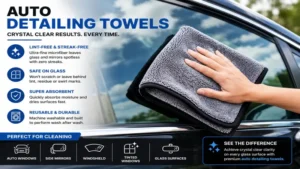
Meguiar’s Water Magnet Waffle Weave approaches liquid extraction through geometric surface area rather than thick, heavy plushness. Rated at approximately 400 GSM with an 80/20 microfiber composition, its unique waffle-grid pattern creates hundreds of micro-pockets that trap water droplets via capillary action. In my hands-on testing, this towel excelled particularly on automotive glass and chrome trim, leaving zero streaks or water spots behind.
The real-world advantage of a waffle weave over a plush towel lies in wringing efficiency. When drying lower body panels or dirty rocker panels, if the towel picks up excess water, you can wring it out completely with minimal effort and resume drying. What the spec sheet won’t tell you, however, is that waffle weaves lack the deep cushion needed to absorb large grit particles safely, making thorough pre-washing imperative before dragging it across soft paint.
Detailing veterans appreciate the Water Magnet’s thin profile for getting into tight door jambs, engine bay channels, and fuel door crevices. Sitting comfortably in the lower $10-$15 price range, it remains a reliable, budget-friendly option specifically tailored for glass clarity and panel drying.
-
Pros:
-
Waffle texture picks up water without leaving streaks on glass
-
Extremely easy to wring out by hand mid-session
-
Compact size fits easily into tight body seams and jambs
-
-
Cons:
-
Less forgiving if fine dirt particles remain on paintwork
-
80/20 blend is slightly less soft than 70/30 alternatives
-
4. Griot’s Garage Edgeless Microfiber Towel
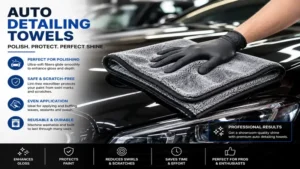
When working with soft Japanese clear coats or delicate piano-black exterior trim, the Griot’s Garage Edgeless Microfiber Towel is my top recommendation. Boasting a 480 GSM density and a 70/30 blend, this towel completely eliminates bound edges, stitched borders, or silk linings. Instead, it utilizes an ultrasonic cut edge, meaning every square millimeter of the towel is soft, unhemmed microfiber.
In my field tests involving waterless washes and heavy spray waxes, the lack of hemmed borders meant zero scratch risk even when applying localized pressure. What I love about this model is its plush, deep pile on both sides—it absorbs liquid spray detailers instantly while gently cushioning fine dust particles. The extra density allows you to fold the towel into quarters, giving you eight clean, fresh surfaces to work with as you move around the vehicle.
User reviews continuously rate this towel at the top of its class for spray wax application and ceramic booster wipe-downs. Priced in the $20-$28 range for a multi-pack, the premium cost is fully justified by the protection it offers against clear coat damage.
-
Pros:
-
Ultrasonic edgeless design removes edge-scratch risks entirely
-
Luxurious 480 GSM plush pile safely traps remaining dust
-
Ideal density for spray waxes, quick detailers, and waterless washing
-
-
Cons:
-
Edges can fray slightly over long-term machine wash cycles
-
Higher price point per towel compared to bulk utility packs
-
5. Relentless Drive Ultimate Microfiber Towels
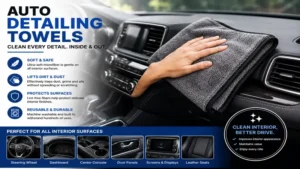
For general utility, interior scrubbing, leather wiping, and rim maintenance, Relentless Drive Ultimate Microfiber Towels provide an unbeatable balance of affordability and performance. Coming in at roughly 400 GSM with an 80/20 weave, these thick, dual-sided towels are tough enough to handle heavy grease in engine bays while remaining soft enough for dashboard surfaces and leather seats.
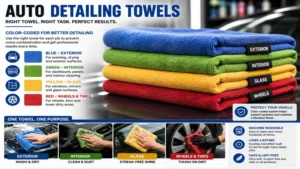
In practical use, I reserve these towels for the dirtiest detailing stages: wiping down exhaust tips, cleaning brake dust from wheel spokes, and cleaning door jambs. The high-contrast color options make it simple to color-code your detailing routine—preventing you from accidentally using a wheel towel on your hood. While most reviewers claim these are fine for paint polishing, I recommend reserving 80/20 blend towels for interior and wheel duties where abrasive contaminants are highest.
Automotive enthusiasts praise their durable silk borders and resistance to shedding during aggressive interior scrubbing. Available in bulk packs in the $12-$18 price range, they offer an incredible cost-per-use ratio for everyday garage maintenance.
-
Pros:
-
Highly affordable bulk option for dirty utility tasks
-
Durable weave holds up well against harsh interior cleaners
-
Great color selection for enforcing strict anti-cross-contamination
-
-
Cons:
-
80/20 blend is slightly stiff for high-end paint finishing
-
Absorbs polish quickly, requiring frequent towel rotation
-
Practical Usage Guide: Microfiber Maintenance & Longevity
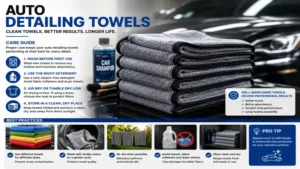
Even the highest-grade 1100 GSM drying towel can lose its softness and start scratching paint within months if washed incorrectly. Microfiber is made of fine synthetic plastics (polyester and polyamide); excessive heat literally melts these micro-fibers, turning soft tips into microscopic plastic hooks that scratch paint.
                  MICROFIBER LAUNDRY WORKFLOW

 ┌─────────────────────────────────────────────────────────────┐
 │ 1. SORT BY USE CASE                                         │
 │    • Separate Paint/Drying towels from Wheel/Engine rags    │
 └──────────────────────────────┬──────────────────────────────┘
                                │
 ┌──────────────────────────────▼──────────────────────────────┐
 │ 2. MACHINE WASH PARAMETERS                                  │
 │    • Temperature: Cold or Warm water ONLY (below 104°F/40°C) │
 │    • Detergent: Free & Clear liquid (NO powder, NO softener)│
 └──────────────────────────────┬──────────────────────────────┘
                                │
 ┌──────────────────────────────▼──────────────────────────────┐
 │ 3. DRYING PROTOCOL                                          │
 │    • Dryer Heat: Tumbler setting: AIR DRY or LOW HEAT       │
 │    • Storage: Clean, sealed plastic container               │
 └─────────────────────────────────────────────────────────────┘
Follow this maintenance schedule to keep your auto detailing towels performing like new for years:
1. The Pre-Wash Sort
Never mix paint-finishing towels with wheel, engine bay, or interior cleaning rags. Brake dust and heavy carbon deposits trapped in utility towels will cross-contaminate your soft drying towels in the wash, embedding metal particles directly into the pile.
2. Washing Parameters
-
Water Temperature: Use cold or warm water (never exceeding 104°F / 40°C).
-
Detergent Choice: Use dedicated microfiber detergents or fragrance-free, dye-free liquid detergents. NEVER use powdered laundry detergent, as un-dissolved crystals lodge inside the split fibers.
-
The Softener Ban: NEVER use fabric softeners or dryer sheets. Fabric softeners coat the split fibers with silicone and tallow, rendering the towel hydrophobic and completely ruining its water absorption capabilities.
3. Drying Protocol
Tumble dry on Air Dry or the Lowest Heat setting possible. Remove towels immediately once dry, shake them out vigorously to fluff the pile, and store them in sealed plastic containers to keep airborne shop dust and garage debris from settling on the fibers.
Real-World Case Study: Matching Towels to Your Detailing Profile
To get the best finish on your vehicle without overspending, match your specific detailing routine to the right towel combination.
                           DETAILING PROFILES
                                   │
      ┌────────────────────────────┼────────────────────────────┐
      │                            │                            │
  Profile A:                   Profile B:                   Profile C:
Daily Commuter               Rinseless Wash              Ceramic Coated
  • Focus: Efficiency          • Focus: Lift & Trap        • Focus: Zero Marring
  • Key: Waffle Weave          • Key: Plush Edgeless       • Key: Twisted-Loop
Profile A: The Weekly Apartment Commuter
-
Vehicle Environment: Outdoor parking, dusty urban environment.
-
Detailing Frequency: Once a week at a self-serve wash bay.
-
Recommended Setup: 1x The Rag Company The Liquid8r for rapid drying + 4x Relentless Drive Towels for wheels and door jambs.
-
Why: When washing in direct sun or high wind at a wash bay, drying speed is critical to avoid water spots. A massive twisted-loop towel dries the paintwork in under three minutes.
Profile B: The Winter Waterless / Rinseless Enthusiast
-
Vehicle Environment: Cold climate with freezing temperatures; water restrictions in place.
-
Detailing Frequency: Bi-weekly inside a closed garage.
-
Recommended Setup: 8x Griot’s Garage Edgeless Microfiber Towels.
-
Why: Rinseless washing requires the “Garary Method”—soaking multiple plush towels in solution and using a fresh, folded section per panel. Edgeless 480 GSM towels trap heavy winter salt slurry deep in the pile without dragging it across paint.
Profile C: The Weekend Ceramic-Coated Show Car Owner
-
Vehicle Environment: Garaged, soft black clear coat, freshly polished and ceramic-coated.
-
Detailing Frequency: Spot cleaning and quick detailing before car meets.
-
Recommended Setup: 2x Chemical Guys Professional Grade (for spray wax/booster leveling) + 1x The Liquid8r (for touchless drying blow-assisted touch-ups).
-
Why: Soft, dark clear coats reveal even microscopic towel marks. Edgeless and silk-banded 70/30 blend towels ensure zero surface friction during light dust removal.
Troubleshooting Guide: Common Microfiber Problems & Solutions
Problem 1: My Drying Towel Is Pushing Water Around Instead of Absorbing It
-
Cause: The towel fibers have been clogged by fabric softener, wax residue, or detergent oils.
-
Solution: Perform a microfiber strip reset. Soak the towels in a bucket of hot water with 2 ounces of distilled white vinegar or a dedicated microfiber restorer for 2 hours. Machine wash on warm with an extra rinse cycle to purge clogged fibers.
Problem 2: Brand New Towels Are Leaving Lint All Over Dark Glass and Paint
-
Cause: Manufacturing fluff and loose fibers remaining from the cutting process.
-
Solution: Always wash brand-new microfiber towels twice before their first official use. Running them through a short wash and tumble-dry cycle removes loose factory fibers and opens up the capillary structure for maximum absorption.
Problem 3: Towel Has Become Stiff, Scratchy, and Feels Like Rough Plastic
-
Cause: The microfiber blend was melted by using high heat settings in the clothes dryer or ironing.
-
Solution: Unfortunately, heat-damaged microfiber cannot be restored. Retired stiff towels immediately from paint duties and relegate them to filthy tasks like exhaust pipe cleaning, tire shine application, or lawnmower maintenance.
How to Choose Auto Detailing Towels: Expert Buyer Criteria
                        BUYER EVALUATION CHECKLIST

  1. Microfiber Blend  ──────► 70/30 (Soft/Paint) vs 80/20 (Durable/Utility)
  2. GSM Density      ──────► 200 (Glass) -> 400 (Buffing) -> 1000+ (Drying)
  3. Edge Construction ──────► Ultrasonic Edgeless > Silk Banded > Stitched
  4. Fiber Weave Type  ──────► Plush (Traps dust) vs Twisted-Loop (Absorbs)
Selecting the right towel involves evaluating four key construction specs rather than relying on brand marketing:
-
Check the Polyester-to-Polyamide Ratio:
Always look for the blend listed on the tag. A 70/30 blend (70% polyester, 30% polyamide) is significantly softer, absorbs liquids faster, and is essential for delicate paint, ceramic coatings, and dark clear coats. An 80/20 blend is cheaper, rougher, and best suited for interior plastics, dirty engine bays, and glass.
-
Match GSM to the Task:
Never use a high 1000 GSM towel to remove dried wax; the fibers are too dense and will drag the product across the panel. Match GSM directly: 200–300 for glass/interiors, 350–500 for wax removal and quick detailers, and 600+ strictly for drying standing water.
-
Inspect the Edge Finish:
Stitched, rough thread borders are the number one cause of straight-line scratches during wipe-downs. Choose ultrasonic edgeless towels for high-risk buffing, or silk-banded edges for heavy drying towels.
-
Evaluate Weave Types:
-
Twisted Loop: Best for single-pass drying.
-
Waffle Weave: Best for streak-free glass and mirror cleaning.
-
Plush / Long Pile: Best for trapping loose dust during waterless washes.
-
Short Pile / Dual Pile: Best for leveling ceramic coatings and buffing off waxes.
-
🔍 Ready to Upgrade Your Auto Detailing Setup?
Upgrading from gas-station chamois cloths or cheap utility rags to true professional-grade microfiber is the fastest way to eliminate swirl marks and dramatically cut down your vehicle wash times.
Click on our recommended models above to view current pricing and find the perfect fit for your detailing routine on Amazon.
Features That Actually Matter (And Those That Don’t)
Marketing claims surrounding auto detailing towels can be confusing. Here is what actually impacts performance in the detailing bay:
                            MARKETING VS REALITY

  MATTERS                                DOESN'T MATTER
  ═══════════════════════════════════    ═══════════════════════════════════
  ✔ True Polyamide Ratio (30% > 20%)     ✖ "Laser-Grip" Marketing Names
  ✔ Ultrasonic / Silk Edge Finish        ✖ Bright Neon Colors (Purely Visual)
  ✔ Split Fiber Microscopic Quality      ✖ Extremely High GSM (1400+) on Wax Towels
What Actually Matters
-
True Polyamide Content: Polyamide is the expensive ingredient in microfiber that absorbs water and provides softness. Budget manufacturers cut costs by using 85/15 or 80/20 blends. Prioritize 70/30 blends for all paint contact.
-
Split Fibers: High-quality detailing towels undergo a chemical splitting process during manufacturing that breaks fibers into microscopic hooks. Unsplit microfiber (like cheap dollar-store dusters) simply pushes water and dust around without trapping it.
-
Color Coding: Using different colored towels for specific zones (e.g., green for glass, blue for paint, black for wheels) is a proven technique used by professional detailers to prevent cross-contamination.
What Doesn’t Matter
-
Excessive GSM Ratings (1400+): Ultra-heavy towels sound impressive, but past 1100 GSM, towels become ridiculously heavy when wet, difficult to wring out, and take days to dry indoors—often developing mildew in the process.
-
Fancy Stitch Names: Features like “Laser-Tough Weave” or “Diamond Fiber Matrix” are purely marketing fluff. Focus strictly on blend ratios (70/30 vs 80/20), GSM, and physical edge construction.
Microfiber vs. Traditional Alternatives: Value & Safety Analysis
| Metric / Feature | Split Microfiber Towels | Natural Leather Chamois | Bath / Cotton Shop Towels |
| Clear Coat Safety | High (Traps grit inside pile) | Low (Flattens grit against paint) | Very Low (Rigid fibers scratch clear coat) |
| Water Absorption | Up to 7–10x weight | Up to 4–5x weight | Up to 2–3x weight |
| Longevity | 100+ Wash Cycles | Requires oil treatments / stiffens | Frays quickly / linting |
| Versatility | Paint, Glass, Leather, Wheels | Drying Paint ONLY | Dirty Engine / Shop Use Only |
| Risk of Swirl Marks | Minimal | High (stuck debris drags) | Extreme |
Traditional chamois leather was long considered the standard for drying cars, but modern paint systems are significantly softer than older single-stage paints. A natural chamois acts like a squeegee: if a single particle of dirt remains on your paint after washing, the flat face of the chamois traps that particle against the panel and drags it across the entire vehicle, creating severe swirl marks.
Split microfiber towels, by contrast, possess depth. The deep pile allows fine dust and remaining dirt particles to sink down into the towel core away from the surface, protecting your clear coat. When evaluating long-term value, high-quality microfiber towels withstand over 100 proper laundry cycles, costing pennies per wash while preserving thousands of dollars in clear coat paint value.
Long-Term Cost & ROI of Quality Microfiber
Investing in a dedicated set of high-end detailing towels might seem like an unnecessary expense compared to buying a cheap 24-pack of yellow utility rags from a big-box store. However, the financial logic becomes clear when analyzing paint correction costs.
                  THE REAL COST OF CHEAP TOWELS

  Cheap Utility Rags ($15) ──► Scratched Clear Coat ──► Paint Correction ($800-$1,500)

  Quality Towel Set ($50)  ──► Safe Wipe-Downs       ──► Flawless Paint Preserved ($0)
A professional single-stage paint correction to remove swirl marks and micro-marring caused by improper wiping typically costs between $800 and $1,500 at a reputable detailing shop. A complete set of premium detailing towels—consisting of one plush drying towel, four edgeless buffing towels, and two waffle-weave glass towels—costs roughly $50 to $70 total.
By spending slightly more upfront on 70/30 blend towels with premium edging, you effectively buy insurance for your vehicle’s finish, eliminating the need for expensive paint correction down the road.
FAQs
❓ What is GSM in auto detailing towels?
✅ GSM stands for Grams per Square Meter. It measures the density and weight of the microfiber cloth. Lower GSM (200-300) is stiff and best for glass, medium GSM (350-500) suits polishing, while high GSM (600-1100+) excels at vehicle drying…
❓ Can I use regular laundry detergent to wash microfiber detailing towels?
✅ Yes, provided it is a liquid detergent that is completely free of dyes, fragrances, and fabric softeners. Never use powdered detergents or bleach, as un-dissolved granules and harsh chemicals damage delicate split microfibers…
❓ Why is my microfiber towel leaving streaks on my car glass?
✅ Streaking occurs when towels are contaminated with leftover wax, silicone, or fabric softeners. Use a low-GSM (200-300) waffle-weave towel dedicated strictly to glass, paired with an alcohol-based, ammonia-free glass cleaner…
❓ What is the difference between an 80/20 and a 70/30 microfiber blend?
✅ The ratio represents polyester to polyamide content. A 70/30 blend contains 30% polyamide, making it significantly softer, more absorbent, and safer for delicate paint. 80/20 blends are stiffer and best reserved for utility tasks…
❓ How often should I replace my auto detailing towels?
✅ Quality microfiber lasts over 100 wash cycles if properly maintained. Replace or downgrade paint-touching towels to wheel/interior duty once they feel stiff, lose absorption, or show frayed edges that could scratch delicate surfaces…
Conclusion
Choosing the right auto detailing towels is the foundation of achieving a swirl-free, showroom-level finish on any vehicle. By understanding the critical balance between GSM density, 70/30 polyamide blends, and edge construction, you can systematically protect your clear coat while drastically reducing your washing and drying times.
For maximum efficiency, invest in a dedicated twisted-loop towel like The Rag Company The Liquid8r for drying, paired with ultrasonic edgeless towels for quick detailers and wax removal. Treat your towels right by washing them in cool water with dye-free liquid detergent and drying on low heat—and they will keep your vehicle looking immaculate for years to come.
✨ Found this guide helpful? Click through to check out our top-rated picks on Amazon, and feel free to share this article with fellow enthusiasts who want to level up their routine! 💬🤗
Recommended for You
- 7 Best Huge Microfiber Towel Options in 2026 for Ultimate Drying
- 7 Best Microfiber Towel Big Sizes Tested for 2026 (Pros & Cons)
- Can You Clean Glasses with Alcohol? 7 Best Cleaners for 2026
Disclaimer: This article contains affiliate links. As an Amazon Associate, I earn from qualifying purchases. If you purchase products through these links, we may earn a small commission at no additional cost to you.
✨ Found this helpful? Share it with your friends! 💬🤗