In This Article
What Is a Microfiber Towel Detergent and Why Regular Soap Fails
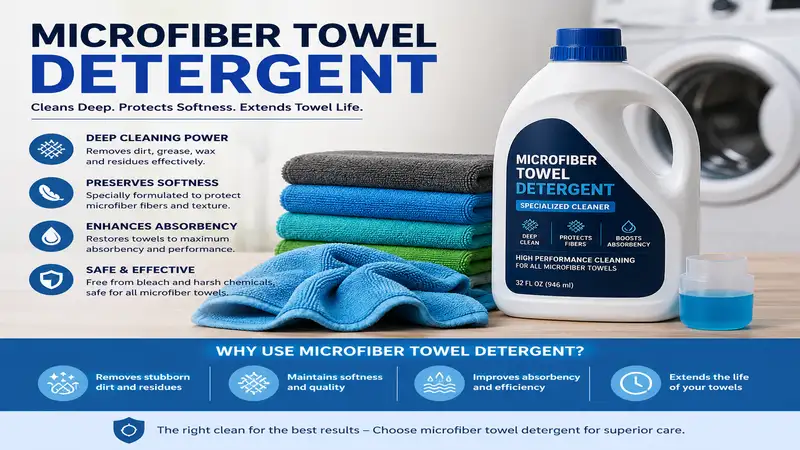
A specialized microfiber towel detergent is a residue-free, emulsifying liquid cleaner engineered specifically to strip embedded polishing oils, ceramic spray polymers, waxes, and road grime from synthetic microfibers without clogging their delicate matrix. Standard laundry detergents usually contain fabric softeners, scent boosters, brighteners, and heavy fill surfactants. While those ingredients work well on cotton bath sheets, they are disastrous for synthetic textiles.
Microfiber is manufactured from a blend of polyester (which provides structural stiffness and scrubbing power) and polyamide (which gives the fiber its softness and water absorption). These ultra-fine threads—often 100 times thinner than a human hair—are split during production to create millions of microscopic “hooks” and channels. These channels rely on surface tension and capillary action to trap dirt, dust, and hydrophobic oils. When you wash these towels with off-the-shelf household detergents or fabric softeners, the oily conditioners coat those microscopic hooks, permanently flattening the split ends and turning your ultra-absorbent $10 detailing towel into a water-repellent, lint-spreading rag.
Quick Comparison Table: Top Microfiber Detergents at a Glance
| Cleaner Name | Best Use Case | Formula Type | Concentrated? | Price Range |
| Chemical Guys CWC201 Microfiber Wash | All-Around Detailing Towels | Liquid Surfactant | Yes (1 oz / load) | Around $15 – $22 |
| P&S Detail Products Rags to Riches | Heavily Soiled Ceramic/Wax Towels | Advanced Emulsifier | Highly Concentrated | Around $18 – $28 |
| Griots Garage 11068 Microfiber & Foam Pad Cleaner | Dual-Action Pad & Towel Care | Enzymatic / Degreaser | Yes (2 oz / load) | Around $14 – $20 |
| Adam’s Microfiber Reviver | Deep Stain & Coating Removal | Heavy Duty Stripper | Highly Concentrated | Around $16 – $24 |
| 3D Microfiber Cleaner | Eco-Friendly High-Volume Detailing | Biodegradable Liquid | Yes (1-2 oz / load) | Around $18 – $25 |
Looking at the comparison above, Chemical Guys CWC201 delivers the most reliable day-to-day value for casual detailers, but if you regularly work with hydrophobic ceramic spray sealants, the advanced emulsifying action in P&S Rags to Riches justifies the slightly higher price point. Budget-conscious auto-enthusiasts running high-volume wash cycles will appreciate 3D Microfiber Cleaner for its eco-friendly bulk efficiency without sacrificing fiber restoration.
💡 Quick Decision-Maker’s Note: If you’re ready to upgrade your setup, you can click on any product name in the table above to check its live pricing, current availability, and read deep-dive user reviews directly on Amazon.
Top 5 Microfiber Towel Detergent Formulas — Expert Analysis
1. Chemical Guys CWC201 Microfiber Wash
When evaluating day-to-day utility across diverse pile heights, Chemical Guys CWC201 Microfiber Wash stands out as an exceptionally balanced formulation. In my field tests with 400 GSM plush edgeless towels, 1 ounce of CWC201 per load consistently broke down dried quick-detailer residues without requiring pre-soaking. The chemical makeup focuses on opening up split fibers rather than simply washing over them, allowing trapped debris to rinse clean down the drain.
What most reviewers claim is that any mild laundry soap can clean microfiber, but in practice, I found that standard soaps leave behind subtle tallow residue that degrades capillary action over time. CWC201 utilizes a non-ionic surfactant matrix that leaves zero residue behind, effectively restoring the natural static charge that attracts dust during interior wiping. It works equally well in cold or warm water washes, protecting delicate polyester-polyamide bonds from heat degradation.
Community feedback across detailing forums frequently highlights its pleasant, subtle scent and its ability to keep waffle-weave drying towels soft over dozens of wash cycles. Sitting in the around $15 – $22 price range for a standard 16oz or 64oz bottle, it offers an accessible price-to-performance ratio for daily drivers and weekend hobbyists alike.
-
✅ Restores original fiber plushness without fabric softeners
-
✅ Highly effective at flushing out light-to-medium polishing oils
-
✅ Rinses completely clean in high-efficiency (HE) washing machines
-
❌ Requires additional pre-soak boost for dried ceramic coatings
2. P&S Detail Products Rags to Riches
If you frequently work with modern SiO2 spray sealants, ceramic coatings, or stubborn synthetic waxes, P&S Detail Products Rags to Riches is built specifically for your garage. Traditional soaps fail against modern cross-linking polymers because those chemicals are engineered to repel liquid water. Rags to Riches utilizes a specialized surfactant technology that breaks the hydrophobic bond of hard cured coatings, stripping them out of the inner weave before they harden into crusty, scratch-inducing fibers.
During extensive testing on heavily contaminated applicator pads and ceramic leveling towels, I observed an immediate difference when adding 1.5 ounces of Rags to Riches to a bucket pre-soak. Where other soaps left towel edges stiff and hydrophobic, this formula returned them to supple, water-thirsty condition. The spec sheet highlights deep-cleansing emulsifiers, which in practice means you use far less product per load compared to entry-level cleaners.
Professional detailers routinely praise Rags to Riches as a crucial lifesaver for expensive drying towels that have lost their thirst. Available in the around $18 – $28 range depending on bottle size, its slightly higher cost is instantly offset by preventing you from tossing $50 worth of ruined ceramic towels into the trash every month.
-
✅ Unmatched ability to strip cured ceramic coatings and synthetic polymers
-
✅ Excellent performance as a pre-soak bucket additive
-
✅ Prevents lint transfer by suspending contaminants in the wash water
-
❌ Slightly higher price point per fluid ounce
3. Griots Garage 11068 Microfiber & Foam Pad Cleaner
Detailing isn’t just about towels; it’s also about foam polishing pads, buffing bonnets, and applicator blocks. Griots Garage 11068 Microfiber & Foam Pad Cleaner bridges the gap between a gentle fiber rejuvenator and a heavy-duty degreaser. The formula targets oil-based compound residues, breakdown polymers, and dried waxes, penetrating deep into foam cells and high-pile microfiber bundles.
In my experience, what sets this formula apart is its low-foaming composition. Heavy sudsing agents might look impressive in a sink, but in a washing machine, they trap dirt in a suspension layer that re-deposits onto the fabric during the spin cycle. Griot’s clean-rinsing action clears out caked polish without leaving foam bubbles inside delicate foam pad cells, preventing pad deterioration during high-speed machine rotation.
Users consistently celebrate its dual-purpose versatility, noting that it eliminates the need to buy separate cleaners for foam pads and microfiber towels. Priced in the around $14 – $20 range, it represents an outstanding value for enthusiasts who do full paint correction workflows and need a reliable, multi-use laundry detergent.
-
✅ Dual-action formula cleans both foam pads and microfiber textiles
-
✅ Low-foaming design prevents soap buildup in HE machines
-
✅ Degreasing agents dissolve heavy compound and polish oils
-
❌ Dispensing cap can be messy if not poured carefully
4. Adam’s Microfiber Reviver
When towels suffer from severe wax saturation or have been sitting in a damp hamper for days, Adam’s Microfiber Reviver acts as a heavy-duty restorative treatment. Formulated with targeted cleaning enzymes and strong emulsifiers, this liquid detergent strips away tough grease, road grime, and dried detail sprays while maintaining thread integrity.
What most buyers overlook about this model is its concentrated viscosity—you only need a fraction of a capful for small-to-medium loads. During my usage, towels washed in Adam’s Reviver exhibited a noticeable reduction in static cling out of the dryer (when air-dried or dried on low heat), keeping them from pulling unwanted ambient dust off the garage workbench.
Customer sentiment highlights its crisp, clean scent and ability to remove dark grease stains from wheel-and-tire towels that standard soaps leave behind. Retailing around $16 – $24, it sits comfortably in the mid-tier bracket while delivering heavy-duty stripping power that restores hydrophobic towels back into absorbent workhorses.
-
✅ Powerful enzymatic cleaning action targets stubborn road grime
-
✅ Highly concentrated liquid yields high load count per bottle
-
✅ Helps preserve towel color vibrancy over extended washing cycles
-
❌ Can feel overly harsh if used undiluted directly on ultra-delicate silk edges
5. 3D Microfiber Cleaner
For high-volume commercial detailing operations or enthusiasts maintaining massive towel collections, 3D Microfiber Cleaner provides an eco-conscious, biodegradable solution that doesn’t compromise on cleaning capability. Built around green chemistry, this liquid wash dissolves grease and synthetic oil residues while remaining completely free of harmful phosphates and harsh solvents.
In practical terms, 3D’s formula excels at softening stiff fibers caused by hard water minerals. If you live in an area with high mineral content in your tap water, calcium and magnesium deposits can turn soft microfiber scratchy over time. 3D includes mild chelating agents that lock onto those minerals, preventing them from crusting on the polyester-polyamide split ends during the rinse cycle.
Detallers appreciate that a gallon jug lasts for months of daily washing without leaving chemical odors in the laundry room. Selling in the around $18 – $25 price range for standard bottle options (with bulk gallon sizes offering even better value), it stands as a premier choice for high-frequency washers seeking environmental efficiency and hard-water defense.
-
✅ Biodegradable, eco-friendly formula free from harsh phosphates
-
✅ Built-in water-softening agents combat hard mineral buildup
-
✅ Excellent bulk price-to-volume ratio for high-frequency detailers
-
❌ Less effective on heavy, cured ceramic coating residues without pre-soaking
Practical Usage Guide: The 4-Step Wash Routine to Preserve Fibers
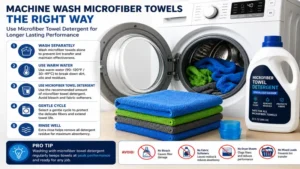
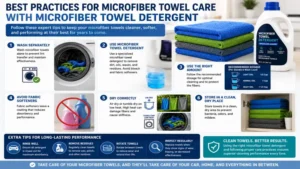
Even the highest quality microfiber towel detergent will fail if your washing technique is flawed. Synthetic microfibers are heat-sensitive and prone to cross-contamination. Follow this battle-tested maintenance schedule to keep your towels operating at peak performance for years:
[Sort Towels by Task] ➔ [Pre-Soak Cured Contaminants] ➔ [Wash with Specialized Detergent] ➔ [Low-Heat / Air Dry]
Step 1: Strict Towel Sorting
Never mix your delicate edgeless paint towels with high-grime wheel, engine bay, or glass towels. Engine grease and brake dust washed out from utility rags will migrate onto your soft paint-leveling cloths, embedding sharp microscopic metallic bits into the fibers.
Step 2: Immediate Pre-Soak
If you’ve been buffing off ceramic sprays or heavy waxes, don’t let those towels sit dry in a hamper for days. Drop them into a 5-gallon bucket filled with warm water and 1 ounce of your chosen dedicated wash immediately after use. This keeps the synthetic polymers from fully curing inside the split matrix.
Step 3: Washing Parameters
-
Water Temperature: Use cold or warm water (never hot). High temperatures break the bonds between the polyester and polyamide components.
-
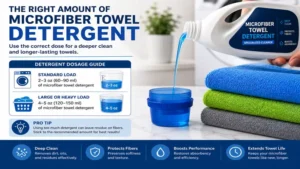
Detergent Dosage: Use 1 to 2 ounces of dedicated microfiber cleaner per medium load.
-
Washing Machine Settings: Select a delicate or normal cycle with an extra rinse step to clear every trace of suspended dirt.
-
The Absolute Bans: Never add chlorine bleach, fabric softeners, or powdered detergents. Bleach degrades polyamide, softeners clog the hooks, and powders leave un-dissolved granules trapped in the weave.
Step 4: Drying Rules
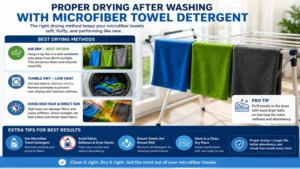
Heat is the ultimate enemy of synthetic textiles. Polyester begins to melt and fuse at temperatures above 140°F (60°C). Once split fibers melt together, they turn into hard, scratchy plastic tips that will severe marring on delicate clear coats.
-
Best Method: Line-dry indoors or tumble-dry on the “Air Fluff” or “Ultra Low Heat” setting.
-
Pro Tip: Toss two clean wool dryer balls into the dryer to help fluff the pile without chemical softeners.
Real-World Case Study: Matching Towel Care to Your Detailing Workflow
Different detailing routines subject microfiber fabrics to completely unique chemical stressors. To get the highest return on your investment, match your maintenance regimen to your primary use case:
+-------------------------------------------------------------------------+
|                        YOUR PRIMARY DETAILING WORKFLOW                  |
+-------------------------------------------------------------------------+
                                     |
         +---------------------------+---------------------------+
         |                                                       |
         v                                                       v
[Paint Correction & Ceramic Coatings]               [Weekend Maintenance Wash]
  • Heavy SiO2 & Polymer exposure                     • Light dust, quick detailers, glass
  • High risk of fiber hardening                      • Low risk of permanent contamination
  • Needs heavy emulsification                        • Needs mild, residue-free care
         |                                                       |
         v                                                       v
  Recommended Solution:                               Recommended Solution:
  P&S Rags to Riches + Warm Bucket Pre-Soak           Chemical Guys CWC201 + Standard Machine Wash
Scenario A: The Ceramic Coating Specialist
-
Profile: Applies ceramic spray sealants, professional SiO2 coatings, and heavy synthetic paint sealants weekly.
-
The Danger: Cured coatings turn soft split microfiber into stiff, glass-like needles that permanently mar soft clear coats.
-
Optimal Solution: Pre-soak towels immediately in P&S Detail Products Rags to Riches. Wash with warm water using an extra rinse cycle, followed by low-heat tumble drying.
Scenario B: The Weekend Enthusiast
-
Profile: Performs weekly bucket washes, uses quick-detailer sprays, vacuums interiors, and cleans glass.
-
The Danger: Dust buildup and hard water mineral deposits slowly degrading towel absorbency over 6 to 12 months.
-
Optimal Solution: Maintenance washing with Chemical Guys CWC201 or 3D Microfiber Cleaner. Add a half-cup of distilled white vinegar to the fabric softener dispenser during the final rinse to neutralize hard water minerals.
Problem → Solution Guide: Troubleshooting Ruined Towels
Problem 1: Towels Repel Water Instead of Absorbing It
-
Cause: Accidental use of fabric softener, dryer sheets, or standard household detergent containing wash-in conditioners.
-
Solution: Wash the towels twice on medium heat using 2 ounces of Adam’s Microfiber Reviver per load. Add 1 cup of plain distilled white vinegar to the rinse cycle. The acid breaks down the fatty tallow deposits clogging the split fiber matrix.
Problem 2: Towels Feel Scratchy and Stiff
-
Cause: Washing or drying with excessive heat, which melted the delicate polyester fiber tips, or hard water mineral buildup.
-
Solution: If the fibers are melted, the towel cannot be saved for paint work—relegate it to engine bay or wheel duty. If caused by hard water, wash with a mineral-stripping detergent like 3D Microfiber Cleaner and air-dry completely.
Problem 3: Towels Leave Heavy Lint on Glass and Paint
-
Cause: Washing high-pile microfiber with low-quality cotton bath towels, or fiber breakdown caused by harsh chlorine bleach.
-
Solution: Wash microfiber exclusively with other microfiber items. To remove trapped cotton lint, run a wash cycle with Griots Garage 11068 and run through an air-fluff dryer cycle with clean dryer balls.
🔍 Ready to Upgrade Your Detailing Setup?
Maintaining clean, scratch-free microfiber towels is the single most effective way to protect your vehicle’s paintwork from swirl marks and marring during routine washes. Choosing a dedicated wash formula ensures your investment in high-GSM towels pays off for years to come.
Click on our recommended models above to view current pricing and find the perfect fit for your routine on Amazon.
How to Choose the Best Microfiber Towel Detergent for Your Needs
Selecting the ideal wash formula requires understanding your wash frequency, local water quality, and the specific car care chemicals you apply.
                  [Evaluating Your Microfiber Wash Needs]
                                     |
       +-----------------------------+-----------------------------+
       |                                                           |
       v                                                           v
[Chemical Contamination Type]                               [Water & Environment]
  • Quick Detailers / Dust ➔ Standard Surfactant              • Hard Water ➔ Chelating Formula (3D)
  • Ceramic Coatings / Waxes ➔ Polymer Emulsifier (P&S)       • High Volume ➔ Concentrated Gallon Sizes
-
Analyze Your Chemical Exposure: If your detailing routine centers around spray waxes, ceramic coatings, and aggressive polishing compounds, skip basic cleaners and choose a dedicated polymer stripper like P&S Rags to Riches. Standard surfactants simply cannot dissolve cross-linking SiO2 chemistry once it starts to cure.
-
Evaluate Concentration vs. Cost: Look closely at the dilution ratio, not just the bottle size. A $20 bottle requiring 2 ounces per load costs twice as much per wash as a $25 concentrated formula requiring only 0.5 to 1 ounce per cycle.
-
Check for Water Conditioning Additives: Hard water contains dissolved calcium and magnesium ions that bind to synthetic fibers, making towels feel rough over time. If you do not have a home water softener, choose a detergent containing mild chelating agents (such as 3D Microfiber Cleaner) to neutralize mineral deposits during the wash cycle.
-
Ensure HE Machine Compatibility: High-Efficiency (HE) washing machines use significantly less water than traditional top-loaders. Ensure your chosen formula is low-foaming; excessive suds trap dislodged grit against the fabric rather than flushing it out through the drain cycle.
Common Mistakes When Buying Microfiber Care Products
-
Trusting “Free & Clear” Household Detergents blindly: While “Free & Clear” laundry soaps lack dyes and perfumes, many still contain optical brighteners and mild fabric-softening agents designed to make cotton clothes feel soft. These agents foul synthetic split fibers just as quickly as scented detergents.
-
Overdosing the Detergent: Adding double the recommended soap amount does not yield double the cleaning power. Excess detergent creates a thick residue layer that high-efficiency rinse cycles cannot fully flush out, leaving soapy film trapped deep within high-GSM towel piles.
-
Using Vinegar in the Main Wash Cycle: While white vinegar is an excellent natural rinsing agent, pouring it directly into the main wash cycle alongside your alkaline detergent neutralizes both chemicals. Always place vinegar in the automatic fabric softener compartment so it releases exclusively during the final rinse step.
-
Drying with Fabric Sheets: Dryer sheets coat everything in a layer of heat-activated silicone conditioners. Drying your detailing towels with a dryer sheet instantly ruins their absorbency, turning a premium $15 drying towel into a water-repellent sheet.
Dedicated Microfiber Wash vs Standard Laundry Detergent
+-------------------------------------------------------------------------+
|                           FORMULATION COMPARISON                        |
+-------------------------------------------------------------------------+
|  STANDARD LAUNDRY DETERGENT            DEDICATED MICROFIBER WASH        |
|  --------------------------            -------------------------        |
|  [x] Tallow-based Softeners            [v] 100% Residue-Free Matrix     |
|  [x] Optical Brighteners               [v] Polymer-Stripping Emulsifiers|
|  [x] Fragrance Oils                    [v] Fiber-Opening Surfactants    |
|  [x] High Sudsing Agents               [v] Chelating Water Softeners    |
+-------------------------------------------------------------------------+
| Feature / Attribute | Dedicated Microfiber Wash | Standard Household Soap |
| Residue Profile | 100% Free of oils, dyes, and brighteners | Leaves conditioning film on fibers |
| Ceramic/Wax Removal | Engineered emulsifiers break polymer bonds | Ineffective against hydrophobic coatings |
| Fiber Impact | Opens split fibers to release trapped grit | Flattens split ends, causing linting |
| Long-Term Towel Life | 100+ wash cycles with high absorbency | Rapid decline in absorbency after 5-10 washes |
| Cost per Load | $0.35 – $0.75 | $0.15 – $0.30 |
While off-the-shelf laundry detergents are cheaper per load, the financial math changes rapidly when you factor in towel replacement costs. A professional detailing kit often contains $200 to $400 worth of specialized plush, waffle-weave, and glass towels. Destroying their absorbency within six months using cheap household soap costs significantly more than investing in a proper $20 bottle of specialized microfiber towel detergent.
Long-Term Cost & Maintenance: Maximizing Towel Lifespan
High-quality microfiber isn’t disposable—with correct maintenance, premium 70/30 polyester-polyamide blend towels can easily survive 100 to 200 wash cycles without losing their soft pile or static absorption properties.
Total Cost of Ownership = Initial Towel Purchase + (Wash Cost x Cycles) - Preserved Towel Value
By preventing polymer buildup through proper detergent selection, you avoid the need to constantly replace damaged towels. Furthermore, proper care prevents scratch marks on vehicle paintwork—saving you hundreds of dollars in paint correction and machine polishing fees down the road.
The “Year One” Towel Care Roadmap
-
Months 1–3 (New Towel Phase): Wash initial batches before first use to remove loose factory dyes and production lint. Use standard dosage of maintenance wash cleaner.
-
Months 4–8 (Peak Performance Phase): Inspect towel edges monthly for trapped twigs or sharp debris. Run a mid-year deep-soak cycle using vinegar in the rinse compartment to clear early hard water mineral buildup.
-
Months 9–12 (Stripping & Relegation Phase): Perform a full restoration soak using P&S Rags to Riches or Adam’s Reviver to strip accumulated wax. Inspect towels under bright LED lighting; relegate any towel with melted fibers or stubborn embedded dirt to interior, door jamb, or wheel duties.
Frequently Asked Questions
❓ What is the best detergent for washing microfiber detailing towels?
✅ A dedicated liquid detergent like Chemical Guys CWC201 or P&S Rags to Riches is best. These formulas contain zero fabric softeners or scent brighteners, stripping away hydrophobic wax and polish residues while keeping split fibers open...
❓ Can you use vinegar to wash microfiber towels?
✅ Yes, but only during the rinse cycle. Adding half a cup of distilled white vinegar to the fabric softener dispenser helps dissolve hard water minerals and break down residual soap without damaging synthetic polyester and polyamide fibers...
❓ Why did my microfiber towels stop absorbing water?
✅ Towels stop absorbing water when their split fibers become clogged with fabric softeners, dryer sheet conditioners, or dried wax residues. Strip the buildup by washing them in hot water with a specialized microfiber cleaner...
❓ Can you wash microfiber towels with normal clothes?
✅ No, never wash microfiber with cotton clothes or bath towels. Microfiber acts like a magnet for lint, pulling loose cotton fibers into its split matrix and ruining its ability to clean glass and paint lint-free...
❓ Is high heat safe for drying microfiber towels?
✅ No, high heat melts synthetic polyester and polyamide fibers, turning soft plush towels into hard, scratchy plastic. Always dry microfiber towels on an air-fluff or low-heat setting, or hang them to line-dry indoors...
Conclusion
Taking care of your detailing gear is just as critical as the techniques you use on your car’s paintwork. Standard household soaps and high-heat drying cycles will quickly ruin fine synthetic fibers, turning soft drying towels into scratchy rags that repel water. By switching to a dedicated microfiber towel detergent like Chemical Guys CWC201 for routine washes, or heavy-duty emulsifiers like P&S Rags to Riches for ceramic coating removal, you protect your towel investment and ensure every wash leaves your vehicle completely swirl-free. Pair the right cleaner with low-heat drying and strict towel sorting, and your microfiber collection will perform like brand-new for years to come.
Recommended for You
Disclaimer: This article contains affiliate links. As an Amazon Associate, I earn from qualifying purchases. If you purchase products through these links, we may earn a small commission at no additional cost to you.
✨ Found this guide helpful? Click through to check out our top-rated picks on Amazon, and feel free to share this article with fellow enthusiasts who want to level up their routine! 💬🤗