In This Article
If you’ve ever pulled your glasses cloth out of a jacket pocket and noticed it smearing more than it’s cleaning, you’ve probably wondered: can you wash eyeglass cleaning cloths, or are they a use-it-until-it’s-gross-then-toss-it kind of product? The short answer is yes — most microfiber eyeglass cleaning cloths are designed to be washed and reused for months, sometimes years, as long as you clean them the right way. Treat them like a disposable tissue, though, and you’ll end up grinding dust and skin oil straight into your lenses.
That distinction matters more than it sounds. A dirty cloth is one of the most common (and least talked about) causes of scratched lenses and stubborn streaking, according to eye-care professionals who see the aftermath daily. The good news is that washing an eyeglass cleaning cloth correctly takes about two minutes and doesn’t require anything fancier than mild soap and water.
In this guide, you’ll get a straight answer on can you wash eyeglass cleaning cloths, a step-by-step washing method that won’t damage the fabric, and a rundown of seven real microfiber cloths worth buying in 2026 — from budget bulk packs to premium options built for coated lenses. We’ll also cover how to choose the right cloth for your lifestyle, common mistakes that shorten a cloth’s lifespan, and how these cloths stack up against pre-moistened lens wipes. By the end, you’ll know exactly how to keep your eyeglass cleaning cloth working like new, and which one to buy if yours has seen better days.
What Is an Eyeglass Cleaning Cloth — And Can You Actually Wash One?
An eyeglass cleaning cloth is a soft, densely woven microfiber cloth designed to lift dust, oil, and smudges off lens surfaces without scratching them. Yes, you can wash eyeglass cleaning cloths — most are machine- or hand-washable, provided you skip fabric softener and harsh detergents, which coat the microfibers and reduce their cleaning ability.
The “micro” in microfiber refers to fiber strands finer than a strand of silk, typically a blend of polyester and polyamide (nylon). That split-fiber structure is what lets the cloth grab onto oil and grime at a microscopic level instead of just pushing it around, which is also why washing it matters — a saturated cloth eventually stops working the way it’s supposed to. You can read more about how these split fibers are engineered on the Wikipedia entry for microfiber, which breaks down the material science behind why it outperforms cotton and paper for optical surfaces.
Quick Comparison: Best Eyeglass Cleaning Cloths at a Glance
Before diving into the full reviews, here’s a snapshot of how the seven picks in this guide compare on size, pack count, and who each one suits best.
| Product | Size | Pack Count | Price Range | Best For |
|---|---|---|---|---|
| ZEISS Jumbo Microfiber Cleaning Cloth | 12″ x 16″ | 2-3 | Around $10-$15 | Anti-reflective coated lenses |
| Carson Stuff-It Pro Microfiber Lens Cloth | 8″ x 8″ | 1 (with pouch) | Around $9-$13 | Keeping the cloth itself clean |
| MagicFiber Premium Microfiber Cleaning Cloths | 6″ x 7″ | 6 | Around $7-$10 | Everyday all-around value |
| MagicFiber Microfiber Eyeglasses Pack | 6″ x 7″ | 6 cloths + 4 cases | Around $12-$18 | Wanting a case with every cloth |
| Your Choice Microfiber Cleaning Cloths | 6″ x 7″ | 6 | Around $6-$9 | Tightest budgets |
| 12-Pack Assorted Color Microfiber Cloths | 7″ x 6″ | 12 | Around $9-$13 | Multi-person households |
| Large Microfiber Cleaning Cloths (8×8) | 8″ x 8″ | 6 | Around $8-$12 | Oversized lenses and sunglasses |
Looking at the table, the biggest split isn’t really price — it’s size and pack strategy. The ZEISS Jumbo Microfiber Cleaning Cloth and the Large Microfiber Cleaning Cloths trade pack count for surface area, which matters if you wear wide sunglasses or rimless frames with more exposed lens. Meanwhile, the bulk 6- and 12-packs from MagicFiber Premium Microfiber Cleaning Cloths, Your Choice Microfiber Cleaning Cloths, and the 12-Pack Assorted Color Microfiber Cloths are built around the idea that you’ll stash one everywhere — car, desk, bag, nightstand — so losing one doesn’t leave you without a backup.
💬 One click helps you find the right cloth for your glasses today! 😊
7 Best Eyeglass Cleaning Cloths You Can Actually Wash (2026)
Every cloth below is a real, currently available product on Amazon, and every single one is washable when you follow the care steps later in this guide. We’ve mixed budget, mid-range, and premium options so there’s a realistic pick no matter your priorities.
1. ZEISS Jumbo Microfiber Cleaning Cloth — best for coated lenses
The distinguishing benefit here is right in the name: this cloth comes from ZEISS, the same optics company behind a huge share of the anti-reflective and lens-coating technology used by eyewear labs worldwide. That pedigree isn’t just marketing — ZEISS engineers its lens coatings and its cleaning cloths to work together.
At 12″ x 16″, it’s noticeably larger than the standard 6×7-inch cloths bundled with most glasses purchases, which means you get more clean surface area between washes and less doubling-back over an already-oily patch of fabric. The dense, non-abrasive weave is specifically formulated to be gentle on delicate coatings like anti-reflective (AR) and blue-light filters, which are more prone to micro-scratching than an uncoated lens. Reviewers and eye-care providers consistently point to ZEISS as one of the safer choices for coated prescription lenses, since cheaper cloths sometimes use a rougher or unevenly finished microfiber that can haze AR coatings over time.
Based on comparing the specs against generic cloths, the jumbo size is the real differentiator — most complaints about smaller cloths (“I keep folding it into a wet spot”) disappear once you have this much surface to work with. Reviews consistently mention that it holds up well through repeated hand washing without fraying at the edges, a common failure point on cheaper cloths.
Pros:
- ✅ Extra-large size covers wide or rimless lenses easily
- ✅ Engineered specifically for anti-reflective coatings
- ✅ Edges resist fraying after repeated washing
Cons:
- ❌ Bulkier to carry in a shirt pocket
- ❌ Costs more per cloth than bulk multi-packs
At around $10-$15 for a 2-3 pack, the ZEISS Jumbo Microfiber Cleaning Cloth costs more per cloth than the budget bundles on this list, but if you’ve invested in AR-coated or blue-light lenses, it’s a reasonable insurance policy against premature coating wear.
2. Carson Stuff-It Pro Microfiber Lens Cleaning Cloth — cleanest between uses
The Carson Stuff-It Pro Microfiber Lens Cleaning Cloth solves a problem most other cloths don’t even acknowledge: what happens to the cloth when it’s not cleaning your glasses? Its built-in pouch design lets you stuff the cloth into its own attached pocket, protecting the cleaning surface from picking up pocket lint, keys, or bag debris between uses.
The 8″ x 8″ microfiber panel is generously sized for a single cloth, and the attached drawstring pouch means you’re never digging through a bag for a loose cloth that’s fallen into the bottom seam. Practically speaking, this is the feature that matters most for anyone who’s ever pulled a “clean” cloth out of a pocket only to find it covered in pocket fuzz — the pouch keeps the cleaning surface isolated, so it stays effective longer between washes.
What most buyers overlook with this model is that the pouch itself is also washable, so the whole system — cloth and carrying case — can go through a gentle wash cycle together. Reviews commonly describe it as a favorite for photographers and outdoor enthusiasts who also use it on camera lenses and binoculars, not just eyeglasses, which speaks to how well the material performs across delicate optical surfaces.
Pros:
- ✅ Attached pouch keeps the cloth free of lint
- ✅ Doubles as camera and binocular lens cloth
- ✅ Pouch and cloth are both machine washable
Cons:
- ❌ Sold as a single cloth, not a multi-pack
- ❌ Pouch adds bulk compared to a flat cloth
Priced around $9-$13 for the single cloth-and-pouch combo, the Carson Stuff-It Pro Microfiber Lens Cleaning Cloth is a smart pick if you tend to lose cloths in a bag or want one dedicated, protected cloth rather than a stack of spares.
3. MagicFiber Premium Microfiber Cleaning Cloths — best all-around value
The MagicFiber Premium Microfiber Cleaning Cloths are one of the best-selling microfiber cloth lines on Amazon, and the reason is simple: they work well on almost anything with a screen or a lens, not just glasses. That versatility is the standout benefit for anyone who wants one product to handle eyeglasses, phone screens, laptop displays, and camera lenses.
Each cloth measures roughly 6″ x 7″, a size that fits comfortably in a shirt pocket or glasses case, and the pack of six means you can distribute them across your car, desk, bag, and nightstand without ever hunting for one. The dual-layer microfiber weave is soft enough to avoid scratching delicate coated surfaces while still being dense enough to lift oil in one or two passes, rather than smearing it around the way a cotton T-shirt would.
Reviews consistently report that these cloths hold their softness through dozens of wash cycles, which is the single biggest factor separating a cloth that lasts a year from one that goes stiff and streaky after a month. A common theme in customer feedback is that buyers stop buying disposable lens wipes entirely once they get into the habit of keeping one of these cloths nearby.
Pros:
- ✅ Works on phones, screens, and camera lenses too
- ✅ Six-pack means backups in every bag or room
- ✅ Stays soft through many wash cycles
Cons:
- ❌ Standard size may feel small for large sunglasses
- ❌ Thinner than premium single-cloth options like ZEISS
At around $7-$10 for six cloths, this is one of the strongest value plays on this list — you’re paying roughly a dollar or two per cloth for a product with a genuinely strong review history.
4. MagicFiber Microfiber Eyeglasses Pack — best with matching cases
Building on the same trusted MagicFiber fabric, the MagicFiber Microfiber Eyeglasses Pack adds something the standard six-pack doesn’t: four soft microfiber cases to store your glasses alongside the cleaning cloths. The distinguishing benefit here is convenience — you get storage and cleaning solved in one purchase.
The six cloths are the same 6″ x 7″ dual-layer microfiber as MagicFiber’s standalone packs, so the cleaning performance doesn’t change. What’s different is the inclusion of four microfiber-lined pouches, which protect your lenses from scratches when your glasses aren’t on your face — something a cloth alone can’t do. For anyone who owns multiple pairs (readers, sunglasses, a backup prescription pair), having a matching case for each pair means fewer scratched lenses from tossing glasses loose into a bag.
Based on comparing this bundle to buying a cloth and a case separately, the combined price usually works out to a modest savings, and reviewers frequently mention buying it specifically to outfit multiple family members with their own dedicated cloth-and-case set — a detail that matters if you’re the household’s designated “who has my glasses cloth” referee.
Pros:
- ✅ Cases prevent lens scratches during storage
- ✅ Enough pieces to outfit a whole household
- ✅ Same trusted MagicFiber cleaning performance
Cons:
- ❌ Higher upfront cost than cloth-only packs
- ❌ Cases are soft pouches, not hard-shell protection
Expect to pay in the $12-$18 range for the bundle, which is reasonable if you were going to buy cases separately anyway.
5. Your Choice Microfiber Cleaning Cloths — most wallet-friendly multi-use pick
If your priority is simply having a clean cloth within arm’s reach at all times, the Your Choice Microfiber Cleaning Cloths six-pack is built for exactly that. Its short-term benefit is price: this is consistently one of the least expensive multi-packs of genuinely usable microfiber cloths for glasses on Amazon.
The cloths measure roughly 6″ x 7″, a standard size that fits most glasses cases, and the material is a polyester-nylon microfiber blend similar in composition to pricier competitors, even if the finishing and edge-stitching are a step down from premium brands. In practical terms, that means the cleaning performance on day one is comparable to costlier packs, but the fabric may show wear (thinning, minor fraying) a bit sooner with heavy use and frequent washing.
What most buyers overlook with budget multi-packs like this one is that the low per-unit cost actually supports better hygiene habits — because you’re not precious about “wasting” an expensive cloth, you’re more likely to swap in a fresh one and toss a grungy one straight in the wash. Reviews commonly describe this as a solid “good enough” option for households that just need functional cloths scattered everywhere, rather than a single showpiece cloth.
Pros:
- ✅ Lowest price per cloth on this list
- ✅ Enough cloths to place in every room
- ✅ Comparable initial cleaning performance to pricier packs
Cons:
- ❌ Edge stitching wears faster with heavy washing
- ❌ Feels noticeably thinner than premium single cloths
At around $6-$9 for six cloths, this is the pick for anyone who wants functional coverage everywhere without spending much to get there.
6. 12-Pack Assorted Color Microfiber Lens Cleaning Cloths — best for sharing by household
The 12-Pack Assorted Color Microfiber Lens Cleaning Cloths solves a very specific, very common household problem: everyone using the same cloth and nobody knowing whose is whose. Each cloth in the twelve-pack comes in a different color, so the standout benefit is that every family member (or every bag, car, and desk) can have its own color-coded cloth.
At roughly 7″ x 6″ each, the cloths are close in size to the industry-standard glasses cloth, and the twelve-pack count means you genuinely can place one in every jacket, backpack, and junk drawer without running out. Because each color functions as its own “assigned” cloth, cross-contamination between a greasy kitchen-counter cloth and the one that touches your lenses becomes less likely — a subtle but real hygiene benefit that single-color multi-packs don’t offer.
Reviews consistently mention buying these specifically for large families or offices where several people share a communal glasses-cleaning station, precisely because the color variety cuts down on mix-ups. The tradeoff, as with most 12-packs, is that individual cloths tend to run slightly thinner than premium single- or six-packs, since manufacturers keep per-unit costs down by using a lighter-weight fabric.
Pros:
- ✅ Color-coding prevents cross-cloth mix-ups
- ✅ Twelve cloths cover an entire household easily
- ✅ Affordable enough to treat as semi-disposable
Cons:
- ❌ Thinner fabric than premium options
- ❌ Colors may vary slightly from listing photos
Priced around $9-$13 for twelve cloths, this is arguably the best per-cloth value on the list if quantity and color organization matter more to you than plush thickness.
7. Large Microfiber Cleaning Cloths (8×8, 6-Pack) — best oversized coverage
Rounding out the list, the Large Microfiber Cleaning Cloths six-pack combines the oversized format of the ZEISS cloth with the multi-pack value of the MagicFiber and Your Choice lines. At 8″ x 8″ each, these cloths give you noticeably more surface area than the standard 6×7-inch format, without the premium single-cloth price tag.
That extra two inches of fabric on each side matters more than it sounds: it means you can fold the cloth into quarters and still have a clean, dry section to finish the job, instead of running out of unsoiled fabric halfway through wiping a lens. For anyone with wraparound sunglasses, safety glasses, or wide-frame readers, the added coverage reduces the number of passes needed to clean the whole lens surface.
Based on comparing this pack to the smaller 6×7-inch multi-packs earlier on this list, the main tradeoff is bulk — six 8×8 cloths take up noticeably more drawer or bag space than six smaller ones. Reviews commonly note that buyers appreciate having “one for the car, one for the desk, one for the gym bag” coverage without sacrificing the larger size they’d normally only get from a premium single cloth.
Pros:
- ✅ Larger surface area than standard 6×7 cloths
- ✅ Six-pack keeps a spare in every location
- ✅ Ideal for wide or wraparound lenses
Cons:
- ❌ Takes up more storage space per cloth
- ❌ Bulkier to carry than compact cloths
At around $8-$12 for six cloths, this pack hits a sweet spot between the oversized ZEISS option and the compact budget multi-packs.
Full Comparison: How the Top 7 Stack Up
| Product | Material Quality | Wash Durability | Customer Sentiment | Best For |
|---|---|---|---|---|
| ZEISS Jumbo Microfiber Cleaning Cloth | Premium, coating-safe | Excellent | Widely positive on AR-coating safety | Coated lenses |
| Carson Stuff-It Pro Microfiber Lens Cloth | High | Very good | Praised for pouch design | Staying lint-free |
| MagicFiber Premium Microfiber Cleaning Cloths | High | Very good | Consistently strong, best-seller | Everyday value |
| MagicFiber Microfiber Eyeglasses Pack | High | Very good | Positive, especially for bundle value | Cases + cloths together |
| Your Choice Microfiber Cleaning Cloths | Moderate | Fair to good | Generally positive, budget caveats | Tight budgets |
| 12-Pack Assorted Color Microfiber Cloths | Moderate | Fair | Positive for households/offices | Multi-person sharing |
| Large Microfiber Cleaning Cloths (8×8) | High | Good | Positive on size, mixed on bulk | Oversized lenses |
A quick note on that “Customer Sentiment” column: rather than inventing specific star ratings, we’re summarizing the recurring themes found in real, publicly visible customer reviews on each product’s Amazon listing, since exact rating counts shift constantly. Looking at the table, the clearest pattern is that wash durability tracks closely with price — the ZEISS Jumbo Microfiber Cleaning Cloth and Carson Stuff-It Pro Microfiber Lens Cleaning Cloth hold their texture longest, while the budget multi-packs trade some longevity for the ability to treat individual cloths as nearly disposable. If you wash cloths weekly, that durability gap becomes more noticeable after six months or so of use.
How to Wash Your Eyeglass Cleaning Cloth the Right Way: Step-by-Step
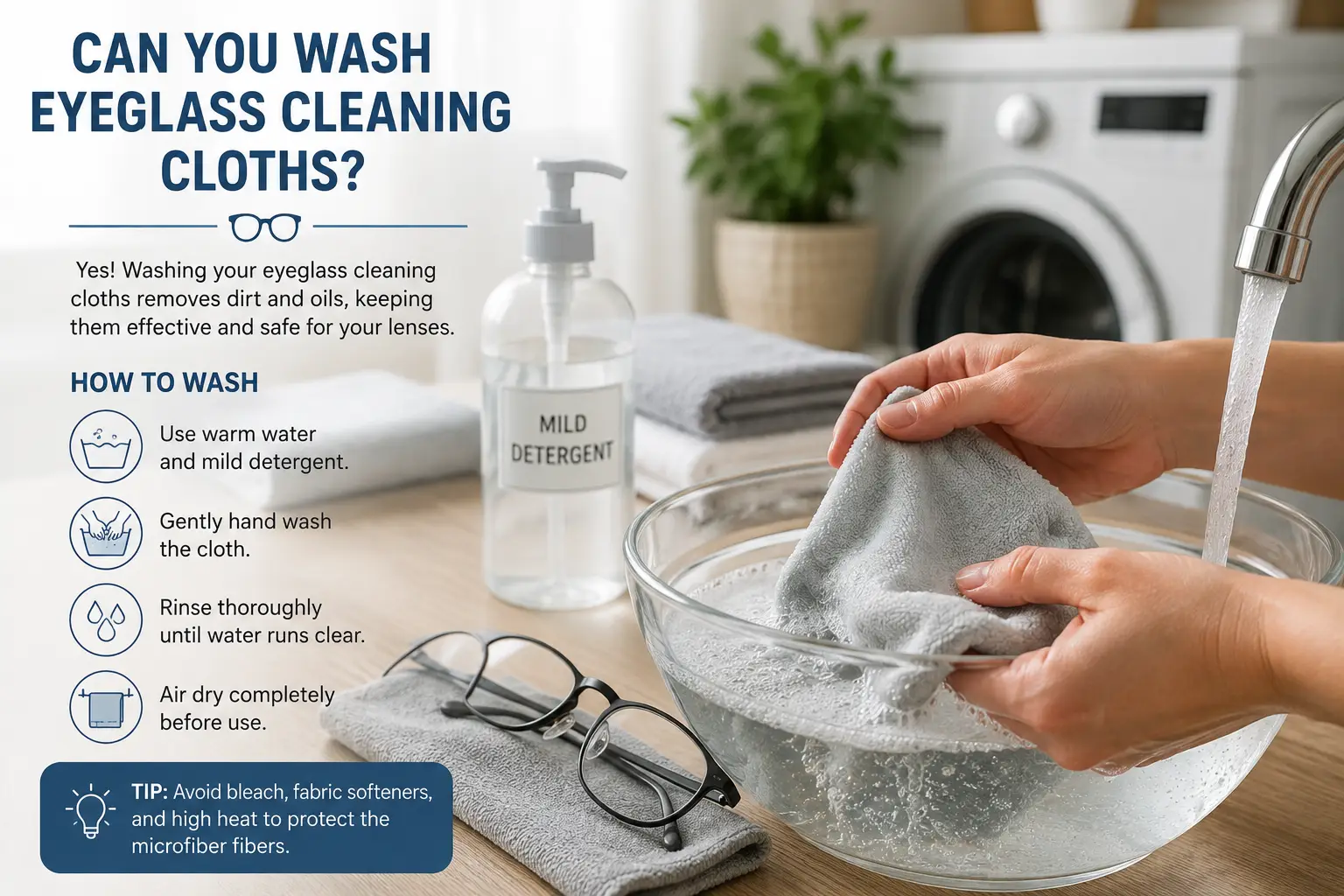
This is the section that actually answers can you wash eyeglass cleaning cloths in practice — because the method matters as much as the “yes.” Get it wrong (hot water, fabric softener, high heat drying) and you can permanently reduce a cloth’s cleaning power even though it still looks fine.
- Check for visible debris first. Shake the cloth out or brush off any grit, since rubbing debris into the fibers during washing can embed it deeper rather than removing it.
- Hand wash in lukewarm water. Use water that’s warm, not hot — high heat can degrade the synthetic fibers over repeated washes and shorten the cloth’s usable life.
- Add a small amount of mild, oil-free soap. A drop of gentle dish soap or a fragrance-free detergent works; avoid anything with added moisturizers or oils, which coat the fibers exactly the way you’re trying to remove.
- Skip fabric softener entirely. Softeners leave a residue that clogs the microscopic gaps between fibers, which is the number one reason a “washed” cloth still smears instead of cleaning.
- Rinse thoroughly until the water runs clear. Any leftover soap residue can transfer back onto your lenses and cause streaking on the next use.
- Air dry, or tumble dry on low heat only. High heat from a dryer can warp or melt the fine synthetic fibers, so air drying flat is the safer default.
- If machine washing, use a mesh bag on a gentle cycle. This keeps the cloth from tangling with other laundry and picking up lint from cotton items in the same load.
For a second opinion on lens-safe cleaning habits from the medical side, the American Academy of Ophthalmology publishes its own tips for cleaning eyeglasses, which reinforces the same core idea: mild soap, lukewarm water, and a cloth that’s actually clean before it touches your lenses.
Which Cloth Fits Your Routine? 3 Real-World Scenarios
The daily commuter. If you wear prescription glasses eight-plus hours a day and handle them constantly — putting them on, taking them off, wiping condensation after stepping outside — you’re contaminating your cloth faster than an occasional wearer. A six-pack like the MagicFiber Premium Microfiber Cleaning Cloths or Your Choice Microfiber Cleaning Cloths lets you rotate cloths every few days and wash a batch at once, rather than relying on a single overworked cloth.
The AR-coating investor. If you paid extra for anti-reflective, blue-light, or photochromic coatings, protecting that investment should outweigh saving a few dollars on a cloth. The ZEISS Jumbo Microfiber Cleaning Cloth is purpose-built by the same company that makes many of those coatings, making it the lower-risk choice for anyone who’s already spent $200+ on lenses.
The multi-pair, multi-person household. Families juggling readers, sunglasses, kids’ glasses, and safety glasses benefit most from either the 12-Pack Assorted Color Microfiber Cloths (color-coded per person) or the MagicFiber Microfiber Eyeglasses Pack (cloth plus case for each pair). Both solutions cut down on the “whose cloth is this, and how dirty is it” problem that plagues shared households.
Common Eyeglass Cloth Problems and How to Fix Them
Problem: The cloth smears instead of cleans. This is almost always a saturation issue — the fibers are full of old oil and can’t absorb any more. Solution: wash it using the method above; if smearing continues after washing, the fabric softener residue from a previous wash cycle is the likely culprit, and switching to a softener-free wash should resolve it.
Problem: The cloth feels stiff or scratchy. Stiffness usually points to either high-heat drying or mineral buildup from hard water. Solution: rewash in lukewarm water with a small amount of mild soap, rinse extra thoroughly, and air dry instead of using heat.
Problem: You keep losing the cloth. This is a logistics problem, not a cleaning one. Solution: buy in bulk (the 12-pack or a six-pack) and deliberately stash cloths in fixed locations — car, desk drawer, nightstand — so you’re never without one.
Problem: The cloth smells musty. A damp cloth stored in a closed case without fully drying first can develop a mildew smell. Solution: always let the cloth air dry completely before returning it to a sealed glasses case or pouch.
Problem: Lenses look scratched after cleaning. If a cloth has picked up grit or sand, it becomes an abrasive rather than a cleaner. Solution: rinse the cloth under running water immediately if you suspect it’s picked up debris, and never wipe a lens dry without first checking the cloth is genuinely clean.
How to Choose an Eyeglass Cleaning Cloth: 6 Things That Matter
- Fiber composition. Look for a polyester-polyamide (nylon) microfiber blend rather than plain polyester or cotton, since the split-fiber structure is what actually lifts oil instead of smearing it.
- Size relative to your lenses. Standard 6×7-inch cloths suit most prescription glasses, but wraparound sunglasses or oversized frames benefit from an 8×8-inch or jumbo cloth.
- Coating compatibility. If your lenses have an anti-reflective or blue-light coating, prioritize a cloth explicitly marketed as coating-safe, since a rougher weave can gradually haze delicate coatings.
- Pack size versus your habits. If you tend to misplace things, a bulk multi-pack beats a single premium cloth you’ll stress about losing.
- Wash durability. Cheaper cloths often thin out or fray at the edges faster; if you wash weekly, a mid-range or premium option will likely outlast several budget packs.
- Storage solution. A cloth paired with a case (like the MagicFiber Microfiber Eyeglasses Pack) or a self-contained pouch (like the Carson Stuff-It Pro Microfiber Lens Cleaning Cloth) keeps the cleaning surface protected between uses, extending its effective lifespan.
Common Mistakes to Avoid When Washing Your Glasses Cloth
The single biggest mistake is using fabric softener, whether as a standalone product or built into a laundry detergent’s “softening” formula — it coats the microfibers with a waxy residue that blocks their oil-lifting ability, and it’s genuinely hard to fully reverse once applied. A close second is washing the cloth alongside heavily soiled cotton laundry, which sheds lint that embeds in the microfiber weave and ends up transferring right back onto your lenses.
High-heat drying is another common misstep: tossing the cloth in with a hot dryer cycle can subtly melt or warp the fine synthetic strands, reducing softness over time even if the cloth still looks intact. And using the cloth dry on dusty lenses, rather than lightly dampening it first, can grind particulate debris into the lens surface instead of lifting it away — a small habit change that meaningfully reduces the risk of fine scratches. For a broader look at eyewear upkeep beyond just the cloth, Consumer Reports has covered how to take care of your eyeglasses as part of general consumer eyewear guidance, and the core advice lines up with what eye-care providers recommend: gentle cleaning agents, no paper towels, and regular cloth maintenance.
✨ Ready to Stop Smearing Your Lenses?
🔍 Take your eyewear care routine to the next level with a cloth that’s actually built to be washed and reused. Click a highlighted pick above to check current pricing and availability on Amazon — your glasses (and your patience) will thank you.
Microfiber Cloths vs. Pre-Moistened Lens Wipes vs. Paper Tissues
| Method | Reusable? | Streak Risk | Lens-Safe? | Cost Over Time |
|---|---|---|---|---|
| Microfiber cloth | Yes, washable | Low (when clean) | Yes, including coated lenses | Low after initial purchase |
| Pre-moistened lens wipes | No, single-use | Low | Usually, check alcohol content | Ongoing, adds up |
| Paper tissue/napkin | No, single-use | High | No — abrasive wood fibers | Low per use, high lens risk |
The comparison makes the case for microfiber fairly clear: paper products, even soft facial tissue, contain wood fibers that are abrasive enough to create fine surface scratches over repeated use, which is why most optometrists advise against them entirely. Pre-moistened wipes are genuinely convenient for travel and can be lens-safe, but the ongoing cost adds up compared to a one-time cloth purchase, and some formulations contain alcohol or ammonia that aren’t ideal for certain lens coatings. A washable microfiber cloth ends up being the most cost-effective and lowest-risk option for daily use, provided — again — that it’s actually washed regularly rather than used indefinitely without care.
What to Expect: Everyday Performance After a Wash Cycle
Right after a proper wash and full air dry, a good microfiber cloth should glide across a lens with almost no resistance and leave zero streaking, since the fibers are fully “reset” and ready to grab oil again. Within the first few uses post-wash, you’ll typically get one or two clean passes per lens before the cloth needs to move to a fresh section of fabric — which is part of why the larger cloths on this list (ZEISS, the 8×8 pack) have a practical edge, since you get more clean surface before the whole cloth is saturated.
Performance predictably declines the longer a cloth goes between washes: by day three or four of daily use without a wash, most users report the cloth starting to push oil around rather than lift it, especially in humid climates where skin oil transfers more readily. That decline is gradual, not sudden, which is exactly why it’s easy to keep using an under-performing cloth without noticing — you adjust to slightly smudgier lenses without registering the cause. Healthline’s guide on how to clean glasses properly makes a similar point: the cloth is only as good as its last wash, and rinsing lenses under water before wiping removes the grit that causes most of the visible scratching people blame on cloths.
Eyeglass Cleaning Cloths for Every Type of Wearer
Glasses-only wearers get the most mileage out of a mid-range multi-pack like MagicFiber Premium Microfiber Cleaning Cloths, since daily all-day wear means frequent contact and frequent washing.
Sunglasses-and-prescription wearers juggling two pairs benefit from the larger surface area of the Large Microfiber Cleaning Cloths (8×8), which handle wraparound sunglass lenses better than a compact 6×7-inch cloth.
Coated-lens wearers (anti-reflective, blue-light, photochromic) should lean toward the ZEISS Jumbo Microfiber Cleaning Cloth, since coating manufacturers specifically formulate their cloths to avoid the haze that a rougher generic microfiber can cause over time.
Kids and multi-person households do best with color-coded or bundled options like the 12-Pack Assorted Color Microfiber Cloths or the MagicFiber Microfiber Eyeglasses Pack, both of which reduce cross-contamination and mix-ups between family members’ cloths.
Photographers and outdoor users who also clean camera lenses or binoculars alongside their glasses tend to prefer the Carson Stuff-It Pro Microfiber Lens Cleaning Cloth, since its attached pouch keeps one dedicated, protected cloth ready for multiple types of optics.
Long-Term Cost and Care: How Often Should You Replace Your Cloth?
Most microfiber eyeglass cleaning cloths last six months to two years with regular washing, depending on wash frequency and how they’re dried. A cloth that’s hand washed weekly and air dried will typically outlast one that’s machine washed and tumble dried on high heat, since heat is the main driver of fiber breakdown over time.
| Wash Method | Fiber Wear Over Time | Recommended Frequency |
|---|---|---|
| Hand wash, air dry | Slowest | Weekly for daily wearers |
| Machine wash (mesh bag), air dry | Moderate | Weekly to biweekly |
| Machine wash, tumble dry low | Faster | Biweekly, monitor for stiffness |
| Machine wash, tumble dry high heat | Fastest (avoid) | Not recommended |
Interpreting that table, the practical takeaway is straightforward: air drying — regardless of whether you hand wash or machine wash — is the single biggest lever for extending a cloth’s useful life. If you notice a cloth smearing even immediately after a wash, or if you can see visible fraying at the seams, that’s the signal to retire it rather than keep pushing a compromised cloth through another cycle; at $1-$3 per cloth in most multi-packs, replacing one is cheap insurance against lens damage.
Features That Actually Matter (and Ones That Don’t)
Actually matters: fiber blend. A genuine polyester-polyamide split-fiber microfiber outperforms cheap all-polyester “microfiber-labeled” cloths, which can feel similar in the package but perform noticeably worse at lifting oil.
Actually matters: edge stitching quality. Cloths with reinforced or rolled edges resist fraying through repeated wash cycles far better than raw-cut edges, which unravel after a handful of washes.
Doesn’t matter much: scent or color. Marketing aside, a cloth’s color or any added scent has zero bearing on cleaning performance — pick based on function, not packaging.
Doesn’t matter much: brand name alone. Several of the best-value cloths on this list aren’t from big-name optical brands, and they perform comparably to pricier options for basic day-to-day cleaning, provided the fiber blend is genuine microfiber.
Actually matters: size relative to your lens area. As covered earlier, undersized cloths run out of clean surface mid-wipe, forcing you to either stop cleaning or start smearing residual oil back onto the lens.
Frequently Asked Questions
❓ Can you wash eyeglass cleaning cloths in a washing machine?
❓ How often should you wash an eyeglass cleaning cloth?
❓ Can you put an eyeglass cleaning cloth in the dryer?
❓ Is it safe to wash eyeglass cleaning cloths with fabric softener?
❓ Do eyeglass cleaning cloths wear out, and when should you replace them?
Conclusion
So, can you wash eyeglass cleaning cloths? Absolutely — and if you’ve been treating yours like a disposable tissue, switching to a regular wash routine is one of the easiest upgrades you can make to your eyewear care. Mild soap, lukewarm water, no fabric softener, and air drying will keep almost any microfiber cloth performing well for months at a time.
Among the seven picks in this guide, the right choice comes down to your priorities. If you’ve invested in coated lenses, the ZEISS Jumbo Microfiber Cleaning Cloth is the lower-risk, purpose-built option. If you want dependable everyday value, the MagicFiber Premium Microfiber Cleaning Cloths deliver strong performance at a fair price. Budget-focused households will do well with Your Choice Microfiber Cleaning Cloths or the 12-Pack Assorted Color Microfiber Cloths, while anyone who wants a cloth that stays protected between uses should look at the Carson Stuff-It Pro Microfiber Lens Cleaning Cloth. Larger lenses and sunglasses are best served by the Large Microfiber Cleaning Cloths (8×8), and households juggling multiple pairs will appreciate the all-in-one convenience of the MagicFiber Microfiber Eyeglasses Pack.
Whichever cloth you choose, the habit matters more than the brand: wash it regularly, skip the fabric softener, and let it air dry. Do that, and a $10 cloth can easily outperform a drawer full of disposable wipes.
✨ Grab the Cloth That Fits Your Routine
🔍 Take your eyewear care routine to the next level with a pick from this list. Click through to check current pricing and availability, and give your lenses the streak-free clean they deserve.
Recommended for You
- Dust Rag: 7 Best Options for a Cleaner Home in 2026
- 7 Best Glass Cleaners for Cars in 2026 (Streak-Free & Tint-Safe Picks)
- Auto Dashboard Cleaner: 7 Best Picks to Stop Fading (2026)
Disclaimer: This post contains affiliate links. As an Amazon Associate, I earn from qualifying purchases made through these links, at no additional cost to you.
✨ Found this article helpful? Share it with someone who needs it! 💬🤗