In This Article
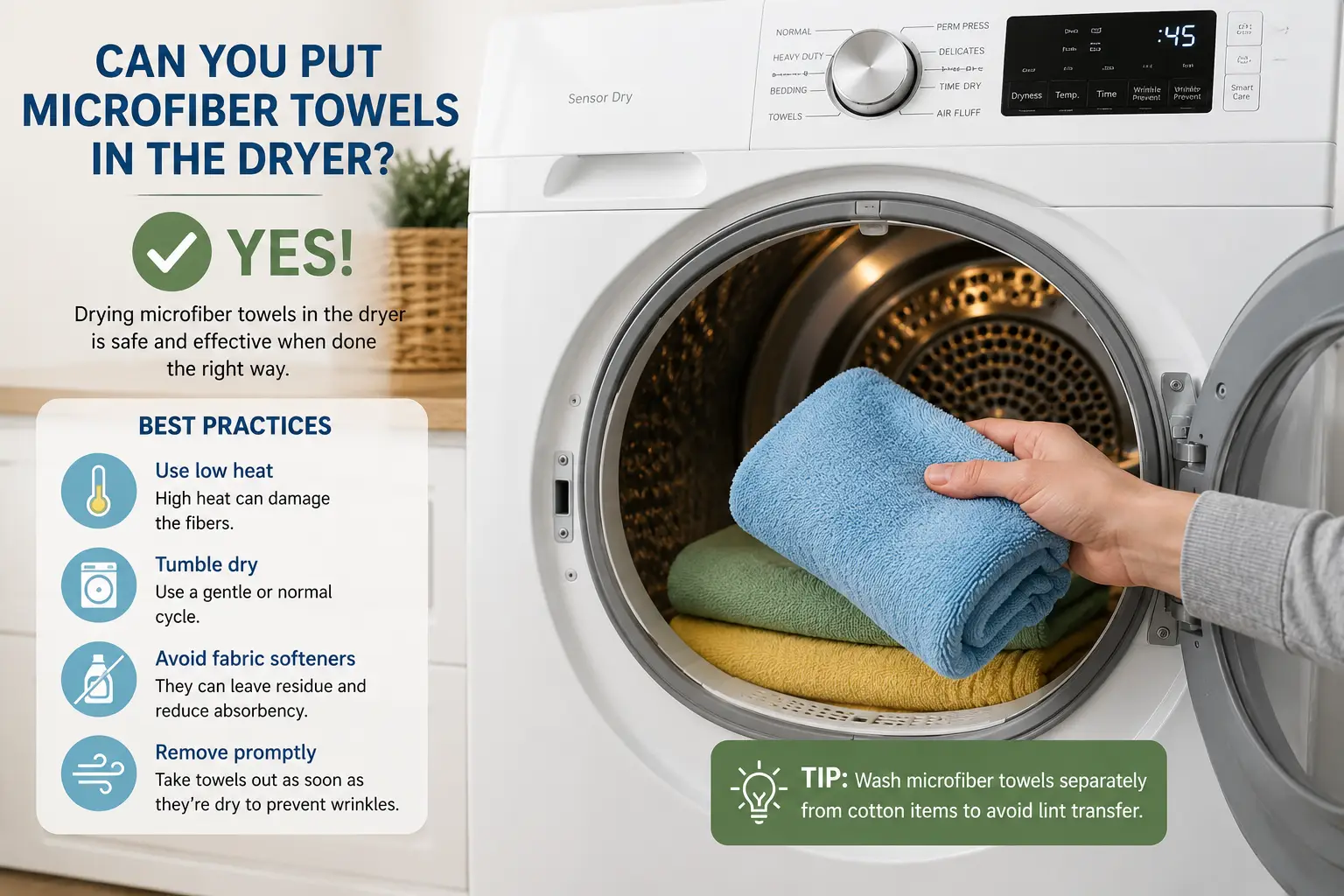
Yes, can you put microfiber towels in the dryer, but only under specific conditions: low heat or no-heat/air-fluff settings, no fabric softener, and no dryer sheets. Microfiber’s cleaning power comes from thousands of split synthetic fibers that create static and surface area to trap dust and oil. High heat melts or warps those fibers, and softener coats them with a waxy residue that kills their ability to grab dirt.
If you’ve ever tossed a load of cleaning cloths in with your regular towels on the “normal” cycle and pulled them out feeling stiff, less absorbent, or oddly slick, you already know something in that process went wrong. It’s rarely the towel’s fault. Microfiber is a polyester-polyamide blend engineered at a microscopic scale — a state health department overview of microfiber cleaning cloths explains that each strand is split into even finer fibers during manufacturing, which is what creates the enormous surface area and static charge responsible for its cleaning performance. That same delicate structure behaves nothing like cotton terry cloth once it hits a hot dryer drum. Get the settings wrong a few times and a $20 pack of towels that should last years starts underperforming within a couple of months.
This guide breaks down exactly why microfiber reacts the way it does to heat and to softener, walks through seven real, well-reviewed microfiber towels currently sold on amazon.com (spanning budget multi-packs to professional-grade detailing towels), and gives you a step-by-step drying routine that keeps every towel in your stack absorbent for years instead of months. You’ll also find a buyer’s framework for matching towel weight and weave to your actual use case, a look at what “GSM” and “70/30 blend” really mean for performance, and answers to the questions people ask most often about washing and drying this material. By the end, you’ll know exactly which setting to press on your dryer and which towel on this list fits your household.
Quick Comparison: 7 Microfiber Towels at a Glance
| Product | Best For | GSM/Weight | Price Range |
|---|---|---|---|
| AmazonBasics Microfiber Cleaning Cloths | Everyday household budget pick | Lightweight | around $10-$15 |
| Zwipes Microfiber Cleaning Cloths (36-Pack) | Bulk multi-room stocking | Medium | around $15-$20 |
| MR.SIGA Color-Coded Microfiber Cloths | Cross-contamination control | Medium | between $12 and $18 |
| SINLAND Microfiber Car Drying Towels | Car washing and drying | 380 GSM | around $15-$20 |
| The Rag Company Eagle Edgeless 500 | Professional-grade detailing | 500 GSM | between $20 and $30 |
| SINLAND Microfiber Sports & Travel Towels | Gym, camping, quick-dry travel | Lightweight, compact | around $18-$25 |
| SINLAND Waffle-Weave Kitchen Towels | Dish drying and kitchen cleanup | Medium, waffle weave | around $12-$18 |
Looking at the table above, the split isn’t really about quality — every brand here uses genuine split microfiber — it’s about weight and weave matched to a job. The AmazonBasics Microfiber Cleaning Cloths and Zwipes Microfiber Cleaning Cloths are light, general-purpose wipes best suited to dusting, glass, and counters, while the The Rag Company Eagle Edgeless 500 is a dual-pile plush towel built to buff paint without introducing swirl marks. Buyers who need one towel type for a dozen different rooms should lean toward the mid-weight, color-coded MR.SIGA option, since its color system does double duty as a cross-contamination safeguard between the kitchen and bathroom.
💬 One click helps other shoppers make an informed choice too! 😊
Top 7 Microfiber Towels: Expert Analysis
1. AmazonBasics Microfiber Cleaning Cloths — cheapest reliable entry point
The AmazonBasics Microfiber Cleaning Cloths are the towel most people already own without realizing it’s a genuine split-fiber product rather than a flimsy imitation. Sold in 24- and 48-packs at 16 x 12 inches, they’re a plain-weave, single-pile cloth rather than a plush terry towel, which is exactly why they excel at glass, screens, and countertops without leaving lint behind. In practice, the flatter weave means less surface area to trap heavy grime than a plush towel, so this isn’t the pick for scrubbing baked-on kitchen grease or drying a car.
Reviewers consistently describe these as the towel they buy in bulk to leave in every room, citing the low per-cloth cost as the main draw over name-brand detailing towels. A recurring theme in aggregated feedback is that colors bleed slightly in the first wash or two, so a first cold-water wash alone (separate from light fabrics) is worth doing before mixing them into general laundry. For anyone stocking a first apartment or replacing worn-out cotton rags, this is the towel that gets recommended first — not because it’s the best performer on this list, but because it’s the lowest-risk way to discover whether microfiber fits your routine at all.
Pros:
- ✅ Very low cost per cloth for genuine split microfiber
- ✅ Streak-free on glass, mirrors, and electronics
- ✅ Widely available in large multi-packs
Cons:
- ❌ Thinner weave struggles with heavy grease
- ❌ Some dye transfer reported in the first wash
Priced around $10-$15 for a 24-pack, this is close to the cheapest genuine microfiber you’ll find on amazon.com, and the value holds up as long as you treat it as a light-duty wipe rather than a scrub towel.
2. Zwipes Microfiber Cleaning Cloths — best bulk multi-pack for whole-house stocking
The Zwipes Microfiber Cleaning Cloths, sold in assorted-color packs of up to 36 or 48, are built for households that want to color-code by room without paying detailing-towel prices. Each cloth is a mid-weight, all-purpose terry weave, which gives it noticeably more scrubbing bite than a flat-weave cloth like the AmazonBasics option, while still staying gentle enough for stainless steel appliances and painted surfaces.
What separates this pick from a generic bulk pack is the assortment of colors included in a single order, which means you can dedicate a color to bathrooms, another to kitchen counters, and a third to general dusting without buying three separate products. Aggregated reviews frequently mention that the cloths hold up through dozens of wash cycles when air-dried or tumbled on low, though several buyers note that machine-drying on standard heat noticeably shortened the towels’ lifespan within a few months — a pattern consistent with how heat degrades any split-fiber material. For a family managing a full house of surfaces, the sheer quantity per order is the real selling point.
Pros:
- ✅ Large assortment covers a whole house in one order
- ✅ Terry weave handles both scrubbing and polishing
- ✅ Reasonable cost per cloth at bulk pack sizes
Cons:
- ❌ Performance drops noticeably if dried on high heat
- ❌ Assorted colors aren’t a fixed, repeatable color-coding system
At around $15-$20 for a 36-pack, the Zwipes Microfiber Cleaning Cloths land firmly in budget territory while offering more scrubbing capability than flat-weave alternatives, making this a strong pick for anyone replacing an entire rag drawer at once.
3. MR.SIGA Color-Coded Microfiber Cleaning Cloths — best for cross-contamination control
The MR.SIGA Color-Coded Microfiber Cleaning Cloths ship in fixed, repeatable color sets (commonly white, blue, green, red, or yellow), which is the detail that separates them from assorted multi-packs — you can consistently reserve one color for bathrooms and another for food-prep surfaces every time you reorder. At roughly 12.6 x 12.6 inches, they’re a dense, mid-weight weave that balances absorbency with a soft enough hand feel for glass and glossy surfaces.
This is a genuinely useful system for households managing allergy sensitivities or anyone following commercial-cleaning best practices at home, since color-coding is the exact method janitorial and food-service industries use to prevent cross-contamination between bathroom and kitchen surfaces. Reviews consistently highlight the consistent sizing and color repeatability across multiple orders as the standout feature, with a smaller number of buyers noting the cloths feel thinner than premium detailing towels — a fair trade-off, since this product isn’t marketed for automotive use. For anyone who wants a system rather than just a stack of rags, this is the most organized pick on this list.
Pros:
- ✅ Repeatable color-coding across reorders
- ✅ Balanced weave works on both glass and countertops
- ✅ Soft enough for glossy and painted surfaces
Cons:
- ❌ Thinner than dedicated detailing towels
- ❌ Not intended for heavy automotive use
Priced between $12 and $18 for a 12-pack, the value proposition here is organizational as much as material — you’re paying for a system you can maintain over years of reordering, not just a one-time stack of cloths.
4. SINLAND Microfiber Car Drying Towels — best for washing and drying a vehicle
The SINLAND Microfiber Car Drying Towels step up to a genuine 380 GSM (grams per square meter) terry weave at 16 x 24 inches, which puts them solidly in car-care territory rather than household dusting. That higher GSM number translates directly into more loops per square inch, meaning the towel can absorb significantly more water per pass — a meaningful difference when you’re trying to dry an entire vehicle before water spots set in.
Based on comparing the specs against lighter household cloths, the extra density here is what lets these towels lift water off a hood in two or three passes instead of five or six, cutting drying time and reducing the number of passes that could theoretically drag grit across clear coat. Aggregated customer feedback consistently praises the absorbency-to-size ratio and reports minimal streaking on glass and paint after a proper wash-and-dry routine, though a handful of reviewers mention that the edges (which aren’t fully edgeless-stitched on this model) can occasionally leave a faint line on very high-gloss finishes if used aggressively. For anyone doing their own car washes at home, this is the towel that closes the gap between household cloths and professional detailing gear without professional-detailing pricing.
Pros:
- ✅ High 380 GSM density absorbs water quickly
- ✅ Large 16 x 24-inch size covers more surface per pass
- ✅ Minimal streaking on paint and glass when used correctly
Cons:
- ❌ Standard-stitched edges aren’t fully swirl-free like edgeless towels
- ❌ Overkill for light indoor dusting tasks
At around $15-$20 for a 3-pack, this sits in the mid-range of the lineup, delivering most of the performance of premium detailing towels at a noticeably lower price per towel.
5. The Rag Company Eagle Edgeless 500 — best for professional-grade detailing
The The Rag Company Eagle Edgeless 500 is the premium option on this list, built from a Korean 70/30 polyester-polyamide blend at a substantial 500 GSM with a dual-pile plush construction and fully edgeless (satin-bound) stitching. That edgeless border isn’t a cosmetic detail — it’s specifically designed to eliminate the hard, stitched seam that can catch grit and scratch clear coat during buffing, which matters enormously once you’re working with polishes and sealants rather than just soap and water.
What most buyers overlook with a towel like this is that the plush, dual-pile weave is engineered to hold more product (wax, sealant, ceramic coating) per pass while still gliding smoothly, rather than dragging across the surface the way a flatter, cheaper towel would. This is a towel built for people who care about paint correction, not just cleanliness — reviews from detailing-focused buyers consistently describe it as noticeably plusher and more absorbent than typical automotive towels, with the main critique being that at 500 GSM it takes longer to fully dry between uses than lighter towels, meaning a serious detailer needs enough of them in rotation to avoid running out mid-job. For anyone investing real time in paint care, waxing, or ceramic coating maintenance, this is the towel that justifies its price premium through construction quality alone.
Pros:
- ✅ Edgeless satin binding prevents scratching during buffing
- ✅ Dual-pile 500 GSM plush holds more product per pass
- ✅ Korean 70/30 blend is durable across hundreds of washes
Cons:
- ❌ Highest price per towel on this list
- ❌ Takes longer to air-dry fully due to density
Priced between $20 and $30 for a 4-pack, this is a genuine investment tier, but the cost per wash drops dramatically over a multi-year lifespan if you follow proper low-heat care — the exact opposite outcome you’d get from tumbling a towel like this on high heat even once.
6. SINLAND Microfiber Sports & Travel Towels — lightest for gym bags and backpacking
The SINLAND Microfiber Sports & Travel Towels trade household cleaning duty for personal use, functioning as ultra-compact, quick-dry towels for the gym, pool, camping, or travel. At around 16 x 32 inches and a noticeably lighter weight than the car-drying or detailing towels on this list, they’re designed to pack down small and dry in a fraction of the time a cotton bath towel needs — a real advantage when you’re stuffing a towel into a backpack or gym bag between uses.
The practical case for this category over cotton is straightforward: a soaked cotton towel stays damp (and starts smelling) for hours, while a wrung-out microfiber travel towel is usually dry to the touch within 30-60 minutes in open air. Reviewers who use these for backpacking and camping consistently mention the compact carry size and fast dry time as the deciding factors over bringing a regular towel, with a smaller subset noting the texture feels less plush against skin than a cotton towel — an honest trade-off for the weight and pack-size savings. For anyone who travels light or works out regularly, this is the towel category that solves a genuinely different problem than the cleaning-focused picks above.
Pros:
- ✅ Packs down significantly smaller than cotton towels
- ✅ Dries to the touch in under an hour when wrung out
- ✅ Lightweight enough for backpacking and carry-on travel
Cons:
- ❌ Less plush against skin than cotton bath towels
- ❌ Can feel clingy on damp skin compared to terry cotton
At around $18-$25 for a 3-pack, this is priced for the convenience it delivers rather than raw material cost, and it earns that price back on any trip where laundry access is limited.
7. SINLAND Waffle-Weave Kitchen Towels — best for dish drying and kitchen cleanup
The SINLAND Waffle-Weave Kitchen Towels use a distinct waffle-textured weave rather than flat or terry construction, and that texture is the whole point: the raised grid pattern increases surface area and water-wicking ability specifically for drying dishes and glassware without the streaking a flat cloth can leave behind. At roughly 16 x 24 inches, they’re sized closer to a traditional kitchen towel than a small cleaning cloth.
Based on how waffle weaves perform structurally, the raised pattern also means these towels dry faster on a towel bar between uses than a dense terry towel would, which matters in a kitchen where a towel gets used dozens of times a day and needs to stay reasonably dry (and odor-free) between washes. Aggregated reviews consistently highlight the streak-free glass and dishware results and the towel’s ability to double as an oven-adjacent hand towel, with the main recurring complaint being that the lighter waffle weave doesn’t hold up as well against very greasy, heavy-duty kitchen messes as a thicker terry cloth. For anyone replacing a drawer of cotton flour-sack towels, this is the closest microfiber equivalent in both size and everyday kitchen function.
Pros:
- ✅ Waffle texture improves drying and reduces streaking
- ✅ Dries quickly between uses on a towel bar
- ✅ Sized like a traditional kitchen towel, not a small cloth
Cons:
- ❌ Less absorbent than terry weave for heavy grease
- ❌ Waffle texture shows visible wear sooner than flat weaves
Priced around $12-$18 for a 3-pack, this is a mid-budget pick that earns its place through fit-for-purpose design rather than raw absorbency numbers.
How to Dry Microfiber Towels the Right Way (Step-by-Step)
Getting this process right is what determines whether your towels last two years or two months, and it takes less effort than most people assume once you know the sequence.
- Wash separately from lint-producing fabrics. Cotton towels and clothing shed lint that microfiber’s static charge grabs onto instantly, which is why a load of cotton-and-microfiber together often comes out with microfiber cloths covered in fuzz.
- Use warm or cold water, never hot. Hot wash water starts the same fiber-degradation process that a hot dryer accelerates, so keeping wash temperature moderate protects the towel before it even reaches the dryer.
- Skip liquid fabric softener entirely. Softener works by coating fibers in a waxy, lubricating film — great for cotton, disastrous for microfiber, since that coating fills the microscopic gaps between split fibers that create the cleaning effect in the first place.
- Select low heat or the no-heat/air-fluff dryer setting. Reviewers and cleaning professionals alike point out that microfiber’s synthetic fibers begin to warp and melt at temperatures cotton towels tolerate easily; a widely cited home-care guide specifically recommends skipping high heat to preserve the towel’s cleaning ability.
- Never use dryer sheets. Like liquid softener, dryer sheets leave a residue coating that clogs the fiber structure, and the effect compounds with every use.
- Remove towels promptly and shake them out. Sitting damp in a dryer drum encourages odor-causing bacteria growth, which microfiber is slightly more prone to than cotton due to its synthetic composition trapping moisture differently.
- Air-dry when time allows. For premium or heavily-used towels like detailing cloths, a flat air-dry or a drying rack extends fiber life the most, since it removes heat exposure from the equation entirely.
Real-World Scenarios: Matching the Right Towel to Your Routine
If you’re a renter stocking a first apartment on a tight budget, the AmazonBasics Microfiber Cleaning Cloths or Zwipes Microfiber Cleaning Cloths cover glass, counters, and dusting for less than the cost of a single roll of paper towels used over a month, and they hold up fine as long as you keep them off high heat.
If you’re a parent managing a household with a toddler and a dog, the MR.SIGA Color-Coded Microfiber Cleaning Cloths solve a real hygiene problem: dedicating a fixed color to the bathroom and a different one to the kitchen prevents you from accidentally cross-contaminating food-prep surfaces with bathroom cleaner residue, which is a bigger deal in a house with young kids than it might seem.
If you wash your own car every other weekend, the SINLAND Microfiber Car Drying Towels cut a 20-minute drying job down to closer to 10, and the added GSM means fewer passes across the paint — fewer opportunities to drag grit and cause micro-scratches.
If you’re seriously into paint correction, waxing, or ceramic coating maintenance, the The Rag Company Eagle Edgeless 500 is worth the premium; the edgeless construction alone reduces the risk of introducing swirl marks during a process where you’re already spending an hour or more on a single panel.
If you’re a runner, gym-goer, or weekend backpacker, the SINLAND Microfiber Sports & Travel Towels solve the “damp towel in a bag” problem that cotton simply can’t, drying fast enough between gym sessions that odor never gets the chance to set in.
If you’re replacing a drawer of stained, aging cotton kitchen rags, the SINLAND Waffle-Weave Kitchen Towels are sized and shaped for the exact same use case, minus the lint that cotton flour-sack towels leave on glassware.
How to Choose the Best Microfiber Towel for Your Needs
- Match GSM to the job. Lightweight cloths (under 300 GSM) suit dusting and glass; 350-400 GSM suits general car care; 500+ GSM suits paint correction and heavy absorbency needs.
- Check the weave type. Flat weaves streak-free on glass; terry weaves scrub better; waffle weaves dry dishes without streaking; plush dual-pile buffs paint without swirling.
- Confirm edgeless construction for automotive use. A hard stitched edge is fine for household dusting but risky on clear coat, where satin-bound edgeless towels are the safer choice.
- Consider color-coding if hygiene separation matters. Households managing food prep, bathrooms, and pets benefit from a repeatable color system over assorted multi-packs.
- Factor in pack size versus your actual rotation needs. Detailing work needs enough towels in rotation that you’re never reaching for a dirty one mid-job; household dusting can get by with fewer.
- Read the washing instructions before buying, not after. Some premium towels specify cold-water-only washing to preserve GSM and plushness over time — know this before the first wash, not after a mistake.
- Price per towel, not price per pack. A 4-pack at $25 and a 24-pack at $15 aren’t comparable value propositions once you divide by unit count and factor in expected lifespan.
Common Mistakes to Avoid When Washing and Drying Microfiber Towels
The single most common mistake is treating microfiber like cotton and tossing it into a normal wash-and-dry cycle with everything else in the hamper — this both contaminates the towels with lint and exposes them to heat and softener residue they can’t tolerate. A close second is assuming “low heat” and “no heat” are interchangeable; many dryers’ “low” setting still runs hotter than ideal for a 500 GSM plush towel, so checking the manufacturer’s specific care label matters more than assuming a universal rule applies to every product on this list.
Another frequent error is using bleach or high-alkaline detergents, which can break down the polyurethane core that gives split-fiber microfiber its structure, leaving the towel feeling stiff and less absorbent even after just a few washes. Finally, storing damp microfiber towels balled up in a bucket (common after a car wash) invites mildew and odor far faster than it would with cotton, since synthetic fibers trap moisture differently — always let towels dry fully before storage, ideally spread flat or hung rather than folded while damp.
Microfiber Towels vs Cotton Towels
Microfiber towels win decisively on absorbency-per-weight, lint-free performance on glass and electronics, and fast-dry time between uses, which is why they’ve displaced cotton in most professional cleaning and detailing contexts over the past decade. Cotton terry towels still win on plushness against skin, tolerance for high-heat drying and harsh detergents without performance loss, and upfront cost for basic bath and kitchen use, since cotton is a far more forgiving material to launder carelessly.
The practical takeaway is that microfiber is the better choice anywhere performance (streak-free glass, fast car drying, scratch-safe paint work) matters more than laundering convenience, while cotton remains reasonable for applications where you genuinely can’t commit to gentler washing and drying habits. That split-fiber structure allows microfiber to trap significantly more dust and bacteria than cotton without needing as much cleaning chemical, which is part of why institutional cleaning has shifted toward it over the past two decades — but that same fiber structure is precisely what makes heat and softener so damaging if care instructions aren’t followed.
Long-Term Cost and Maintenance
A quality microfiber towel washed and dried correctly can realistically last 300-500 wash cycles before absorbency noticeably declines, according to patterns reported across detailing and cleaning-industry sources — figure roughly two to four years of regular household use, or six months to a year of daily professional detailing use. Compare that to the cost of replacing a batch of cotton rags or paper towels on a similar cleaning schedule, and the total cost of ownership tips clearly in microfiber’s favor once you factor in that a single microfiber towel replaces dozens of paper towels over its lifespan.
The catch is that this lifespan estimate assumes correct care from day one. A towel dried on high heat with fabric softener even occasionally can lose 30-50% of its absorbency within the first year, effectively erasing the cost advantage that made microfiber worth buying in the first place. A home-care maintenance guide echoes the same core rule covered throughout this article: skip high heat and skip fabric softener, and a microfiber towel will keep performing at close to its original absorbency for years. This is why the drying routine outlined earlier in this guide isn’t a minor suggestion — it’s the single biggest factor determining whether your investment in a $25 pack of premium towels pays off over years or gets thrown in a drawer as an expensive disappointment after six months.
Safety, Regulations, and Standards
Microfiber towels sold in the US aren’t subject to a dedicated federal safety standard the way, say, children’s sleepwear flammability is, but general textile product regulations from the Consumer Product Safety Commission still apply to labeling, flammability, and chemical content for household textiles. On the environmental side, independent laboratory research is worth knowing about: a peer-reviewed study published in Scientific Reports found that synthetic textiles, including polyester-based microfiber, release microplastic fibers into wastewater during ordinary machine washing, with fiber shedding measurably reduced by cooler wash temperatures and gentler cycles — one more practical reason the low-heat, cold-wash routine recommended throughout this guide matters beyond just towel longevity.
If environmental fiber shedding is a concern for your household, a washing bag designed to catch microplastic fibers during the wash cycle is a low-cost add-on that doesn’t require changing any of the drying guidance above. None of the products on this list carry special regulatory certifications beyond standard US consumer textile compliance, and none require registration, licensing, or professional installation of any kind.
✨ Don’t miss these exclusive deals!
🔍 Take your cleaning routine to the next level with this carefully curated lineup. Click a highlighted item to check current pricing and availability. These picks will help you get streak-free, lint-free results the whole household will appreciate!
Features That Actually Matter (and Ones That Don’t)
GSM (grams per square meter) actually matters — it’s the single best predictor of absorbency and durability across brands, and it’s printed on nearly every legitimate microfiber product listing. Edgeless (satin-bound) construction actually matters for anything touching a car’s paint, since a hard stitched edge is a genuine scratch risk during buffing. Weave type (flat, terry, waffle, plush) actually matters because it determines what job the towel is good at, and mismatching weave to task is the most common reason people feel disappointed with a microfiber purchase.
What doesn’t matter nearly as much as marketing suggests: exotic color options (functionally irrelevant outside of a color-coding system), “eco-friendly” packaging claims that have nothing to do with the towel’s actual fiber content, and thread-count-style marketing numbers that aren’t standardized the way GSM is. A towel advertised as “ultra-premium” without a GSM number listed is a red flag worth skipping in favor of a competitor that discloses it.
Frequently Asked Questions
❓ Can you put microfiber towels in the dryer on high heat?
❓ Why can't you use fabric softener on microfiber towels?
❓ How long do microfiber towels typically last?
❓ Can microfiber towels go in the washing machine with other laundry?
❓ What GSM is best for a microfiber car-drying towel?
Conclusion
The short answer to whether you can put microfiber towels in the dryer is yes, but the settings you choose determine whether that towel is still performing well a year from now or has quietly become a stiff, streaky disappointment sitting in a drawer. Low heat or no heat, no fabric softener, no dryer sheets, and a separate load away from lint-producing cotton — that four-part routine is really all it takes to protect the investment, whether you spent $12 on a household multi-pack or $30 on professional-grade detailing towels.
Across the seven towels covered here, the right pick comes down to matching GSM and weave to your actual task rather than assuming one towel handles everything well. Budget multi-packs like the AmazonBasics Microfiber Cleaning Cloths and Zwipes Microfiber Cleaning Cloths are the sensible starting point for general household use, the MR.SIGA Color-Coded Microfiber Cleaning Cloths solve a real hygiene-separation problem, the SINLAND Microfiber Car Drying Towels and The Rag Company Eagle Edgeless 500 cover car care from casual to serious, and the SINLAND Microfiber Sports & Travel Towels and SINLAND Waffle-Weave Kitchen Towels each solve a specific, everyday problem cotton handles less efficiently. Whichever you choose, the drying routine matters more than the price tag — get that right, and any towel on this list will earn back its cost many times over.
Recommended for You
- How to Clean Lens Cloth: 7 Best Picks & Easy Care Tips (2026)
- Carbon Cloth Fabric: 7 Best Picks for DIY Composites in 2026
- Dust Rag: 7 Best Options for a Cleaner Home in 2026
Disclaimer: This post contains affiliate links. As an Amazon Associate, I earn from qualifying purchases made through these links, at no additional cost to you.
✨ Found this article helpful? Share it with someone who needs it! 💬🤗