In This Article
If your glasses or camera lens look smeary no matter how many times you wipe them, the problem usually isn’t the lens — it’s the cloth. Knowing how to clean lens cleaning cloth properly is the single most overlooked step in optical care, and it’s the difference between a cloth that lifts oil cleanly and one that just pushes grime around in circles.
A lens cleaning cloth is a piece of ultra-fine synthetic microfiber, typically woven from split polyester and polyamide fibers, engineered to trap dust and oil without scratching delicate coated glass or plastic surfaces. Once that cloth gets loaded up with skin oil, sunscreen, or laundry residue, it stops cleaning and starts smearing — even though it still looks fine to the eye.
This guide covers both halves of the problem. First, the correct, dermatologist-and-manufacturer-backed method for washing a lens cloth so it keeps its static charge and split-fiber structure intact. Second, seven real, current lens cleaning cloths worth buying on Amazon, spanning individually wrapped budget packs, brand-name eyewear cloths, and premium Japanese-weave options for camera gear. According to Healthline’s guide to eyewear hygiene, a light daily cleaning routine paired with the right tools also cuts down on the bacteria that regularly build up on frequently touched eyewear. Whether you’re maintaining a single pair of glasses or a bag full of camera lenses, the routine below will keep your gear streak-free for years instead of months.
Quick Comparison: Top Lens Cleaning Cloths at a Glance
| Product | Pack Size | Best For | Price Range |
|---|---|---|---|
| LOJWRY Eye Glass Clean Cloths | 6-pack, individually wrapped | Travel & on-the-go touch-ups | Under $10 |
| MagicFiber Microfiber Cleaning Cloth | 6-pack | All-around household value | Under $10 |
| ZEISS Microfiber 8×8 Eyeglass Lens Cleaning Cloth | Single cloth | Trusted optical brand name | Under $5 |
| SPUDZ Classic Microfiber Lens Cleaner | 2-pack, clip-on pouch | Hikers, cyclists, outdoor use | $10–$15 |
| K&F Concept Microfiber Lens Cleaning Cloth X6 | 6-pack, individually packaged | Photographers & camera gear | $10–$15 |
| Carson Stuff-It Microfiber Lens Cloth Cleaning System | Cloth + stuff-pouch | All-in-one carry system | $10–$15 |
| Koala Lens Cleaning Cloth | 6-pack, Japanese microfiber | Premium multicoated lenses | $15–$20 |
Looking at the table above, the LOJWRY Eye Glass Clean Cloths and MagicFiber Microfiber Cleaning Cloth dominate the budget-value category thanks to their multi-piece packs and individually wrapped hygiene. If you’re maintaining an interchangeable-lens camera system, though, the K&F Concept Microfiber Lens Cleaning Cloth X6 and Koala Lens Cleaning Cloth are worth the step up — their denser weave is built to handle multicoated glass without leaving fiber residue behind.
💬 Found a pick you like already? One click on any product name above helps you check today’s price and availability. 😊
The 7 Best Lens Cleaning Cloths for 2026
1. LOJWRY Eye Glass Clean Cloths — individually wrapped for hygiene on the go
The standout feature of the LOJWRY Eye Glass Clean Cloths is that each 6×7-inch cloth ships in its own sealed wrapper, so a fresh one is always sitting in your bag, glovebox, or desk drawer. That matters more than it sounds: an unwrapped cloth left loose in a pocket or purse collects lint and grit between uses, which is exactly what causes micro-scratches on coated lenses. The high-density weave is built to grab oil rather than smear it, and the individual packaging means you’re never tempted to reuse a cloth that’s already picked up grime from something else in your bag. Based on comparing this format to bulk unwrapped multi-packs, the trade-off is clear: you pay slightly more per cloth for the wrapping, but you eliminate the single most common way lens cloths get contaminated between cleanings. Reviews consistently report that buyers appreciate having a “sealed spare” for eyeglass cases, camera bags, and travel kits specifically because it stays clean until the moment it’s used. This is the pick for anyone who cleans lenses in different locations throughout the day — the office, the car, the gym bag — rather than from one dedicated spot at home.
Pros:
- ✅ Individually wrapped, so each cloth stays contamination-free
- ✅ Compact 6×7-inch size fits any pocket or case
- ✅ Budget-friendly for a 6-cloth multi-pack
Cons:
- ❌ Wrapping adds a small amount of daily plastic waste
- ❌ Thinner weave than premium camera-grade options
Priced under $10 for a full pack, the LOJWRY Eye Glass Clean Cloths deliver strong value for anyone who wants a dedicated, always-clean cloth in more than one location.
2. MagicFiber Microfiber Cleaning Cloth — best all-around value pick
The MagicFiber Microfiber Cleaning Cloth earns its reputation as one of the best-selling lens cloths on Amazon by being genuinely versatile rather than narrowly specialized. Each 6×7-inch cloth uses a zig-zag stitched edge specifically designed to resist fraying, which in practice means the cloth keeps its shape and doesn’t shed loose threads onto your lens after repeated washing — a common failure point on cheaper, straight-cut cloths. It’s rated for eyeglasses, camera lenses, phone and tablet screens, and even TVs, so a single 6-pack can realistically replace the assorted mismatched rags most households already have scattered around. On paper, this cross-compatibility is the product’s biggest advantage: you don’t need a separate cloth for every device. Aggregated customer reviews cited by third-party buying guides put this product’s rating consistently above 4.5 stars, with buyers specifically calling out the soft feel and lack of streaking on glasses lenses. Budget-conscious households and anyone who wants one cloth style to standardize on will get the most value here.
Pros:
- ✅ Zig-zag edges resist fraying after repeated washes
- ✅ Works across glasses, cameras, phones, and screens
- ✅ Strong aggregated customer ratings across retailers
Cons:
- ❌ Six cloths ship loose, not individually wrapped
- ❌ Not marketed specifically for multicoated camera optics
In the under-$10 range, the MagicFiber Microfiber Cleaning Cloth is hard to beat as a household default, and it’s the cloth most reviewers recommend first to someone buying their very first proper lens cloth.
3. ZEISS Microfiber 8×8 Eyeglass Lens Cleaning Cloth — trusted optical brand name
What sets the ZEISS Microfiber 8×8 Eyeglass Lens Cleaning Cloth apart is simply the name behind it: Zeiss is a German optics manufacturer with more than a century of lens-coating expertise, and it designs this cloth specifically around the anti-reflective coatings it also puts on its own eyewear lenses. The larger 8×8-inch size gives you more usable surface area per wipe than the standard 6×7-inch competitors, which matters if you’re cleaning wide sunglasses lenses or a large camera front element in one pass. Because Zeiss also manufactures premium camera and microscope optics, the cloth’s weave is engineered with the same coating-safe tolerances used across its higher-end product lines — a level of formulation most no-name cloths simply don’t disclose. Reviews aggregated across retailers consistently cite the larger size and brand trust as the top reasons buyers choose it over unbranded alternatives, even at a comparable price point. This is the natural pick for anyone who specifically wants coating-safe assurance from an established optics company rather than an unfamiliar brand.
Pros:
- ✅ Backed by Zeiss’s optical coating expertise
- ✅ Larger 8×8-inch surface area per cloth
- ✅ Widely recognized, trusted eyewear brand
Cons:
- ❌ Sold as a single cloth, not a multi-pack
- ❌ No clip-on case included for portability
At under $5 per cloth, the ZEISS Microfiber 8×8 Eyeglass Lens Cleaning Cloth is an easy add-on purchase, and it’s a smart choice specifically for anyone who wants brand-name coating assurance without paying for a multi-pack they don’t need.
4. SPUDZ Classic Microfiber Lens Cleaner — best clip-on design for outdoor use
The SPUDZ Classic Microfiber Lens Cleaner solves a problem the flat multi-packs above don’t: keeping the cloth clean and accessible while you’re moving. It comes housed in a small zippered pouch with a carabiner-style clip, so it attaches directly to a backpack strap, camera bag, or belt loop rather than getting buried in a pocket. That’s a meaningful practical upgrade for cyclists, hikers, and anglers who need to clean sunglasses or binocular lenses mid-activity without digging through a bag. The 6×6-inch microfiber cloth tucks fully inside the pouch when not in use, which protects it from trail dust and pocket lint between cleanings — the same contamination risk the LOJWRY wrapped cloths solve differently. Based on comparing this design to flat cloths, the pouch system trades a bit of surface area for genuinely better field protection and one-handed accessibility. Aggregated reviews frequently praise the clip for staying securely fastened during high-movement activities like mountain biking, which is exactly the audience this product is built for.
Pros:
- ✅ Clip-on pouch keeps the cloth dust-free between uses
- ✅ Attaches directly to bags, straps, or belt loops
- ✅ Ideal for active, outdoor lens-cleaning needs
Cons:
- ❌ Smaller 6×6-inch cloth than flat multi-pack options
- ❌ Two-pack costs more per cloth than bulk packs
In the $10–$15 range, the SPUDZ Classic Microfiber Lens Cleaner is worth the premium specifically for anyone who cleans lenses away from a desk or car — the portability here is the entire value proposition.
5. K&F Concept Microfiber Lens Cleaning Cloth X6 — best for photographers and camera gear
Camera owners have different needs than glasses wearers, and the K&F Concept Microfiber Lens Cleaning Cloth X6 is built specifically around them. K&F Concept is a photography-accessories brand, and this cloth is marketed with precision cleaning of multicoated camera lens elements in mind — coatings that are notably more delicate and expensive to replace than a typical eyeglass lens. Each of the six cloths is individually packaged, which matters enormously for camera work, since a single stray dust particle trapped in a shared cloth can scratch a front element that costs hundreds of dollars to repair. The high-density weave is designed to lift oil and fingerprints from glass without leaving the faint haze that lower-grade microfiber can leave on coated optics under bright light. What most buyers overlook with camera-specific cloths like this one is that they’re formulated to avoid the loose lint that can migrate onto a camera sensor during a lens change — a risk that generic eyeglass cloths don’t account for. Reviews from photography-focused buying guides consistently rank this among the safer options for daily lens-cap-off cleaning routines.
Pros:
- ✅ Individually packaged to protect delicate camera coatings
- ✅ Formulated to minimize lint near open camera bodies
- ✅ Purpose-built for multicoated optical glass
Cons:
- ❌ Costs more per cloth than general-purpose packs
- ❌ Slight overkill if you only clean glasses lenses
Priced in the $10–$15 range for six cloths, the K&F Concept Microfiber Lens Cleaning Cloth X6 earns its price premium for anyone with an interchangeable-lens camera system where a single scratch is a genuinely expensive mistake.
6. Carson Stuff-It Microfiber Lens Cloth Cleaning System — best all-in-one carry system
The Carson Stuff-It Microfiber Lens Cloth Cleaning System takes a different approach entirely: instead of a flat cloth you fold and stow yourself, the cloth “stuffs” directly into its own attached pouch, turning the whole unit into a self-contained, mess-free package. Carson is an established optics brand best known for binoculars and magnifiers, and this cloth reflects that background — it’s designed to handle the kind of multicoated glass found in binoculars, spotting scopes, and cameras, not just eyeglasses. The stuff-pouch design means the cloth can never flop open loose in a bag and pick up grit, which directly extends how long the microfiber stays effective between washes. On paper, this is a genuine middle ground between the flat MagicFiber-style cloths and the clip-on SPUDZ pouch: it’s more self-contained than a flat cloth but doesn’t need a separate carabiner attachment point. Aggregated reviews across retail platforms consistently rate it above 4.5 stars, with buyers repeatedly highlighting how quickly they can stuff the cloth away one-handed after a quick wipe.
Pros:
- ✅ Self-contained stuff-pouch prevents loose contamination
- ✅ Backed by Carson’s binocular and optics expertise
- ✅ Quick one-handed stow after use
Cons:
- ❌ Bulkier in a pocket than a flat folded cloth
- ❌ Sold as a single cloth-and-pouch unit, not a multi-pack
At around $10–$15, the Carson Stuff-It Microfiber Lens Cloth Cleaning System is the pick for anyone who wants a genuinely mess-proof carry option without the extra step of clipping a pouch to a bag.
7. Koala Lens Cleaning Cloth — premium Japanese microfiber weave
At the top of this lineup, the Koala Lens Cleaning Cloth uses a denser, higher-quality Japanese microfiber weave than the more generic cloths earlier on this list, and the difference is most noticeable on multicoated, anti-reflective, and hydrophobic lens surfaces. Denser weaves create more of the microscopic wedge-shaped channels that actually do the work of lifting oil, rather than just moving it around — which is precisely why premium camera and optics reviewers tend to reach for a higher-density cloth on their most expensive glass. The six-pack ships in two color combinations, which is a small but genuinely useful touch for households that want to color-code cloths by purpose (one for glasses, one for camera gear, one for screens) to avoid cross-contaminating different surfaces. Based on comparing the fiber density claims against the K&F Concept and MagicFiber options above, the Koala cloth sits a clear step above both in raw material quality, which is reflected in its higher per-pack price. Reviews aggregated across retail buying guides frequently describe it as the closest thing to a “no-compromise” pick for buyers who’ve already had a cheaper cloth leave a faint haze on a premium lens.
Pros:
- ✅ Denser Japanese microfiber weave than standard cloths
- ✅ Six-pack allows color-coding by surface type
- ✅ Well-suited to hydrophobic and multicoated lenses
Cons:
- ❌ Highest price point of the seven picks here
- ❌ Arguably more cloth than casual glasses wearers need
In the $15–$20 range, the Koala Lens Cleaning Cloth is the splurge pick — reserved for buyers who’ve already been burned by a lower-grade cloth hazing an expensive coated lens.
How to Clean and Wash Your Lens Cleaning Cloth the Right Way
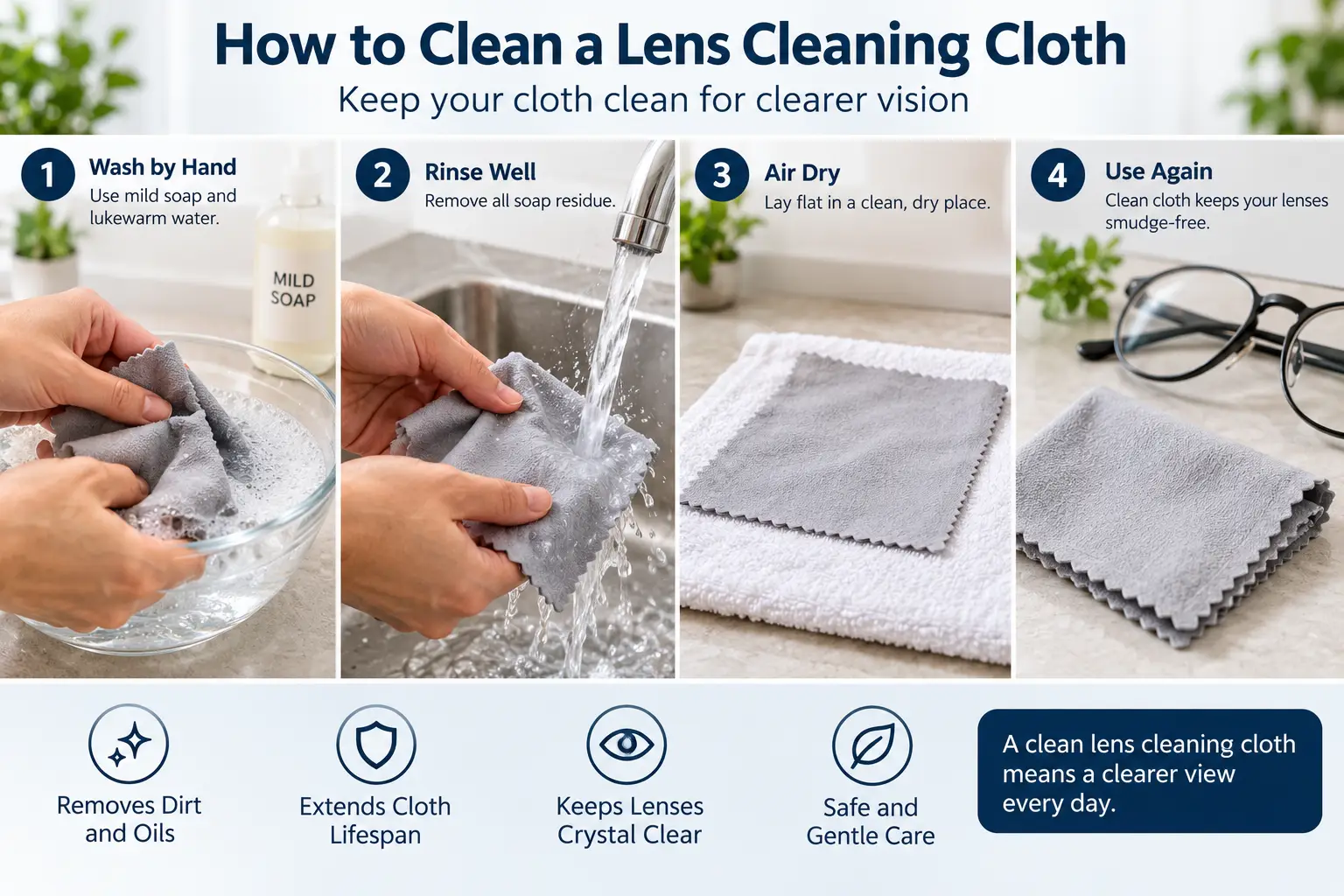
This is the step that most lens-cloth owners skip entirely, and it’s the actual answer to how to clean lens cleaning cloth without ruining it. A dirty cloth doesn’t look dirty — it still looks clean and feels soft — but a clogged cloth smears oil instead of lifting it, which is usually the real reason your glasses “never look clean” no matter how much you wipe them.
- Shake it out first. Before washing, shake the cloth outdoors or over a trash can to release loose dust and grit that would otherwise grind against the fibers during the wash.
- Wash it alone. Never machine wash a lens cloth with cotton towels, clothing, or anything lint-producing — cotton lint clings to microfiber and permanently reduces its cleaning ability, according to Unger USA’s professional cleaning guidance.
- Use warm, never hot, water. Hot water and high dryer heat can fuse the split synthetic fibers together, permanently dulling the cloth’s ability to trap oil.
- Use a small amount of mild, fragrance-free liquid detergent. Powdered detergent and scented additives can leave residue trapped inside the fiber channels; roughly half your normal detergent dose is enough.
- Skip fabric softener completely. Softener coats the fibers in a waxy film that blocks the microscopic channels responsible for lifting oil — this single mistake ruins more lens cloths than anything else.
- Air-dry when possible, or tumble dry on low. If you use a dryer, skip dryer sheets entirely and clean the lint trap first so stray fibers from previous loads don’t transfer onto the cloth.
- Wash on a regular schedule. A cloth used daily for glasses should be washed roughly once a week; a cloth used for messier camera or lab work should be washed more often, per general guidance from Whirlpool’s care instructions for microfiber towels.
What most buyers overlook is that a lens cloth can also be hand-washed in under two minutes: rinse it in cool-to-warm water, work in a drop of the same mild detergent, rinse thoroughly, and let it air-dry. This is often the faster option if you’re only maintaining one or two dedicated lens cloths rather than a full laundry load.
Real-World Scenarios: Matching a Cloth (and Routine) to Your Life
If you’re a commuter who wears glasses eight hours a day, a single individually wrapped cloth like the LOJWRY Eye Glass Clean Cloths kept in your bag, plus one at your desk, covers both quick midday touch-ups and a proper end-of-day clean — wash both weekly using the warm-water, no-softener method above.
If you’re a hobbyist photographer swapping lenses several times per shoot, keep at least two K&F Concept Microfiber Lens Cleaning Cloth X6 cloths in rotation — one for the front element, one dedicated strictly to the camera body and mount — and wash them separately from any household laundry to avoid transferring lint near your sensor.
If you’re an outdoor enthusiast who bikes, hikes, or fishes regularly, the clip-on SPUDZ Classic Microfiber Lens Cleaner solves the biggest field problem: keeping the cloth itself clean between uses when it’s not practical to wash it mid-trail. Rinse it under a water bottle if it picks up sunscreen or sweat, and run it through a proper wash once you’re home.
If you’re maintaining premium multicoated eyewear or optics — progressive lenses, anti-glare coatings, or a hydrophobic camera filter — the denser Koala Lens Cleaning Cloth weave is worth the extra cost, and washing it slightly more gently (hand wash, air dry only) will preserve that density longer than machine washing on a regular cycle.
Common Lens Cloth Problems and How to Fix Them
Problem: Your cloth smears instead of cleaning. This almost always means the fibers are clogged with oil or softener residue. Wash it using the warm-water, no-softener method above; if smearing continues after two washes, the cloth’s fibers may be permanently damaged and it’s time to replace it.
Problem: Your cloth leaves lint on the lens. This usually happens when a lens cloth has been washed with cotton fabric. Once cross-contaminated, lint transfer is difficult to fully reverse — dedicate a fresh cloth going forward and always wash microfiber separately.
Problem: Your cloth smells musty. Add roughly a tablespoon of white vinegar to the rinse cycle to neutralize odor without coating the fibers the way fragranced detergent or softener would.
Problem: Your cloth feels stiff after drying. This is typically a sign of detergent buildup from using too much soap. Rinse the cloth again in plain water and reduce your detergent amount on future washes.
Problem: You can’t remember which cloth is for which surface. Color-code your cloths — a light color for glasses, a darker one for camera gear, for example — the same logic behind the multi-color packs like the Koala Lens Cleaning Cloth.
✨ Ready to build a proper lens-care kit? Take a look at the seven picks above and grab the one that matches how you actually use your gear. 🔍
How to Choose a Lens Cleaning Cloth
- Check the weave density. Denser microfiber (measured loosely by GSM, or grams per square meter) traps more oil per wipe and is gentler on multicoated glass.
- Match pack format to your habits. Individually wrapped cloths like the LOJWRY Eye Glass Clean Cloths suit people who clean lenses in multiple locations; a single premium cloth suits a fixed home or desk setup.
- Consider portability. If you’re active outdoors, a clip-on pouch system like the SPUDZ Classic Microfiber Lens Cleaner keeps the cloth protected between uses far better than a loose cloth in a pocket.
- Think about what you’re actually cleaning. Eyeglass-focused cloths work fine for daily wear, but camera owners should lean toward purpose-built options like the K&F Concept Microfiber Lens Cleaning Cloth X6 to protect multicoated elements.
- Factor in washability. Every cloth on this list is reusable and machine- or hand-washable — confirm this before buying, since some novelty “cleaning cloths” are actually disposable and not designed for repeat washing.
- Don’t ignore brand-specific coating guidance. Brands like ZEISS design their cloths around their own coating chemistry, which can offer extra peace of mind if you already wear that brand’s lenses.
- Buy more than one. Having a dedicated cloth per surface type (glasses, phone, camera) prevents cross-contamination and extends the life of each cloth individually.
Common Mistakes to Avoid When Buying (or Washing) a Lens Cleaning Cloth
The most common buying mistake is treating every microfiber cloth as interchangeable. A cloth marketed for cleaning car dashboards or kitchen counters is not woven or finished the same way as one intended for coated optical glass, and using the wrong one can introduce fine scratches over time. The second most common mistake is buying based on price alone rather than pack format — a single wrapped cloth that stays clean is often more useful in practice than a large loose bundle that gets contaminated after the first few uses.
On the washing side, the single biggest mistake is reaching for fabric softener out of habit, since it’s standard practice in regular laundry but actively harmful to microfiber. The second is mixing lens cloths into a normal laundry load with towels or clothing, which transfers lint that then ends up back on your lenses. Finally, many people never wash their lens cloth at all, assuming that because it “looks clean,” it’s still performing — when in reality, oil buildup is invisible to the eye but very noticeable in how well the cloth actually cleans.
Lens Cleaning Cloth vs. Pre-Moistened Wipes vs. Paper Towels
A reusable lens cloth, a pre-moistened disposable wipe, and a paper towel solve the same basic problem in very different ways. Pre-moistened wipes are convenient for a single quick clean — no washing required — but they’re single-use, generate ongoing waste, and some formulations contain alcohol that isn’t recommended for every lens coating. A reusable cloth like the MagicFiber Microfiber Cleaning Cloth costs more upfront per unit but works out cheaper over months of use and produces no ongoing waste, provided you actually wash it on schedule.
Paper towels and tissues are the option to avoid entirely for coated lenses. Their wood-pulp fibers are coarse compared to split synthetic microfiber and are widely cited by eyewear and optics sources as a leading cause of fine surface scratches on anti-reflective coatings, according to guidance summarized by Glasses.com’s cleaning overview. If you only keep one item in your bag, a proper microfiber cloth beats both alternatives on cost-per-use and coating safety over time — pre-moistened wipes are best reserved as a backup for situations where washing isn’t practical, like travel days.
What to Expect: Everyday Performance
In daily use, a properly maintained lens cloth should remove fingerprint oil and light dust in one or two gentle passes without any circular buffing needed. If you find yourself wiping the same spot repeatedly, that’s a sign the cloth is either already loaded with oil from previous uses or that you’re cleaning a dry lens — always clear loose grit first, ideally with a rinse or a puff of air, since wiping dust directly can grind it into the coating.
Expect a well-cared-for cloth from any of the seven picks above to last well over a year of regular use before the fibers noticeably degrade, provided it’s washed correctly and kept away from fabric softener. Cloths used daily for glasses will typically need replacing sooner than a camera cloth used a few times a week, simply due to wash frequency. A cloth that’s begun to feel slightly stiff, thin in spots, or that consistently leaves streaks even right after washing has reached the end of its useful life and is worth replacing rather than fighting.
Long-Term Cost and Maintenance
Running the numbers, a single $2–$5 premium cloth like the ZEISS Microfiber 8×8 Eyeglass Lens Cleaning Cloth that lasts over a year of weekly washing works out to just a few cents per use — cheaper over time than repeatedly buying disposable lens wipes, which need continuous restocking. A 6-pack in the $10–$15 range, like the K&F Concept Microfiber Lens Cleaning Cloth X6, spreads that cost across multiple dedicated cloths for different surfaces, which is often the better long-term value if you’re maintaining more than one type of gear.
The real long-term cost driver isn’t the cloth’s price — it’s how it’s washed. A cloth ruined by fabric softener or hot-water washing after a few months effectively resets your investment to zero, while a correctly maintained cloth of any price point on this list can realistically last well beyond a year. Budgeting a few minutes a week for proper washing, rather than replacing cloths reactively once they start smearing, is the single highest-ROI habit in this entire guide.
Coatings, Materials, and Safety: What Actually Protects Your Lenses
Most modern eyeglass and camera lenses use anti-reflective (AR), scratch-resistant, or hydrophobic coatings layered directly onto the glass or polycarbonate surface, and these coatings are notably more delicate than the base lens material itself. According to guidance referenced by multiple eyewear sources, coated lenses should never be cleaned with ammonia-, alcohol-, or vinegar-based household glass cleaners, since these can break down the coating chemistry over repeated use — a microfiber cloth paired with plain water or a lens-safe solution is the standard safe combination.
Material-wise, the split-fiber polyester/polyamide blend used in every product on this list is specifically chosen because it’s softer than the glass and coating layers it touches, unlike cotton or wood-pulp paper fibers, which can carry embedded grit. There’s no federal regulatory body that certifies lens cloths the way the CPSC oversees other consumer products, so the practical safety standard comes down to material quality and correct washing — buying from an established brand and following the wash guidance in this article covers both halves of that equation.
Frequently Asked Questions
❓ How do you clean lens cleaning cloth without ruining it?
❓ Can you put a lens cleaning cloth in the washing machine?
❓ How often should you wash a lens cleaning cloth?
❓ Why does my lens cloth smear instead of clean?
❓ What's the best lens cleaning cloth for camera lenses?
Conclusion
Learning how to clean lens cleaning cloth properly is a five-minute habit that quietly extends the life of every pair of glasses, camera lens, and screen you own. The routine is simple: wash it alone, use warm water and a mild detergent, skip fabric softener entirely, and air-dry or tumble dry on low. Get that right, and even a budget pick like the MagicFiber Microfiber Cleaning Cloth will outperform an expensive cloth that’s been ruined by softener or hot water.
On the buying side, this guide covered seven real options across every use case: the individually wrapped LOJWRY Eye Glass Clean Cloths for hygiene on the go, the versatile MagicFiber Microfiber Cleaning Cloth as an everyday default, the brand-trusted ZEISS Microfiber 8×8 Eyeglass Lens Cleaning Cloth, the field-ready SPUDZ Classic Microfiber Lens Cleaner, the camera-focused K&F Concept Microfiber Lens Cleaning Cloth X6, the mess-proof Carson Stuff-It Microfiber Lens Cloth Cleaning System, and the premium-weave Koala Lens Cleaning Cloth. Whichever one you choose, pair it with the washing routine above and it’ll keep doing its job for a long time to come.
Recommended for You
- Carbon Cloth: 7 Best Picks for DIY Projects in 2026
- Glass Towels: 7 Best Picks for a Streak-Free Shine (2026)
- 7 Best Glass Cleaning Fabric Picks for a Streak-Free Shine (2026)
Disclaimer: This post contains affiliate links. As an Amazon Associate, I earn from qualifying purchases made through these links, at no additional cost to you.
✨ Found this article helpful? Share it with someone who needs it! 💬🤗