In This Article
If you’ve ever run your hand over a suede-look sofa cushion, a car seat cover, or a no-iron dress lining and wondered what that buttery-soft surface actually was, there’s a good chance it was microfiber. Shopping for microfiber material by the yard for the first time can feel oddly complicated for something that looks so simple on a store shelf — there’s GSM weight, width, weave, stretch, and a dozen brands all claiming to be “the good stuff.” That confusion is exactly why this guide exists.
We dug into real spec sheets, aggregated customer feedback, and durability testing standards used across the upholstery and sewing industries to help you buy with confidence instead of guessing. Whether you’re reupholstering a dining chair, sewing a lightweight dress lining, building a cosplay costume, or just replacing worn drapery, the right yardage choice comes down to matching the fabric’s weight, weave, and finish to your actual project — not just picking whatever shows up first in a search.
Below, you’ll find a quick-glance comparison table, seven real, purchasable options spanning budget to upholstery-grade, and a full breakdown of how to choose, what mistakes to avoid, and how microfiber material by the yard stacks up against cotton, real suede, and other traditional alternatives. Let’s get into it.
What Is Microfiber Material by the Yard?
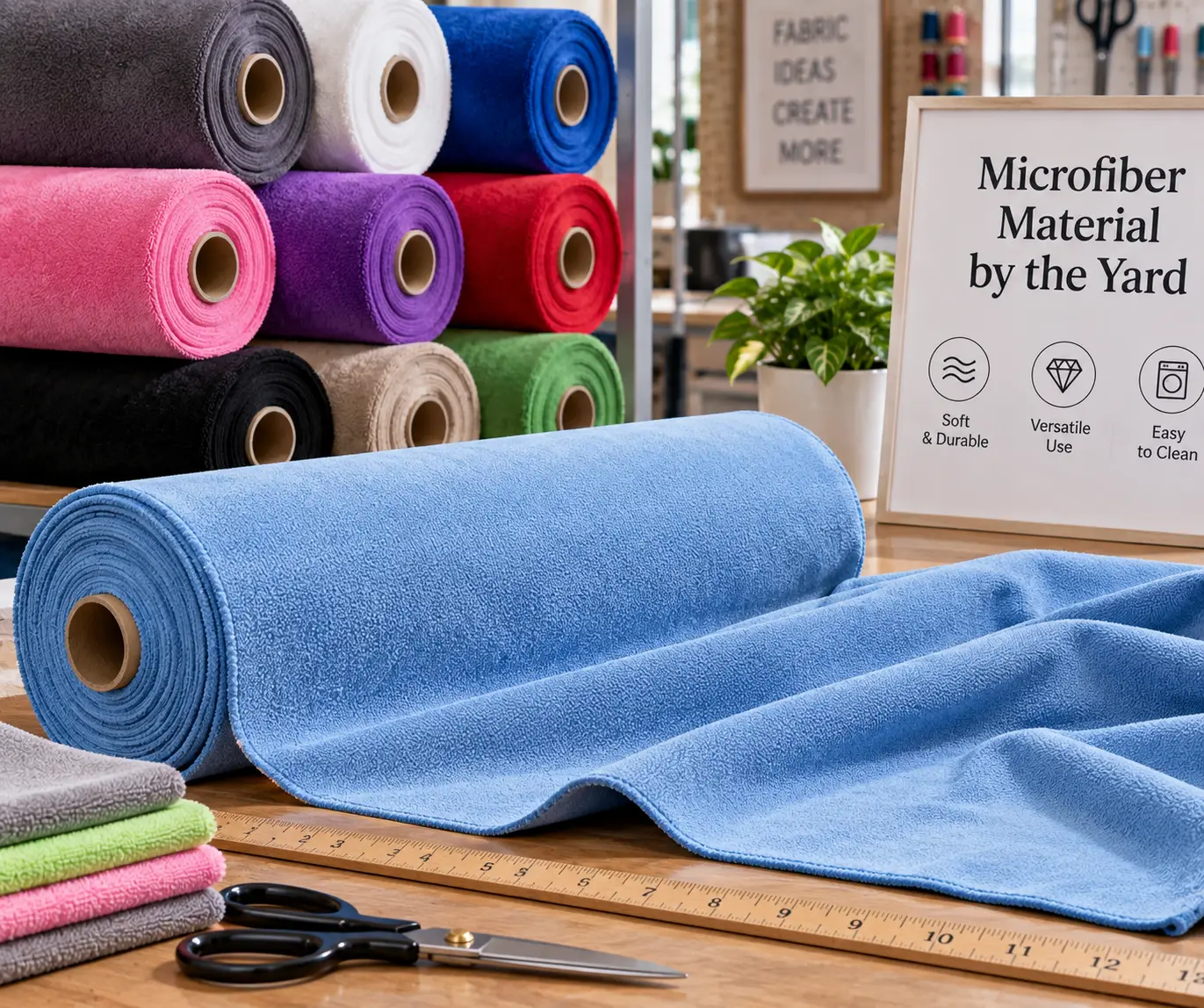
Microfiber material by the yard refers to synthetic polyester (or polyester-blend) fabric, woven from ultra-fine fibers thinner than a strand of silk, sold in continuous yardage rather than pre-cut panels — letting buyers order exactly the length they need for sewing, upholstery, or craft projects. Most rolls range from 54 to 65 inches wide.
The technical definition comes down to fiber diameter: true microfiber is a synthetic fiber finer than one denier, with a diameter under ten micrometers, which is what gives it that dense, almost powdery-soft hand feel compared to standard polyester. That fineness is also why microfiber drapes well, resists fraying, and can be brushed on one side to mimic the texture of real suede — a version often labeled “microsuede” or “faux suede.”
Quick Comparison: Microfiber Material by the Yard at a Glance
Before diving into full reviews, here’s a fast reference for how our seven picks stack up on weight, width, and best use case.
| Product | Weight (GSM) | Width | Best For | Price Range |
|---|---|---|---|---|
| BloomSesame Microfiber Fabric | 200 GSM | 65″ | General DIY & travel towels | Under $25 |
| Sewdudely Microfiber Lining Fabric | Lightweight | 56″ | Garment lining & sewing | Under $20 |
| GoldWheel Micro-Suede Upholstery Fabric | Mid-weight | 64″ | Car interiors & cushions | Under $20 |
| Tusrai 4-Way Stretch Microfiber Suede | 260 GSM | ~58″ | Apparel, costumes, stretch projects | Around $20-$30 |
| C078 Platinum Solid Microsuede | Heavy (upholstery grade) | 54″ | Heavy-duty reupholstery | Around $25-$40 |
| Dotson White Solid Microsuede | Heavy (upholstery grade) | 54″ | Light-colored upholstery projects | Around $25-$40 |
| Mybecca Micro Suede Fashion Fabric | Mid-weight | 58″ | Budget color variety | Under $20 |
A quick read of the table above shows the real divide in this category: craft-and-lining fabrics like the Sewdudely Microfiber Lining Fabric are built for softness and drape, not abrasion resistance, while upholstery-grade options like the C078 Platinum Solid Microsuede and Dotson White Solid Microsuede are engineered specifically to survive years of sitting, scooting, and pet claws. If your project involves a seat cushion rather than a skirt lining, that distinction matters more than color or price.
💬 Found a favorite already? Tap through to check today’s price and yardage options before they’re back-ordered!
Top 7 Microfiber Material by the Yard: Expert Analysis
We chose these seven picks to cover the full range of what “microfiber material by the yard” shoppers actually search for — from featherweight lining fabric to commercial-grade upholstery cloth — using real, currently listed products rather than discontinued or fictional ones.
1. BloomSesame Microfiber Fabric — most versatile all-rounder
The BloomSesame Microfiber Fabric earns its spot as the most versatile pick on this list because it’s genuinely marketed and used across three very different categories: home sewing, light upholstery, and absorbent towels. At 200 GSM and a generous 65-inch width, it sits in the sweet spot between “too thin for structure” and “too heavy for garments.”
In practice, that 200 GSM weight means the fabric holds a crease well enough for pillow covers and drapery, but it’s not so dense that it fights your sewing machine. The 65-inch width is also wider than most competitors, which practically translates into fewer seams on wide projects like curtains or bedding. Reviewers frequently point to this dual identity — some buyers use it purely as a quick-drying travel or beach towel, while others cut it for pillow shams.
Based on comparing the specs against narrower 54-56 inch rolls, the extra width here is the standout advantage: you can get a full pillow panel or a small curtain panel out of a single cut without piecing fabric together. Reviews consistently mention the fabric’s quick-drying, absorbent quality for towel use, alongside praise for how easily it presses and sews for craft projects — though a few buyers note the suede-style nap can shed lint during the first few washes, which is typical of napped microfiber and settles down after laundering.
Pros:
- ✅ Extra-wide 65″ panel reduces seams on big projects
- ✅ Dual-purpose: sewing fabric and absorbent towel material
- ✅ Machine washable and quick-drying for repeat use
Cons:
- ❌ Initial nap shedding reported in early washes
- ❌ 200 GSM is too light for heavy-traffic upholstery
At a price typically landing under $25 for a two-yard cut, the BloomSesame Microfiber Fabric is one of the better value-per-yard picks here, especially for buyers who aren’t sure yet whether they need it for sewing or general household use.
2. Sewdudely Microfiber Lining Fabric — smoothest hand feel for garment lining
If your project is a dress, jacket, or skirt lining rather than a cushion cover, the Sewdudely Microfiber Lining Fabric is built specifically for that job, and it shows. It’s woven from an unusually high-density microfiber yarn count, which is what gives lining fabric that slippery, glide-against-skin feel that keeps garments from clinging or bunching.
What most buyers overlook with lining fabric is that density does double duty: a tighter weave doesn’t just feel smoother, it also resists pilling and fraying at the cut edge — a real headache with cheaper lining that unravels before you’ve even pinned a pattern. Sewdudely’s tightly woven construction directly addresses that, and it’s a meaningfully different engineering goal than the suede-brushed upholstery fabrics elsewhere on this list.
Reviews consistently report that the fabric cuts cleanly and doesn’t need serging or pinking shears to prevent fraying, which beginner sewists in particular call out as a relief. The trade-off, as you’d expect from a lining-weight fabric, is that it has no structural body of its own — it’s meant to sit inside another layer of fabric, not stand alone as upholstery or heavy drapery.
Pros:
- ✅ Ultra-smooth glide, ideal for dress and jacket linings
- ✅ Cuts cleanly with minimal fraying at the edge
- ✅ Beginner-friendly for first sewing projects
Cons:
- ❌ Too lightweight for upholstery or structured bags
- ❌ Limited color range compared to suede-style options
Priced under $20 for a single continuous yard, the Sewdudely Microfiber Lining Fabric is a smart, low-risk buy for anyone learning to sew garments, where fabric behavior under a machine needle matters more than color selection.
3. GoldWheel Micro-Suede Upholstery Fabric — best double-sided finish for car and home
The GoldWheel Micro-Suede Upholstery Fabric stands out for one specific reason: it’s finished on both sides rather than just one. Most microsuede is brushed on a single face and left plain-woven on the back, but a double-sided nap means you don’t have to think about “right side out” when wrapping an oddly shaped cushion, headrest, or armrest.
That detail matters more than it sounds. On a single-sided fabric, wrapping a rounded object like a car headrest or a bolster pillow often exposes a sliver of the unfinished backing at the seam. With a double-sided finish, that seam allowance is forgiving — the fabric looks intentional and finished from every angle, which is exactly why it’s positioned for auto upholstery and cushion work rather than flat drapery. At 64 inches wide, it also gives enough coverage for most bucket-seat panels in a single cut.
Aggregated customer feedback frequently highlights the fabric’s softness relative to its price point, with several reviewers specifically using it for car seat and headliner repairs — a use case where breathability and a soft touch against skin matter in ways flat home decor fabric doesn’t need to consider. On the downside, a handful of reviews mention that very light colors can show soiling faster in high-touch automotive settings, which is a fair trade-off for the double-sided convenience.
Pros:
- ✅ Finished on both sides for seamless wrapped cushions
- ✅ Breathable feel suited to car interiors and headrests
- ✅ Generous 64″ width covers most bucket-seat panels
Cons:
- ❌ Lighter colors show soiling faster in car use
- ❌ Not rated for heavy commercial-grade abrasion
For under $20 per yard in most listings, the GoldWheel Micro-Suede Upholstery Fabric is a strong pick specifically for automotive reupholstery and rounded cushion work where a double-sided nap saves real labor.
4. Tusrai 4-Way Stretch Microfiber Suede — the only stretch-knit option here
Every other fabric on this list is a woven, non-stretch cloth — the Tusrai 4-Way Stretch Microfiber Suede is the exception, and it fills a genuinely different niche. At 260 GSM with a four-way stretch knit construction, it’s built for projects where the fabric needs to move with a body or a curved surface: costumes, fitted apparel, upholstered furniture with rounded contours, and cosplay armor padding.
Here’s what the spec sheet doesn’t say outright but the construction implies: a knit sueding cloth behaves completely differently under a sewing machine than a woven one. It won’t fray the way woven microsuede does, but it can curl at raw edges and needs a ballpoint or stretch needle to avoid skipped stitches. For anyone coming from woven fabric, that’s a real adjustment — but it’s also exactly why costume and dancewear makers specifically search out stretch microfiber suede instead of the woven upholstery-style versions.
Reviews centered on cosplay and performance-wear applications consistently praise the fabric’s recovery — meaning it stretches to fit a curved surface and springs back rather than staying baggy, which is the entire point of a 4-way stretch claim. Buyers making structured items like bags or firm cushions, however, note that the same stretch that makes it great for costumes works against it when rigidity is what you actually need.
Pros:
- ✅ True 4-way stretch for fitted apparel and costumes
- ✅ 260 GSM gives more body than typical stretch knits
- ✅ Double-side sueding for a finished look either way
Cons:
- ❌ Requires a stretch/ballpoint needle for clean stitching
- ❌ Too flexible for structured upholstery or firm bags
Typically priced in the $20 to $30 range depending on yardage, the Tusrai 4-Way Stretch Microfiber Suede is the clear pick whenever your project needs to bend, wrap, or move — not sit flat.
5. C078 Platinum Solid Microsuede — heaviest-duty upholstery-grade option
For anyone reupholstering a couch, dining chair, or ottoman that will see daily use, the C078 Platinum Solid Microsuede is the pick built specifically for that job. This is genuine upholstery-grade fabric rated to exceed 200,000 Wyzenbeek double rubs — the industry’s standard abrasion test, in which a mechanical arm drags fabric back and forth to simulate years of sitting and standing.
To translate that number into something useful: general-use residential fabric is often rated around 15,000 double rubs, while anything above roughly 30,000 is already considered heavy-duty commercial grade. At over 200,000 rubs, this fabric is rated well beyond what a home sofa or dining chair will ever realistically experience, which is exactly the kind of headroom you want in a fabric you’re not planning to replace again in five years. That durability rating is backed by a stain- and fade-resistant finish, which is what actually keeps upholstery looking new — abrasion resistance stops the weave from wearing thin, while the finish stops spills and sunlight from dulling the color.
Reviews on comparable upholstery-grade microsuede consistently describe the fabric as noticeably thicker and more substantial than the craft-store suede-look fabrics sold for sewing projects, which tracks with its stated purpose. The trade-off for that heft is a stiffer hand feel that’s better suited to furniture than to garments or soft draping projects.
Pros:
- ✅ Rated over 200,000 Wyzenbeek double rubs
- ✅ Stain- and fade-resistant finish for daily-use furniture
- ✅ Machine washable, unlike many true suede alternatives
Cons:
- ❌ Stiffer hand feel, not suited for garments
- ❌ Premium durability comes at a higher per-yard price
Running roughly $25 to $40 per yard depending on the retailer, the C078 Platinum Solid Microsuede is worth the premium specifically for furniture that gets used every single day — the cost per year of service is lower than it looks at checkout.
6. Dotson White Solid Microsuede — best for light and bright upholstery projects
The Dotson White Solid Microsuede shares the same upholstery-grade construction and 200,000-plus Wyzenbeek rub rating as our previous pick, but it deserves its own spot on this list because white and light-colored upholstery fabric is a genuinely different buying decision than darker colors — and it’s the one most buyers get wrong.
Here’s the honest analysis: on paper, a stain-resistant finish sounds like it solves the “white fabric gets dirty” problem entirely, and it does meaningfully reduce how deeply spills set into the weave. What it doesn’t do is make the fabric invisible to daily wear patterns — arm rests and seat edges on light fabric will show soiling sooner than the same fabric in a mid-tone color, simply because there’s less color to hide it. That’s not a flaw specific to this product; it’s physics that applies to any pale upholstery fabric, and it’s worth knowing before you commit a full sofa’s worth of yardage to white.
Where this fabric earns its recommendation is in low-traffic, design-forward pieces — an accent chair, a headboard, a bedroom bench — where the bright, clean look matters more than daily abrasion. Aggregated reviews for this line consistently praise how true the white reads in person (no yellow or cream undertone, which is a common complaint with budget white fabrics) and how well the stain-release finish handles minor spills when caught early.
Pros:
- ✅ True, clean white with no yellow undertone
- ✅ Same 200,000+ Wyzenbeek durability as darker colorways
- ✅ Stain-release finish handles minor spills well
Cons:
- ❌ Light color still shows wear faster in high-traffic spots
- ❌ Best reserved for low-traffic or accent furniture
Priced in the same $25 to $40 range as its darker sibling, the Dotson White Solid Microsuede is the right call for accent pieces and design-focused furniture, not the family-room sofa that sees three kids and a dog every day.
7. Mybecca Micro Suede Fashion Fabric — best color selection on a budget
The Mybecca Micro Suede Fashion Fabric rounds out this list as the budget-friendly, color-first option — and with dozens of shades available, from deep charcoal to sky blue to terracotta, it solves a real problem the other picks don’t: most upholstery-grade microsuede comes in a fairly narrow neutral palette.
At 58 inches wide with a soft, medium-weight twill weave, this fabric is positioned as fashion-and-light-decor suede rather than commercial upholstery — and it’s honest about that positioning rather than overselling itself. What most buyers overlook is that “medium weight” microsuede like this is genuinely well suited to bags, apparel accents, pillow covers, and light-use ottomans, but it isn’t rated or marketed for the kind of heavy-duty rub-count durability you’d want on a daily-use sofa cushion, which is exactly where the two upholstery-grade picks above come in instead.
Reviews consistently describe the fabric as noticeably thinner than true upholstery-grade suede, which some buyers flag as a downside if they expected commercial durability, while others — particularly those making bags, apparel, or light throw pillows — say the thinner hand actually makes it easier to sew and drape. That split in feedback is really a matter of matching expectations to the product category rather than a quality defect.
Pros:
- ✅ Widest color selection of any pick on this list
- ✅ Soft, easy-to-sew hand for bags and apparel
- ✅ Consistently competitive price per yard
Cons:
- ❌ Thinner than true upholstery-grade suede fabric
- ❌ Not intended for daily heavy-use furniture
At well under $20 per yard in most colorways, the Mybecca Micro Suede Fashion Fabric delivers the best value for crafters and apparel makers who want variety without paying upholstery-grade prices for a project that doesn’t need it.
Full Comparison: All 7 Microfiber Material by the Yard Picks
| Product | Weave Type | Durability Focus | Best For | Price Range |
|---|---|---|---|---|
| BloomSesame Microfiber Fabric | Suede-brushed woven | Moderate | Sewing, towels, light decor | Under $25 |
| Sewdudely Microfiber Lining Fabric | Tight plain weave | Anti-pill, not abrasion | Garment lining | Under $20 |
| GoldWheel Micro-Suede Upholstery Fabric | Double-sided brushed | Moderate | Car interiors, cushions | Under $20 |
| Tusrai 4-Way Stretch Microfiber Suede | Stretch knit | Moderate + recovery | Costumes, fitted apparel | $20-$30 |
| C078 Platinum Solid Microsuede | Upholstery-grade woven | 200,000+ Wyzenbeek rubs | Daily-use furniture | $25-$40 |
| Dotson White Solid Microsuede | Upholstery-grade woven | 200,000+ Wyzenbeek rubs | Accent/light-use furniture | $25-$40 |
| Mybecca Micro Suede Fashion Fabric | Medium-weight twill | Light-use | Bags, apparel, budget decor | Under $20 |
Laid out side by side, the pattern is clear: the C078 Platinum Solid Microsuede and Dotson White Solid Microsuede are the only two picks built for genuine daily-use upholstery abrasion, while the Sewdudely Microfiber Lining Fabric sits at the opposite end, optimized purely for softness and drape rather than rub resistance. Everything else on this list — the BloomSesame Microfiber Fabric, GoldWheel Micro-Suede Upholstery Fabric, Tusrai 4-Way Stretch Microfiber Suede, and Mybecca Micro Suede Fashion Fabric — occupies a flexible middle ground suited to crafts, light furniture, and apparel rather than heavy daily wear.
Microfiber vs. Cotton and Real Suede: Advantages Comparison
A detailed side-by-side helps explain why microfiber fabric by the yard has become the default choice for so many upholstery and craft projects that used to reach for cotton twill or genuine suede leather.
| Factor | Microfiber/Microsuede | Cotton Twill | Genuine Suede Leather |
|---|---|---|---|
| Stain resistance | High (many finishes repel liquid) | Low to moderate | Low, absorbs stains |
| Machine washable | Usually yes | Usually yes | No, dry clean/spot only |
| Price per yard | Low to moderate | Low | Very high |
| Best for | Upholstery, sewing, crafts | Casual apparel, quilting | High-end fashion, luxury decor |
The biggest practical advantage microfiber holds over real suede is care: genuine suede leather typically can’t touch water without staining, while most of the fabrics reviewed here — including the C078 Platinum Solid Microsuede — are machine washable and built to shrug off everyday spills. Against cotton twill, microfiber’s edge is less about price and more about texture and stain resistance, since cotton absorbs liquid rather than repelling it. The trade-off in both comparisons is breathability: natural fibers generally breathe better over long, hot use than synthetic microfiber, which is worth factoring in for apparel worn against skin for extended periods.
How to Get Started: A Practical Guide to Cutting, Sewing, and Prepping Your Yardage
Buying the right fabric is only half the job — how you handle it in the first hour after it arrives determines how the finished project looks. Here’s what the listing photos won’t tell you.
First, resist the urge to cut immediately. Unroll the fabric flat for a few hours (or overnight for larger cuts) to let it relax out of the shipping fold lines, especially with heavier upholstery-grade picks like the C078 Platinum Solid Microsuede, which can hold a crease if cut while still rolled tight. Second, always test your cutting tool on a scrap corner first — woven microsuede cuts cleanly with sharp fabric shears or a rotary cutter, but stretch-knit fabric like the Tusrai 4-Way Stretch Microfiber Suede is easier to control with a rotary cutter on a self-healing mat, since scissors can drag and distort a knit edge.
For sewing, match your needle to the weave: a universal needle handles woven microsuede fine, but stretch knits genuinely need a ballpoint or ballpoint-stretch needle to avoid skipped stitches and small holes along the seam. A longer stitch length (roughly 3.0-3.5mm) also reduces perforation tearing along the seam line on napped fabrics — a common first-project mistake that shows up as a slightly frayed-looking seam a few washes later.
Finally, before committing full yardage to a big project, always wash a swatch the way you plan to care for the finished item. Most microfiber handles a cold, gentle machine cycle and air- or low-tumble drying well, but heat is the enemy of the synthetic fibers involved — high dryer heat can flatten the nap on suede-style fabric permanently, dulling that soft, plush texture that made you choose it in the first place.
✨ Ready to start your project? 🧵 Grab your yardage today and check current pricing before you commit to a cut!
Real-World Scenarios: Matching Fabric to Your Project
Different buyers land on this page for very different reasons, so here’s how three common situations map onto the picks above.
The first-time reupholsterer on a weekend budget. If you’re tackling your first dining chair or ottoman with a $50-$75 total budget and want something forgiving to work with, the BloomSesame Microfiber Fabric or Mybecca Micro Suede Fashion Fabric are the safer starting points — both are easier to handle for a beginner and cost far less per mistake than committing to upholstery-grade yardage on your first attempt.
The family with pets and a well-used living room sofa. For furniture that gets sat on daily and occasionally scratched at by a dog or cat, durability has to come first. The C078 Platinum Solid Microsuede, with its 200,000-plus Wyzenbeek rating and stain-resistant finish, is built specifically for this level of daily wear, and its higher per-yard price is genuinely offset by not needing to reupholster again in two years.
The costume maker or performer needing fitted stretch. Anyone sewing dance costumes, cosplay armor padding, or fitted apparel needs fabric that moves with the body, which rules out every woven option on this list. The Tusrai 4-Way Stretch Microfiber Suede is the only pick engineered for that stretch-and-recover behavior, making it worth its slightly higher price for this specific use case.
How to Choose Microfiber Material by the Yard: 7 Buying Criteria
Use this checklist before adding yardage to your cart, in the order that matters most:
- Identify your project category first. Upholstery, apparel, lining, and crafts each demand different weights and weaves — this single decision eliminates most of the wrong options before you even compare colors.
- Check the GSM weight. Roughly 150-200 GSM suits lining and lightweight crafts; 250+ GSM or an explicit “upholstery-grade” label suits furniture and heavy-use items.
- Look for a Wyzenbeek rub count on furniture fabric. Anything under about 15,000 rubs is decorative-only; residential daily-use furniture should look for 15,000-30,000 at minimum, and heavier households should look higher still.
- Confirm the width before calculating yardage. A 65-inch roll versus a 54-inch roll can change how many yards you actually need for the same project — always check width, not just price per yard.
- Decide if you need stretch. Fitted apparel, costumes, and curved padding need a knit stretch fabric; structured items like bags and upholstery need a stable woven fabric instead.
- Read the care label before you buy, not after. Most microfiber is machine washable, but always verify — some finished or backed fabrics require spot cleaning only.
- Order a swatch for color-critical projects. Screen colors shift between monitors, and this single step prevents the single most common return reason in fabric shopping.
Common Mistakes to Avoid When Buying Microfiber Fabric by the Yard
Even experienced sewists and DIYers trip over a few recurring pitfalls in this category. What most buyers overlook is that fabric weight and rub-count ratings aren’t marketing fluff — they’re the actual engineering specs that determine whether your project survives daily use.
The single most common mistake is buying craft-weight suede fabric, like the lighter end of this list, for a heavy-use furniture project, then being surprised when it wears thin within a year. The fix is simple: match GSM and Wyzenbeek rating to how often the finished item will be touched, sat on, or washed, not just to color and price. A close second mistake is under-ordering yardage by assuming all fabric rolls are the same width — a project planned around a 65-inch roll like the BloomSesame Microfiber Fabric will come up short if you actually receive a narrower 54-inch bolt instead, so always confirm width against your pattern requirements before purchasing. Finally, many first-time buyers skip pre-washing a test swatch, then discover after cutting an entire project that their chosen fabric shrinks slightly or the nap flattens under dryer heat — a five-minute test that saves hours of rework.
What to Expect: Everyday Performance and Feel
Specs only tell part of the story, so here’s what these fabrics are actually like to live with day to day. Lighter picks like the Sewdudely Microfiber Lining Fabric feel almost slippery against skin, which is exactly the point for garment lining, but that same slipperiness makes it a poor choice anywhere you need grip or structure, like bag exteriors. Mid-weight suede-style fabrics such as the BloomSesame Microfiber Fabric, GoldWheel Micro-Suede Upholstery Fabric, and Mybecca Micro Suede Fashion Fabric have a plush, slightly grippy hand that holds its shape reasonably well but will show compression lines if folded tightly for long storage periods — a quick steam or low-heat iron on the wrong side usually restores the nap.
Upholstery-grade fabric like the C078 Platinum Solid Microsuede and Dotson White Solid Microsuede feels noticeably stiffer and heavier off the bolt, which can be mistaken for lower quality by first-time buyers used to softer craft fabric — in reality, that firmness is exactly what gives it structure over a cushion and resistance to sagging or stretching out of shape over months of use. The Tusrai 4-Way Stretch Microfiber Suede, meanwhile, behaves closer to athletic knit fabric than any other pick here, with genuine give in every direction rather than the fixed shape of a woven cloth.
Microfiber Fabric by the Yard for Different Buyers
For beginners and hobby sewists, softer, forgiving fabrics like the BloomSesame Microfiber Fabric and Mybecca Micro Suede Fashion Fabric are the easiest to learn on, since minor stitching mistakes are simple to unpick without leaving visible needle holes. For upholsterers and furniture flippers, the C078 Platinum Solid Microsuede and Dotson White Solid Microsuede deliver the durability rating and stain finish that professional-quality reupholstery work actually requires. For costume, cosplay, and performance-wear makers, the Tusrai 4-Way Stretch Microfiber Suede is essentially a category of one on this list, since it’s the only stretch-knit option. For dressmakers and garment sewists, the Sewdudely Microfiber Lining Fabric solves the specific problem of finding lining that won’t add bulk or cling.
Long-Term Cost and Maintenance
Price per yard tells only part of the ownership story — total cost of ownership matters more over a multi-year project like reupholstered furniture. A budget fabric at $12 per yard that needs replacing in eighteen months costs more over three years than a $35-per-yard upholstery-grade fabric like the C078 Platinum Solid Microsuede that lasts five-plus years of daily use, once you factor in the labor of reupholstering twice instead of once.
Maintenance costs stay low across this entire category compared to real leather or suede, which typically require professional cleaning. Most of the fabrics reviewed here handle a cold machine wash and air-dry cycle, and stain-resistant finishes on the upholstery-grade picks mean most spills lift with a damp cloth rather than requiring specialty cleaners. The University of Georgia Extension’s textile care guidance is a genuinely useful free reference for matching wash temperatures and drying methods to different synthetic fiber blends if you’re working with multiple fabric types on the same project.
Safety, Labeling, and Regulations You Should Know
A few regulatory basics are worth knowing before you buy or resell furniture made with microfiber material by the yard. Under U.S. federal rules, the FTC’s Care Labeling Rule requires fabric sold for home sewing, along with finished garments, to carry accurate care instructions — which is part of why reputable fabric retailers list wash, dry, and iron guidance directly on the product listing rather than leaving buyers to guess.
If your project involves upholstering seating furniture for resale, it’s also worth knowing that finished upholstered furniture sold in the U.S. is subject to federal smolder-resistance flammability standards. The Consumer Product Safety Commission’s guidance on upholstered furniture explains labeling and compliance requirements in detail — reupholsterers selling finished pieces commercially should review it, while hobbyists reupholstering their own furniture for personal use face a much lighter compliance burden.
Problem → Solution: Fixing Common Microfiber Fabric Headaches
Problem: The nap looks flattened or matted after washing. Solution — run a low-heat iron over the wrong side of the fabric with a pressing cloth, or steam it lightly; this restores most of the plush texture on suede-style microfiber without damaging the fibers.
Problem: Seams look slightly frayed on a stretch-knit project. Solution — this almost always traces back to using a standard sewing needle instead of a ballpoint on knit fabric like the Tusrai 4-Way Stretch Microfiber Suede; switching needles and lengthening the stitch slightly usually resolves it on the next seam.
Problem: A stain set in before it could be treated. Solution — on stain-resistant upholstery-grade fabric like the C078 Platinum Solid Microsuede, a mix of mild dish soap and lukewarm water applied with a soft brush, working from the outside of the stain inward, lifts most set-in spills without leaving a water ring.
Problem: You ordered the wrong width and came up short on yardage. Solution — always recalculate yardage against the actual roll width listed (54″ versus 65″ makes a real difference), and when in doubt, order an extra half-yard rather than risk a dye-lot mismatch on a second order.
Frequently Asked Questions
❓ Is microfiber material by the yard good for upholstery?
❓ How much microfiber fabric by the yard do I need for a chair?
❓ Can microfiber material by the yard be machine washed?
❓ What's the difference between microfiber and microsuede fabric by the yard?
❓ Is microfiber fabric by the yard pet-friendly?
Conclusion
Choosing the right microfiber material by the yard really comes down to matching the fabric’s weight and weave to what you’re actually building, not just picking the softest or cheapest roll on the page. For daily-use furniture, the durability rating on the C078 Platinum Solid Microsuede and Dotson White Solid Microsuede genuinely earns its higher price. For sewing and lining projects, the Sewdudely Microfiber Lining Fabric solves problems that upholstery fabric never will, and for fitted, stretch-dependent work, the Tusrai 4-Way Stretch Microfiber Suede is the only real option on this list.
Whichever project you’re tackling, the research holds up across every pick here: microfiber earns its popularity honestly, through genuine stain resistance, easy care, and a soft hand that natural fabrics and real suede often can’t match at the same price point. Take the buying criteria above, match it to your specific project, and order a swatch first if color accuracy matters — it’s a small step that prevents the most common regret in fabric shopping.
✨ Don’t miss these exclusive deals! 🔍 Take your next sewing or upholstery project to the next level with this carefully curated lineup. Click a highlighted item above to check current pricing and availability, and get the durable, great-looking results your home or wardrobe deserves!
Recommended for You
- Is Microfiber Lint Free? 7 Best Lint-Free Cloths (2026)
- Commercial Microfiber Mop: 7 Top Picks for Busy Facilities (2026)
- Washing Microfiber Rags: 7 Powerful Tips to Keep Them Clean and Reusable
Disclaimer: This post contains affiliate links. As an Amazon Associate, I earn from qualifying purchases made through these links, at no additional cost to you.
✨ Found this article helpful? Share it with someone who needs it! 💬🤗