In This Article
Washing microfiber towels for car wash use is not the same job as tossing bath towels into a machine and walking away. Microfiber is a split-fiber synthetic (usually a polyester-polyamide blend) engineered to trap dirt, oil, and wax in thousands of tiny grooves per fiber — which is exactly why the wrong detergent, water temperature, or dryer setting can permanently clog those grooves and turn a $12 towel into an expensive shop rag. If you have ever pulled a once-plush detailing towel out of the dryer feeling stiff, greasy, or strangely slick, you already know the stakes.
This guide breaks down the real science and the real shopping decision behind washing microfiber towels for car wash routines: how to choose a detergent that actually restores absorbency instead of just adding fragrance, which mistakes quietly kill towels months early, and where seven genuinely well-reviewed, currently available products land on price and performance. Federal guidance on textile care labeling — see the FTC’s Care Labeling Rule guidance — even requires manufacturers to have real evidence behind any wash instruction, which is a useful baseline for thinking about why “just use whatever detergent is under the sink” is bad advice for microfiber specifically.
Whether you’re a weekend detailer with a stack of waffle-weave drying towels or a mobile detailer running a dozen wash cycles a week, the goal here is the same: get every towel back to lint-free, streak-free, fully absorbent condition without shortening its working life.
Quick Comparison: Best Detergents at a Glance
The table below is a fast reference for anyone who wants a category winner without reading all seven full write-ups.
| Category | Product | Price Range | Best For |
|---|---|---|---|
| Best Overall | Chemical Guys Microfiber Wash & Towel Detergent | around $25–$30 (1 gallon) | All-around wax/polish removal |
| Best Value | Malco Microfiber Refresh Concentrated Detergent | around $20–$25 (1 gallon) | High-volume, budget-minded washing |
| Best for Reviving Dead Towels | P&S Rags to Riches Premium Microfiber Detergent | around $18–$22 (quart) | Restoring hydrophobic, “dead” towels |
| Best for HE Washing Machines | Wolfgang Concours Series Microfiber Cleaner & Rejuvenator | around $15–$18 (16 oz) | Low-sudsing, HE-safe formula |
| Best Budget Pick | Maplefield Concentrated Microfiber Detergent | under $20 (32 oz) | First-time buyers, small towel collections |
Looking at this snapshot, notice that price doesn’t map neatly to performance — the Maplefield Concentrated Microfiber Detergent costs less than half of some gallon jugs but still targets the same wax-and-polish removal job. The real differentiators, as the full breakdown below shows, are HE-machine compatibility, scent strength, and how aggressively each formula tackles baked-in silicone dressings versus everyday dust and pollen.
💬 Bookmark this table before laundry day — it’ll save you a second trip to the store for the wrong bottle! 😊
Top 7 Detergents for Washing Microfiber Towels for Car Wash
Every pick below is a real, currently sold product. Coverage spans entry-level and budget options, mid-range daily drivers, and premium/professional-grade formulas, so there’s a fit whether you own three towels or three hundred.
1. Chemical Guys Microfiber Wash & Towel Detergent — best overall for wax and polish removal
Chemical Guys Microfiber Wash & Towel Detergent is the detergent most detailers reach for first, and the reason is simple: it’s built specifically to strip wax, sealant, and polish residue without the additives that gum up microfiber’s split-fiber structure. The concentrated orange-scented formula is sold in 16 oz, 32 oz, and 1-gallon sizes, so it scales from a small home collection to a full detail bay. In practice, “concentrated” matters more than it sounds — a capful per load means a single gallon realistically covers dozens of wash cycles, which changes the cost-per-wash math significantly compared to diluted alternatives.
Based on comparing the formula against plain laundry detergent, the difference shows up mainly on towels that have seen heavy wax or ceramic-coating contact; Chemical Guys Microfiber Wash & Towel Detergent is built to emulsify those oils rather than just rinse around them. It’s the strongest fit for buyers who want one bottle that handles both light dusting towels and heavier polishing pads without switching products.
Reviews consistently report that the formula restores absorbency to towels that had gone stiff from old wax buildup, with several detailers calling it the best wax-stripper they’ve tried on buffing towels specifically. A smaller number of reviewers note it underperforms plain detergent on deeply set stains, and a few waffle-weave owners reported some loss of water-wicking ability after repeated washes — a reminder that even a purpose-built detergent isn’t a substitute for washing towels before they’re fully saturated.
Pros:
- ✅ Concentrated formula stretches across dozens of wash loads
- ✅ Purpose-built to emulsify wax, sealant, and polish oils
- ✅ Available in three sizes for any collection size
Cons:
- ❌ Some reviewers found it weaker than expected on set-in stains
- ❌ A few waffle-weave towels lost some absorbency over time
At around $25 to $30 for the 1-gallon size (check current price, as pricing fluctuates), Chemical Guys Microfiber Wash & Towel Detergent delivers solid value for anyone washing towels weekly.
2. Malco Microfiber Refresh Concentrated Detergent — best value for high-volume washing
Malco Microfiber Refresh Concentrated Detergent is the gallon jug that professional detail shops buy in bulk, and the reason is straightforward economics: it’s formulated specifically to clean, restore, and preserve microfiber softness at a price point built for frequent, large-batch laundering. Malco is a long-established automotive chemical manufacturer, and this detergent reflects that industrial pedigree — it’s not a boutique product dressed up for retail shelves.
The formula is designed to lift wax, dressing, and polish residue in a single wash cycle rather than requiring a pre-soak, which matters in practice for shops running multiple loads per day. What most buyers overlook with this kind of workhorse product is that its low-frills approach (minimal fragrance, straightforward ingredient list) is actually an advantage for HE machines, since heavily perfumed formulas can leave more residue behind in low-water-volume cycles.
Aggregated customer sentiment for Malco Microfiber Refresh Concentrated Detergent skews positive, with detailers frequently citing it as their go-to bulk detergent and noting it holds up well across hundreds of towels per gallon. A smaller number of users describe the scent as more industrial than “spa-like,” which tracks with its shop-first positioning rather than a home-garage marketing angle.
Pros:
- ✅ Bulk gallon size built for high wash-cycle volume
- ✅ Formulated by a long-standing automotive chemical manufacturer
- ✅ Low-fragrance formula rinses cleanly in HE machines
Cons:
- ❌ Scent profile reads as more industrial than premium
- ❌ Less effective on towels coated in heavy silicone dressing
At around $20 to $25 per gallon (prices may vary by retailer), this is one of the strongest cost-per-wash values on this list for anyone washing microfiber towels for car wash use on a weekly basis.
3. P&S Rags to Riches Premium Microfiber Detergent — best for reviving dead, hydrophobic towels
P&S Rags to Riches Premium Microfiber Detergent has a reputation in professional detailing circles for doing something most detergents can’t: bringing back towels that have gone fully hydrophobic — the ones that bead water instead of absorbing it because wax and polish have permanently coated the fibers. P&S Professional Detail Products markets this as a “next generation cleaning technology” formula, and it’s sold in quart and gallon sizes with a double-black professional line variant.
In practice, what separates a restorative formula like this from a standard cleaner is emulsifying power against cured wax and ceramic-coating overspray, not just fresh grime. Based on comparing it to entry-level microfiber detergents, P&S Rags to Riches Premium Microfiber Detergent is the pick for anyone with a drawer of “retired” towels they assumed were unsalvageable, and it also doubles safely as a polishing-pad cleaner.
Aggregated reviews are strongly positive — one detailing retailer’s review data shows a 96% repurchase rate — with detailers specifically praising its ability to revive towels “messed up” by coating and polish buildup. The recurring complaint is cost relative to volume, since the concentrated formula is priced above mass-market options, and a handful of reviewers noted shipping-related packaging issues like leaking caps.
Pros:
- ✅ Specifically formulated to revive hydrophobic, wax-clogged towels
- ✅ Strong aggregated repurchase rate among professional detailers
- ✅ Doubles safely as a polishing pad cleaner
Cons:
- ❌ Priced higher per ounce than mass-market alternatives
- ❌ A few reviewers reported leaking caps on arrival
Expect to pay in the $18 to $22 range for a quart, with the gallon size running higher (check the current price before ordering) — a fair trade for buyers trying to save towels instead of replacing them.
4. Griot’s Garage Microfiber and Foam Pad Cleaner — best for washing towels and pads together
Griot’s Garage Microfiber and Foam Pad Cleaner comes from one of the most established names in US car care, and the 35 oz bottle is designed to do double duty: it removes polish, wax, and sealant residue from both microfiber towels and foam polishing pads in the same wash. That dual-purpose design matters for anyone running a dual-action polisher regularly, since pad-cleaning products and towel-cleaning products are often sold — and priced — separately elsewhere.
The formula is built around restoring what Griot’s calls a cloth’s “effectiveness,” which in practical terms means re-opening the split fibers that trap and hold polish rather than just adding a rinse-friendly surfactant. Based on the brand’s decades-long focus on detailing chemistry, this is a dependable choice for buyers who already trust Griot’s Garage products elsewhere in their kit and want one bottle that handles microfiber, foam, and wool pad cleanup.
Detailing-forum discussion around Griot’s Garage Microfiber and Foam Pad Cleaner is generally favorable, with users noting it handles routine wax and polish buildup reliably, though a few forum posts mention that heavily baked-in compound residue benefits from a short soak rather than a straight wash-cycle dose.
Pros:
- ✅ Cleans microfiber towels and foam pads in one product
- ✅ Backed by a long-established, trusted detailing brand
- ✅ Widely available through auto parts and detailing retailers
Cons:
- ❌ Smaller bottle size means more frequent reordering
- ❌ Heavily baked-in compound may need a short pre-soak
At around $20 to $25 for the 35 oz bottle (prices may vary), it’s a smart pick for buyers who want fewer bottles cluttering the laundry shelf.
5. Adam’s Polishes Microfiber Revitalizer & Brightener — best for brightening graying towels
Adam’s Polishes Microfiber Revitalizer & Brightener targets a specific and common problem: towels that are still functionally clean but have visibly grayed or yellowed over months of use. Sold in a 1-gallon size (with a 32 oz “HD” version also available), the formula is marketed explicitly to keep towels “bright and soft” while remaining gentle enough for repeated washing.
What this means in practice is that Adam’s Polishes Microfiber Revitalizer & Brightener is less about aggressive wax-stripping and more about the cosmetic and tactile life of a towel — the softness and appearance that make a towel pleasant to use versus merely functional. For buyers who care about their gear looking as sharp as their finished paint job (a real consideration for mobile detailers who work in front of clients), that distinction matters.
Owner discussion on detailing forums tends to describe the brightening effect as noticeable after just one or two washes on graying towels, with users appreciating that it doesn’t leave the stiff, scratchy texture some harsher degreasers can cause. As with any brightening-focused formula, it’s honest to note that it’s not positioned as the strongest option here for towels caked in heavy grease or tar.
Pros:
- ✅ Visibly brightens graying or yellowing microfiber towels
- ✅ Gentle formula preserves soft, plush texture
- ✅ Gallon size suits frequent, high-volume detailers
Cons:
- ❌ Higher price point relative to bottle size
- ❌ Not the top pick for heavy grease or tar buildup
Pricing typically falls in the $30 to $35 range for the gallon size (check current pricing), positioning it as a premium-tier choice within this lineup.
6. Wolfgang Concours Series Microfiber Cleaner & Rejuvenator — best for HE washing machines
Wolfgang Concours Series Microfiber Cleaner & Rejuvenator is built around a detail that a lot of buyers only discover the hard way: standard detergents can over-suds in high-efficiency machines, leaving residue that reduces absorbency over time. This 16 oz concentrate is explicitly formulated as a clean-rinsing detergent for HE washers, which the ENERGY STAR clothes washer program notes now make up the large majority of new machines sold in the US.
In practical terms, a low-sudsing, clean-rinsing formula like this one matters because HE machines use far less water per cycle than older top-loaders — meaning any detergent residue has fewer opportunities to fully rinse away. Wolfgang Concours Series Microfiber Cleaner & Rejuvenator is the boutique pick here, aimed at buyers who already own an HE machine and want a formula engineered around that constraint rather than a general-purpose detergent that happens to work.
Owner feedback on detailing forums and boutique car-care retailers frequently highlights the “Concours Series” line’s reputation for premium, show-car-oriented chemistry, with users reporting towels that rinse cleaner and dry softer versus mass-market detergents. The main tradeoff reviewers mention is the smaller 16 oz size, which runs out faster than gallon-format competitors for high-volume users.
Pros:
- ✅ Engineered specifically for low-sudsing HE machine cycles
- ✅ Boutique “Concours Series” reputation for premium chemistry
- ✅ Rinses cleanly without leaving residue behind
Cons:
- ❌ Smaller 16 oz size depletes faster for frequent washing
- ❌ Primarily available online rather than in local stores
Expect to pay around $15 to $18 for the 16 oz size (prices may vary at the time of purchase) — reasonable for a formula this targeted.
7. Maplefield Concentrated Microfiber Detergent — best budget pick for first-time buyers
Maplefield Concentrated Microfiber Detergent rounds out this list as the lesser-known, budget-friendly alternative for anyone testing the waters before committing to a full-size gallon jug from a bigger brand. The 32 oz bottle uses a concentrated lemon-scented formula aimed at the same core job as its pricier competitors: lifting grime and residue from microfiber cloths without leaving the fibers stiff.
Because Maplefield Concentrated Microfiber Detergent is a newer entrant compared to legacy detailing brands, it’s worth being upfront about what’s verifiable: it’s a real, currently sold product with a smaller independent review base than category leaders like Chemical Guys or Malco, so its long-term performance on heavily soiled or wax-caked towels is less independently documented. What is consistent across the reviews available is that buyers describe the scent as pleasant and the price as genuinely budget-friendly relative to concentrate volume.
For someone with a small collection of drying and buffing towels — say, under a dozen — who isn’t ready to invest in a full gallon of a premium formula, this is a sensible low-commitment starting point. It’s reasonable to treat it as an entry-level option to try before scaling up to a more established, heavily reviewed formula for a larger towel collection.
Pros:
- ✅ Lowest price point among concentrated options on this list
- ✅ Pleasant lemon scent noted across available reviews
- ✅ Usable on general microfiber cloths, not just car towels
Cons:
- ❌ Smaller independent review base than legacy detailing brands
- ❌ Heavy-duty restorative performance is less independently verified
At under $20 for 32 oz (check the current price, as budget-tier pricing shifts often), it’s a low-risk way to start washing microfiber towels for car wash use the right way without a big upfront investment.
✨ Ready to Give Your Towels the Wash They Actually Deserve?
🔍 Take your detailing kit to the next level with a detergent that matches how you actually use your towels. Click a highlighted pick above to check current pricing and availability, and get your whole stack of drying, buffing, and glass towels back to like-new softness and absorbency.
How to Wash Microfiber Towels for Car Wash Step by Step
Getting this right is less about any single product and more about a consistent routine. Here’s the process that keeps microfiber towels performing like new for years instead of months.
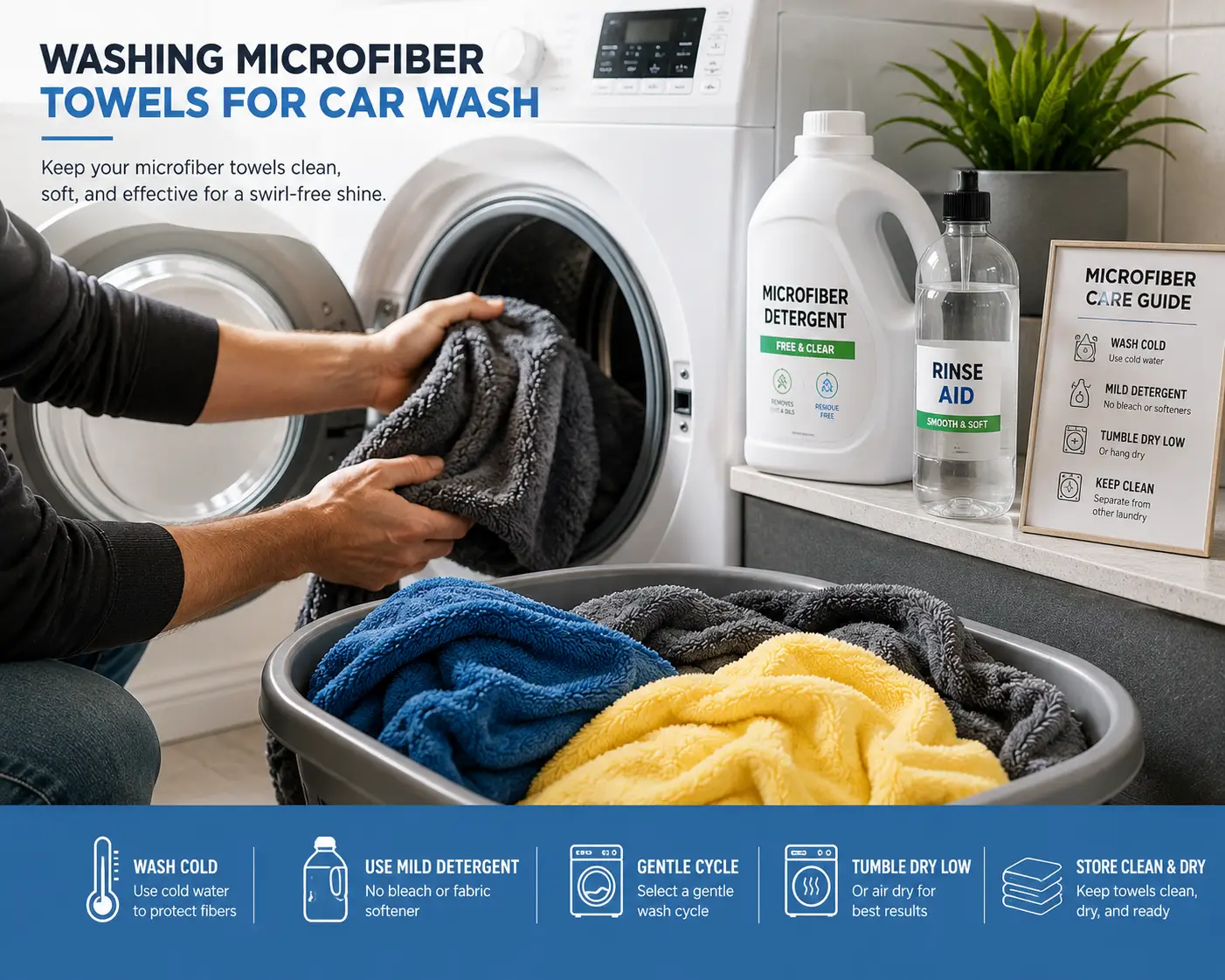
- Sort before you wash. Separate microfiber towels from cotton towels, and separate by task — glass towels away from wheel towels, wax-removal towels away from interior towels. Lint and cross-contamination from cotton fibers or heavy grit is one of the fastest ways to introduce swirl-causing debris into a “clean” towel.
- Shake out loose debris. A quick shake or a pass with a soft brush removes grit before it gets ground deeper into the weave during agitation.
- Use cold or warm water only. Hot water can soften and distort the synthetic fibers; most microfiber-specific guidance recommends staying well below 105°F.
- Add a microfiber-specific detergent — one of the seven above, dosed per the label rather than eyeballed. Skip fabric softener entirely; it coats fibers with a film that kills absorbency.
- Run a normal or delicate cycle, avoiding extra-high spin speeds that can fray edgeless towel borders over repeated washes.
- Skip the dryer sheets. Like fabric softener, dryer sheets leave a residue that reduces the very trapping and wicking action that makes microfiber useful in the first place.
- Dry on low heat or air-fluff, or hang-dry indoors. If you do use a dryer, a lower heat setting protects the fiber structure the same way cold-water washing does.
If your home uses a high-efficiency washer, which now describes most machines sold in the US, pairing this step-by-step routine with a low-sudsing, HE-labeled detergent avoids the residue buildup that gradually dulls absorbency cycle after cycle.
Real-World Scenarios: Which Wash Routine Fits Your Garage?
The weekend hobbyist. If you wash your own car every other Saturday and own six to ten towels, a budget-friendly option like Maplefield Concentrated Microfiber Detergent paired with a monthly wash cycle is plenty — you’re not putting enough wear on towels to need industrial-strength restoration.
The enthusiast with a coating and polish habit. If you’re regularly applying ceramic coatings, sealants, or compound, your towels are absorbing oils that plain detergent won’t fully release. P&S Rags to Riches Premium Microfiber Detergent or Chemical Guys Microfiber Wash & Towel Detergent earns its higher price here, since reviving hydrophobic towels costs less than replacing a $15–$20 towel every few months.
The mobile or side-hustle detailer. Running multiple cars a week means dozens of towels cycling through the laundry constantly. A bulk gallon like Malco Microfiber Refresh Concentrated Detergent keeps cost-per-wash low, and if your setup includes an HE machine at a shop or storage unit, alternating in Wolfgang Concours Series Microfiber Cleaner & Rejuvenator on show-car jobs protects your best towels for client-facing work.
Common Microfiber Towel Problems (and How to Fix Them)
Problem: towels feel stiff after washing. This is almost always fabric softener or dryer-sheet residue. Switch to a microfiber-specific detergent and skip both additives entirely going forward.
Problem: towels have lost their absorbency. Wax, polish, or silicone dressing has coated the fibers. A restorative formula like P&S Rags to Riches Premium Microfiber Detergent is designed specifically to reverse this.
Problem: towels smell musty even after washing. Damp towels left balled up in a hamper breed odor-causing bacteria. Air-dry or tumble-dry fully before storage, and wash promptly after use rather than letting a bag of used towels sit.
Problem: new scratches or swirl-like marks appear on paint. This usually traces back to cross-contamination — a towel used on wheels or a dirty exterior later used on paint. Color-code towels by task and keep the sorting habit from step one above.
Problem: towels shed lint onto the vehicle. Washing new microfiber towels separately for the first two or three cycles, and avoiding co-washing with cotton, resolves most lint-shedding complaints.
How to Choose a Detergent for Washing Microfiber Towels for Car Wash
- Match the formula to your machine type. HE washers need a clean-rinsing, low-sudsing detergent; standard top-loaders have more flexibility.
- Check for fabric softener and fragrance additives. Heavier fragrance often means more coating agents, which work against absorbency.
- Consider your towel condition, not just your budget. Restorative formulas cost more but can save towels that a basic cleaner won’t fix.
- Look at concentration and bottle size relative to wash frequency. A gallon of concentrate is cheaper per wash than repeatedly buying small bottles if you’re washing weekly.
- Weigh scent strength against your storage space. Strongly scented detergents can be a plus or a nuisance depending on whether towels are stored in an enclosed cabinet.
- Verify it’s marketed specifically for microfiber, not a general all-purpose or wool/delicates detergent repurposed for the job.
- Read aggregated review themes, not star ratings alone, since the real signal is whether reviewers mention restored absorbency versus just “smells nice.”
Common Mistakes to Avoid When Washing Microfiber Towels for Car Wash
The single most common mistake is using fabric softener out of habit — it’s the default setting on many washing machines and the single fastest way to ruin absorbency. A close second is washing microfiber alongside cotton towels or clothing; cotton sheds lint that microfiber’s static charge grabs onto instantly. Overloading the machine is another quiet towel-killer, since towels need room to agitate freely to release trapped grit rather than grinding it deeper into the weave. High heat — in either the wash or the dry cycle — is consistently flagged across manufacturer care guidance as the fastest way to damage the fiber structure permanently. Finally, letting used towels sit balled up before washing lets oils set into the fibers, making even a good detergent work harder than it should.
Microfiber-Specific Detergent vs Regular Laundry Detergent
| Factor | Microfiber-Specific Detergent | Regular Laundry Detergent |
|---|---|---|
| Fabric softener | Absent by design | Often included or added separately |
| Wax/polish removal | Formulated to emulsify automotive oils | Not designed for automotive residue |
| HE-machine residue | Typically low-sudsing | Varies widely by brand |
| Restorative power on “dead” towels | Often yes (restorative formulas) | Rarely |
| Cost per wash | Higher upfront, lower per-load when concentrated | Lower upfront |
The practical takeaway from this comparison is that regular laundry detergent isn’t “wrong,” it’s just not built for the job — most mainstream formulas include softening agents by default, which work directly against microfiber’s split-fiber design. If you already own a bottle of detergent specifically labeled fragrance-free and softener-free, it can work in a pinch, but for towels that regularly contact wax, sealant, or ceramic coating, a purpose-built formula pays for itself in extended towel life.
What to Expect: Everyday Performance After a Proper Wash
Towels washed correctly should come out of the dryer feeling noticeably plush rather than crunchy, with visible “loft” in the pile rather than flattened fibers. On glass and paint, a properly washed towel should glide with minimal drag and leave no streaking; if you’re still seeing streaks, that’s often a sign of residue rather than a bad towel. Absorbency is the clearest real-world test: a healthy microfiber drying towel should visibly pull water off a panel in one or two passes rather than pushing water around. Expect a gradual, not sudden, decline in performance over a towel’s life — sudden stiffness or streaking after a single wash almost always points to a detergent or dryer-sheet issue rather than the towel itself wearing out.
Long-Term Cost and Maintenance of Your Microfiber Fleet
A quality microfiber towel typically runs in the $8 to $20 range depending on GSM (grams per square meter) and construction, and a well-maintained towel can realistically last two to three years of regular use versus a matter of months if it’s routinely washed with softener or dried on high heat. Run the math on a ten-towel collection: replacing even half of it early because of preventable detergent damage costs more than a gallon of purpose-built detergent that would have prevented the damage in the first place. Budgeting for the right detergent from day one is, in effect, a towel-replacement-avoidance strategy — not an optional upsell.
Safety, Regulations, and Standards for Detergents and Textile Care
Laundry detergents sold in the US aren’t required to carry a specific automotive-textile certification, but a few reference points are worth knowing. The EPA’s Safer Choice program certifies cleaning and laundry products whose ingredients have been reviewed against a safer-chemistry standard, which is a useful filter if you’re specifically shopping for a lower-toxicity formula around a home garage. Separately, microfiber itself has drawn attention as a source of microplastic shedding during laundering; a factsheet from the University of Washington’s Department of Environmental & Occupational Health Sciences outlines what’s understood about synthetic fiber shedding in wash water, which is a reasonable consideration if you’re washing a large volume of microfiber regularly. Neither of these is a legal requirement for detailing towels specifically, but both are legitimate references for buyers who want to make an informed choice beyond marketing copy.
Features That Actually Matter (and Ones That Don’t)
What actually matters: low-sudsing HE compatibility if you own that machine type, the absence of fabric softener in the formula, and documented restorative performance on hydrophobic towels if you’re dealing with wax-caked cloths. What matters less than marketing suggests: scent variety (lemon versus orange versus unscented has no bearing on cleaning performance), and elaborate “professional-grade” branding language that isn’t backed by a distinct formulation difference from a mid-tier competitor. When comparing two similarly priced detergents, prioritize the ingredient and use-case claims over the packaging tier.
Frequently Asked Questions
❓ What's the best detergent for washing microfiber towels for car wash use?
❓ Can you wash microfiber towels with regular laundry detergent?
❓ What water temperature is safe for washing microfiber car towels?
❓ Can microfiber towels go in the dryer?
❓ How often should you wash microfiber towels for car wash use?
Conclusion
Washing microfiber towels for car wash use comes down to a short list of consistent habits: skip fabric softener and dryer sheets, wash in cold or warm water, sort by task to avoid cross-contamination, and choose a detergent actually formulated for microfiber rather than whatever’s already open under the laundry sink. Among the seven products covered here, Chemical Guys Microfiber Wash & Towel Detergent stands out as the best all-around pick for most home detailers, Malco Microfiber Refresh Concentrated Detergent wins on pure value for high-volume washing, and P&S Rags to Riches Premium Microfiber Detergent is worth the premium if you’ve got towels you assumed were beyond saving. Whichever bottle ends up on your laundry shelf, the bigger win is the routine around it — a proper wash cycle protects an investment that, done right, should last years rather than months.
Recommended for You
- How to Clean Lens Cloth: 7 Best Picks & Easy Care Tips (2026)
- Carbon Cloth Fabric: 7 Best Picks for DIY Composites in 2026
- Dust Rag: 7 Best Options for a Cleaner Home in 2026
Disclaimer: This post contains affiliate links. As an Amazon Associate, I earn from qualifying purchases made through these links, at no additional cost to you.
✨ Found this article helpful? Share it with someone who needs it! 💬🤗